Harvest Basil Without Killing It: The Cut That Doubles Growth
One simple cut doubles your basil's growth instead of killing it. Learn the science-backed pinching technique, ideal timing, bolting prevention, and storage — so one plant feeds you all summer.
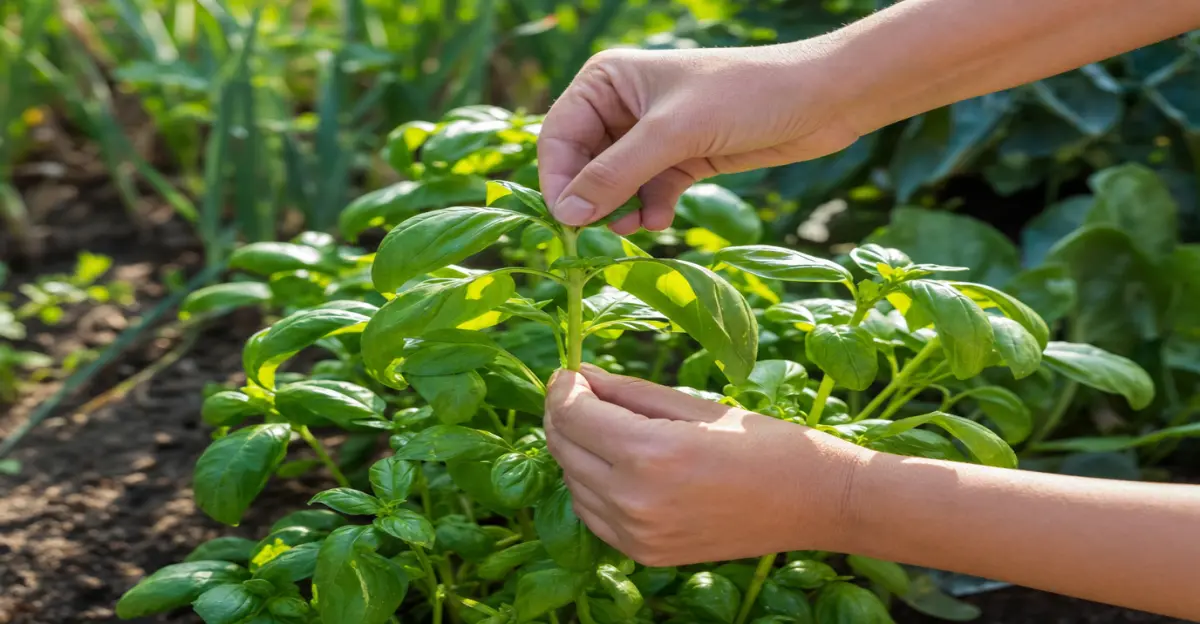
Key point: A single basil plant (Ocimum basilicum) can produce over half a kilogram of leaves in one season — but only if you harvest it correctly. The difference between a plant that dies after one picking and one that keeps branching for months comes down to where, when, and how you cut. This guide explains the science behind basil's branching response and gives you a step-by-step technique to keep your plants producing all season long.
Why the way you harvest matters
Most new growers make one of two mistakes: they pluck individual leaves off the stem, or they cut the entire plant down at once. Neither approach gets the best results.
Plucking single leaves doesn't trigger new growth. The plant stays tall, leggy, and eventually bolts — sending up flowers, going to seed, and stopping leaf production altogether. Cutting everything at once shocks the plant and often kills it outright.
The solution is a technique called cut-and-come-again harvesting: you cut stems at specific points that activate the plant's natural branching response, turning one stem into two, two into four, and so on. Done right, each harvest makes the plant bushier and more productive than it was before.
The science: why pinching works
When you pinch or cut the tip of a basil stem, you're removing the apical meristem — the growing point that produces a hormone called auxin. Auxin flows downward through the stem and suppresses the growth of lateral buds at every node below it. This phenomenon is called apical dominance.
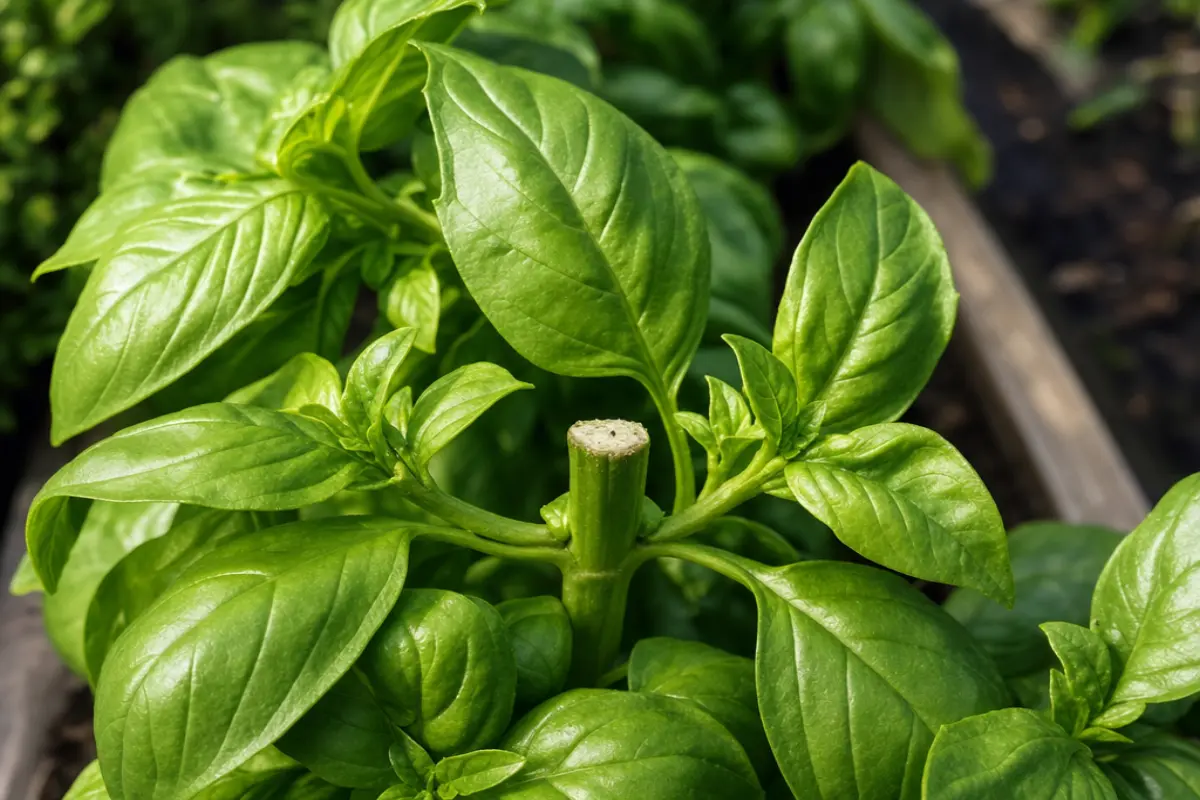
Remove the tip and the auxin signal drops. Without that hormonal suppression, cytokinins produced in the roots activate the dormant buds at the nodes below the cut. Each node sends out two new lateral shoots, and within five to seven days you have two growing stems where there was one.
This is why basil responds so dramatically to proper pruning — it has relatively weak apical dominance compared to woody plants, so lateral buds activate quickly once the tip is removed. The more often you cut, the bushier the plant becomes.
When your basil is ready to harvest
Basil is ready for its first harvest when it reaches 15-20 cm (6-8 inches) tall and has developed at least three sets of true leaves. This typically happens 30-45 days after transplanting or 50-65 days from seed.
Here are the readiness signs to look for:
- Height: The plant stands at least 15 cm tall
- Leaf sets: Three or more pairs of true leaves are visible on the main stem
- Stem thickness: The main stem is sturdy enough to handle cutting without breaking
- Node spacing: You can clearly see nodes (the points where leaves emerge from the stem)
Don't wait too long. If you see flower buds forming at the tip of any stem, harvest immediately — once basil shifts into reproductive mode, leaf production slows and flavor compounds change.
Step-by-step: how to harvest basil correctly
What you need
- Clean, sharp scissors or pruning snips (sterilize with rubbing alcohol between plants to prevent spreading disease)
- A bowl or basket for harvested stems
The cut
-
Find a node with two healthy leaves. Starting from the top of the stem, look down to the first or second node — the point where a pair of leaves grows from the stem.
-
Cut just above that node. Position your scissors about 5 mm (a quarter inch) above the leaf pair and make a clean cut. Never cut into the node itself or below it.
-
Leave at least one leaf pair below your cut. Ideally, leave two or three sets of leaves on the remaining stem. These leaves photosynthesize and feed the new growth.
-
Take the top 5-7 cm (2-3 inches) of each stem. This is the "sweet spot" — enough plant material for the kitchen, while leaving the plant with plenty of energy to regrow.
-
Never remove more than one-third of the plant at once. If you need a large harvest, take stems from different parts of the plant rather than stripping one section bare.
After the cut
Within a week, you'll see two new shoots emerging from the node just below where you cut. Each of those shoots will develop its own nodes, and each can be harvested the same way — creating an exponentially bushier plant with every cycle.
When and how often to harvest
Time of day
Harvest in the early morning, after any dew has dried but before the midday heat. Research shows that essential oil content and yield — the compounds responsible for basil's aroma and flavor — are highest in morning harvests under full sunlight conditions. As temperatures rise through the day, volatile oils dissipate from the leaf surface.
Frequency
Harvest every 7-10 days during the active growing season. In hot climates where daytime temperatures regularly exceed 32C (90F), harvest every 5-6 days, since heat accelerates basil's push toward flowering.
Research on successive basil harvests shows that per-cut herbage weight may decrease modestly — roughly 20% by the second harvest — as the plant reallocates resources across more branches. Even so, the cumulative effect of regular harvesting — more branches, more growing tips — produces a significantly higher total seasonal yield than leaving plants uncut.
Seasonal timing
In the Northern Hemisphere, outdoor basil harvest season typically runs from June through October (USDA zones 4-10). Indoor growers can harvest year-round. The plant data for sweet basil shows harvest months spanning June through October, with active pruning recommended from May through September.
Seasonal Harvest Calendar
This week-by-week calendar maps the full harvest cycle for sweet basil transplanted outdoors after the last frost date. Adjust timing for your climate — indoor growers can repeat this cycle year-round.
| Week | Stage | Action | Expected yield per plant |
|---|---|---|---|
| 1-3 | Establishment | No harvesting. Let the plant develop 4-6 leaf sets and a strong root system. | — |
| 4-5 | First pinch | Make your first harvest when stems reach 15-20 cm. Pinch just the top 3-5 cm of each stem to trigger the initial branching response. | 5-10 g |
| 6-8 | Branching phase | Harvest every 10 days. The plant now has 4-8 growing tips. Focus on keeping all stems at roughly equal height to maintain an even canopy. | 15-25 g per cut |
| 9-14 | Peak production | Harvest every 7-10 days. The plant should have 16+ growing tips. This is the highest-yield window — each cut produces the most leaf mass. | 30-50 g per cut |
| 15-18 | Late season | Increase harvest frequency to every 5-7 days as the plant pushes harder toward flowering. Pinch every flower bud on sight. Stems may begin to lignify (turn woody) at the base — this is normal. | 20-35 g per cut |
| 19-20 | Final harvest | When nighttime temperatures drop below 10C consistently, harvest the entire plant. Cut all stems down to 5 cm above soil level and strip all leaves for processing. | Full plant harvest |
Cumulative yield: Following this calendar, a single sweet basil plant produces approximately 0.5 kg of leaves over a 20-week season, with peak production concentrated in weeks 9-14.
Succession planting tip: Start a second round of basil from seed in week 8-10. By the time your first planting enters late season, the second planting enters peak production — giving you continuous supply without interruption.
How to prevent bolting
Bolting — when basil sends up flower stalks — is the number one reason plants stop producing edible leaves. Once a stem flowers, the leaves on that stem become bitter and the plant redirects all energy into seed production.
What triggers bolting
- Long days exceeding 14 hours of light
- High temperatures consistently above 32C (90F)
- Water stress — irregular watering or drought
- Maturity — the plant naturally shifts to reproduction if left unharvested
How to stop it
-
Harvest regularly. The single most effective anti-bolting strategy. Every time you cut a stem tip, you reset that stem's reproductive clock.
-
Pinch flower buds immediately. Check plants every two to three days during warm weather. The moment you see a flower spike forming at any stem tip, pinch it off completely — don't just remove the flower, take the entire bud cluster down to the next leaf node.
-
Succession plant. Sow new basil seeds every three to four weeks from late spring through midsummer. When older plants inevitably slow down, younger ones take over.
-
Mulch and water consistently. Drought stress accelerates bolting. Keep soil evenly moist (but not waterlogged) and mulch around the base to regulate soil temperature.
Harvesting different basil varieties
The pinch-above-a-node technique works across all basil types, but each variety has some quirks worth knowing:
| Variety | Days to harvest | Leaf size | Growth habit | Harvest notes |
|---|---|---|---|---|
| Genovese | ~60 | Large, rounded | Bushy, 45-60 cm | Classic pesto basil. Responds very well to aggressive pinching. |
| Thai (O. basilicum var. thyrsiflora) | 45-60 | Small, pointed | Upright, sturdy stems | More bolt-resistant than Genovese. Purple stems and flowers are also edible. |
| Lemon (O. x citriodorum) | 50-60 | Medium, light green | Compact | Lighter citrus flavor. Bolts faster in heat — harvest more frequently. |
| Purple (Dark Opal, Red Rubin) | 60-70 | Medium, dark burgundy | Moderate bush | Slightly slower to branch. Handle gently as leaves bruise easily. |
| Greek/Spicy Globe | 60 | Tiny | Naturally compact dome | Rarely needs aggressive pruning — just harvest outer stems. |
Research on five O. basilicum varieties showed that essential oil composition varies significantly between harvests and between cultivation conditions (field vs. greenhouse), with linalool content ranging from approximately 47% to 54% depending on variety and harvest timing.
Storing your harvest
How you store basil matters as much as how you cut it. Basil is a tropical plant — cold damages it fast.
Fresh storage (up to 2 weeks)
- Trim 1 cm off the bottom of stems with a fresh cut.
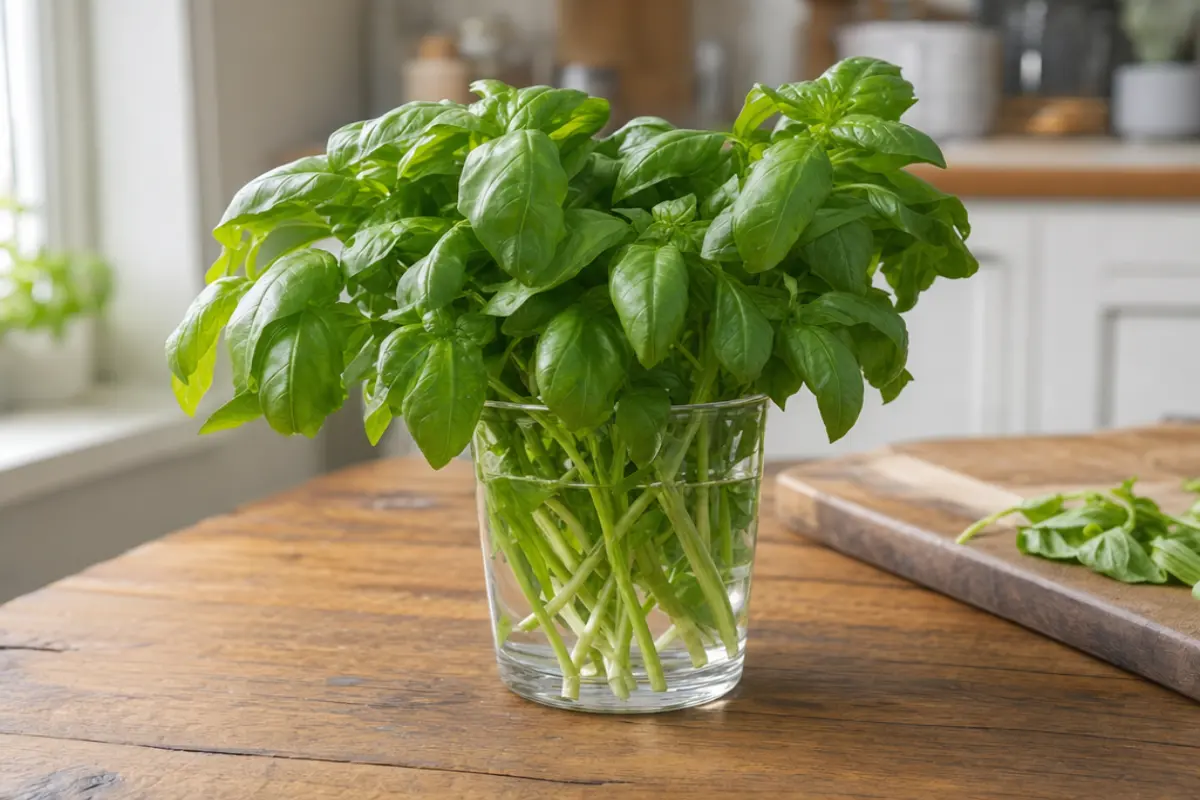
- Place stems upright in a glass with 2-3 cm of room-temperature water, like a bouquet.
- Keep at room temperature — never in the refrigerator. Research confirms that storage below 12C causes chilling injury in basil leaves, resulting in blackening and loss of aroma compounds.
- Change the water every two to three days.
This method keeps basil fresh, green, and aromatic for up to two weeks.
Longer preservation
- Freezing in olive oil: Chop leaves, pack into ice cube trays, cover with olive oil, and freeze. Best flavor retention — use within six months.
- Pesto: Blend basil with oil, garlic, nuts, and cheese. Freeze in portions. Retains more flavor than dried basil.
- Drying: Hang small bundles upside-down in a warm, dry, well-ventilated area for one to two weeks. Dried basil loses most of its volatile oils but works for slow-cooked dishes.
Common harvesting mistakes
| Mistake | Why it hurts | Fix |
|---|---|---|
| Plucking individual leaves | Doesn't trigger branching; plant stays leggy | Always cut the stem above a node |
| Cutting below the lowest leaves | Removes all photosynthetic capacity | Leave 2-3 leaf sets on every stem |
| Letting flowers bloom | Plant stops producing flavorful leaves | Pinch buds the moment they appear |
| Harvesting in afternoon heat | Essential oils have partially volatilized | Harvest in early morning |
| Refrigerating fresh basil | Causes chilling injury below 12C | Store at room temp in water |
| Removing more than one-third at once | Shocks the plant, stunts regrowth | Harvest in rotation across the whole plant |
When Regrowth Fails: Diagnostic Guide
If your basil isn't responding to harvesting as expected, work through this diagnostic sequence to identify the root cause.
No new shoots within 10 days of cutting
Check 1: Cut placement. Did you cut above a visible node with healthy leaves? If the cut was made on bare stem below all leaf nodes, the stem has no lateral buds to activate. Solution: cut higher on remaining stems where leaf nodes are visible.
Check 2: Light levels. Basil requires a daily light integral (DLI) of at least 15 mol/m²/day for vigorous vegetative growth. Plants in partial shade produce weaker branching responses. If growing indoors, ensure at least 14-16 hours under grow lights at 300 umol/m²/s or higher.
Check 3: Root health. Lift the plant gently and inspect roots. Brown, mushy roots indicate root rot — often Pythium in hydroponic systems or overwatered containers. Healthy basil roots are white and firm. Compromised roots cannot supply the cytokinins needed to activate lateral buds.
Leggy, stretched regrowth
New shoots growing tall and thin with large gaps between leaf sets indicates insufficient light. Move the plant to full sun (6+ hours direct) or increase artificial lighting intensity. Basil stretches to reach light, sacrificing the compact, bushy growth that produces the most harvestable leaf mass.
Brown or black discoloration at cut sites
Darkening at the cut surface within 2-3 days may indicate Fusarium oxysporum f. sp. basilici entry through the wound. Look for asymmetric wilting — one side of the plant declining while the other looks healthy. If confirmed:
- Remove and destroy the infected plant immediately
- Sterilize all cutting tools with 70% isopropyl alcohol
- Do not compost infected material
- Replace with resistant cultivars such as 'Prospera' or 'Nufar F1'
Woody stems that won't branch
Basil stems lignify naturally as the season progresses. Woody sections have fewer viable lateral buds. Prevention is more effective than cure: maintain a regular 7-10 day harvest cycle throughout the season so stems stay green and herbaceous. If stems have already become woody, focus harvesting on the newest green growth at the top and consider succession planting to replace aging plants.
Commercial Harvest Scaling
For growers producing basil at commercial volumes, harvesting technique directly impacts both yield per area and post-harvest shelf life.
Yield benchmarks
Under optimal conditions with regular harvesting, sweet basil produces approximately 2 kg per square meter over a full growing season. In controlled-environment agriculture, aeroponic systems have achieved the highest per-plant yields at 438.6 g per plant in just 7 weeks, compared to 229.3 g in deep water culture and 188 g in drip systems.
Harvest scheduling at scale
Commercial basil operations typically harvest on a staggered rotation: divide your growing area into 3-4 zones and harvest one zone every 2-3 days. This ensures:
- Continuous supply without gaps
- Each zone gets 7-10 days of regrowth between cuts
- Labor is distributed evenly across the week
Post-harvest handling
The window between cutting and cooling determines shelf life. Research on basil post-harvest handling recommends:
- Cut in early morning when leaf turgor is highest and essential oil content peaks
- Hydrate stems immediately — place cut stems upright in clean water within 5 minutes of harvesting
- Avoid cold storage below 12C — basil is chilling-sensitive and develops blackening and off-flavors at refrigeration temperatures
- Target storage at 15-18C with 90-95% relative humidity for maximum shelf life (up to 12-14 days)
- Modified atmosphere packaging (MAP) with reduced O2 and elevated CO2 can extend shelf life further for wholesale distribution
Cost considerations
Labor is the largest variable cost in basil production. Manual harvest takes approximately 15-20 minutes per square meter for a thorough cut-and-come-again pass. At commercial scale, semi-mechanical systems (handheld reciprocating cutters) can reduce harvest time by 60-70% but require wider row spacing and sacrifice some precision in cut placement.
Putting it all together
A well-managed basil plant can produce roughly one cup of fresh leaves per week from a single harvest cycle. Over a full growing season, sweet basil (O. basilicum) can yield approximately 0.5 kg per plant — or around 2 kg per square meter — when harvested with proper technique.
The rhythm is simple: harvest every 7-10 days, always cut above a node, never take more than a third, and pinch flowers on sight. Follow that pattern and one basil plant will outproduce a grocery store herb section from June through frost.
For detailed growing parameters including temperature, humidity, and light requirements, see the full basil growing profile. If you're growing basil hydroponically, check out our guide to passive hydroponics — basil is one of the most rewarding herbs for soilless systems.