Hydroponic Cucumbers: 52% More Yield, 30+ Fruit Per Plant
Science-backed guide to growing hydroponic cucumbers. Covers best systems (Dutch bucket, drip, DWC), stage-specific EC/pH charts, parthenocarpic varieties, umbrella training, nutrient schedules, lighting, and yield expectations up to 30+ fruit per plant.
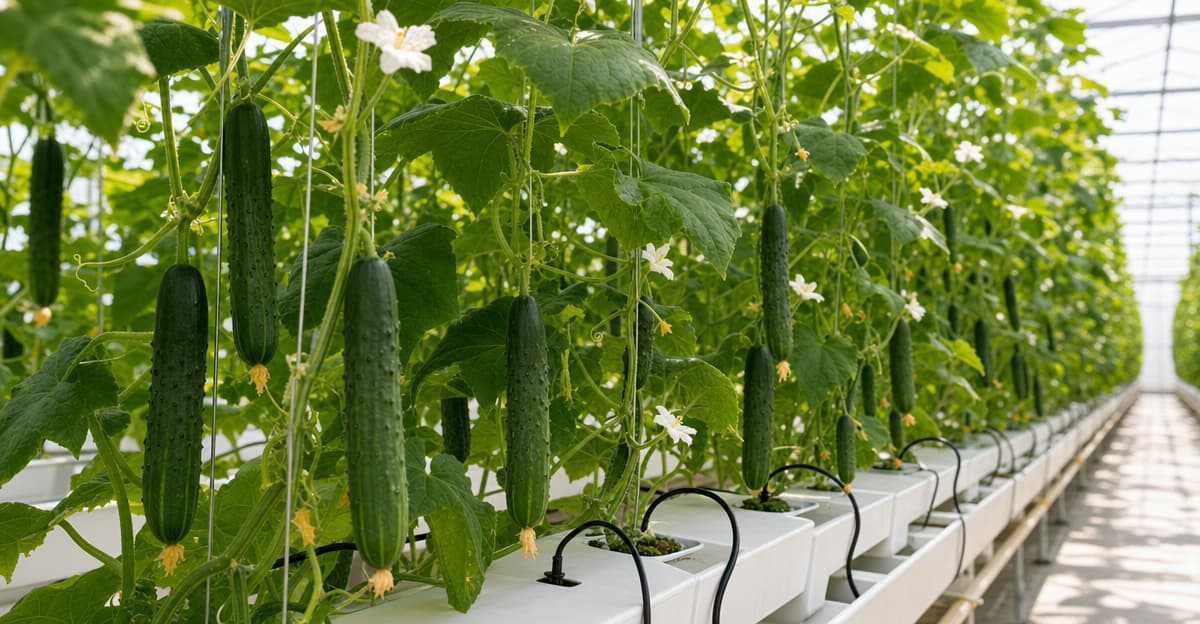
Key takeaway: Hydroponic cucumbers (Cucumis sativus) are one of the fastest and highest-yielding fruiting crops you can grow. With the right system, a single plant produces 9-14 kg (20-30 lbs) of fruit over a 12-week harvest period — reaching first harvest just 50-65 days from seed. Parthenocarpic varieties set fruit without pollination, making them ideal for indoor growing. The keys to success are a drip or Dutch bucket system, umbrella training for maximum yield, and keeping EC between 2.0-2.5 mS/cm during fruiting. A modified-umbrella training system nearly doubled marketable fruit per plant compared to single-stem high-wire in Penn State trials (30.5 vs 16.6 fruit).
Why Grow Cucumbers Hydroponically?
Cucumbers (Cucumis sativus) are among the most productive hydroponic crops in the world. Dutch commercial greenhouses produce 350-400 tonnes per hectare annually — compared to just 15 tonnes per hectare in open-field production. Even a modest home setup dramatically outperforms soil growing:
- Faster harvest. Hydroponic cucumbers reach first harvest 10-15 days faster than soil-grown plants — as few as 50 days from seed versus 65-70 in the ground. Fruit develops from flower to marketable size in about 10 days under good light.
- Massive yield per plant. A well-managed hydroponic cucumber produces 9-14 kg (20-30 lbs) of fruit over a single crop cycle. That's roughly double the typical soil yield for the same variety.
- 52% higher yield in direct comparison. A 2025 controlled study in Scientific Reports found that soilless cucumber cultivation increased yield per plant by 52%, with 31% greater leaf area and 19.5% larger fruit diameter compared to soil-grown plants.
- 90% less water. Recirculating hydroponic systems use a fraction of the water needed for field irrigation. An Australian study found water use efficiency of 60-109 kg of cucumber per cubic meter of water — roughly 10 times more efficient than field production.
- No soil-borne disease. Eliminating soil removes Fusarium, nematodes, and other pathogens that devastate cucumber crops in conventional agriculture.
- Year-round production. With supplemental lighting and climate control, you can run 3-4 crop cycles per year instead of one seasonal harvest.
- Seedless fruit without bees. Parthenocarpic greenhouse varieties produce seedless cucumbers with no pollinators needed — a major advantage for indoor growers.
Cucumbers are also the perfect next step if you've already grown hydroponic tomatoes or bell peppers. They share similar system requirements but grow much faster, giving you quicker feedback and faster harvests.
Best Hydroponic Systems for Cucumbers
Cucumbers are fast-growing vining plants with large root systems and high water demand — a mature plant can consume 4-8 litres (1-2 gallons) per day during peak fruiting. They need consistent moisture delivery, strong root support, and high nutrient concentrations. Not every system is equally suited.
| System | Suitability | Best For | Setup Cost |
|---|---|---|---|
| Drip / Dutch bucket | Excellent | All scales, commercial standard | $60-200 |
| Bag / Slab culture | Excellent | Commercial production | $80-250 |
| Ebb & Flow | Good | Home growers, multiple plants | $80-200 |
| DWC (Deep Water Culture) | Fair | Single plants, small setups | $30-80 |
| NFT (Nutrient Film Technique) | Not recommended | — | — |
| Kratky (passive) | Not recommended | — | — |
Drip / Dutch Bucket — The Industry Standard
Commercial hydroponic cucumber production worldwide runs on drip systems — either Dutch buckets (Bato buckets) filled with perlite, coco coir, or perlite-vermiculite blends, or bag culture with coco coir or rockwool slabs. Nutrient solution is pumped through drip emitters to each plant on a timer, with excess draining back to the reservoir.
Why drip dominates: cucumbers have enormous water demand during fruiting, producing a new marketable fruit every 1-3 days per plant at peak. Consistent moisture delivery prevents bitter fruit and ensures rapid fruit expansion. A substrate-based drip system buffers moisture between irrigation events, which is critical during hot weather when transpiration spikes.
A 2022 study in Scientia Horticulturae compared substrates in Dutch bucket cucumber systems and found that pine bark substrate produced 23.9% higher yield and 48.3% higher fruit vitamin C content than perlite. However, perlite remains the most widely used medium due to its consistency, reusability, and excellent drainage.
For a DIY setup, fill 5-gallon Dutch buckets with 70% perlite and 30% vermiculite (or 100% coco coir), run a drip line from a 20-gallon reservoir, and set a timer to irrigate 4-6 times daily for 3-5 minutes per cycle. Ensure 10-20% runoff to prevent salt buildup.
Bag and Slab Culture — Commercial Scale
In Dutch-style commercial greenhouses, cucumbers grow in rockwool slabs or coco coir grow bags laid horizontally on raised gutters. Each slab supports 2-3 plants. Drip stakes deliver nutrient solution directly to each plant's root zone. This system is optimized for high-density production at 2.5-3.0 plants per square meter.
Ebb & Flow — Good for Home Growers
Ebb and flow systems cycle nutrient solution in and out of a grow tray filled with clay pebbles (LECA), perlite, or coco coir. The intermittent flooding provides good root-zone oxygenation. Flood for 15-30 minutes, drain fully for 45-60 minutes. This works for cucumbers, though the high water demand means frequent flood cycles during fruiting.
DWC — Fair for Single Plants
Deep Water Culture (DWC) suspends roots directly in an oxygenated nutrient solution. It works for cucumbers but presents challenges. Cucumber root systems grow aggressively, and the high water uptake during fruiting (up to 8 litres per day) means frequent reservoir top-ups. Keeping dissolved oxygen above 6 mg/L is critical — cucumbers are highly susceptible to root rot in warm, oxygen-poor solutions.
Use a minimum 5-gallon (19L) bucket per plant with a powerful air pump and large air stone. Keep nutrient solution temperature at 18-20°C (65-68°F). DWC works best for single plants or small experimental setups.
Why NFT and Kratky Don't Work
NFT channels cannot accommodate the massive root systems of a fruiting cucumber vine. Roots block flow in standard channels within weeks, causing nutrient and oxygen starvation. Kratky (passive hydroponics) lacks the active oxygenation and water volume that cucumbers demand during their rapid fruiting phase. Both systems lead to root rot and crop failure for this crop.
Best Cucumber Varieties for Hydroponics
Variety choice is critical for hydroponic cucumbers — more so than for most other crops. You need parthenocarpic varieties (fruit sets without pollination) since indoor environments lack pollinators. Nearly all greenhouse cucumber varieties are also gynoecious (producing only female flowers), which means every flower can become a fruit.
European / English (Long Seedless) — The Premium Choice
These are the shrink-wrapped cucumbers you see at grocery stores. They produce long, seedless fruit (35-40 cm / 14-16 inches, 300-400 g) with thin, tender skin that doesn't need peeling.
| Variety | Fruit Length | Notes |
|---|---|---|
| Tyria | 35-40 cm | Powdery mildew tolerance; widely available |
| Camaro | 35-40 cm | Strong PM tolerance; commercial standard |
| Corinto | 30-35 cm | PM and CMV resistance; high productivity |
| Hi Jack RZ | 35-40 cm | Vigorous; high yield |
| Kalunga | 35-38 cm | Uniform fruit; good for winter production |
Beit Alpha / Mini — High Volume, Easy to Grow
Mini cucumbers (15-20 cm / 6-8 inches, 80-150 g) are productive, disease-tolerant, and excellent for beginners. They produce more individual fruit per plant and tolerate a wider range of conditions.
| Variety | Fruit Length | Notes |
|---|---|---|
| Socrates | 15-18 cm | Best overall — PM, scab, and target leaf spot resistance |
| Katrina | 15-20 cm | Less PM-susceptible than many alternatives |
| Manny | 15-18 cm | Good PM resistance; productive |
| Picolino | 12-15 cm | Compact; good for small spaces |
American Slicer (Parthenocarpic) — Familiar Shape
If you want the classic slicing cucumber shape without needing pollinators, parthenocarpic slicer varieties work in hydroponic systems.
| Variety | Fruit Length | Notes |
|---|---|---|
| Corinto | 18-22 cm | PM and CMV resistant; reliable producer |
| Lisboa | 18-22 cm | Strong disease resistance |
| Sweet Success | 25-30 cm | Burpless; vigorous grower |
Why Parthenocarpy Matters
If standard (monoecious) cucumbers get pollinated inconsistently indoors, you get misshapen, seedy fruit. Worse, if parthenocarpic varieties accidentally get pollinated (by stray bees or wind from open windows), the fruit develops seeds and becomes deformed. Commercial greenhouses use insect screens specifically to keep pollinators away from parthenocarpic crops. For indoor growing, this is rarely an issue — just choose the right variety and you'll get perfect seedless fruit every time.
Nutrient Solution and EC/pH Management
Cucumbers are heavy feeders with nutrient demands that shift across growth stages. They share some similarities with tomatoes and bell peppers but differ in two key ways: cucumbers need lower EC overall (they're more sensitive to salt stress), and the vegetative-to-fruiting transition happens much faster.
Stage-Specific EC and pH Targets
| Growth Stage | Duration | EC (mS/cm) | pH | Key Nutrient Focus |
|---|---|---|---|---|
| Seedling | 2-3 weeks | 0.5-1.0 | 5.5-6.5 | Low concentration; balanced |
| Establishment (post-transplant) | 1-2 weeks | 1.0-1.5 | 5.5-6.5 | Gentle ramp-up |
| Vegetative | 2-3 weeks | 1.8-2.2 | 5.5-6.5 | Nitrogen for rapid vine growth |
| Flowering / Fruiting | 10-14 weeks | 2.0-2.5 | 5.5-6.5 | Maximum potassium; steady calcium |
These ranges align with Auburn University Extension recommendations and Oklahoma State University data. Start at the lower end of each range and increase gradually. Cucumbers are less tolerant of EC spikes than tomatoes or peppers — a 2023 study found that EC above 2.5 mS/cm can initially enhance growth but hinders later-stage development due to osmotic stress.
During low-light periods (winter or cloudy days), Oregon State Extension recommends keeping EC at 2.2 mS/cm. As light increases, you can push to 2.5 mS/cm — higher light drives more photosynthesis and nutrient uptake, so the plant tolerates higher concentrations.
Macronutrient Targets (ppm)
| Nutrient | Seedling | Post-Transplant (0-14 days) | Flowering to First Harvest | After First Harvest |
|---|---|---|---|---|
| Nitrogen (N) | 50-80 | 60-80 | 100-120 | 120-140 |
| Phosphorus (P) | 20-30 | 25-35 | 30-45 | 30-50 |
| Potassium (K) | 40-60 | 50-70 | 140-160 | 160-180 |
| Calcium (Ca) | 40-60 | 60-80 | 80-100 | 80-100 |
| Magnesium (Mg) | 20-30 | 35-40 | 35-40 | 35-40 |
| Sulfur (S) | 20-30 | 30-40 | 40-50 | 40-50 |
Data from Auburn University Extension (Blanchard et al., 2022). Note the dramatic potassium increase from seedling (40-60 ppm) to fruiting (160-180 ppm). Potassium drives fruit development, skin quality, and sugar accumulation. The N:K ratio shifts from approximately 1:1 during vegetative growth to 1:1.5 during active fruiting.
Micronutrient Requirements
| Micronutrient | Target (ppm) |
|---|---|
| Iron (Fe) | 0.9-1.0 |
| Manganese (Mn) | 0.55 |
| Zinc (Zn) | 0.30 |
| Boron (B) | 0.25 |
| Copper (Cu) | 0.05 |
| Molybdenum (Mo) | 0.05 |
Micronutrient targets based on Auburn University Extension recommendations and Oklahoma State University guidelines.
Use chelated iron (Fe-DTPA or Fe-EDDHA) to maintain availability across the 5.5-6.5 pH range. Iron deficiency causes interveinal chlorosis on young leaves — a common nutrient deficiency that's easily corrected when caught early.
Calcium Management
Unlike bell peppers, cucumbers are less prone to blossom end rot. However, calcium deficiency still occurs — symptoms include cupped-down leaves, shortened internodes, and occasionally soft spots on fruit. Maintain calcium at 80-100 ppm during fruiting, keep the K:Ca ratio near 1.3:1, and favour nitrate-nitrogen over ammonium-nitrogen (ammonium competes with calcium at root uptake sites).
For precise nutrient calculations based on your specific system and nutrient brand, use the Truleaf Nutrient Manager.
Stage-Specific Nutrient Targets
The ranges above give you safe zones. This schedule provides specific optimal targets and transition protocols.
Weeks 1-3 (Seedling / Establishment): Start at EC 0.5 with half-strength nutrients once the first true leaf appears. Increase EC by 0.2 mS/cm per week until transplant. Post-transplant, hold at EC 1.0-1.5 for one week to let roots establish before ramping.
Weeks 4-6 (Vegetative): Transition EC from 1.5 to 2.0 over 5-7 days. Optimal targets: N 100 ppm, P 35 ppm, K 120 ppm, Ca 80 ppm, Mg 40 ppm. Nitrogen demand peaks during this phase — the vine can grow 15-30 cm per day under optimal conditions. Monitor pH closely during rapid growth; vigorous nitrogen uptake causes pH to rise.
Weeks 7-8 (Flowering / Early Fruit Set): Shift to fruiting formula. Potassium jumps to 150 ppm while nitrogen holds steady at 110 ppm. Begin increasing calcium to 90 ppm. The shift in nutrient ratios can cause pH drift — check and adjust daily.
Weeks 9+ (Full Production): Full fruiting formula with N 130 ppm, P 40 ppm, K 170 ppm, Ca 100 ppm, Mg 40 ppm. The N:K ratio at this stage is approximately 1:1.3. Maintain this formula through the entire harvest period. Replace reservoir solution completely every 1-2 weeks to prevent salt buildup and nutrient imbalances.
Transition Protocol
When switching between stages, never jump EC by more than 0.5 mS/cm in a single day. A sudden EC spike causes osmotic stress that manifests as wilting, leaf curl, and flower drop.
The safest transition protocol:
- Mix the new stage formula at target concentration
- Day 1: Replace 25% of reservoir with new formula
- Day 2: Replace another 25%
- Day 3: Full reservoir change to new formula
- Monitor EC and pH for 48 hours before further adjustments
Potassium and Powdery Mildew Connection
Research shows that nutrient status directly affects powdery mildew susceptibility. Elad et al. (2021) found that maintaining higher potassium and magnesium levels in the nutrient solution reduced powdery mildew severity, while excessive nitrogen and phosphorus increased it. This gives you another reason to shift toward higher K and lower N during fruiting — it improves both fruit quality and disease resistance.
Lighting for Indoor Hydroponic Cucumbers
Cucumbers are high-light crops — among the most demanding of common hydroponic vegetables, comparable to tomatoes and peppers.
Light Targets
| Parameter | Seedling | Vegetative / Fruiting |
|---|---|---|
| DLI (mol/m2/day) | 6-12 | 25-30+ |
| PPFD (umol/m2/s) | 110-200 | 250-500 |
| Photoperiod | 14-16 hours | 14-16 hours |
A 2021 study on cucumber seedlings found optimal growth at a DLI of 11.5 mol/m2/day with PPFD of 110-125 umol/m2/s. For mature fruiting plants, commercial greenhouses target a DLI of 25-30 mol/m2/day — a 2025 study on commercial-scale production used supplemental LED lighting at a threshold of 245 umol/m2/s to maintain this target.
LED Spectrum
Full-spectrum LEDs work well for cucumbers. A mix of approximately 60% red (600-700 nm), 25% green (500-600 nm), and 15% blue (400-500 nm) supports both vegetative growth and fruit development. Blue light prevents excessive stem elongation — important for cucumbers, which can grow 15-30 cm per day.
CO2 Enrichment
If you have a sealed growing environment, CO2 enrichment to 800-1,000 ppm can increase cucumber yields by 20-25%. This is most effective when combined with high light levels (DLI 25+). At standard atmospheric CO2 (420 ppm), light is usually the limiting factor — adding CO2 without adequate light produces no benefit.
Practical Setup
For a single plant in a 2x2 ft (60x60 cm) growing area, a 200W LED panel positioned 30-45 cm above the canopy delivers approximately 300-450 PPFD. Raise the light as the plant grows — cucumbers are tall-growing vines that can reach 2+ metres. Use a timer set to 14-16 hours. Cucumbers need a dark period of at least 8 hours for proper hormone regulation.
Temperature and Humidity
Cucumbers are warm-weather crops that grow fastest at temperatures well above what lettuce or herbs prefer.
Temperature Targets
| Parameter | Target | Notes |
|---|---|---|
| Day temperature | 24-29°C (75-85°F) | Optimal growth range |
| Night temperature | 18-21°C (65-70°F) | 6-8°C differential aids fruit set |
| Minimum (growth slows) | 18°C (65°F) | Below this, vine growth stalls |
| Maximum (productivity drops) | 32°C (90°F) | Above this, bitter fruit and flower drop |
| Germination optimal | 29°C (84°F) | Germinates in 2-3 days |
| Nutrient solution | 18-20°C (65-68°F) | Above 24°C (75°F) increases root rot risk |
Root zone temperature is critical. Cucumber roots begin dying below 16°C (60°F), and at 24°C+ (75°F+), the oxygen-carrying capacity of water drops significantly while pathogen metabolic rates double. If you struggle with warm reservoir temperatures, a water chiller is one of the best investments for cucumber production.
Humidity Targets
| Stage | Relative Humidity | VPD Target |
|---|---|---|
| Vegetative | 65-75% | 0.4-0.8 kPa |
| Flowering / Fruiting | 60-70% | 0.5-1.0 kPa |
Cucumbers prefer higher humidity than most hydroponic crops. Low humidity (below 50%) causes excessive transpiration, wilting, and leaf edge burn even when water supply is adequate. However, humidity above 80% promotes powdery mildew — the most common cucumber disease. Use oscillating fans to maintain airflow and prevent humidity pockets in the canopy.
Training and Support
Cucumbers are vigorous climbing vines that need vertical training. Without support, the vine sprawls across the ground, fruit develops poorly, and disease pressure increases dramatically. Proper training is one of the biggest factors in hydroponic cucumber yield.
Modified-Umbrella System — Highest Yield
The modified-umbrella is the most productive training system for home and small commercial growers. Penn State trials found it produced nearly double the marketable fruit compared to single-stem high-wire training (30.5 vs 16.6 fruit per plant).
How it works:
- Train the main stem up a vertical support string to an overhead wire at 2.0-2.4 m (7-8 ft) height
- Remove all fruit from the bottom 60-75 cm (24-30 inches) of the main stem — this forces the plant to invest in vegetative growth before fruiting
- Allow one fruit per leaf axil from that point up to the wire on the main stem
- Remove all lateral branches on the main stem (pinch them after 1-2 leaves)
- At the wire, allow two shoots to grow in opposite directions — these drape over the wire and hang down, forming the "umbrella"
- Each hanging shoot produces lateral branches with multiple fruit — this is where most of your harvest comes from
High-Wire System — Most Consistent
In the high-wire system, the plant grows up a single string with all lateral branches removed. When the vine reaches the overhead wire, the string is lengthened and the plant is leaned along the wire. This produces fewer total fruit but delivers more consistent weekly harvests. It requires a tall growing space (3+ metres / 10+ feet).
Lateral Management
- Maintain 127-152 cm (50-60 inches) of healthy green leaves on the plant at all times
- Remove yellowing or heavily shaded lower leaves weekly — but remove no more than one leaf per week per stem
- Keeping approximately 15 of the youngest, healthiest leaves manages powdery mildew while maintaining productivity
Plant Spacing
| System | Within-Row | Between-Row | Density |
|---|---|---|---|
| Single-stem vertical | 30-45 cm (12-18 in) | 1.5 m (5 ft) | 1.4-2.2 plants/m2 |
| Double-row vertical | 45-60 cm (18-24 in) | 60 cm between paired rows | 2.5-3.0 plants/m2 |
| Home setup (single plant) | — | — | 1 plant per 0.5-0.65 m2 (5-7 sq ft) |
Growing Medium
Research shows clear differences in cucumber performance across growing media.
A 2022 study in Heliyon found that coco coir significantly increased leaf area index and yield compared to rockwool, with higher calcium, magnesium, and zinc content in coir-grown plants. Coco coir's high cation exchange capacity (CEC) buffers nutrients more effectively than inert media.
| Medium | Water Retention | Drainage | Best For |
|---|---|---|---|
| Coco coir | High | Good | Dutch buckets, bag culture — best overall performance |
| Coco coir + perlite (70:30) | High | Excellent | Best blended substrate — combines retention with oxygen |
| Perlite | Low | Excellent | Dutch buckets — requires more frequent irrigation |
| Rockwool | High | Good | Slab culture — commercial standard, non-biodegradable |
| Clay pebbles (LECA) | Low | Excellent | Ebb and flow, DWC — reusable indefinitely |
For most home growers, a 70:30 coco coir and perlite blend in Dutch buckets offers the best balance of water retention, drainage, and ease of use.
Common Hydroponic Cucumber Problems
Bitter Fruit
Bitterness is caused by cucurbitacin compounds that migrate from leaves and stems into fruit under stress. Common triggers:
- Temperature stress — especially heat above 32°C (90°F)
- Inconsistent watering — irregular irrigation causes cucurbitacin spikes
- Nutrient deficiency — low potassium or nitrogen
- Water stress — allowing the growing medium to dry out between irrigations
Prevention: Use "burpless" or "bitter-free" parthenocarpic varieties (which have naturally lower cucurbitacin levels). Maintain stable temperatures, consistent irrigation, and adequate nutrition. Harvest promptly — overripe fruit becomes more bitter.
Powdery Mildew (Podosphaera xanthii)
The single most common disease in greenhouse cucumbers. White powdery growth appears on leaf surfaces, eventually causing yellowing, defoliation, and reduced yield.
Variety resistance matters enormously. Purdue University trials found dramatic differences: Corinto, Socrates, Katrina, and Manny showed strong resistance, while Tasty Jade and Taurus were highly susceptible.
Nutrient status affects susceptibility. Elad et al. (2021) found that higher magnesium in fertigation decreased powdery mildew severity — spray applications of MgCl2 at 0.1 M achieved 97.6% disease reduction in commercial trials. Maintaining lower phosphorus, lower nitrogen, and higher potassium during fruiting reduces susceptibility.
Cultural control: Good airflow, proper plant spacing, weekly pruning to approximately 15 youngest leaves per stem, and humidity below 70%.
Root Rot (Pythium)
Brown, mushy roots with a foul smell. Wilting despite adequate moisture. Caused by low dissolved oxygen, warm nutrient solution, and light exposure on reservoirs.
Prevention: Keep dissolved oxygen above 8 mg/L. Maintain solution temperature at 18-20°C (65-68°F). Use air pumps and stones continuously. Block light from reservoirs and growing medium surface. Sanitize the system every 3-4 weeks. See our root rot guide for detailed treatment protocols.
Flower Drop / Poor Fruit Set
Flowers dry and fall off without setting fruit.
Causes: Day temperature above 32°C (90°F), night temperature below 16°C (60°F), insufficient light (below DLI 20), excessive nitrogen (promotes vine growth over fruiting), or water stress.
Fix: Regulate temperature to 24-29°C day / 18-21°C night. Ensure DLI reaches at least 25 mol/m2/day. Reduce nitrogen and shift to higher potassium when first flowers appear.
Advanced Disease and Pest Management
Downy Mildew (Pseudoperonospora cubensis)
Angular yellow lesions on upper leaf surfaces with grayish-purple sporulation underneath. More damaging than powdery mildew — can destroy a crop in 1-2 weeks if unchecked. Favoured by cool nights (10-15°C) with leaf wetness.
Treatment: Preventive fungicide rotation (mancozeb + cymoxanil). Remove severely infected leaves. Reduce leaf wetness by irrigating in the morning and improving air circulation.
Prevention: Select resistant varieties. Maintain good airflow. Avoid overhead misting. Scout daily during cool, wet weather.
Cucumber Mosaic Virus (CMV)
Mosaic pattern of light and dark green on leaves. Stunted growth. Fruit develops warts, bumps, or mosaic discoloration. Transmitted by aphids.
Treatment: No cure exists. Remove and destroy infected plants immediately. Control aphid vectors with sticky traps and biological controls.
Prevention: Use CMV-resistant varieties (Corinto, Lisboa). Control aphids preventively. Sanitize tools between plants. Do not save seed from infected plants.
Aphids (Green Peach Aphid, Melon Aphid)
Small soft-bodied insects on leaf undersides and growing tips. Yellowing, curling leaves. Sticky honeydew with black sooty mold. Transmit CMV and other viruses.
Treatment: Dislodge with strong water spray. Apply insecticidal soap or neem oil. Release biological controls: ladybugs, lacewings, or parasitic wasps (Aphidius colemani).
Prevention: Inspect transplants before introducing to grow space. Use yellow sticky traps for early detection. Avoid excessive nitrogen — lush, soft growth attracts aphids.
Spider Mites (Two-Spotted Spider Mite)
Fine stippling on upper leaf surfaces. Webbing between leaves in severe infestations. Thrives in hot, dry conditions — especially when humidity drops below 50%.
Treatment: Increase humidity above 60%. Apply miticide or neem oil. Release predatory mites (Phytoseiulus persimilis) for biological control.
Diagnostic Leaf Symptom Guide
| Symptom | Likely Cause | First Action |
|---|---|---|
| White powder on leaf surfaces | Powdery mildew | Improve airflow; apply potassium bicarbonate |
| Angular yellow lesions, purple underneath | Downy mildew | Remove affected leaves; apply preventive fungicide |
| Mosaic light/dark green pattern | Cucumber mosaic virus | Remove plant; control aphids |
| Older leaves pale yellow; stunted growth | Nitrogen deficiency | Increase N in nutrient solution |
| Leaf edge yellowing and scorching | Potassium deficiency | Increase K; check EC |
| Cupped-down leaves; shortened internodes | Calcium deficiency | Check pH; increase Ca |
| Interveinal chlorosis on older leaves | Magnesium deficiency | Add Epsom salt (MgSO4) |
| Interveinal chlorosis on youngest leaves | Iron deficiency | Check pH (likely too high); add chelated iron |
| Brown, crispy leaf margins | Nutrient burn (high EC) | Flush root zone; reduce EC |
Hydroponic vs. Soil-Grown Cucumbers
| Factor | Hydroponic (optimized) | Soil-Grown (typical garden) |
|---|---|---|
| Yield per plant | 9-14 kg (20-30 lbs) | 4-7 kg (10-15 lbs) |
| Days to first harvest | 50-65 (from seed) | 65-80 |
| Water usage | 15-20 L per kg of fruit | 200+ L per kg of fruit |
| Harvests per year | 3-4 crop cycles | 1 (seasonal) |
| Soilborne disease risk | None | Fusarium, nematodes, bacterial wilt |
| Powdery mildew risk | Present (manageable) | Present |
| Startup cost | $50-300 | $10-30 |
| Year-round production | Yes (with lighting) | Seasonal |
The 2025 Scientific Reports study provides the clearest controlled comparison: soilless cultivation produced 52% higher yield per plant, 13% taller plants, 31% greater leaf area, and 19.5% larger fruit diameter. The water efficiency advantage is even more dramatic — Grewal et al. (2011) documented water use efficiency of 60-109 kg of cucumber per cubic metre, roughly ten times more efficient than field irrigation.
Expected Yields and Timeline
| Growth Stage | Duration | What to Expect |
|---|---|---|
| Germination | 2-6 days | Seeds sprout fastest at 29°C (84°F) in rockwool or coco plugs |
| Seedling | 3-4 weeks | First true leaves; begin half-strength nutrients; transplant at 3-4 true leaves |
| Vegetative | 2-3 weeks | Rapid vine growth — up to 30 cm per day; begin training on vertical string |
| Flowering | ~1 week | Female flowers appear; fruit begins setting without pollination (parthenocarpic) |
| Fruiting / Harvest | 10-14 weeks | New fruit every 1-3 days per plant; harvest 3-7 times per week |
| Total to first harvest | ~50-65 days from seed | ~35-45 days from transplant |
Yield Benchmarks
| Scale | Expected Yield | Notes |
|---|---|---|
| Single plant (home) | 9-14 kg (20-30 lbs) | Over a 12-week harvest period |
| Per m2 (home greenhouse) | 25-50 kg | 2-3 plants per m2, 1-2 crop cycles |
| Commercial greenhouse | 80-150 t/ha | Standard commercial range |
| Dutch high-tech | 350-400 t/ha | World-leading operations |
Penn State seasonal data for the Beit Alpha variety 'Socrates' under modified-umbrella training showed production of 7.8 kg per plant in spring, 11.2 kg in summer, and 3.7 kg in fall — demonstrating the strong light-dependence of cucumber yields.
Getting Started: Your First Hydroponic Cucumber
If this is your first hydroponic cucumber, start simple:
- Choose a Dutch bucket or DWC. One 5-gallon Dutch bucket with coco coir or perlite, or a DWC bucket with air pump and air stone. Total cost: $40-70.
- Pick Socrates or Katrina (Beit Alpha/mini). These are forgiving, disease-resistant, parthenocarpic varieties that produce within 50-60 days from seed. No pollination needed.
- Start seeds at 29°C (84°F). Direct-sow into rockwool cubes or coco plugs. Seeds germinate in 2-3 days. Transplant when the seedling has 3-4 true leaves.
- Set up vertical training. Run a string from the base of the plant to an overhead support at 2+ metres. As the vine grows, gently wrap it around the string. Remove all fruit from the bottom 60 cm.
- Use a pre-mixed hydroponic nutrient. A two-part (A + B) vegetable formula works. Start at EC 1.0 and ramp to 2.0-2.5 by fruiting.
- Get a pH/EC meter. This is non-negotiable. Check daily. Maintain pH 5.5-6.5 and EC within the ranges above.
- Provide enough light. At minimum, a south-facing window plus a 150W LED. Ideally, a 200W LED on a 14-16 hour timer delivering 300+ PPFD.
- Harvest every 2-3 days. Don't let fruit stay on the vine past maturity — it inhibits new fruit set and reduces total yield.
Once you've tasted your first homegrown hydroponic cucumber, the flavour difference from store-bought is immediately obvious. For precise nutrient parameters as you scale up, the Truleaf cucumber page provides stage-specific data you can dial into any system. If you're building a fruiting vegetable collection, hydroponic tomatoes and bell peppers are natural next steps using the same system and similar techniques.