Passion Fruit Growing Stages: Full Seed-to-Harvest Timeline
Passion fruit grows through 6 stages — seed to first harvest in 12–18 months. See exactly how long each stage takes (germination, seedling, vegetative, flowering, fruiting, mature vine), with science-backed care tips for every phase.
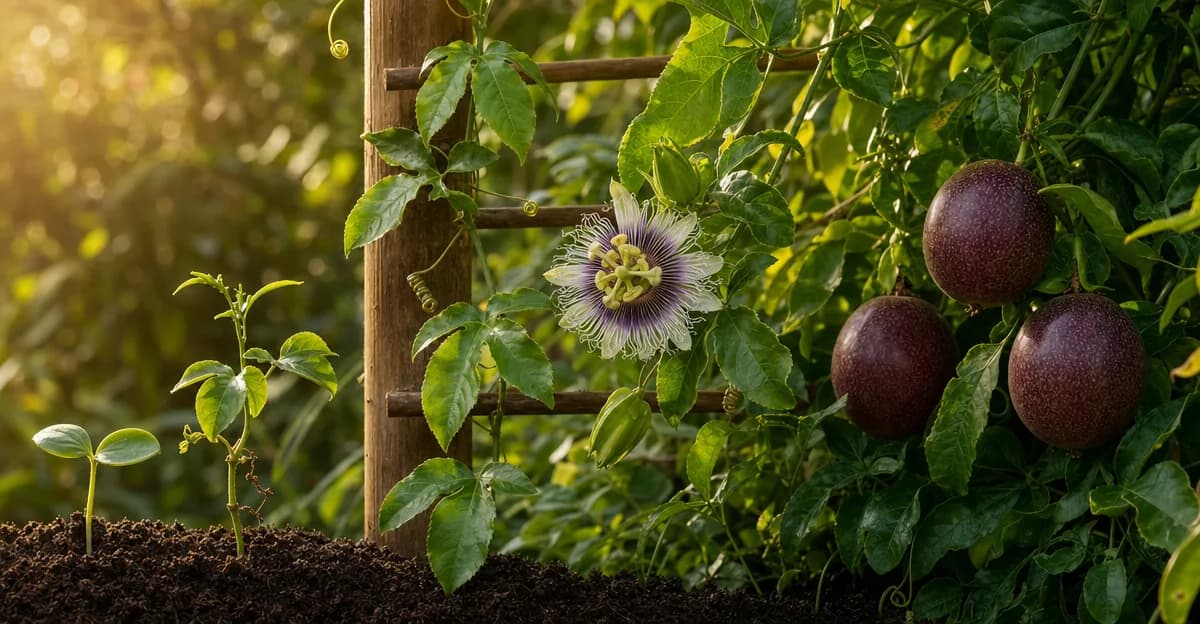
Key point: Passion fruit (Passiflora edulis) takes 12 to 18 months from seed to first harvest, passing through six distinct growth stages. Understanding each stage — and what your vine needs during it — is the difference between a vine that fruits heavily and one that stalls. This timeline is built from validated growing data and peer-reviewed research, with specific durations, temperatures, and care actions for every phase. See the full passion fruit growing profile for nutrient schedules and environment data.
The complete passion fruit timeline
Before diving into each stage, here is the full picture. A passion fruit vine grown from seed follows this approximate schedule:
| Stage | Duration | Cumulative time | What happens |
|---|---|---|---|
| Germination | 10-21 days | ~3 weeks | Seed sprouts, radicle emerges |
| Seedling | ~60 days | ~3 months | First true leaves, root establishment |
| Vegetative growth | ~180 days | ~9 months | Rapid vine extension, trellis training |
| Flowering | Starts month 10-13 | ~12 months | Flower buds, anthesis, pollination window |
| Fruiting | 70-80 days per cycle | ~14-16 months | Fruit development, color change, harvest |
| Mature vine | Years 2-5+ | Ongoing | Peak production, annual pruning cycle |
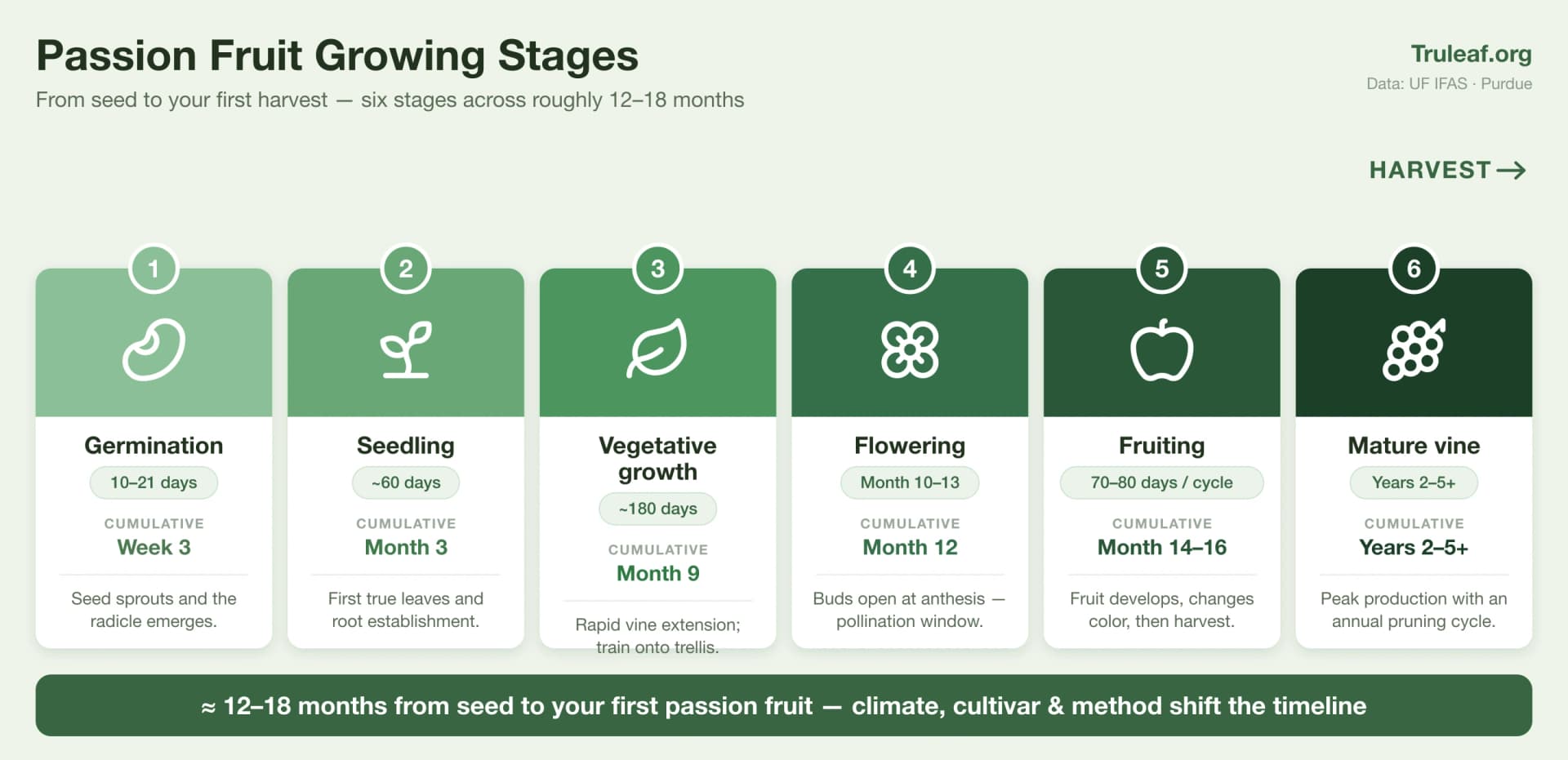
These durations come from our validated enrichment data cross-referenced with UF IFAS extension research and Purdue University's tropical fruit database. Climate, cultivar, and growing method all shift the timeline — container-grown vines and cooler climates tend toward the longer end. If you are growing in pots, see our container passion fruit guide for adjusted timelines.
Month-by-Month Growth Calendar
This calendar maps specific actions and measurements to each month of your vine's first two years. Use it as a checklist — each action is tied to the growth stage your vine should be in at that point.
| Month | Stage | Key Actions | What to Measure |
|---|---|---|---|
| 1 | Germination | Scarify seeds, soak 24h, sow at 25-30 °C. Monitor daily for radicle emergence | Soil temperature (target 29 °C), moisture level |
| 2 | Early seedling | First true leaves appear. Begin 14-16h light schedule. No fertilizer yet | Leaf count, stem height |
| 3 | Late seedling | Second true leaf set — start half-strength feeding (EC 1.0-1.5 mS/cm). Transplant when 4-6 true leaves appear | EC, pH (5.5-6.5), leaf count |
| 4-5 | Early vegetative | Train main leader up stake. Remove competing basal shoots. Increase to full feeding (EC 1.6-2.2 mS/cm) | Vine length, tendril emergence, EC |
| 6-7 | Mid vegetative | Vine reaches top wire — pinch growing tip, encourage two horizontal arms. Watch for adult three-lobed leaves | Canopy spread, internode length |
| 8-9 | Late vegetative | Lateral curtain developing. Shift nutrition toward higher K (265 ppm). Scout for Alternaria in humid conditions | Leaf size, disease presence, EC |
| 10-11 | Early flowering | First flower buds appear under long-day conditions. Begin daily pollination checks. Increase K to 265 ppm | Flower count, pollination success rate |
| 12-13 | Active flowering + early fruit | Peak flowering. Hand-pollinate daily 13:00-15:00 if no carpenter bees. First fruitlets swelling. Increase K to 310 ppm | Fruit set %, fruitlet count, EC |
| 14-16 | First harvest | Fruits reach full color at 70-80 days post-pollination. Collect fallen fruit daily. Record yield | Fruit weight, yield (kg), sugar content |
| 17-24 | Peak production | Annual prune in late winter. Maintain K at 310 ppm during fruiting flushes. Scout for Fusarium wilt symptoms. Plan replacement vine by month 30 | Seasonal yield, disease incidence, vine vigor |
Decision points:
- Month 3: If fewer than 4 true leaves by week 12, increase temperature or light before transplanting.
- Month 10: If no flower buds and day length is below 12 hours, supplemental lighting may be needed to trigger the photoperiod response.
- Month 14: If fruit set is below 20%, switch to hand pollination for every open flower.
- Month 24: If yield is declining year over year, begin propagating replacement cuttings from your healthiest vine.
Stage 1: Germination (10-21 days)
Germination is the slowest start in the passion fruit lifecycle. The hard seed coat of Passiflora edulis creates a physical barrier that delays water uptake, and without intervention, some seeds can take up to 3.5 months to sprout — or remain dormant indefinitely.
Scarification makes the difference
The single most important step for reliable germination is scarification. University of Florida researchers recommend rubbing seeds between two sheets of 100-150 grit sandpaper for 3-5 minutes until visible abrasions appear along the seed margins. After scarification, soak seeds in distilled water for 24 hours to jumpstart water absorption.
With scarification, germination typically occurs within 10-20 days. Without it, you may wait weeks or months.
Germination conditions
| Parameter | Requirement |
|---|---|
| Temperature | 25-30 °C (77-86 °F) |
| Sowing depth | ~1 cm, pointed tip downward |
| Light | Indirect light, not full sun |
| Moisture | Consistently moist, not waterlogged |
| Medium | Seed-starting mix with good drainage |
Seeds maintained at approximately 85 °F (29 °C) germinate in 10-20 days when scarified. Below 20 °C (68 °F), germination slows dramatically. Research from the Journal of Seed Science found that temperatures of 15 °C and below completely prevented seedling emergence across all cultivars tested.
What to expect visually
The radicle (root) emerges first, pushing downward into the medium. Within a few days, the hypocotyl arch breaks the surface and the cotyledons (seed leaves) unfold — two smooth, oval leaves that look nothing like the adult foliage. At this point, your seedling is ready for the next stage.
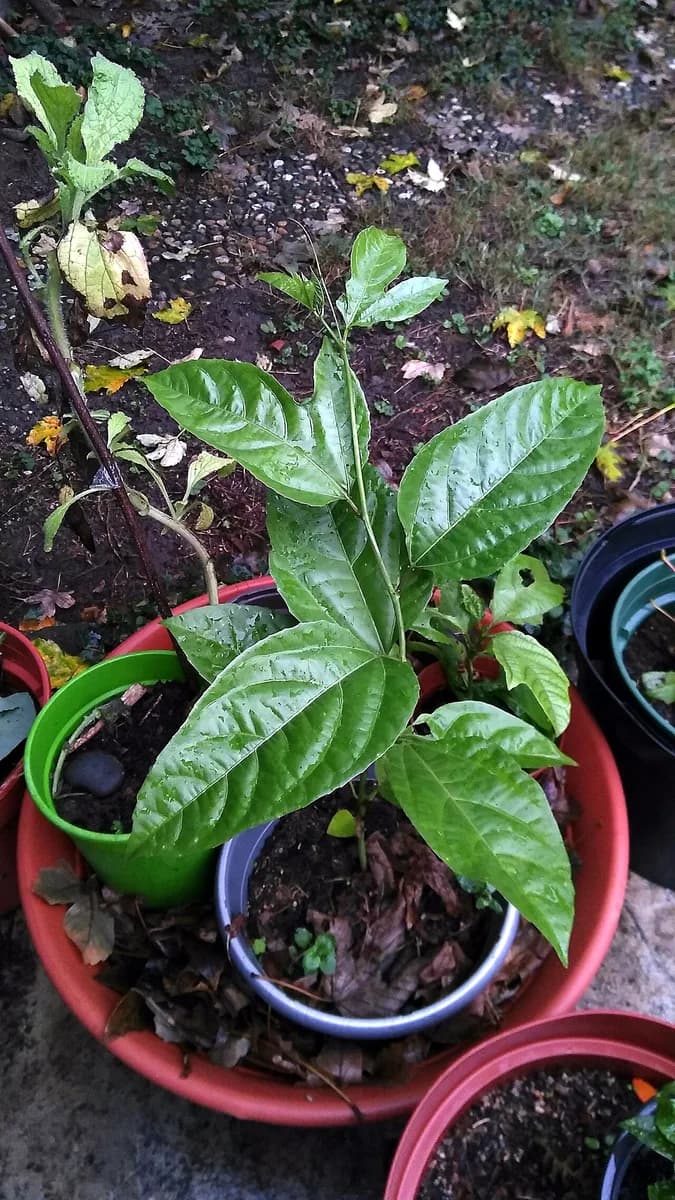
Stage 1: Early leaf forms after germination. Photo by Eiku, licensed CC BY-SA 4.0. Cropped and converted to WebP.
A 2020 study in Frontiers in Plant Science found that commercial passion fruit cultivars germinate at around 80%, while landraces average 63%. If you are using fresh seed from a store-bought fruit, expect germination rates closer to the landrace range.
Stage 2: Seedling (about 60 days)
The seedling stage spans roughly two months — from the emergence of cotyledons to a transplant-ready plant with several sets of true leaves and a developing root system.
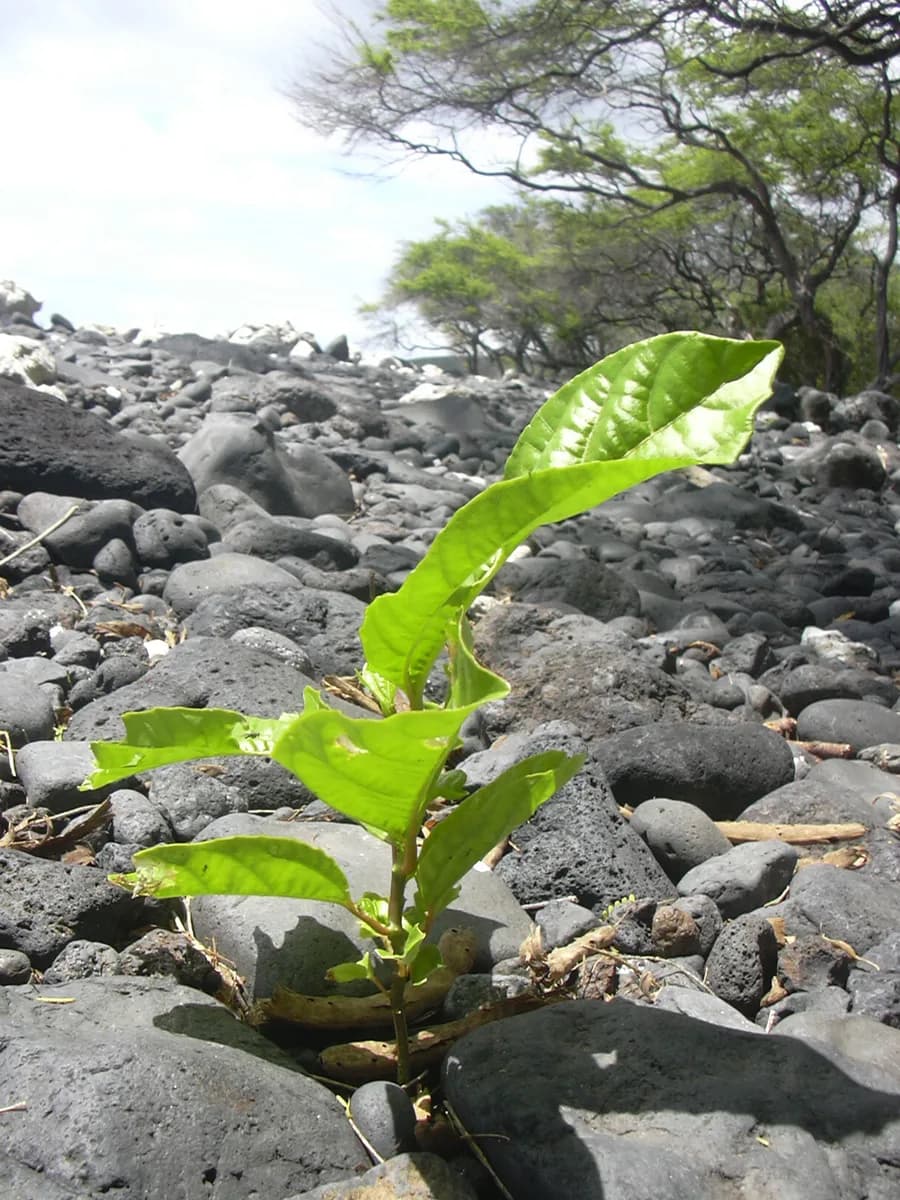
Stage 2: A young passion fruit seedling. Photo by Forest and Kim Starr, licensed CC BY 3.0. Cropped and converted to WebP.
First true leaves
The first true leaves appear 2-3 weeks after germination — but they won't look like the passion fruit leaves you recognize. Passiflora edulis is a heteroblastic species, meaning its leaf shape changes dramatically through development. The earliest true leaves are simple, monolobed, and lanceolate-shaped with smooth margins. An intermediate bilobed form typically appears next. The familiar deeply three-lobed adult leaves with serrated edges emerge from around the tenth leaf onward. Tendril emergence accompanies the transition to adult-form leaves and marks the beginning of the vine's climbing phase.
Care during the seedling stage
- Light: Provide 14-16 hours of bright indirect or supplemental light. Seedlings stretch and weaken under low light.
- Temperature: Maintain 18-29 °C (65-85 °F). The optimal growth temperature is around 27 °C (80 °F).
- Watering: Keep the medium consistently moist but never saturated. Passion fruit seedlings are susceptible to damping-off in overly wet conditions.
- Nutrition: Begin light feeding once the second set of true leaves appears. Use a dilute balanced liquid fertilizer (half-strength) or maintain EC at 1.0-1.5 mS/cm for hydroponic seedlings.
- pH: Keep the root zone between 5.5 and 6.5.
When to transplant
Seedlings are ready for transplanting when they have 4-6 true leaves and a root system that holds the growing medium together when lifted from the cell. In mild climates (USDA zones 9b-11), transplant outdoors after all frost danger has passed. In cooler zones, grow in containers year-round and bring indoors for winter.
For cuttings rather than seed, the timeline compresses: rooted cuttings are ready for planting in 2-3 months and skip the juvenile phase, reaching flowering sooner.
Stage 3: Vegetative growth (about 180 days)
This is the stage where passion fruit earns its reputation as a vigorous grower. Once established, a healthy vine can grow more than 35 feet (10 m) in a single year and eventually reach total lengths exceeding 100 feet. The vegetative phase lasts roughly six months from transplant to the first flower buds.
What happens during vegetative growth
The vine produces a strong central leader that climbs rapidly, anchoring itself with curling tendrils. Leaves enlarge to their full adult size — deeply three-lobed, 7-20 cm across, with a glossy dark-green upper surface. The root system expands to about 60 cm depth.
During this stage, the vine's priority is building the canopy that will support fruiting. Flower production waits until the vine reaches physiological maturity, typically at 10-13 months from seed.
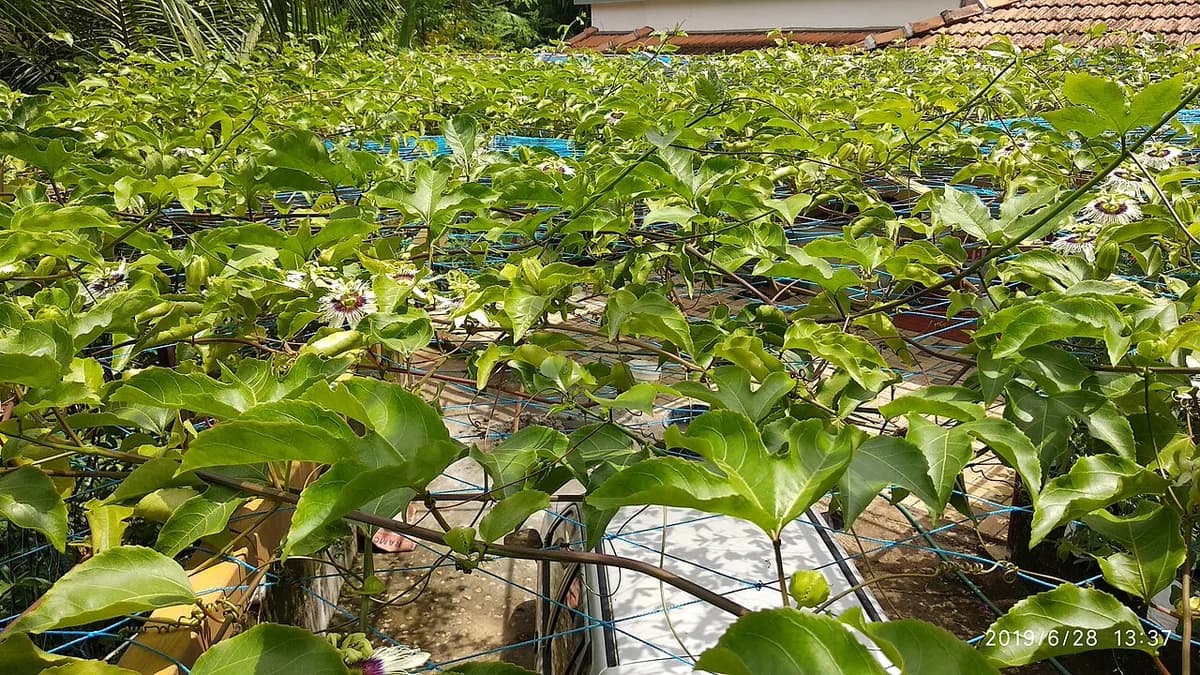
Stage 3: Vegetative canopy trained across a trellis. Photo by Vijayanrajapuram, licensed CC BY-SA 4.0. Cropped and converted to WebP.
Trellis training
A trellis is not optional — it is essential for any productive passion fruit vine. Without support, vines sprawl along the ground, increasing disease pressure and reducing fruit quality.
Training method:
- Select one strong main leader and remove competing shoots at the base
- Train the leader vertically up a stake or string to the top wire (1.8-2.0 m high)
- Once it reaches the top wire, pinch the growing tip to encourage two horizontal arms
- Allow lateral shoots to hang down as a fruiting curtain
- Remove any shoots below the top wire to keep the trunk clean
This single-leader curtain system is the standard for commercial passion fruit production and works equally well in home gardens.
Nutrition shifts
The vegetative stage demands more nitrogen than any other phase. Our validated data shows optimal nutrition at N-P-K of 150-45-220 ppm, with EC maintained at 1.6-2.2 mS/cm. For soil growers, UF IFAS recommends fertilizing 2-3 times per year with a balanced fertilizer, increasing potassium as the vine matures.
| Nutrient | Seedling | Vegetative | Flowering | Fruiting |
|---|---|---|---|---|
| Nitrogen (ppm) | 100 | 150 | 150 | 170 |
| Phosphorus (ppm) | 32 | 45 | 55 | 55 |
| Potassium (ppm) | 140 | 220 | 265 | 310 |
| EC (mS/cm) | 1.0-1.5 | 1.6-2.2 | 2.0-2.8 | 2.0-3.0 |
Notice how potassium increases steadily across stages — passion fruit is a heavy potassium feeder, and K deficiency during flowering and fruiting is one of the most common causes of poor fruit set and small fruit size.
Complete Nutrient Schedule with Secondary Elements
The simplified table above covers the three primary macronutrients. For precision growing — especially in hydroponic or soilless systems — secondary macronutrients are equally critical. Passion fruit is particularly demanding of calcium for cell wall integrity and magnesium for chlorophyll production. These ranges come from our validated nutrient profiles, cross-referenced with UF IFAS extension research.
| Nutrient | Seedling | Vegetative | Flowering | Fruiting | Role |
|---|---|---|---|---|---|
| Calcium (ppm) | 70-94 | 140-189 | 140-189 | 140-189 | Cell wall strength, disease resistance |
| Magnesium (ppm) | 15-21 | 31-42 | 31-42 | 31-42 | Chlorophyll core, enzyme activation |
| Sulfur (ppm) | 20-27 | 40-55 | 40-55 | 40-55 | Protein synthesis, flavor compounds |
EC targets by stage:
| Stage | EC Range (mS/cm) | Notes |
|---|---|---|
| Seedling | 1.0-1.5 | Half-strength solution — sensitive roots |
| Vegetative | 1.6-2.2 | Full strength — high N demand |
| Flowering | 2.0-2.8 | Shift toward K — maintain Ca |
| Fruiting | 2.0-3.0 | Peak K demand — monitor for salt stress above 3.0 |
Critical nutrient interactions:
- Potassium vs. magnesium: K above 387 ppm antagonizes Mg uptake. If you see interveinal chlorosis on older leaves during heavy fruiting, check your K:Mg ratio before adding more magnesium — the issue may be excess potassium, not low magnesium.
- Calcium during temperature stress: Increase Ca toward the upper range (164-189 ppm) when temperatures exceed 29 °C or drop below 20 °C. Calcium stabilizes cell membranes under thermal stress and reduces fruit drop.
- pH drift and nutrient lockout: At pH below 5.0, magnesium availability drops sharply. At pH above 6.5, iron and manganese become less available. The 5.5-6.5 range keeps all elements accessible.
Stage 4: Flowering (starts at 10-13 months)
The first flowers are a milestone. Passion fruit blooms are among the most striking in the plant world — intricate, fragrant, 5-8 cm across, with a corona of purple and white filaments surrounding the reproductive structures.
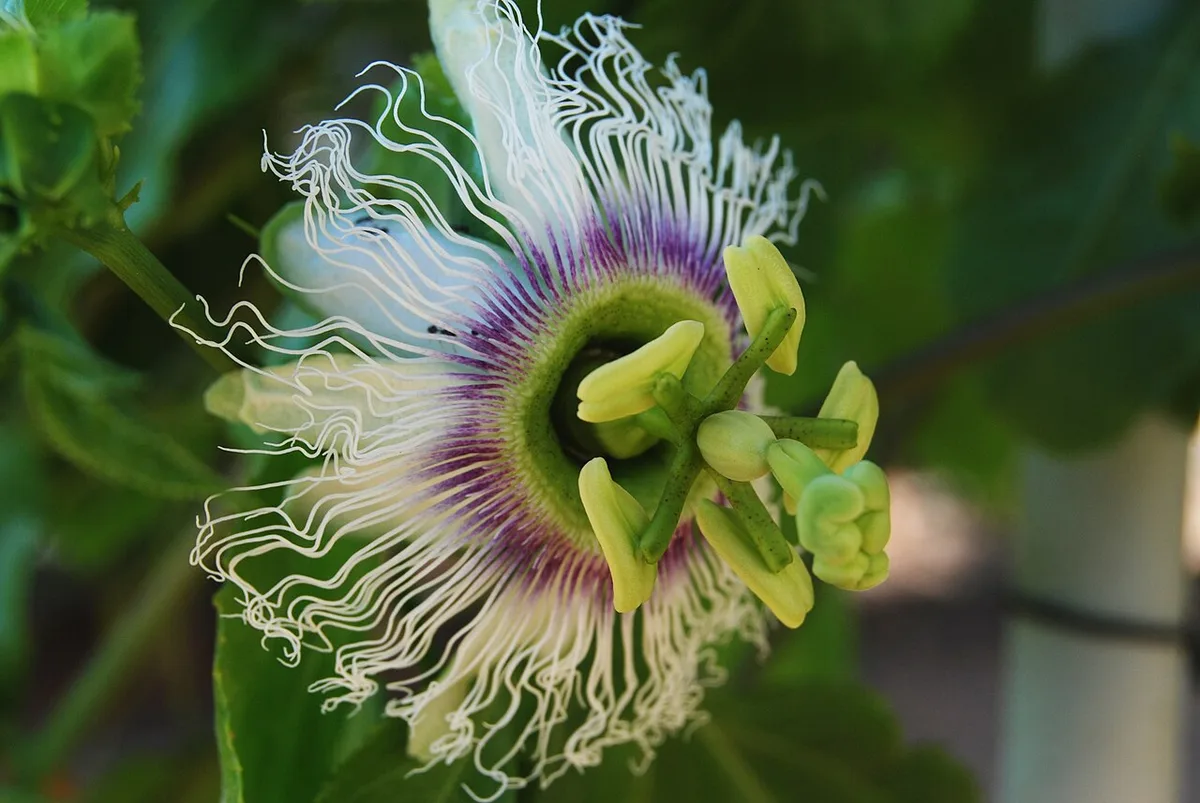
Stage 4: An open passion fruit flower. Photo by Raz Sapir, licensed CC BY-SA 3.0. Cropped and converted to WebP.
When to expect flowers
From seed, expect the first flowers at 10-13 months under favorable conditions. Vines grown from cuttings or grafts may flower 2-3 months earlier because they bypass the juvenile phase. In Florida, vines typically flower from spring through fall.
Photoperiod matters. Research in Plant, Cell & Environment demonstrated that passion fruit flower development requires a graft-transmissible signal produced in mature leaves under long-day conditions. Without sufficient day length, flower primordia initiate but arrest at an early stage. This means short winter days can stall flowering even if temperatures are warm enough — a common frustration for indoor growers at higher latitudes.
Flowers open in the morning and remain receptive for a limited window. Each flower lasts only one day — if pollination does not occur during that day, the flower closes and drops without setting fruit.
Pollination: the make-or-break moment
This is where many home growers hit trouble. Purple passion fruit (P. edulis) is partially self-fertile and can set fruit from its own pollen, though cross-pollination improves fruit size and seed count. Yellow passion fruit (P. edulis f. flavicarpa) is self-incompatible and requires pollen from a genetically different vine.
In nature, carpenter bees (Xylocopa spp.) are the primary pollinators. Their large bodies contact both anthers and stigma as they forage for nectar. Honeybees and smaller bees are too small to effectively transfer pollen between the widely spaced reproductive parts.
Research shows that hand pollination achieves fruit set rates of 32-47%, compared to 13-26% with natural pollination alone. If you don't see carpenter bees visiting your flowers, hand-pollinate:
- Wait until the flower is fully open and the styles have curved downward (early afternoon, around 13:00-15:00, when stigma receptivity peaks)
- Use a clean, soft paintbrush or cotton glove
- Brush pollen from the anthers (five pollen-bearing structures) — ideally from a different vine for yellow types
- Transfer it to the three stigma lobes, pressing gently
- Repeat on every open flower daily
A minimum of about 100 seeds must develop inside the fruit for it to reach acceptable weight and juice content. Poor pollination produces small, hollow fruit even if the flower technically sets — which is why thorough pollen coverage across all three stigma surfaces matters.
Flower-to-fruit transition
Successfully pollinated flowers show visible swelling at the base within 7-10 days. The petals and corona wilt and drop, leaving a small green fruit that begins developing rapidly. Flowers that were not pollinated simply dry and fall off within a day or two — this is normal and not a sign of disease.
Stage 5: Fruiting (70-80 days per cycle)
Fruit development from pollination to harvest takes 70-80 days — consistently reported across UF IFAS, Purdue, and our validated data (75 days). This is one of the most reliable numbers in passion fruit cultivation.
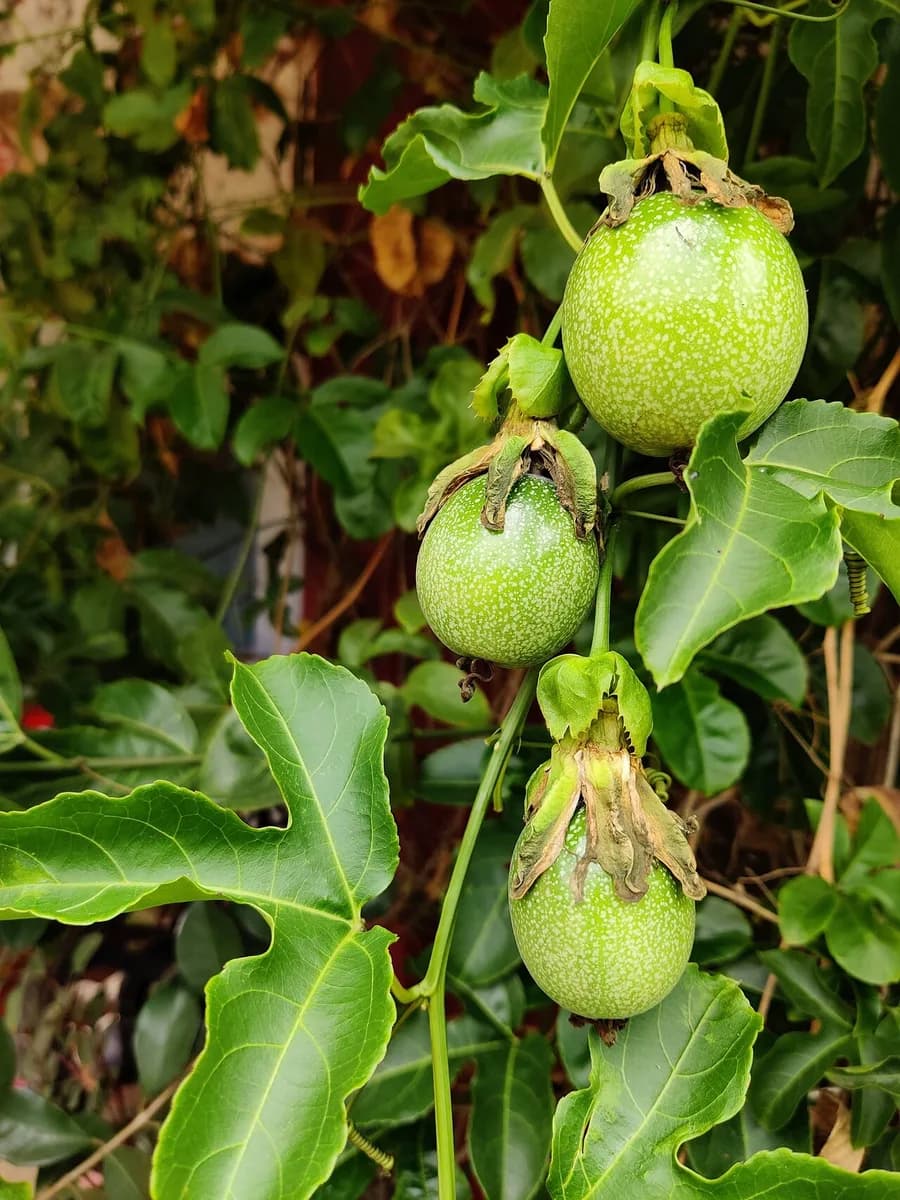
Stage 5: Immature fruit expanding on the vine. Photo by Aldrina A Manashe, released under CC0. Cropped and converted to WebP.
Fruit development phases
The developing fruit passes through three visible phases:
Days 0-14: Fruitlet. Rapid cell division drives quick diameter increase. The fruit is tiny and firm. This is the highest-risk period for fruit drop from poor pollination.
Days 15-35: Green expansion. The fruit grows rapidly to near-full size (5-8 cm diameter), reaching maximum dimensions around day 20. The skin is smooth, hard, and bright green. Citric acid peaks during this phase. This is the highest-demand period for water and potassium — drought stress now causes undersized fruit.
Days 35-50: Veraison. Growth slows and color transition begins. The skin shifts from green toward light purple (purple varieties) or green-yellow (yellow varieties). Citric acid declines sharply as sugar accumulates.
Days 50-70: Internal maturation. The pulp cavity fills with aromatic juice. Weight continues to increase even though external dimensions are stable. Flavonoid and carotenoid biosynthesis drive the deepening peel color.
Days 70-80+: Ripening. The skin reaches full color, develops a slight waxiness, and begins to wrinkle. Sugar content peaks and acidity drops. The fruit naturally abscises (detaches) from the vine and falls to the ground.
When to harvest
There are three reliable harvest indicators:
- Color: Fully colored skin — deep purple or golden yellow depending on cultivar. Light-colored fruit is still immature.
- Drop test: Ripe fruits detach and fall naturally. For fresh eating, this is the easiest and most reliable method — simply collect fallen fruit daily.
- Wrinkle: A slightly wrinkled skin indicates peak ripeness and maximum sugar content. The wrinkling looks concerning but is normal and desirable.
For fresh-market fruit, harvest at full color before the fruit drops to avoid bruising. For processing or home eating, let them fall and collect daily.
First-year yield expectations
A well-grown first-year vine produces 2-7 kg (5-15 lb) of fruit when pollination succeeds. This translates to roughly 30-100 individual fruits, depending on cultivar and fruit size. Yield increases substantially in years two and three as the vine's canopy expands.
Storage
Store partially ripe fruit at 7-10 °C (45-50 °F) and fully ripe fruit at 5-7 °C (41-45 °F) with high humidity. Avoid prolonged storage below 5 °C — chilling injury causes surface pitting and off-flavors.
Stage 6: Mature vine (years 2-5+)
A passion fruit vine is a short-lived perennial. The productive lifespan is typically about 3-4 years. Commercial plantations in Fiji average about 3 years, though well-managed vines at higher elevations in South Africa have maintained production for up to 8 years.
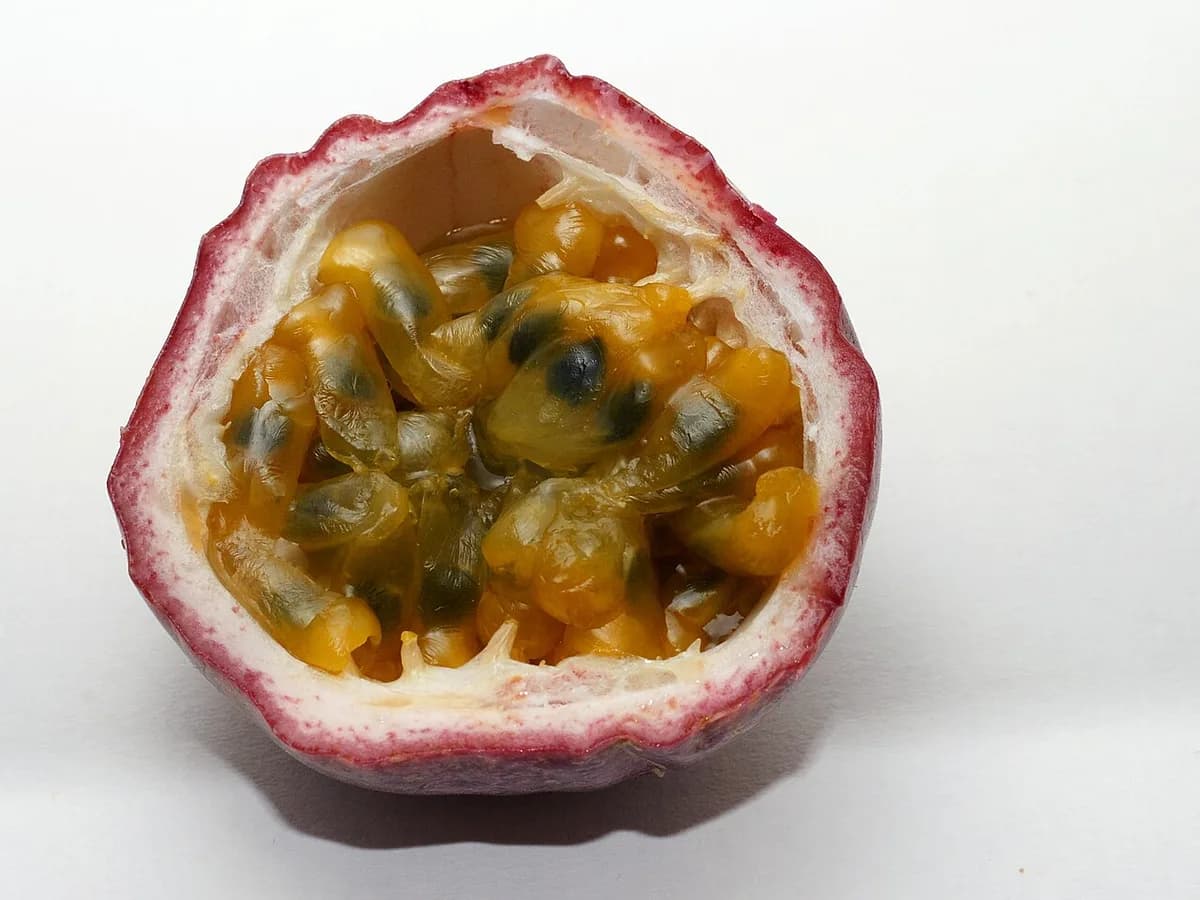
Stage 6: Ripe purple passion fruit at harvest. Photo by Alexander Klink, licensed CC BY 3.0. Cropped and converted to WebP.
Peak production years
Yield peaks in years two and three, when the vine has a fully established canopy and extensive root system. Commercial plantings yield 2,200-4,400 lb per acre at peak production. After year three, production gradually declines as older wood becomes less vigorous and disease pressure accumulates.
Annual pruning cycle
Pruning is essential for sustained production because passion fruit flowers and fruits on new growth only. Without pruning, productive wood moves further from the main framework each year, eventually producing only at the vine's extremities.
When to prune: Late winter, when the vine is dormant or least active.
How to prune:
- Remove all dead, diseased, or weak wood
- Cut back lateral shoots that fruited in the previous season to 2-3 buds
- Thin crowded growth to improve air circulation and light penetration
- Remove any shoots growing below the trellis wire
- Retain a strong framework of healthy main arms and leader
After pruning, the vine pushes new lateral growth in spring, which flowers and fruits through summer and fall. This annual renewal cycle is what keeps a passion fruit vine productive beyond its third year.
When to replace
Consider replacing your vine when:
- Yield drops below 50% of peak production despite good nutrition and pruning
- Viral symptoms appear (mosaic, leaf distortion, stunting) — viral infection incidence increases with vine age
- Fusarium wilt or crown rot compromises the root system
- The vine has passed its fourth or fifth year and shows general decline
Start a new vine from cuttings of your best-performing healthy plant 6-12 months before you plan to remove the old one, ensuring continuous production.
Stage-Specific Troubleshooting Guide
Each growth stage has its own failure modes. This diagnostic matrix maps the most likely problems to the stage where they occur, with specific symptoms and corrective actions.
Germination and Seedling (Months 1-3)
| Problem | Symptoms | Cause | Action |
|---|---|---|---|
| No germination after 21 days | No radicle emergence | Hard seed coat not scarified, or temperature below 20 °C | Re-scarify with 100-150 grit sandpaper, soak 24h, ensure 25-30 °C |
| Damping-off | Seedling collapses at soil line, stem turns brown and mushy | Overwatering, poor drainage, fungal pathogen | Reduce watering frequency, improve drainage, apply hydrogen peroxide drench at 3 mL/L |
| Leggy seedlings | Elongated weak stems with wide internode spacing | Insufficient light (below 14h/day) or excessive heat | Increase light intensity or duration, reduce temperature to 24-27 °C |
Vegetative Growth (Months 4-9)
| Problem | Symptoms | Cause | Action |
|---|---|---|---|
| Slow vine growth | Less than 1 m/month extension | Nitrogen below optimal range, temperatures below 20 °C, or root restriction | Increase N toward 150 ppm (vegetative target), verify temperature 20-29 °C, check root zone |
| Magnesium deficiency | Interveinal chlorosis on older leaves, yellowing moves upward through canopy | Mg below 31 ppm or K:Mg ratio exceeding 10:1 | Increase Mg to 36-42 ppm, apply foliar MgSO4 at 2% for rapid correction |
| Alternaria brown spot | Reddish-brown circular spots on leaves, concentric ring pattern in humid conditions | Humidity above 75%, persistent leaf wetness exceeding 4 hours | Lower humidity to 60-70%, increase airflow to 0.5-1.0 m/s, remove infected leaves |
Flowering and Fruiting (Months 10-16+)
| Problem | Symptoms | Cause | Action |
|---|---|---|---|
| No flowers at month 13+ | Vigorous vegetative growth but no flower buds | Insufficient day length — photoperiod signal not triggered | Supplement with lighting to achieve above 12h day length |
| Poor fruit set (below 20%) | Flowers open and drop without swelling at base | No pollinator present, self-incompatibility (yellow types), or stigma receptivity window missed | Hand-pollinate daily at 13:00-15:00, use pollen from a different vine for yellow cultivars |
| Small hollow fruit | Undersized fruit with few seeds, light weight | Insufficient pollen transfer — fewer than 100 seeds developing | Improve pollination coverage across all 3 stigma surfaces, ensure thorough pollen contact |
| Fruit drop | Developing fruitlets abscise from vine | Temperature outside 20-29 °C range or water stress during green expansion phase | Stabilize temperature, increase Ca to 164-189 ppm, ensure consistent irrigation |
Mature Vine (Years 2-5)
| Problem | Symptoms | Cause | Action |
|---|---|---|---|
| Declining yield | Production drops more than 30% from previous year despite good canopy | Aging wood, insufficient pruning, nutrient depletion | Aggressive late-winter pruning to 2-3 buds on laterals, increase K to upper range |
| Fusarium wilt | Unilateral wilting, dark brown vascular streaks visible in cut stems, progressive collapse | Fusarium oxysporum root infection entering through wounds | Remove and destroy infected vines, sterilize tools and media, maintain pH 5.8-6.2 |
| Collar and root rot | Sudden wilting despite good nutrition, dark girdling lesion at base, mushy foul-smelling roots | Waterlogged root zone, dissolved oxygen below 5 ppm | Improve drainage, maintain O2 above 6 ppm in hydroponic systems, drench with H2O2 at 3 mL/L |
| Viral decline | Mosaic patterns on leaves, leaf distortion, stunting, reduced fruit quality | Accumulated viral infection — incidence increases with vine age | No cure — replace vine with clean propagation material from certified stock |
Quick reference: all stages at a glance
| Stage | Duration | Temperature | Key action | Biggest risk |
|---|---|---|---|---|
| Germination | 10-21 days | 25-30 °C | Scarify seeds, soak 24h | Hard seed coat blocks germination |
| Seedling | ~60 days | 18-29 °C | Bright light, gentle feeding | Damping-off from overwatering |
| Vegetative | ~180 days | 18-29 °C | Trellis training, high N | No trellis = ground sprawl |
| Flowering | From month 10-13 | 18-29 °C | Pollinate daily | No pollinator = no fruit |
| Fruiting | 70-80 days/cycle | 18-29 °C | Increase K, steady water | Drought = small fruit |
| Mature vine | Years 2-5+ | >-1 °C min | Annual pruning, disease scouting | Virus accumulation |
Frequently asked questions
How long does it take passion fruit to grow fruit?
From seed, 12-18 months to first harvest. From cuttings or grafted plants, 8-12 months. The variability depends mainly on temperature — vines in consistently warm climates (USDA zones 10-11) reach flowering faster than those in zone 9b.
How long do passion fruit plants live?
Most passion fruit vines are productive for 3-4 years. With diligent pruning and disease management, some growers extend production beyond this — vines at higher elevations in South Africa have produced for up to 8 years.
What are the stages of passion fruit growth?
Six stages: germination (10-21 days), seedling (~60 days), vegetative growth (~180 days), flowering (starts month 10-13), fruiting (70-80 days per cycle), and mature vine (years 2-5+). See the complete timeline table above for care details at each stage.
What is the life cycle of a passion fruit plant?
Passion fruit is a short-lived perennial vine. Its life cycle runs from seed germination through a juvenile vegetative phase, into a productive flowering-and-fruiting adult phase that repeats in yearly cycles, and finally into decline after roughly 3-4 years. Each spring, an established vine renews itself: annual pruning triggers fresh new growth, which is the only wood that flowers and fruits. Growers typically start a replacement vine from cuttings around year three to keep production continuous.
How long does passion fruit take to grow from seed?
Expect 12 to 18 months from seed to your first ripe fruit. The path is roughly three weeks of germination, about two months as a seedling, six months of vegetative growth, then flowering at 10-13 months, followed by 70-80 days from a pollinated flower to a ripe fruit. Warmer climates (USDA zones 10-11) reach the finish line faster than cooler zone 9b conditions.
How long after flowering does passion fruit take to fruit?
A successfully pollinated flower takes 70-80 days to develop into a ripe fruit — one of the most consistent numbers in passion fruit cultivation, reported across UF IFAS, Purdue, and our validated data (75 days). Fruit set becomes visible as swelling at the flower base within 7-10 days of pollination.
Why is my passion fruit growing but not flowering?
The most common cause is day length. Passion fruit flower development requires a graft-transmissible signal produced in mature leaves under long-day conditions — so short winter days can stall flowering even when temperatures are warm, a frequent frustration for indoor growers at higher latitudes. A vine that is still under 10-13 months old may also simply be too young; vigorous vegetative growth with no buds before that age is normal. Supplement light to push the day length above 12 hours if a mature vine refuses to bloom.
Keep growing
Passion fruit rewards patience with abundance. Those first 12 months from seed feel slow, but once a vine reaches its flowering stage, it can produce multiple fruiting cycles per year in warm climates. Track your vine's progress through each stage using the passion fruit growing profile, and if you are growing in limited space, see our container passion fruit guide for adapted techniques.