Plantgegevens laden...
20 bronnen gebruikt voor dit plantprofiel
da Silva, M.E.J., Mathe, L.O.J., van Rooyen, I.L., Brink, H.G., Nicol, W. (2022). “Optimal Growth Conditions for Azolla pinnata R. Brown: Impacts of Light Intensity, Nitrogen Addition, pH Control, and Humidity.” Plants, 11(8), 1048.
Watanabe, I., Espinas, C.R., Berja, N.S., Alimagno, B.V. (1977). “IRRI2 Growing Medium for Azolla Culture.” IRRI Research Paper Series No. 11 (via The Azolla Foundation).
Hamdan, H.Z., Houri, A.F. (2021). “CO2 sequestration by propagation of the fast-growing Azolla spp..” Environmental Science and Pollution Research, 29(12), 16912-16924.
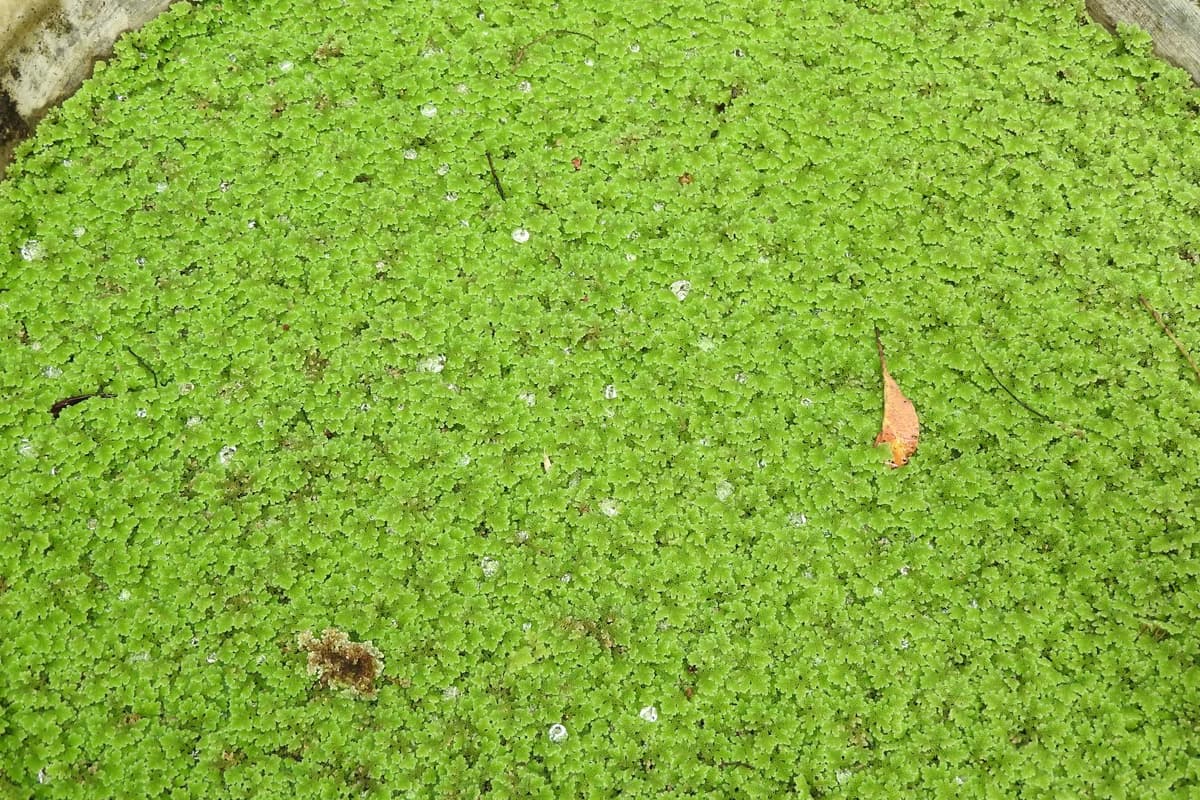
Azolla pinnata is a small, free-floating aquatic fern in the family Salviniaceae that forms dense, carpet-like mats on the surface of still or slow-moving fresh water. The plant consists of a short, branched floating stem bearing two-lobed scale-like leaves that overlap in alternating rows, and fine roots that hang into the water. Leaf colour ranges from bright green to deep rusty red under high light or cooler conditions. Individual plants measure 1.5-2.5 cm across. Azolla is remarkable for its symbiotic relationship with the nitrogen-fixing cyanobacterium Anabaena azollae (Nostoc azollae), which lives in cavities in the dorsal leaf lobes and converts atmospheric nitrogen into plant-available ammonia. Under optimal conditions (20-28C, pH 5.5-7, partial shade), biomass doubles in as little as 2-5 days. Azolla is cultivated globally as a biofertilizer in rice paddy systems (fixing 40-60 kg N/ha/season), as a high-protein livestock and fish feed supplement (25-30% crude protein dry we...
Temperature: 15-35°C (optimal 25°C). Humidity: 70-90% (optimal 85%). Light DLI: 17 mol/m²/day. Photoperiod: 16h.
Hydroponic System Compatibility:
DWC: Suitable. DWC is the most natural and recommended system for Azolla. The plant floats on the water surface just as it does in rice paddies and ponds. Shallow troughs (5-20 cm water depth) are optimal. Both Brouwer et al. (2018) and da Silva et al. (2022) used DWC-style containers in their controlled studies.
NFT: Not suitable. Incompatible. Azolla floats freely and cannot be anchored in NFT channels. The flowing thin nutrient film disrupts mat formation essential for productive growth.
Ebb and Flow: Not suitable. Not recommended. The flood-drain cycle disrupts the floating mat. Drainage phases leave the plant stranded on dry surfaces causing rapid desiccation. Azolla cannot tolerate periodic drying.
Drip: Not suitable. Incompatible. Drip irrigation is designed for rooted plants in solid substrate. Azolla is a floating aquatic fern with no substrate requirements.
Kratky: Suitable. Highly compatible. Kratky passive static water systems mirror Azolla's natural pond habitat. The plant floats on the nutrient solution surface without any pump or aeration required. Simplest and most cost-effective system for small-scale Azolla cultivation.
Aeroponics: Not suitable. Incompatible. Azolla roots hang loosely below the floating frond and are not structured for aeroponic misting. The floating mat lifestyle cannot be supported in an aeroponic chamber.
Common Issues:
Iron Deficiency (Phosphorus-Induced Chlorosis)
Symptoms: Interveinal yellowing (chlorosis) on younger fronds. Reduced frond growth and smaller colony size. Impaired nitrogen fixation by Anabaena symbiont. Pale green to yellowish frond coloration
Causes: Excess phosphorus above 50 umol/L (1.55 ppm) forming insoluble Fe-PO4 complexes. Insufficient chelated iron (Fe-EDTA) in nutrient solution below 0.028 ppm. High pH above 7.0 reducing iron bioavailability in the water column
Solutions: Add chelated iron (Fe-EDTA) to maintain 0.05-0.26 ppm iron in solution. Reduce phosphorus to 1-5 ppm optimal range to prevent iron antagonism. Lower water pH to 5.5-6.5 range to increase iron solubility. Perform 30-50% water change if iron lockout persists
Prevention: Monitor phosphorus levels weekly and keep below 1.55 ppm to avoid Fe chlorosis. Use chelated iron forms (Fe-EDTA) that remain available across wider pH range. Maintain pH at 6.0-6.5 for optimal iron-phosphorus balance
Heat Stress and Frond Scorching
Symptoms: Fronds turning brick-red from anthocyanin accumulation under high light and heat. Brown leaf edges with crispy dried texture. Rapid mat thinning and die-off in surface layer. Growth rate declining sharply above 30C
Causes: Water temperature exceeding 30C sustained or 35C acute. Light intensity far exceeding 20000 lux with no shading. Ambient air temperature sustained above 35C
Solutions: Reduce light intensity to 20000 lux or provide 30-50% shade cloth. Maintain water temperature between 18-28C using a chiller if necessary. Increase air humidity to 80-90% to reduce evaporative stress. Add floating shade structures to reduce direct solar exposure
Prevention: Install shade cloth providing 30-50% shade for outdoor cultivation. Use insulated containers to buffer temperature fluctuations. Monitor water temperature daily during warm seasons
Phosphorus Deficiency
Symptoms: Reduced frond size and stunted growth. Red-anthocyanin coloration of fronds. Lower protein content in frond tissue. Impaired nitrogen fixation by Anabaena symbiont with N fixation declining 2.5-4.5x
Causes: Phosphorus levels falling below 0.93 ppm minimum threshold in water. High calcium or iron levels antagonizing phosphorus uptake. Infrequent nutrient solution replenishment
Solutions: Supplement phosphorus to maintain 1-5 ppm optimal concentration in water. Use monopotassium phosphate (MKP) or single superphosphate for precise P adjustment. Adjust pH to 5.5-6.5 to maximize phosphorus availability. Replace 25-30% of water with fresh nutrient solution every 10 days
Prevention: Test phosphorus concentration weekly using colorimetric kit. Maintain P at 1-5 ppm with regular small additions rather than infrequent large doses. Schedule regular nutrient top-offs every 3-5 days
Fungal Mat Rot and Decomposition
Symptoms: Dark mushy patches appearing on frond mat surface. Foul odor emanating from the water surface. Rapid decomposition of frond clusters. Water turning turbid and dark beneath the mat
Causes: Stagnant water conditions with poor aeration. Excessive mat density blocking air exchange at water surface. Sustained humidity above 95% with no air circulation. Nutrient buildup and decomposing organic matter in standing water
Solutions: Increase aeration with air stones providing gentle bubbling beneath the mat. Thin frond mat to maintain no more than 70-80% water surface coverage. Remove and discard all visibly decaying frond material. Replace 25-30% of water with fresh solution to dilute pathogens
Prevention: Harvest regularly to prevent excessive mat density buildup. Maintain gentle air movement across water surface. Replace all water and clean container every 6 months. Relocate cultivation to a new container at first sign of persistent rot
Nitrogen Fixation Decline
Symptoms: Yellowing of fronds despite adequate nutrients in solution. Severely reduced growth rate and biomass doubling time. Fronds appearing pale green instead of deep green. Loss of Anabaena symbiont visible as reduced cavity coloration
Causes: Micronutrient depletion especially molybdenum and cobalt needed for nitrogenase enzyme. Excess ammonium-N in water above 2 ppm suppressing nitrogenase activity. Water temperature outside 18-28C optimal range suppressing symbiont activity. Iron deficiency affecting nitrogenase iron-molybdenum cofactor
Solutions: Add micronutrient supplement with Mo (0.005 ppm) and Co (0.001 ppm). Replace 25-30% of water to reduce accumulated ammonium-N. Stabilize water temperature to 22-25C for optimal symbiont activity. Supplement chelated iron (Fe-EDTA) to support nitrogenase function
Prevention: Use complete micronutrient formulation (IRRI2 medium or equivalent) when preparing nutrient solution. Monitor water temperature continuously. Avoid adding any nitrogen fertilizer to the water — Azolla fixes its own
Azolla Weevil Infestation (Stenopelmus rufinasus)
Symptoms: Rapid and complete mat destruction over days to weeks. Fronds with visible feeding holes and chewed edges. Tiny 2 mm brown-black beetles visible on frond surface. Sudden collapse of established colonies with no recovery
Causes: Introduction of Stenopelmus rufinasus weevil via contaminated inoculum. Both larvae and adults feed exclusively on Azolla species. Weevil populations can expand rapidly in dense Azolla mats
Solutions: Remove and destroy all infested frond material. Relocate remaining clean Azolla to a new container. Clean and disinfect original container before re-inoculation. No reliable chemical controls are available for this pest
Prevention: Source Azolla inoculum from verified weevil-free nurseries. Inspect all incoming plant material before introducing to grow beds. Screen outdoor beds with fine mesh netting to exclude beetles. Quarantine new Azolla for 7-10 days before adding to main cultivation
Golden Apple Snail Damage (Pomacea canaliculata)
Symptoms: Ragged chewed frond edges and rapid mat reduction overnight. Visible mucus trails on container edges. Bright pink egg masses on emergent surfaces above waterline. Progressive mat thinning despite optimal growing conditions
Causes: Pomacea canaliculata feeding nocturnally on Azolla fronds. Introduction via contaminated water or plant material. Snails reproducing rapidly in warm nutrient-rich water
Solutions: Hand-pick snails and remove egg masses at dawn when snails are most visible. Introduce ducks (Cayuga or similar breeds) as biological control agents. Deep drain and clean container to eliminate snail populations. Physically remove and destroy all pink egg masses from above-water surfaces
Prevention: Inspect all incoming plant material and water for snails and eggs. Install mesh barriers around grow ponds to exclude snails. Monitor regularly at dawn when snails are most active. Use dedicated clean water sources not connected to natural waterways
Nitrogen Toxicity from Over-Fertilization
Symptoms: Reduced nitrogen fixation activity despite healthy-looking mat. Slower growth than expected under otherwise optimal conditions. Algal bloom in the water beneath the mat. Elevated ammonium-N in water causing nitrogenase suppression
Causes: Excessive nitrogen fertilizer applied to Azolla water. Runoff from nearby fertilized fields entering the cultivation area. Fish waste or manure accumulating ammonium-N above 5 ppm. Infrequent water changes allowing decomposing frond N to accumulate
Solutions: Stop all nitrogen inputs to grow water immediately. Replace 30-50% of water with fresh nutrient-free or low-N water. Flush grow bed water to dilute accumulated ammonium. Allow 5-7 days for nitrogenase activity to recover after N reduction
Prevention: Never apply nitrogen fertilizer to Azolla cultivation water. Replace 25-30% of water every 10 days to prevent N buildup from decomposition. Monitor water ammonium-N and keep below 2 ppm for optimal N fixation. Use only phosphorus-based supplements (superphosphate, MKP)
temperature: Azolla pinnata thrives between 18C and 28C, with optimal growth at approximately 25C[1][4]. Growth rate begins declining above 30C and is significantly impaired above 35C; prolonged exposure to 45C is lethal[3]. At the low end, Azolla can survive brief periods at 5C though growth effectively stops[10], and temperatures below -4C cause irreversible tissue damage[3]. For indoor or greenhouse cultivation, maintain water temperature in the 22-28C range for maximum doubling rates. A. pinnata specifically tolerates higher temperatures better than other Azolla species such as A. filiculoides[3]. Da Silva et al. (2022) achieved optimal growth rates of 0.321 day-1 (doubling time 2.16 days) under controlled greenhouse conditions at approximately 25C[1].
humidity: Azolla performs best at relative humidity of 80-90%, with peak growth rates recorded at 90% humidity in controlled studies[1]. A minimum of 70% is recommended for sustained productive cultivation[3]. Below 60% relative humidity, growth rates decline significantly and frond desiccation becomes a risk. At high humidity (90%), pH must be actively managed to prevent algal overgrowth on the water surface[1]. Without pH control at high humidity, algal populations can drive water pH above 9.0, severely damaging Azolla[1]. For greenhouse cultivation, target 80-90% RH with active ventilation to prevent stagnant conditions that promote pathogen pressure.
light: Azolla pinnata grows optimally at moderate to bright light intensities of approximately 20,000 lux (300-370 umol/m2/s PPFD) with a 16-hour photoperiod[1][4]. Photosynthesis saturates at around 400 umol/m2/s — intensities beyond this do not improve growth and may cause photoinhibition at lower temperatures[10]. Outdoors, Azolla grows best in 30-50% of full sunlight; shade cloth or partial canopy cover is beneficial in summer. A minimum of 5,000 lux is needed for sustained vegetative growth[1]. Brouwer et al. (2018) used 300 umol/m2/s PPFD for productive A. pinnata cultivation[4]. High-intensity light combined with low temperatures triggers anthocyanin stress responses (red-orange frond coloration) without necessarily killing the plant[10].
airflow: Azolla is sensitive to air movement and water currents. As a floating fern, its growth mat fragments and disperses under strong wind or turbulent water flow[1][3]. Avoid high-velocity fans directed at the water surface or recirculating pumps that create surface agitation. In greenhouse or indoor setups, maintain gentle ambient air circulation to prevent stagnant pockets of humid air that encourage algal growth and pathogens. Still or very slow-moving water is ideal for mat formation and density. Standard greenhouse ventilation (approximately one full air exchange per minute) is appropriate[1].
nutrition: Azolla has a fundamentally different nutritional profile from conventional crops due to its symbiotic nitrogen-fixing cyanobacterium Anabaena azollae. External nitrogen is NOT required — the plant derives all nitrogen from atmospheric N2 fixation, producing 1.1-4.6 kg N/ha/day[8]. Adding nitrogen (especially ammonium-N above 2 ppm) actively suppresses nitrogenase activity[1][5]. Da Silva et al. (2022) confirmed that N addition produced only a marginal 6.3% non-significant growth difference[1]. Phosphorus is the primary limiting nutrient: growth saturates at 10 umol/L P (0.31 ppm) and P above 50 umol/L (1.55 ppm) causes iron-deficiency chlorosis via Fe-PO4 complex formation[6][7]. Practical cultivation maintains 1-5 ppm P in the water column[5]. Potassium threshold for full nitrogenase activity is 0.6 mmol/L (23.5 ppm)[5]. Magnesium must reach 12 ppm to support nitrogenase function[5]. Molybdenum and cobalt are critical micronutrients — Mo is a structural component of nitrogenase and Co is essential for vitamin B12 synthesis in the Anabaena symbiont[5][9]. Use the IRRI2 medium (nitrogen-free, with chelated iron) as the standard nutrient formulation[2].
Some intensive cultivation systems (e.g., Brouwer et al. 2018) used low concentrations of external nitrate (12.6 mg/L N as KNO3) alongside N fixation, showing no inhibition of symbiotic N fixation at this level[4]. However, ammonium-N is strongly inhibitory even at 1.4 mg/L[5].
propagation: Azolla propagates almost exclusively by vegetative fragmentation — the same mechanism by which it grows[11][12]. To start a new colony, obtain fresh azolla starter culture from a local farmer, agricultural extension office, research institution such as IRRI, or an online aquatic plant supplier. Gently rub the azolla between your palms to break fronds into smaller pieces for faster multiplication[13]. Inoculate at 125-400 g fresh weight per square metre of water surface[12][13]. Under good conditions the colony doubles in biomass every 3-5 days (as fast as 2.16 days under optimal conditions[1]), fully covering the surface within 10-20 days. Sexual reproduction via spores (megaspores and microspores) can occur in temperate species from June to September but is negligible for practical cultivation[11]. No seeds, soil preparation, or transplanting is required. Difficulty: beginner.
harvesting: Harvest azolla by skimming the water surface with a fine-mesh net or perforated tray[12][13]. Remove no more than 200 g of fresh biomass per square metre per day — always leave at least 25-30% of the mat unharvested to ensure vigorous regrowth. A standard 2x2x0.2 m cultivation bed yields 500-600 g of fresh azolla daily once established[13]. First harvest is possible 10-20 days after inoculation[12]. Brouwer et al. (2018) measured sustained production of 90 kg DW/ha/day at ambient CO2, increasing to 132 kg DW/ha/day at 800 ppm CO2[4]. Azolla is extremely perishable — use fresh within 48 hours in tropical conditions or shade-dry immediately for storage. Post-harvest uses include livestock feed (25-30% crude protein DW), green manure incorporation into rice paddies (40-60 kg N/ha/season), and compost activation[12].
calendar: Azolla has no traditional planting calendar — cultivation begins with inoculation (floating starter culture on prepared water). In tropical and subtropical climates, year-round cultivation is possible where water temperature remains 20-30C[11]. In temperate climates, outdoor growing runs from spring (water temperature above 10C) through early autumn[3]. Harvest begins 10-20 days after inoculation once the colony covers the water surface[12]. After establishment, harvest daily or every other day. Temperate growers should move a portion of the culture indoors before the first autumn frost and maintain in an aquarium or greenhouse at 10-25C over winter[12]. Partial water changes (25-30%) every 10 days and phosphorus supplementation every 5-14 days sustain productivity indefinitely[2].
environments: Azolla is highly adaptable and can be cultivated in all four environment types. Outdoor cultivation in ponds and rice paddies is the most extensive globally — the primary and largest-scale use of azolla, with hundreds of thousands of hectares treated annually in Asia[11]. Greenhouse cultivation is ideal for year-round production in non-tropical climates, maintaining 22-28C and 80-90% humidity[1]. Indoor climate chambers and grow rooms are fully suitable with artificial lighting at 300 umol/m2/s PPFD and 16-hour photoperiod, matching or exceeding field productivity[1][4]. Any waterproof container from 1-litre lab tubs to large tanks functions as an azolla growing vessel, requiring no specialized equipment beyond water and nutrients[1][4].
systemCompat: Azolla's system compatibility differs fundamentally from terrestrial crops because it is a floating aquatic fern. Deep Water Culture (DWC) and Kratky passive systems are the most natural and recommended — azolla simply floats on the water surface, replicating its natural paddy and pond habitat[1][4]. Shallow troughs (5-20 cm water depth) are the most documented and productive system globally. Kratky (passive static water with no pump) is ideal for small-scale cultivation. NFT is incompatible because azolla cannot be anchored in flowing channels. Drip irrigation is designed for rooted substrate plants and is entirely inapplicable. Ebb-and-flow disrupts the floating mat during drain cycles. Aeroponics is structurally incompatible with azolla's floating lifestyle.
growingMedia: Azolla does not use solid growing media — its only 'medium' is the water body in which it floats. For productive cultivation, maintain the water as a dilute nutrient solution. The IRRI2 medium (nitrogen-free, pH 6.0-6.5) is the internationally validated standard used across decades of azolla research[2]. Alternatively, 15% strength Hoagland solution at pH 6.5 was found to be the best-performing formulation in controlled A. pinnata studies[1]. Dilute aquaponic water with phosphorus supplementation is also effective. Water depth should be 10-15 cm to provide adequate root zone without wasting water[12][13]. Never attempt to grow azolla in soil, coco coir, rockwool, perlite, or any solid substrate — roots must hang freely in water.
containerSpecs: Azolla grows in water, not soil — any shallow, non-toxic waterproof container is suitable. Common options include plastic tarpaulin-lined pits (most common farm-scale approach), plastic bins and troughs, aquarium tanks (ideal for indoor growing), and concrete or brick ponds[12][13]. The critical specification is water depth: maintain 10-15 cm so azolla roots float freely. A starter bed of 2m x 2m (4 m2) is a practical minimum for meaningful daily harvests[13]. Da Silva et al. (2022) used 1L cylindrical PVC containers (0.115 m diameter)[1]; Brouwer et al. (2018) used 30L containers with 1,495-1,505 cm2 surface area[4]. No drainage holes are needed. Position in 25-50% shade outdoors. Optionally spread 10-15 kg of sieved fertile soil on the container floor before filling with water to provide trace minerals[13].
trainingSupport: Azolla requires no training, staking, trellising, or physical support of any kind. As a free-floating aquatic fern, it positions itself naturally on the water surface. The only management actions needed are: maintaining water level at 10-15 cm, performing partial water changes (25-30%) every 10 days, adding phosphorus fertiliser regularly, providing 25-50% shade, and harvesting to prevent overcrowding (maintain standing biomass at 300-350 g/m2)[12][13].
commonIssues: Azolla is generally robust but susceptible to specific environmental, nutritional, and biological stresses. Iron deficiency is the most counterintuitive issue: it is often triggered not by low iron supply but by excess phosphorus (above 1.55 ppm) forming insoluble Fe-PO4 complexes that render iron unavailable[6][7]. Phosphorus deficiency reduces growth rate and nitrogen fixation capacity by 2.5-4.5x[6]. Heat stress above 30-35C causes anthocyanin accumulation (red-brick frond coloration) and eventual mat collapse[1][3]. Nitrogen fixation decline results from micronutrient deficiency (Mo, Co), excess ammonium-N in water, or temperature stress disrupting the Anabaena symbiosis[5][9]. The Azolla weevil (Stenopelmus rufinasus) is the most devastating biological pest — tiny 2 mm beetles that feed exclusively on Azolla and can eliminate an entire mat with no chemical controls available[14]. Golden apple snails (Pomacea canaliculata) feed nocturnally and can decimate mats; ducks are the most practical biological control[15].
Propagation: Azolla propagates exclusively by vegetative fragmentation in cultivation. Break fronds into small pieces and place on water surface at 125-400 g/m2. Colony doubles every 2-5 days under optimal conditions. No seeds, soil, or transplanting required. Source starter culture from agricultural extension, IRRI, or aquatic plant suppliers.
Harvesting: Surface skimming with fine-mesh net or perforated tray. Drain water through mesh before use.
Growing Media: Azolla does not use solid growing media. It floats on water. The growing medium is the water body itself, enriched with phosphorus and micronutrients. Water depth 10-15 cm is optimal. Do not use soil, coco coir, rockwool, perlite, or any solid substrate.
Container: Any non-toxic waterproof container works. Recommended starter size: 2m x 2m (4 m2). Water depth 10-15 cm is critical — roots must float freely. No drainage holes needed (fully aquatic). Position in 25-50% shade. Optional: spread 10-15 kg sieved fertile soil on container floor before filling with water to provide trace minerals.
Training: No training, staking, or support of any kind required. Azolla floats freely on the water surface. Management consists of maintaining water level at 10-15 cm, water quality (pH 5.5-7.0), 25-50% shade, phosphorus nutrition, and regular harvesting to prevent overcrowding.