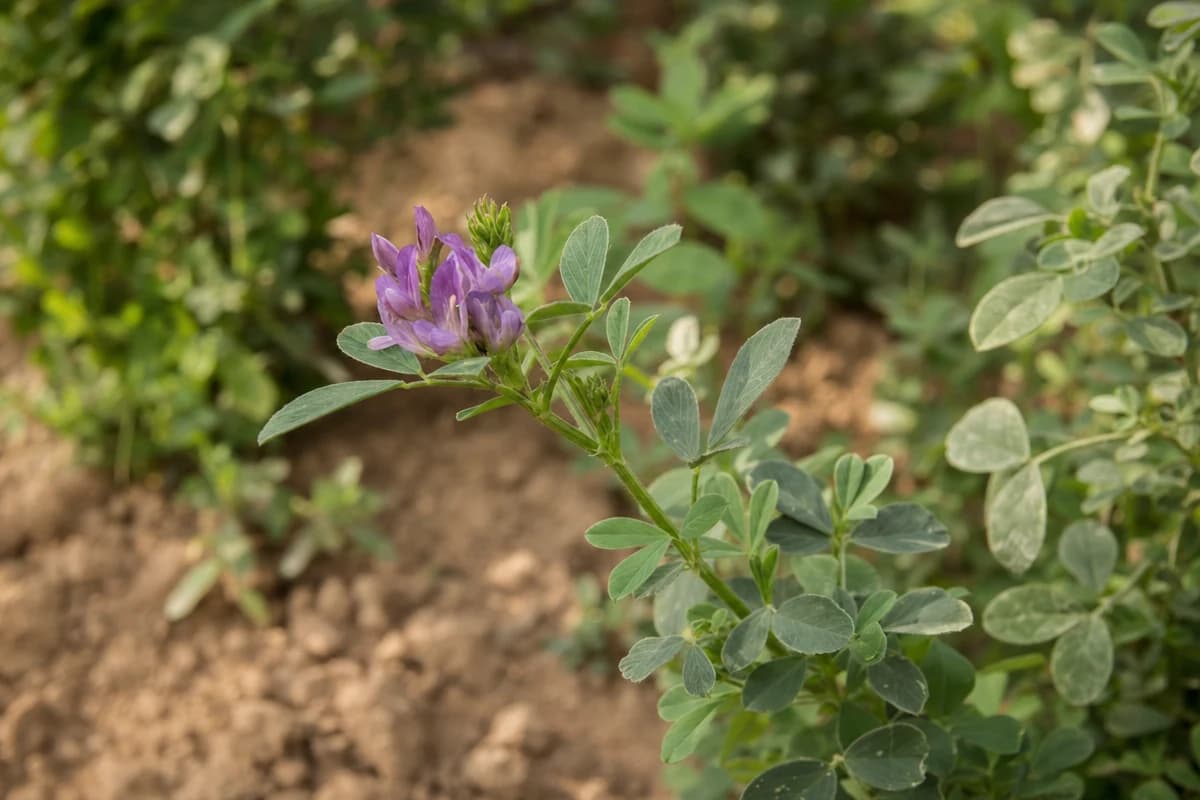
About This Plant
Alfalfa, also known as lucerne, is a perennial legume grown as a high-protein forage crop and as a fast microgreen or sprout. In Truleaf it is treated primarily as a microgreen: seed is broadcast densely, grown in shallow trays or floating hydroponics, and harvested young before flowering. Full-cycle alfalfa behaves differently because mature plants develop deep taproots, crown buds, and nitrogen-fixing Rhizobium nodules.
How to Grow Alfalfa
Learn how to grow Alfalfa from seed to harvest in 8 days. Beginner difficulty. Complete nutrient guide, pH/EC requirements, and growing conditions for hydroponics, soil & greenhouse.
Backed by 13 peer-reviewed citations.
Nutrient Requirements by Growth Stage
For alfalfa microgreens, use a dilute seedling solution early, then increase only if growing beyond the sprout stage. Seedling targets are N 50-110 ppm, P 8-16 ppm, and K 55-120 ppm; seed reserves can carry very short sprout cycles, but 14-21 day microgreens benefit from external nutrition…
Sign in to view nutrient requirements
A free account unlocks NPK targets for all four growth stages, micronutrient levels, a per-stage nutrient calculator, and the full nutrition guide. Signing up takes one click. Truleaf is a free, non-profit project, and every new account helps it grow. No spam, ever.
Growing Environments
Alfalfa microgreens are best suited to indoor rooms, vertical farms, heated greenhouses, and container or tray systems. The primary controlled study used a heated greenhouse and floating hydroponics, while broader microgreen literature supports indoor and greenhouse production for climate and sanitation control…
Temperature
Alfalfa microgreens germinate best near 20C, with direct floating-hydroponic trials using 20C and broader Medicago temperature work supporting an 18-22C germination window. Seedling growth is strongest in the cool microgreen range of about 17-22C, and 20C is the best practical set point for balancing speed, morphology, and disease risk. The previous 25C upper germination value is still survivable, but it sits above the optimum and increases moisture-disease pressure in dense trays.
Humidity
Maintain 60-70% relative humidity for tray alfalfa, with 65% as a practical target that supports germination while limiting damping-off and seed-surface mold. The alfalfa microgreen trial operated successfully in greenhouse conditions, while microgreen reviews place most production targets in the 50-70% range…
Light
Alfalfa microgreens need moderate light rather than fruiting-crop intensity. A 16-hour photoperiod with about 150-250 umol/m2/s PPFD supplies roughly 9-14 mol/m2/day DLI, matching the 12 mol/m2/day target used here…
Airflow
No alfalfa-specific airflow trial was found, so airflow guidance is extrapolated from microgreen disease management and dense-canopy production practice. Use gentle indirect circulation, about 0.2-0.6 m/s at canopy level, to prevent humidity stratification, support gas exchange, and reduce damping-off pressure…
Sign in to view environmental requirements
A free account unlocks exact temperature, humidity, light and airflow targets, including germination and growth ranges, DLI, photoperiod and PPFD, plus the full environment guide. Signing up takes one click. Truleaf is a free, non-profit project, and every new account helps it grow. No spam, ever.
Hydroponic System Compatibility
Floating hydroponics or DWC is the strongest fit because alfalfa microgreens were directly grown in perlite-filled floating containers over nutrient solution. Ebb-flow tray systems and NFT are compatible for short-cycle microgreens when sanitation and root cleanup are managed…
Growing Media
Perlite is the preferred medium because it was directly used for alfalfa microgreens in floating hydroponics. Vermiculite, coco coir, rockwool, and peat moss are also suitable microgreen media when clean, shallow, and well-drained…
Container Specs
Use shallow clean plastic microgreen trays or containers around 25-50 cm wide and at least 3 cm deep, with drainage or a mesh insert for bottom-watering. The alfalfa floating-hydroponic study used 0.5 x 0.3 m polystyrene containers filled with perlite, seeded at 300 g/m2…
Training & Support
Alfalfa needs no staking, trellising, pruning, topping, or structural training. Microgreens are harvested at 5-12 cm before any woody or vining structure develops…
Sign in to view system compatibility
A free account unlocks why each of the six systems fits or fails, plus growing media, container sizes, training methods, companion plants, and the full systems guide. Signing up takes one click. Truleaf is a free, non-profit project, and every new account helps it grow. No spam, ever.
Propagation
Alfalfa is propagated by seed for both microgreens and field stands. For microgreens, broadcast seed densely onto moist perlite or another clean medium and keep covered until emergence; the direct alfalfa microgreen trial used 300 g seed per m2 in perlite-filled floating containers at 20C and 60% RH…
Harvesting
Harvest microgreen alfalfa once at 7-10 days for tender cotyledon-stage greens, cutting just above the seed line with clean scissors. The controlled floating-hydroponic study harvested larger alfalfa microgreens 20 days after sowing and measured 0.85 kg/m2 fresh yield…
Planting Calendar
Alfalfa microgreens can be sown indoors every month because the crop cycle is independent of outdoor frost dates under controlled conditions. Use direct tray sowing only; there is no transplant step…
Common Issues
Tray alfalfa mainly suffers from damping-off, seed/media mold, uneven germination, leggy growth, and seed hull retention when moisture, light, and airflow are mismanaged. Full-cycle alfalfa adds classic field pests and diseases: alfalfa weevil and aphids are major insect threats, while anthracnose, Phytophthora root…
Get the full science-backed guide
By signing up, you help keep Truleaf free and support the growth of our nonprofit project. Your account unlocks full details for every plant issue—including symptoms, causes, step-by-step solutions, and prevention—plus the month-by-month planting calendar, the complete guide, and all research sources. It only takes one click. No spam, ever.