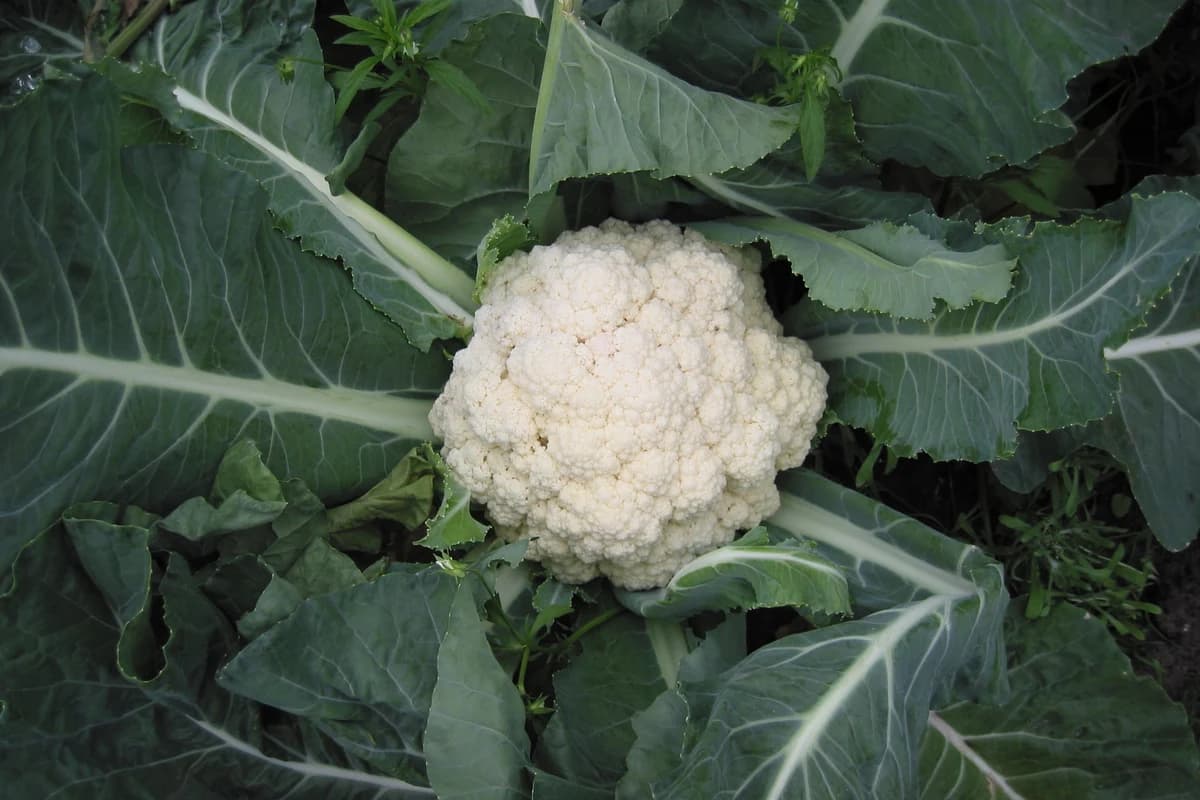
About This Plant
Cauliflower (Brassica oleracea var. botrytis) is a cool-season cole crop producing a dense, white edible curd of undeveloped flower buds. A heavy feeder with high nitrogen and potassium demands, it requires nutrient solution phasing through its 90-day seed-to-harvest cycle. Unlike broccoli, cauliflower does not produce side shoots and each plant yields only one head. Curd quality is highly temperature-sensitive: curds initiate at 10-15C and develop best at 15-18C, with heat above 25C causing ricing or buttoning. Boron and molybdenum are critical micronutrients; deficiency causes hollow stem and whiptail respectively. CO2 enrichment to 800 ppm increases assimilation rates 2.5-fold. White varieties require blanching by folding outer leaves over the curd to maintain color.
How to Grow Cauliflower
Learn how to grow Cauliflower from seed to harvest in 90 days. Intermediate difficulty. Complete nutrient guide, pH/EC requirements, and growing conditions for hydroponics, soil & greenhouse.
Sources cited: 25.
Nutrient Requirements by Growth Stage
Cauliflower is a heavy feeder with K-dominant nutrition. Total crop potassium demand (399 kg/ha) exceeds nitrogen (320 kg/ha)…
Sign in to view nutrient requirements
A free account unlocks NPK targets for all four growth stages, micronutrient levels, a per-stage nutrient calculator, and the full nutrition guide. Signing up takes one click. Truleaf is a free, non-profit project, and every new account helps it grow. No spam, ever.
Growing Environments
Cauliflower grows successfully in four environments. OUTDOOR: The primary growing environment, performing best in cool weather (15-20C)…
Temperature
Cauliflower is a cool-season crop with an optimal growing temperature of 18C (range 15-22C). Seeds germinate across a wide range of 10-27C, with 21-24C being optimal for rapid, uniform emergence. Curd initiation requires exposure to cool temperatures of 10-15C, which acts as a vernalization signal for the transition from vegetative to reproductive growth. Sustained heat above 25C during curd development causes ricing (loose, fuzzy curds) and premature bolting. Temperatures below 10C on young transplants can trigger buttoning (premature miniature heads). The narrow thermal window for quality curd development (15-18C) makes cauliflower the most temperature-sensitive of all Brassica oleracea crops, exceeding the sensitivity of broccoli, cabbage, and kale.
Humidity
Optimal relative humidity for cauliflower is 65%, within a range of 50-75%. Greenhouse production guides recommend 65-75% RH for firm, healthy curd development…
Light
Cauliflower requires a daily light integral (DLI) of 12-18 mol/m2/day, with 15 as a practical target for indoor systems. Recommended photoperiod is 14 hours for vegetative growth, though the plant tolerates 12-16 hours…
Airflow
Maintain air velocity of 0.3-0.8 m/s at crop height for disease prevention and calcium transport. Adequate air circulation is critical for cauliflower because it reduces leaf surface moisture that promotes downy mildew and Alternaria infections…
Sign in to view environmental requirements
A free account unlocks exact temperature, humidity, light and airflow targets, including germination and growth ranges, DLI, photoperiod and PPFD, plus the full environment guide. Signing up takes one click. Truleaf is a free, non-profit project, and every new account helps it grow. No spam, ever.
Hydroponic System Compatibility
Cauliflower is compatible with all major hydroponic systems. NFT (Nutrient Film Technique) has been validated in peer-reviewed research by Bianco et al…
Growing Media
Six growing media are suitable for cauliflower in hydroponic and container systems. Coco coir is preferred for mature plants due to its excellent balance of water retention and aeration, and is commonly used in drip and ebb-flow systems…
Container Specs
Cauliflower requires a minimum container depth of 30 cm (12 in) and width of 30 cm (12 in) for compact varieties, with larger varieties benefiting from 40-46 cm containers. Container volume should be at least 19 liters (5 gallons) to provide adequate root space and moisture buffering for the 90-day crop cycle…
Training & Support
Cauliflower requires no staking, trellising, or structural support. Plants are compact, low-growing brassicas reaching 45-60 cm height that support their own weight without assistance…
Sign in to view system compatibility
A free account unlocks why each of the six systems fits or fails, plus growing media, container sizes, training methods, companion plants, and the full systems guide. Signing up takes one click. Truleaf is a free, non-profit project, and every new account helps it grow. No spam, ever.
Propagation
Cauliflower is propagated exclusively by seed. Seeds germinate in 5-10 days at 21-24C optimal soil temperature, with viable germination across 10-27C…
Harvesting
Harvest cauliflower when the curd reaches 15-30 cm in diameter and is still compact, firm, and uniformly white, before individual florets begin to separate or develop a ricey texture. Cut the main head with a sharp knife, leaving several wrapper leaves attached to protect the curd during handling…
Planting Calendar
Cauliflower has two main planting windows in temperate climates. SPRING: Sow indoors January through March (6-10 weeks before last frost), transplant March through May (2-3 weeks before last frost)…
Common Issues
Cauliflower faces 10 significant issues spanning physiological disorders, diseases, and pests. PHYSIOLOGICAL: Buttoning (premature miniature heads from cold/stress), ricing (fuzzy curds from heat >25C), hollow stem (boron deficiency), and tip burn (localized calcium deficiency under high humidity) are the four main…
Get the full science-backed guide
By signing up, you help keep Truleaf free and support the growth of our nonprofit project. Your account unlocks full details for every plant issue—including symptoms, causes, step-by-step solutions, and prevention—plus the month-by-month planting calendar, the complete guide, and all research sources. It only takes one click. No spam, ever.