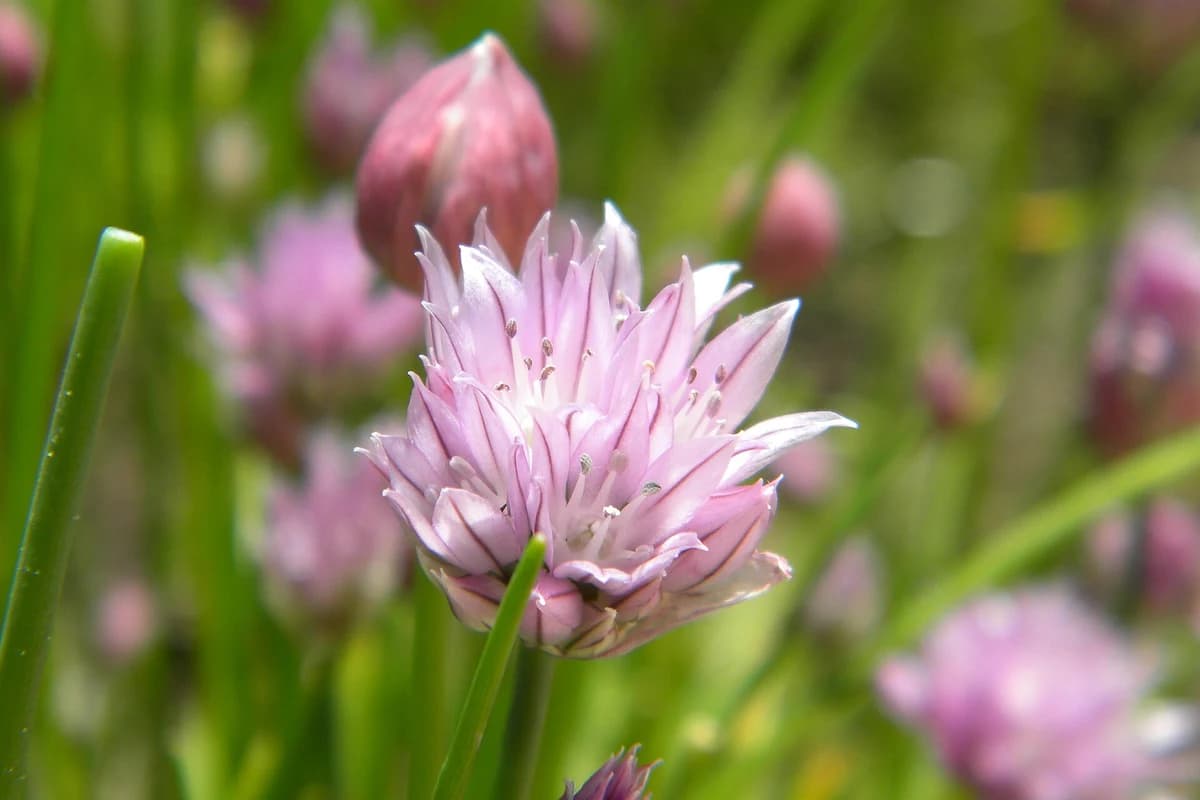
About This Plant
Chive Blossom (Allium schoenoprasum) is the edible purple flower of common chives, a cold-hardy perennial Allium grown for hollow leaves and mild onion-flavored blooms. It suits containers, outdoor beds, and low-EC hydroponic herb systems, with flowers harvested young for garnishes, salads, vinegars, and pollinator-friendly edible borders.
How to Grow Chive Blossom
Learn how to grow Chive Blossom from seed to harvest in 60 days. Beginner difficulty. Complete nutrient guide, pH/EC requirements, and growing conditions for hydroponics, soil & greenhouse.
Sources cited: 11.
Nutrient Requirements by Growth Stage
Treat chive blossoms as a moderate leafy herb, not a heavy bulbing onion. The chive-specific hydroponic EC study found increasing EC from 1 to 5 dS/m linearly reduced fresh mass and nutrient-solution use efficiency, with maximum yield at 1 dS/m…
Sign in to view nutrient requirements
A free account unlocks NPK targets for all four growth stages, micronutrient levels, a per-stage nutrient calculator, and the full nutrition guide. Signing up takes one click. Truleaf is a free, non-profit project, and every new account helps it grow. No spam, ever.
Growing Environments
Chive blossoms fit outdoor beds, greenhouse herb benches, containers, and indoor bright-window or hydroponic culture. Extension sources describe chives as full-sun to part-shade perennials that grow well in containers and indoors, while the hydroponic study demonstrates production in a protected hydroponic system to…
Temperature
Chives are cool-season, cold-tolerant perennial Alliums, but productive protected culture should stay mild rather than hot. Keep germination and establishment near 18-24C, then target about 18-24C for leaf and flower-stem growth; growth can continue outdoors in cooler spring weather, but heat and drought consistently reduce tender leaf quality.
Humidity
Use moderate humidity and fast leaf drying. A 50-70% RH band supports tender leaves without creating persistent wet canopies; high humidity plus leaf wetness is the major risk because downy mildew sporulates in very humid Allium canopies and infects leaves, seed stalks, and flower parts…
Light
Grow chive blossoms in full sun outdoors or a bright indoor location. NC State lists full sun to partial shade, and UMN notes indoor chives need bright sun and slow down in poor winter light…
Airflow
No chive-specific airflow trial was found, so airflow is managed from disease biology and dense-clump habit. Provide gentle continuous air movement around 0.3-1.0 m/s to avoid stagnant humidity in hollow-leaf clumps, dry foliage after irrigation, and reduce downy mildew risk…
Sign in to view environmental requirements
A free account unlocks exact temperature, humidity, light and airflow targets, including germination and growth ranges, DLI, photoperiod and PPFD, plus the full environment guide. Signing up takes one click. Truleaf is a free, non-profit project, and every new account helps it grow. No spam, ever.
Hydroponic System Compatibility
Hydroponic chive production is supported directly by the EC study, so DWC or DFT-style raft systems, drip substrate systems, ebb-flow benches, and NFT can all be used when crowns stay aerated and root mats are managed. Mature perennial clumps form dense roots, so NFT and passive Kratky are better for short cycles or…
Growing Media
Use moist, fertile, well-drained media. UMN recommends soil enriched with organic matter outdoors and a light, well-drained houseplant mix indoors; USU likewise emphasizes rich, moist, fertile, well-drained soils…
Container Specs
Containers are appropriate for chive blossoms, but drainage is non-negotiable. Use at least 20 cm depth for small herb pots and about 20-30 cm width per clump, matching extension spacing of 6-12 inches between plants…
Training & Support
No structural support is needed. Chive blossoms are upright clumping perennials with hollow leaves and scapes, so management consists of harvest pruning, flower-stalk removal when seed is not wanted, and periodic division…
Sign in to view system compatibility
A free account unlocks why each of the six systems fits or fails, plus growing media, container sizes, training methods, companion plants, and the full systems guide. Signing up takes one click. Truleaf is a free, non-profit project, and every new account helps it grow. No spam, ever.
Propagation
Propagate chive blossoms from seed or, more reliably, by division. UMN calls rooted spring clumps the easiest and most successful method, and Illinois recommends division every two to three years to prevent overcrowding…
Harvesting
Harvest leaves as a cut-and-come-again herb and pick blossoms shortly after opening for edible garnish use. USU supports harvest as early as 60 days from seeding or 30 days from transplanting, cutting leaves back to 1-2 inches above soil…
Planting Calendar
For temperate outdoor production, sow or divide in early spring, transplant rooted clumps after frost, and harvest from late spring through fall. Chives generally flower in May and June, with NC State noting April-May blooms and UMN noting late May or June in Minnesota…
Common Issues
The original issue list was too narrow. In hydroponics, high EC reduces fresh mass, while stagnant wet roots can trigger decline, so keep solution strength low and oxygen high…
Get the full science-backed guide
By signing up, you help keep Truleaf free and support the growth of our nonprofit project. Your account unlocks full details for every plant issue—including symptoms, causes, step-by-step solutions, and prevention—plus the month-by-month planting calendar, the complete guide, and all research sources. It only takes one click. No spam, ever.