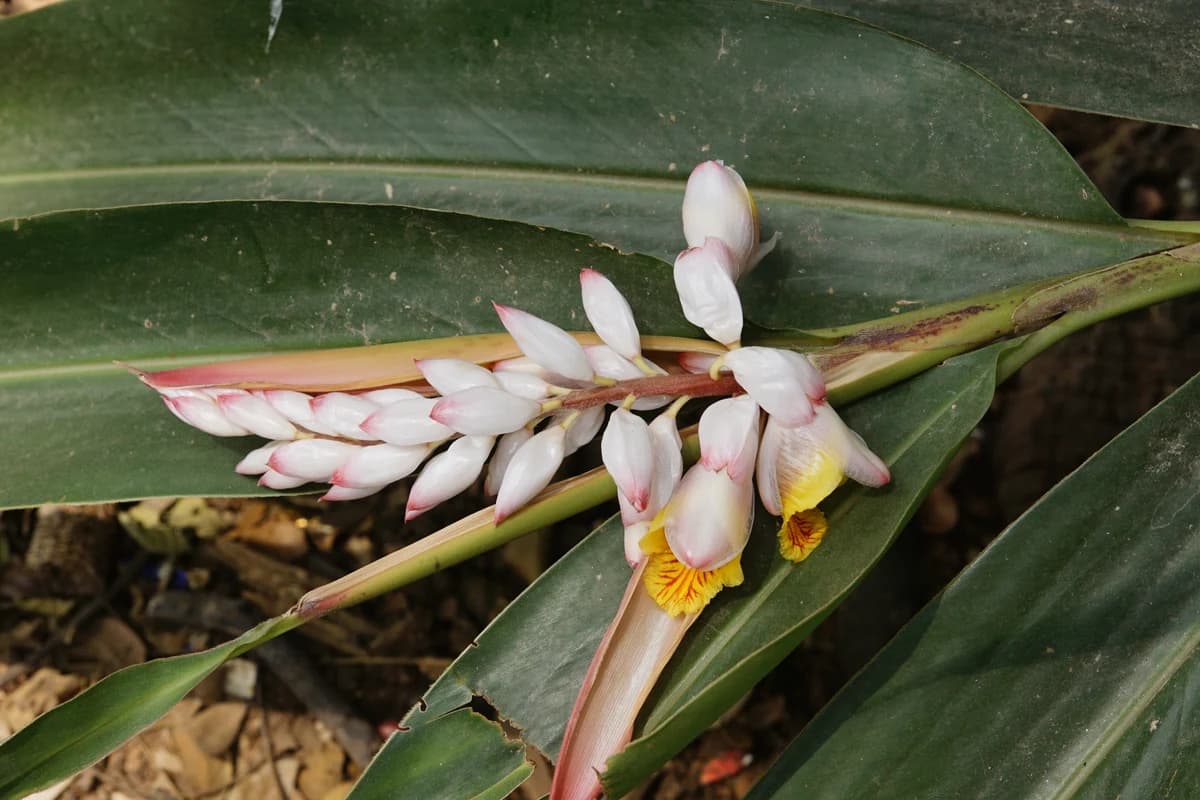
About This Plant
Galangal is a tropical, rhizomatous perennial herb in the ginger family grown for aromatic rhizomes used as a Southeast Asian spice and medicinal plant. It prefers humid tropical conditions, fertile well-drained soil, and propagation from healthy rhizome pieces rather than seed.
How to Grow Galangal
Learn how to grow Galangal from seed to harvest in 365 days. Intermediate difficulty. Complete nutrient guide, pH/EC requirements, and growing conditions for soil & container.
Sources cited: 9.
Nutrient Requirements by Growth Stage
Galangal-specific nutrition evidence is field-rate, not hydroponic ppm. Joy et al…
Sign in to view nutrient requirements
A free account unlocks NPK targets for all four growth stages, micronutrient levels, a per-stage nutrient calculator, and the full nutrition guide. Signing up takes one click. Truleaf is a free, non-profit project, and every new account helps it grow. No spam, ever.
Growing Environments
Galangal can grow outdoors in humid tropical or subtropical climates, in greenhouses, and in large drained containers. NMPB says it is successfully cultivated on sandy loam in humid tropical climate and can be grown up to 1000 m with irrigation…
Temperature
Galangal is a tropical rhizome crop and should be kept warm from sprouting through rhizome expansion. In vitro plantlets grew best across 20-35C, with dry biomass and ACA content strongest around 30C. Field manuals also place the crop in humid tropical production rather than cool temperate culture. Treat 20C as the lower active-growth threshold, protect containers from cool nights, and use 30C as the warm greenhouse target when humidity and drainage are controlled.
Humidity
Use humid tropical conditions, but do not solve humidity by waterlogging the rhizome zone. NMPB describes successful cultivation in humid tropical climate, while PROSEA specifies fertile, moist but not swampy soil…
Light
Galangal tolerates a broad light window. PROSEA lists sunny or moderately shady locations, and NMPB says open sunny areas work where rainfall or irrigation is sufficient…
Airflow
No galangal-specific airflow speed trial was found, so airflow is managed as disease prevention rather than a yield prescription. The crop likes humid conditions, but NMPB reports Colletotrichum leaf spots and PROSEA warns against swampy soils…
Sign in to view environmental requirements
A free account unlocks exact temperature, humidity, light and airflow targets, including germination and growth ranges, DLI, photoperiod and PPFD, plus the full environment guide. Signing up takes one click. Truleaf is a free, non-profit project, and every new account helps it grow. No spam, ever.
Hydroponic System Compatibility
The evidence supports soil beds, raised rows, and drained substrate culture rather than bare-water hydroponics. Galangal rhizomes need volume, support, organic matter, and drainage; PROSEA explicitly warns that rhizomes do not develop under waterlogged conditions…
Growing Media
Use fertile, organic-rich media that hold moisture but drain quickly. NMPB specifies sandy loam under humid tropical conditions and uses FYM, humus, or vermicompost as amendments…
Container Specs
No complete academic or government source gave a galangal pot-size trial, so container dimensions are extrapolated from rhizome habit and field spacing. NMPB uses 35 x 35 cm holes, 15-20 cm deep, and 30 x 30 cm to 45 x 45 cm field spacing…
Training & Support
Galangal does not need trellising, caging, or staking. Its management is rhizome-zone care: hoeing, weeding, and earthing-up during early growth…
Sign in to view system compatibility
A free account unlocks why each of the six systems fits or fails, plus growing media, container sizes, training methods, companion plants, and the full systems guide. Signing up takes one click. Truleaf is a free, non-profit project, and every new account helps it grow. No spam, ever.
Propagation
Propagate galangal vegetatively from rhizomes. JIRCAS recommends dividing older rhizomes into 5-10 cm pieces, each with at least two undamaged terminal buds…
Harvesting
Harvest timing depends on the product. For market spice use, PROSEA notes good-quality rhizomes can be harvested around 3 months, but older rhizomes become more fibrous after about 4 months…
Planting Calendar
In north-eastern Indian hill conditions, NMPB plants from February to mid-April; elsewhere in India, monsoon planting is appropriate. Rhizomes sprout in about 15-20 days, with hoeing around 45 and 60 days and manual weeding around 60, 90, and 120 days…
Common Issues
The main verified risks are soil and rhizome diseases. Recent work identifies bacterial wilt caused by Ralstonia solanacearum as a serious Alpinia galanga disease, with infection through roots and vascular blockage leading to wilt…
Get the full science-backed guide
By signing up, you help keep Truleaf free and support the growth of our nonprofit project. Your account unlocks full details for every plant issue—including symptoms, causes, step-by-step solutions, and prevention—plus the month-by-month planting calendar, the complete guide, and all research sources. It only takes one click. No spam, ever.