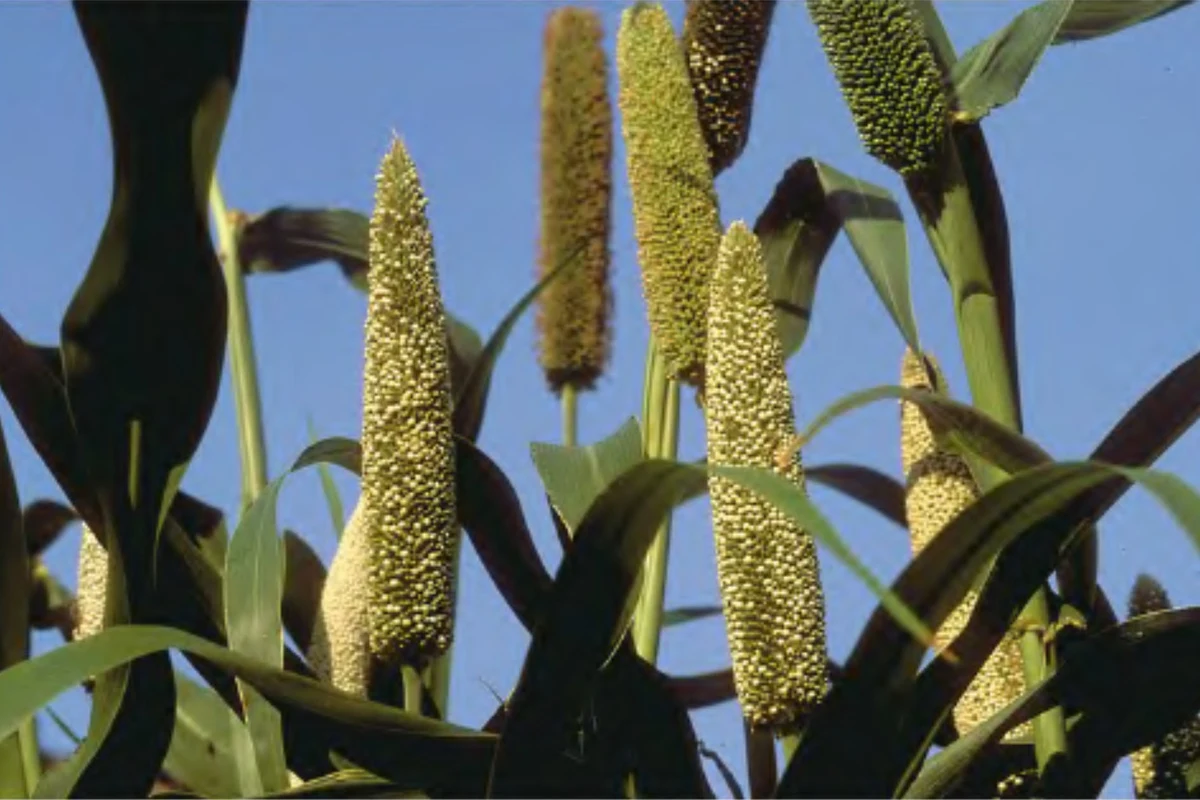
About This Plant
Pearl millet (Pennisetum glaucum) is a warm-season C4 cereal grain in the Poaceae family, widely cultivated in semi-arid tropics of Africa and India. One of the most drought-tolerant grains in production, it thrives in sandy soils and tolerates pH 4-8. Plants reach 150-300 cm tall with roots exceeding 120 cm depth. Quick-maturing varieties produce grain in 80-85 days, yielding 15-57 g per plant. Grain is high in protein (9-21%), iron, and zinc. Requires high light intensity (DLI 30-45 mol/m2/d). For soilless cultivation, drip irrigation or DWC systems are recommended. Peak nitrogen demand occurs during vegetative growth. Aquaponic trials confirm viable grain production in recirculating systems.
How to Grow Millet
Learn how to grow Millet from seed to harvest in 85 days. Intermediate difficulty. Planting, care, feeding and the right growing conditions.
Sources cited: 36.
Nutrient Requirements by Growth Stage
Pearl millet follows a front-loaded nitrogen uptake pattern: 79-100% of total N is absorbed before flowering [ref-20]. Peak demand of 188 ppm N occurs during vegetative/tillering growth (26 days)…
Sign in to view nutrient requirements
A free account unlocks NPK targets for all four growth stages, micronutrient levels, a per-stage nutrient calculator, and the full nutrition guide. Signing up takes one click. Truleaf is a free, non-profit project, and every new account helps it grow. No spam, ever.
Growing Environments
Outdoor cultivation is ideal — pearl millet evolved for semi-arid open-field conditions and handles heat, drought, and poor soils better than most cereals [ref-2]. Greenhouse growing is effective for season extension and research, maintaining 25-35C with adequate ventilation; ICRISAT and speed breeding programs use…
Temperature
Pearl millet is a heat-loving C4 cereal thriving in warm conditions. Optimal germination occurs at 20-26C with soil temperature of at least 20C required for reliable emergence; below this, germination is significantly delayed [ref-2]. The species can germinate across 15-40C, though supra-optimal temperatures cause radicle damage [ref-9]. Cardinal germination temperatures: base 7.7C, optimum 38.9C, ceiling 46.0C [ref-9]. Optimal vegetative growth occurs at 33-35C, with a productive range of 25-35C [ref-2]. Pearl millet maintains growth even at 38C day temperatures where maize declines [ref-6]. Minimum growth temperature is 12C; the plant does not survive frost. For controlled environments, maintain 25-35C with nighttime minimum of 15C.
Humidity
Pearl millet is adapted to semi-arid climates and performs best at moderate humidity of 40-65% RH. ICRISAT field trials documented productive growth from 32% RH in dry seasons to 82% RH in rainy seasons [ref-6]…
Light
As a C4 photosynthesis crop, pearl millet has very high light requirements. Full sun is essential…
Airflow
Pearl millet naturally grows in the open, windy Sahel region and benefits from moderate to high airflow. Good air circulation serves three critical functions: (1) disease prevention — stagnant humid air promotes ergot and downy mildew [ref-16]; (2) pollination — pearl millet is wind-pollinated, so airflow is essential…
Sign in to view environmental requirements
A free account unlocks exact temperature, humidity, light and airflow targets, including germination and growth ranges, DLI, photoperiod and PPFD, plus the full environment guide. Signing up takes one click. Truleaf is a free, non-profit project, and every new account helps it grow. No spam, ever.
Hydroponic System Compatibility
Pearl millet's extensive fibrous root system and tall growth habit (1-2 m) constrain hydroponic options. Drip irrigation is the best hydroponic approach, widely used in field fertigation and adaptable to container systems with inert media [ref-2]…
Growing Media
Pearl millet is best adapted to sandy or light loam soils with excellent drainage — it does not tolerate waterlogging [ref-2]. Optimal soil pH is 6.0-7.0, with tolerance up to 8.0…
Container Specs
Use containers at least 30 cm deep x 30 cm wide (5-gallon / 19 L minimum) to accommodate pearl millet's vigorous fibrous root system. Drainage is essential — provide 4-6 holes and use well-draining potting mix with perlite or coarse sand [ref-2]…
Training & Support
Pearl millet is a self-supporting upright bunchgrass that requires no training or support under normal growing conditions [ref-12][ref-2]. The plant develops sturdy, erect stems capable of supporting its own weight at heights of 120-300 cm [ref-13][ref-14]…
Sign in to view system compatibility
A free account unlocks why each of the six systems fits or fails, plus growing media, container sizes, training methods, companion plants, and the full systems guide. Signing up takes one click. Truleaf is a free, non-profit project, and every new account helps it grow. No spam, ever.
Propagation
Pearl millet is an annual warm-season grass propagated exclusively by seed [ref-2]. Propagation difficulty is easy — seeds germinate rapidly (~5 days at optimal soil temperature >20C) and seedlings establish vigorously [ref-2][ref-10]…
Harvesting
Pearl millet panicles reach maturity ~40 days after flowering when grain moisture drops to 15-18% [ref-4]. For grain, harvest when seeds are firm and brown…
Planting Calendar
Pearl millet is a frost-sensitive warm-season annual requiring warm soil for establishment [ref-2][ref-13]. Sow indoors March-April (6-8 weeks before last frost) [ref-11]…
Common Issues
The most economically significant diseases are downy mildew (Sclerospora graminicola — the #1 disease worldwide), ergot (Claviceps fusiformis — devastating at flowering), blast (Magnaporthe grisea — up to 80% yield loss), rust (Puccinia substriata var. indica), and smut (Moesziomyces penicillariae) — all managed…
Get the full science-backed guide
By signing up, you help keep Truleaf free and support the growth of our nonprofit project. Your account unlocks full details for every plant issue—including symptoms, causes, step-by-step solutions, and prevention—plus the month-by-month planting calendar, the complete guide, and all research sources. It only takes one click. No spam, ever.