Loading plant details...
33 sources used for this plant profile
Boote, K.J. (1982). “Growth Stages of Peanut (Arachis hypogaea L.).” Peanut Science.
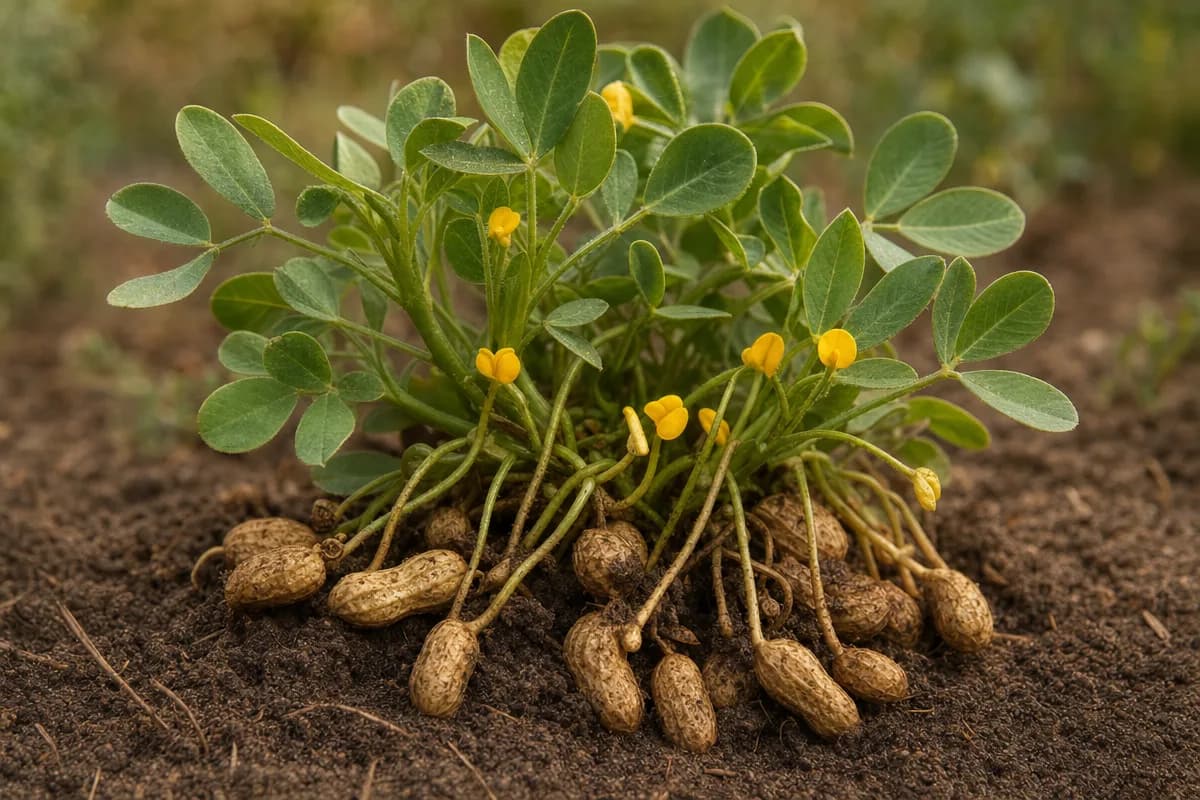
Peanut (Arachis hypogaea) is a warm-season annual legume in the Fabaceae family, unique among crops for developing its fruit underground. After pollination, flower stalks called pegs curve downward and penetrate the soil where pods mature. Native to South America, peanuts thrive in loose, sandy, well-drained soils with full sun. They fix atmospheric nitrogen through symbiosis with Bradyrhizobium bacteria via a distinctive crack-entry root invasion mechanism. Four main market types exist: Valencia (fastest, 95-120 days), Spanish (120 days), Runner (130-150 days), and Virginia (130-150 days). Requires 120-150 frost-free days and soil temperatures above 18°C for germination.
Temperature: 15-35°C (optimal 28°C). Humidity: 50-85% (optimal 70%). Light DLI: 22 mol/m²/day. Photoperiod: 12h.
Hydroponic System Compatibility:
DWC: Suitable. Verified by NASA CELSS research. Slotted tray covers allow peg penetration into dark root zone. Yields 350 g/m² dry seed mass with or without sphagnum substrate. Strong aeration required for the 120-160 day crop cycle.
NFT: Suitable. Verified by NASA/Tuskegee NFT studies. Channel depth must accommodate peg growth into dark zone. High humidity (85% RH) significantly improves yield. Peg penetration slots in tray covers are essential.
Ebb and Flow: Suitable. Suitable with deep containers and loose media (perlite, vermiculite, sand) allowing peg penetration. Flood cycles must not disturb developing pegs or pods. No direct peanut ebb-flow trials found.
Drip: Suitable. Suitable with deep containers and loose, well-drained media. Similar to automated container growing with fertigation. Provides good control over moisture and nutrient delivery to the pegging zone.
Kratky: Not suitable. Not recommended. 120-160 day crop cycle exceeds practical Kratky limits. Static solution lacks oxygen for extensive root system over this duration. Peg zone management is difficult in stagnant solution.
Aeroponics: Not suitable. Not suitable. Pegs require physical contact and darkness to trigger pod formation. Mist chambers lack substrate for peg penetration. Geocarpy is incompatible with aeroponic root suspension.
Common Issues:
Early Leaf Spot (Passalora arachidicola)
Symptoms: Circular brown to dark-brown lesions surrounded by a yellow halo on leaves. Silvery-gray spore tufts visible on upper leaf surface with hand lens
Causes: Fungal pathogen Passalora arachidicola favored by warm temperatures (25-30°C) and prolonged leaf wetness. Spores spread by wind and rain splash
Solutions: Apply foliar fungicides beginning 35-55 days after planting on 14-day intervals. Use moderately resistant cultivars such as Georgia 06G or Georgia 16HO. Rotate fungicide modes of action to prevent resistance
Prevention: Rotate peanuts with non-host crops on a 3-year cycle. Avoid overhead irrigation that prolongs leaf wetness. Plant resistant or tolerant cultivars. Remove and destroy crop debris after harvest
Late Leaf Spot (Notholopassalora personata)
Symptoms: Circular dark-brown to black lesions without yellow halo. Sporulation (dark tufts) visible on lower leaf surface; severe infections cause heavy defoliation
Causes: Fungal pathogen Notholopassalora personata thriving in warm humid conditions. Spread by windborne conidia; more destructive than early leaf spot in wet seasons
Solutions: Apply fungicide blocks of 3-4 mid-season sprays on 14-day intervals starting at row closure (60-70 DAP). Use resistant cultivars such as AUNPL-17. Scout regularly to time applications
Prevention: Implement minimum 3-year crop rotation away from peanut. Bury crop residue through deep tillage to reduce inoculum. Plant moderately resistant cultivars. Begin fungicide programs before symptoms appear
Southern Blight (Athelia rolfsii)
Symptoms: Sudden wilting with collapsed leaves. White fan-like mycelial mat at stem base giving a whitewashed appearance. Small reddish-brown to tan sclerotia near soil line
Causes: Soilborne fungus Athelia rolfsii favored by high temperatures, moist soil, and dense canopy. Sclerotia persist in soil for years
Solutions: Apply fungicides at 60 days after planting or canopy closure targeting lower canopy. Deep plowing to bury sclerotia below 10 cm. Apply gypsum at pegging to reduce severity
Prevention: Rotate with corn or sorghum (avoid soybean) for at least 2-3 years. Avoid excessive plant density that creates humid microclimate. Use deep tillage to bury crop debris and sclerotia. Control foliar diseases to maintain plant vigor
Sclerotinia Blight (Sclerotinia minor)
Symptoms: Stem wilting and flagging with curled leaves. White cottony fluffy hyphae on stems near ground line. Black pepper-like sclerotia in shredded stem tissue; rapid plant death
Causes: Soilborne fungus Sclerotinia minor favored by cool nights (below 25°C) and wet conditions. Sclerotia viable in soil for several years
Solutions: Apply fungicide programs beginning in August targeting lower canopy. Iprodione (Rovral) is an effective labeled product. Deep burial of crop residue through moldboard plowing
Prevention: Use minimum 3-year crop rotation avoiding soybean and other susceptible hosts. Sanitize harvesting equipment between fields. Plant early to allow canopy closure before cool wet weather. Select tolerant cultivars when available (e.g. Tamspan 90)
Aflatoxin Contamination (Aspergillus flavus)
Symptoms: Black fluffy fungal growth near soil line (A. niger). Ring of black spores at crown; kernel discoloration. No visible field symptoms for internal aflatoxin contamination until post-harvest testing
Causes: Aspergillus flavus and A. niger infect pods and kernels. Strongly favored by drought stress and high soil temperatures (>30°C) during pod fill. Insect damage to pods creates entry points
Solutions: Harvest promptly at maturity to minimize soil exposure. Dry kernels rapidly to below 10% moisture. Apply biocontrol products containing atoxigenic A. flavus strains (e.g. Afla-Guard). Avoid late planting
Prevention: Irrigate to prevent drought stress during pod development. Control pod-feeding insects (lesser cornstalk borer) that create infection sites. Maintain good crop rotation to reduce soilborne inoculum. Use proper post-harvest drying and storage at 10-15°C, 65-70% RH
Tomato Spotted Wilt Virus (TSWV)
Symptoms: Ring spots and mottling on leaves; plant stunting and yellowing. Wilting and rapid plant death in severe cases. Chlorotic rings, deformed pegs, corky pods, and discolored seed coat
Causes: Tomato spotted wilt virus transmitted by thrips (Frankliniella fusca, F. occidentalis). Most transmission occurs in spring during early growth; thrips acquire virus as larvae
Solutions: Plant resistant cultivars (Georgia-06G, Georgia Runner, Southern Runner). Use in-furrow phorate insecticide to suppress thrips and reduce transmission. Increase plant density for faster canopy closure
Prevention: Avoid early planting (before May 10) which increases exposure to spring thrips flights. Use twin-row planting patterns for faster ground coverage. Adopt reduced tillage to suppress thrips populations with crop residue. Avoid planting adjacent to other TSWV-susceptible crops (tomato, pepper, tobacco)
Pod Rot (Pythium spp. / Rhizoctonia solani)
Symptoms: Greasy brown-to-black soft lesions on pods (Pythium). Dry firm brown lesions on pods (Rhizoctonia); reduced pod fill and kernel quality. Root decay with sloughed outer layers
Causes: Soilborne Pythium species and Rhizoctonia solani. Exacerbated by excessive irrigation, poor drainage, low soil calcium, and prolonged pod exposure
Solutions: Apply gypsum (calcium sulfate) at pegging to strengthen pod walls. Improve field drainage; apply appropriate fungicides. Avoid overwatering especially in furrow-irrigated fields
Prevention: Rotate with grass crops (corn, sorghum, small grains) to reduce pathogen buildup. Ensure adequate calcium nutrition through gypsum application. Avoid excessive irrigation during pod development. Harvest promptly at maturity to reduce pod exposure to pathogens
Thrips (Frankliniella fusca / F. occidentalis)
Symptoms: Silvery or bronzed feeding scars on young leaves; plant stunting. Distorted terminal growth. Vector of Tomato Spotted Wilt Virus which causes greater economic damage than direct feeding
Causes: Tiny piercing-sucking insects; F. fusca (tobacco thrips) is primary vector in Southeast US. Populations peak in spring; prefer fields with bare soil and no crop residue
Solutions: Apply in-furrow insecticides (phorate or acephate) at planting. Use reduced tillage with crop residue to suppress thrips. Phorate also induces plant defense responses against TSWV
Prevention: Maintain crop residue on soil surface through conservation tillage. Plant at recommended dates to avoid peak thrips flights. Use twin-row patterns for faster canopy closure. Select TSWV-resistant cultivars to reduce economic impact of thrips-vectored virus
Lesser Cornstalk Borer (Elasmopalpus lignosellus)
Symptoms: Wilting plants with damaged crowns; larvae bore into stems, pegs, and developing pods. Stunted and deformed plants; plant death and thin stands in severely infested areas
Causes: Larvae of pyralid moth; most damaging in dry conditions on sandy soils. Drought stress predisposes plants; larval boring creates entry points for Aspergillus
Solutions: Apply granular insecticide (chlorpyrifos) in seed furrow or banded over row. Irrigate to maintain soil moisture which suppresses egg-laying and larval survival. Direct liquid insecticides to root zone
Prevention: Irrigate frequently to keep soil moist — dry sandy soils favor infestations. Practice clean cultivation and destroy weeds before planting to eliminate larval hosts. Plant early to establish vigorous stands before peak moth activity. Use conservation tillage with surface residue to deter egg-laying
Southern Corn Rootworm (Diabrotica undecimpunctata)
Symptoms: Larvae feed on roots and pods causing irregular scarring. Injured pods range from match-head to nearly full-size; damaged pods rot before harvest
Causes: Beetle larvae (spotted cucumber beetle adults) in soil. Favored by moist heavy soils and irrigated fields; sporadic pest
Solutions: Apply granular chlorpyrifos banded over the row as preventive treatment. Scout by pulling plants and examining roots/pods; sift soil to locate larvae
Prevention: Scout fields with history of SCR problems regularly. Monitor for adult spotted cucumber beetles as indicator of larval risk. Rotate crops to break pest cycle. Apply preventive soil insecticides in fields with known infestation history
temperature: Peanut is a warm-season crop demanding consistent heat throughout its 120-160 day cycle. Soil temperature must reach 18°C for germination, with the optimum at 29-30°C [3][15]. Growth ceases below 15°C and is inhibited above 35°C [23]. NASA NFT studies used a 28/22°C day/night regime as the productive standard [3][4]. The best commercial yields occur at monthly means of 22-27°C [23]. Speed breeding programs maintained 28-32°C daytime with a 20°C minimum [10]. For controlled-environment production, target 25-30°C daytime and 20-22°C nighttime. Peanut is frost-sensitive — even brief near-freezing exposure is lethal. CO2 enrichment to 800 ppm increased seed yield by 33%, though this benefit diminishes above 35°C [8][9].
Field production guides cite 22-27°C monthly mean as the optimal band for commercial yield. Container and indoor growers should prioritize maintaining 25+°C for the entire cycle.
humidity: Peanut benefits from moderately high humidity. NASA NFT research demonstrated that 85% RH significantly outperformed 50% RH, producing greater leaf area, higher stomatal conductance, earlier flowering by three days, and increased pod yield [4]. For practical indoor and greenhouse production, target 65-80% RH during vegetative and reproductive stages. Speed breeding programs maintained approximately 65% RH [10]. Below 50% RH, growth and flowering are significantly reduced. Monitor for foliar disease at the upper range and ensure adequate airflow to prevent persistent leaf wetness, as peanut's dense canopy can trap moisture and promote fungal infections such as leaf spot and southern blight [20][21].
In arid climates or dry indoor environments, supplemental humidity may be needed. Below 50% RH, growth and flowering are significantly reduced.
light: Peanut requires high light intensity and responds strongly to photoperiod for reproductive development. NASA studies used 500 µmol/m²/s PPFD with a 12-hour photoperiod as the standard [3][4]. Low irradiance (300 µmol/m²/s) produced equivalent leaf counts but reduced flowering, pegging, and seed yield [4]. Critically, short days (12 hours) doubled flower and peg counts compared to long days (16 hours), though longer photoperiods increased vegetative biomass [7][4]. Peanut does not photosaturate below full sunlight intensity. For optimal pod yield in controlled environments, provide 400-500 µmol/m²/s PPFD at a 12-hour photoperiod, delivering a DLI of approximately 17-22 mol/m²/d. Outdoors, full sun with at least six hours direct light is essential [15].
If maximizing vegetative biomass (e.g. for forage), longer photoperiods up to 16 h are acceptable, but pod yield will be reduced.
airflow: Provide gentle, continuous canopy airflow to manage the high humidity (65-85% RH) that peanut prefers. Target 0.3-0.8 m/s air movement at canopy level to prevent condensation on foliage, reduce foliar disease risk from leaf spot and southern blight, and ensure adequate CO2 mixing [20][21]. Peanut's dense canopy, which closes by 60 days after planting, creates a humid microclimate favorable to soilborne pathogens. Indoor crops require oscillating fans positioned to move air across the canopy without causing excessive transpiration stress. Outdoor and greenhouse crops rely on natural ventilation supplemented by open sidewalls or ridge vents during warm weather.
nutrition: Peanut has a unique nutritional profile driven by nitrogen fixation and geocarpic fruiting. In soil with Bradyrhizobium inoculant, 60-66% of nitrogen comes from biological fixation and supplemental N is unnecessary [1][6][18]. In hydroponic systems where Rhizobium symbiosis is absent, full nitrogen must be supplied at 80-120 ppm [3][4]. The NASA modified half-Hoagland solution (EC 1.1-1.2 mS/cm, pH 6.4-6.7, N:K ratio 1:2.4) achieved 350 g/m² dry seed yield [3]. Calcium is uniquely critical — pods absorb Ca directly through pegs from surrounding media, not via root translocation [5]. Over 90% of pod calcium is absorbed during a 15-35 day window after pegging [5]. Maintain 180-280 ppm Ca in the pegging zone during pod fill [4][5]. Potassium is the second most absorbed nutrient, with modern cultivars requiring 65% more K than older varieties [1]. Excess K in the pegging zone inhibits Ca uptake, so maintain a Ca:K ratio of at least 3:1 [28][30]. Boron prevents hollow heart deficiency and molybdenum is essential for the nitrogenase enzyme in nitrogen fixation [17][18].
Advanced hydroponic growers can experiment with Bradyrhizobium inoculants in soilless media to reduce N input. Reduce solution N to 50-80 ppm after nodulation onset (~21 DAE) if inoculating, but this approach is experimental in soilless systems.
propagation: Peanuts are propagated exclusively by seed. Remove kernels from shells carefully, preserving the thin colored testa, and pre-soak for 12 hours in warm water to accelerate germination [27]. Germination occurs within 7-14 days at 21-28°C [15][27]. For optimal nitrogen fixation, inoculate seeds with Bradyrhizobium sp. inoculant before planting — this promotes root nodule formation via a crack-entry invasion mechanism unique to approximately 25% of legumes [11][12]. Co-inoculation with Trichoderma further enhances chlorophyll content, biomass, and yield [11]. Without inoculation, plants grow but require supplemental nitrogen. Temperature sensitivity affects the symbiosis: nitrogen fixation is reduced at 37°C root temperature and nodulation is completely inhibited at 40°C [12]. Valencia and Spanish types suit shorter growing seasons. Seeds maintain best viability when stored in pods until ready to plant [26].
Planting depth of 3-5 cm is optimal. Deeper planting (8-15 cm) modulates ethylene production and shifts allocation toward roots, but reduces emergence rate.
harvesting: Peanuts mature 120-160 days after planting depending on variety: Valencia 120-130 days, Spanish 90-130, Virginia 120-150, and Runner 125-165 [14][15]. Maturity is assessed by hull scraping — when the inner pod mesocarp shows 70-80% dark brown to black coloration, pods are ready [20]. Plants are dug and inverted to expose pods for field curing over 3-7 days until kernel moisture drops to 18-24%. Artificial drying then reduces moisture to 10% or below at temperatures not exceeding 35°C to prevent off-flavors [20]. Peanut does not regrow from the same plant. Premature digging reduces yield from immature kernels, while delayed harvest increases aflatoxin risk from Aspergillus flavus colonization, particularly under drought stress [20][21]. Store cured peanuts at 10-15°C and 65-70% RH for up to 10 months. High-oleic cultivars have roughly double the shelf life [15].
Green/boiling peanuts can be harvested at 90-110 DAP for fresh consumption, before full maturity. These must be consumed or frozen immediately as they have no shelf life at room temperature.
calendar: In temperate Northern Hemisphere climates (USDA zones 7-10), direct sow peanuts outdoors 3-4 weeks after last frost when soil temperature reaches at least 18°C, typically April through June [15][24]. In northern regions with shorter seasons, start seeds indoors 5-8 weeks before last frost in large peat pots — peanuts dislike root disturbance — and transplant in April-May [15][25]. Optimal planting is May 1-15; later plantings in June yield 74-84% of May plantings [14]. Harvest when leaves yellow and wither, typically September-October, or after the first light frost [15][26]. Valencia types (95-120 days) are best for short-season areas. No pruning is required, though hilling soil around the plant base at 30 cm height is essential during active growth [25].
In tropical and subtropical regions, peanut can be planted year-round during warm seasons with adequate rainfall or irrigation.
environments: Peanut is viable in all four growing environments. Outdoors, it is commercially cultivated in tropical and subtropical zones between 40°N and 40°S latitude, requiring a long warm frost-free season [23]. Greenhouse production is validated by speed breeding programs that reduced generation time to 89-113 days under controlled heat and extended light [10]. Indoor hydroponic production is proven by NASA CELSS research achieving 350 g/m² dry seed yield in growth chambers with precise temperature, humidity, and photoperiod control [3][4]. Container growing is practical with pots at least 45 cm wide and 30 cm deep to accommodate pegging and underground pod formation [15][25]. Indoor growing demands high-intensity lighting (400-500 µmol/m²/s) and a strict 12-hour photoperiod for optimal reproductive output [3][7].
Indoor growing is the most demanding environment due to the long crop cycle, high light needs, and geocarpy management. Container growing in cold climates works if containers are started indoors and moved outside after frost risk passes.
systemCompat: Peanut's geocarpy — underground pod formation via pegs — fundamentally constrains hydroponic system choice. DWC is directly verified: NASA research used slotted tray covers allowing pegs to reach the dark root zone, achieving 350 g/m² dry seed mass [3]. NFT is also verified by Tuskegee/NASA studies; high humidity (85% RH) significantly improved NFT yield [4]. Both score 4/5 for suitability. Ebb-flow and drip systems are suitable (3/5) when deep containers with loose media provide a peg penetration zone, though no direct peanut trials exist for these systems. Kratky is not recommended (1/5) because the 120-160 day crop cycle exceeds practical limits for static solution oxygenation. Aeroponics is unsuitable (1/5) — pegs require physical contact and darkness to trigger pod initiation; mist chambers cannot provide this [7]. All hydroponic systems require modifications for gynophore penetration into a dark zone.
Modified DWC with slotted covers is the best-documented approach. For home growers, deep containers with drip irrigation and loose sandy media may be the most practical hydroponic option.
growingMedia: Growing media selection for peanut is dominated by the peg penetration requirement. Media must be soft, loose, and penetrable so that delicate gynophores can push through to form pods underground. Sandy loam soil is the traditional preference [15][23]. For soilless production, perlite, vermiculite, sand, coco coir, peat moss, and sphagnum moss are all suitable — they offer low mechanical resistance and adequate moisture retention [3][15]. NASA research tested sphagnum-filled pod compartments but found substrate was not required in recirculating systems with slotted covers [3]. Rockwool, clay pebbles, and lava rock are excluded because their rigid or coarse structure damages or deflects developing pegs [23]. Heavy clay soils are also unsuitable as crusting prevents peg entry. Maintain pH 6.0-6.5 in the growing media [15][19].
For container growing, a 50:50 perlite-vermiculite mix or sandy potting soil with added compost provides excellent drainage and peg penetration. Minimum depth of 30 cm is critical.
containerSpecs: Containers must be at least 45 cm (18 inches) wide and 30 cm (12 inches) deep to allow pegs to penetrate the growing medium and pods to develop underground [15][25]. A 19-liter (5-gallon) container yields approximately 30-50 pods per plant. Spanish and Valencia types are preferred for containers due to their compact, upright bush habit, while Runner types spread too wide for most containers [14][15]. Use loose, sandy, well-drained potting mix and leave room at the top for hilling — mounding 15 cm of soil around the plant base when it reaches 30 cm height is essential for peg burial and pod development [25]. Apply gypsum (calcium sulfate) at flowering for proper pod fill. Fabric and plastic pots provide adequate drainage; terracotta is suitable in frost-free climates [25].
Wider containers (60+ cm) or fabric grow bags work well for Runner and Virginia types that spread more aggressively than bunch types.
trainingSupport: Peanuts are low-growing bushes (30-50 cm) that require no trellis, staking, or structural support [14][16]. The single most important cultivation technique is hilling: when plants reach approximately 30 cm tall, mound 15 cm of loose soil or media around the plant base [15][25]. This allows the flower pegs to penetrate the soil where pods develop underground. Mulch with 7-10 cm of compost or grass clippings after hilling to retain moisture and keep soil loose [25]. Remove any plastic mulch when flowering begins so pegs can reach the soil surface. In hydroponic DWC and NFT systems, slotted tray covers serve the same function as hilling by providing peg access to the dark root zone [3].
commonIssues: Peanut faces ten documented pests and diseases across five categories. Early and late leaf spots (Passalora arachidicola, Notholopassalora personata) are the most common foliar diseases, managed with fungicide programs starting 35-55 days after planting [20][21]. Southern blight (Athelia rolfsii) causes sudden wilting with white mycelial mats at stem bases [20]. Aflatoxin contamination by Aspergillus flavus is the primary food safety concern — drought stress and insect pod damage are key risk factors, with biocontrol using atoxigenic strains (Afla-Guard) as the leading management tool [20][21]. Tomato spotted wilt virus (TSWV), vectored by thrips, is the most economically significant viral disease; cultivar resistance (Georgia-06G) is the primary defense [22]. Lesser cornstalk borer damage directly increases aflatoxin risk by creating pod entry points. Calcium management via gypsum application at flowering prevents pod rot and unfilled pods [28][30].
In controlled hydroponic environments, soilborne diseases (southern blight, pod rot) and soil-dwelling pests (cornstalk borer, rootworm) are largely eliminated. Foliar diseases and thrips remain relevant for indoor production.
Propagation: Propagated exclusively by seed. Remove nuts from shells, preserving the thin inner skin (testa). Pre-soak seeds 12 hours in warm water. Germination occurs within 7-14 days at 21-28°C. Inoculate seeds with Bradyrhizobium sp. for nitrogen fixation. Without inoculation, plants need supplemental N. Valencia and Spanish types suit shorter seasons. Store seeds in pods until planting.
Harvesting: Peanuts mature 120-160 days after planting. Maturity is assessed by hull scraping — when inner pod mesocarp shows 70-80% dark brown to black coloration, pods are ready. Plants are dug and inverted to expose pods to sun and air. Field-cure inverted windrows for 3-7 days until kernel moisture drops to 18-24%. Artificial drying reduces moisture to 10% or below — drying must be gradual (not exceeding 35°C) to prevent off-flavors. Once cured, pods are cleaned, graded by size, and stored.
Growing Media: Media must be loose enough for peg penetration. Sandy, light-textured substrates are strongly preferred. Rockwool, clay pebbles, and lava rock are excluded — too rigid or coarse for delicate gynophore growth. Maintain pH 6.0-6.5. For DWC/NFT, sphagnum or no substrate with slotted covers.
Container: Container must be at least 45 cm wide and 30 cm deep for peg penetration and pod development. A 19 L container yields 30-50 pods per plant. Spanish and Valencia types preferred for compact habit. Leave room at top for hilling 15 cm of soil at 30 cm plant height. Apply gypsum at flowering.
Training: Peanuts are low-growing bushes (30-50 cm) requiring no structural support. The critical technique is hilling: mound 15 cm of loose soil around the plant base at 30 cm height for peg burial. Mulch with 7-10 cm of compost after hilling. Remove plastic mulch at flowering so pegs can reach soil.