LED Grow Light Spectrum: 3 Costly Myths Exposed by Research
University research debunks 3 common LED spectrum myths that waste energy and stunt growth. Learn which wavelengths actually drive photosynthesis and yield.
Key takeaway: Modern full-spectrum white LEDs outperform the old "blurple" red-blue lights in most home setups. For leafy greens, target 200-350 PPFD, a daily light integral (DLI) of 12-17, and look for fixtures rated above 2.0 µmol/J. Far-red supplementation can boost lettuce biomass by up to 30%, but is not essential for beginners.
The Spectrum Matters More Than You Think
Walk into any grow shop and you will see a wall of LED panels promising "full spectrum," "optimized PAR," or "tunable output." Marketing jargon aside, the science behind grow light spectrum is well established -- and most home growers are either overspending or underperforming because they do not know what the numbers mean.
Here is what the research actually says, broken down into practical terms.
What Each Color of Light Does
Plants use light between 400 and 700 nanometers (nm) for photosynthesis. This range is called PAR (Photosynthetically Active Radiation). Each color within that range has a different effect on how your plants grow.
Blue Light (400-500 nm)
Blue wavelengths drive compact, sturdy growth. They promote strong stems, increase stomatal conductance (how your plant breathes), and boost phytonutrient accumulation. Research from the University of Minnesota found that higher blue light ratios produce "spicier" lettuce with curlier texture.
Too much blue, though, can stunt growth. It is a regulator, not a growth driver.
Red Light (600-700 nm)
Red light is the engine of photosynthesis. Chlorophyll a and b absorb light most efficiently at around 660 nm (deep red). Red wavelengths drive biomass accumulation, leaf expansion, and flowering.
A 2025 study on Chinese kale in hydroponic vertical farming found that an 80% red + 20% blue treatment produced the highest fresh weight, leaf area, root length, and total biomass. However, the inverse ratio (20% red + 80% blue) maximized chlorophyll, anthocyanin, and phenolic content -- the nutritional compounds.
This is a real trade-off: more red gives you bigger plants, more blue gives you more nutrient-dense plants.
Green Light (500-600 nm)
Green light often gets dismissed as wasted energy because leaves reflect green wavelengths (that is why they look green). But research shows green light penetrates deeper into the canopy and reaches lower leaves that red and blue cannot. In dense plantings, green light contributes meaningful photosynthesis below the top leaf layer.
Far-Red Light (700-750 nm)
Far-red is technically outside the traditional PAR range, but recent research has changed how we think about it. Scientists now reference ePAR (extended PAR, 400-750 nm) to include far-red.
Dr. Shuyang Zhen at Utah State University found that adding far-red light increased lettuce biomass by 30% over four weeks compared to controls without far-red supplementation. The mechanism is a synergistic effect called the Emerson Enhancement Effect -- far-red photons boost the efficiency of red and blue photons already being absorbed.
A PLOS ONE study pinpointed the sweet spot: 10-25% far-red fraction (the ratio of far-red to red + far-red photons) maximizes yield. Above 25%, leaves expand but get thinner -- more area, but not more mass. Quality also drops, with reduced anthocyanin (color pigment) levels.
Practical takeaway: Far-red supplementation is a genuine yield booster for lettuce and leafy greens, but it is not essential for beginners. If your light has a far-red channel, use it at moderate levels.
The Numbers That Matter: PPFD and DLI
Two metrics determine whether your plants get enough light. If a manufacturer does not list both of these, think twice before buying.
PPFD (Photosynthetic Photon Flux Density)
PPFD measures how much usable light hits your plants per second, in µmol/m²/s. Think of it as light intensity at the leaf level.
Recommended PPFD ranges:
| Crop | Minimum | Optimal | Maximum |
|---|---|---|---|
| Lettuce | 200 | 250-350 | 400 |
| Herbs (basil, cilantro) | 200 | 250-350 | 400 |
| Microgreens | 100 | 200-300 | 350 |
| Tomatoes | 170 | 270 | 350 |
| Peppers | 120 | 230 | 300 |
Source: MU Extension, MechaTronix LED Grow Lights
Going above the maximum does not help. Missouri University Extension notes that excessive PPFD causes photoinhibition -- your plant's photosynthetic machinery gets overwhelmed and efficiency drops.
DLI (Daily Light Integral)
DLI is the total amount of light your plant receives in a day, measured in mol/m²/d. It is calculated from PPFD and photoperiod:
DLI = PPFD x hours of light x 0.0036
For example, 300 PPFD for 16 hours = 17.3 DLI.
Recommended DLI ranges:
| Crop | DLI (mol/m²/d) |
|---|---|
| Microgreens | 6-12 |
| Lettuce | 12-17 |
| Basil | 14-17 |
| Herbs (general) | 12-17 |
| Tomatoes | 20-30 |
A 2023 study published in Scientific Reports found that iceberg lettuce in vertical hydroponic systems hit peak fresh weight at a DLI of 11.5 mol/m²/d. Increasing DLI to 14.4 actually decreased fresh weight, dry weight, and leaf area. More light is not always better.
For basil, research showed that 250 µmol/m²/s (DLI of 14.4) produced the best biomass and leaf area, with no significant gains above a DLI of 16.5.
Full Spectrum vs "Blurple": The Debate Is Over
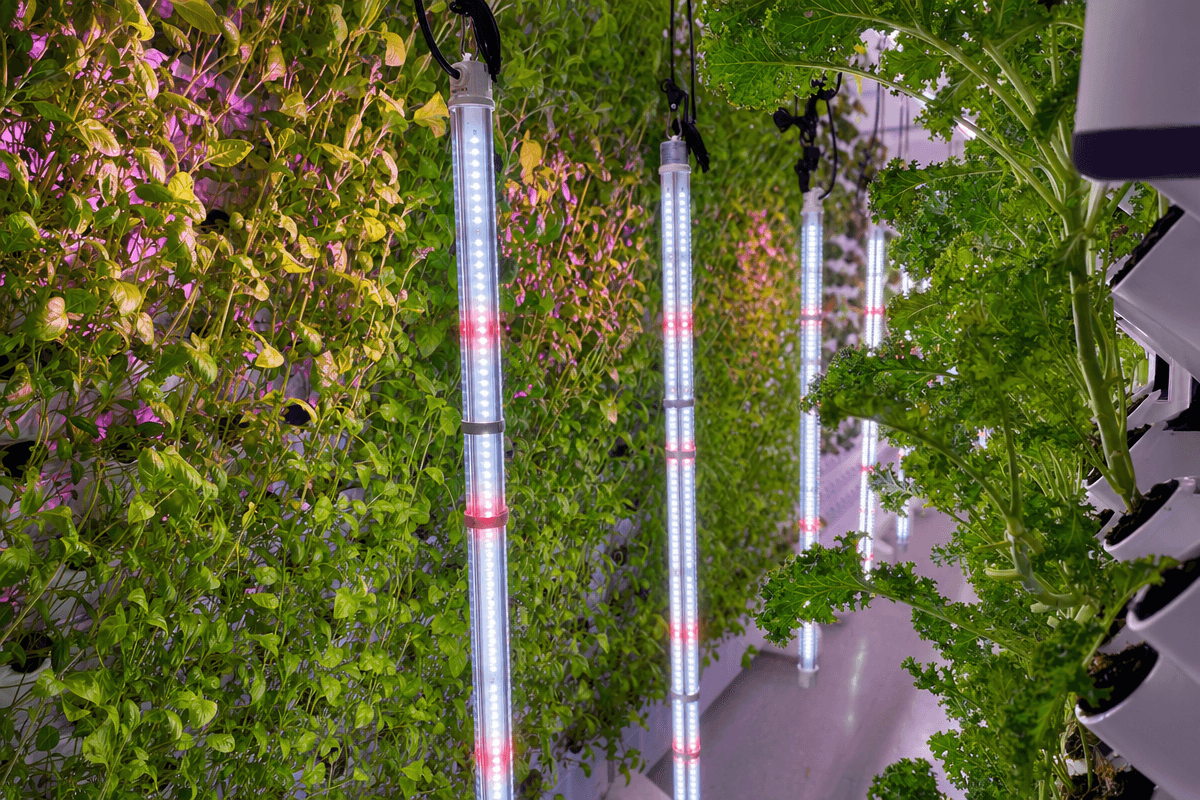
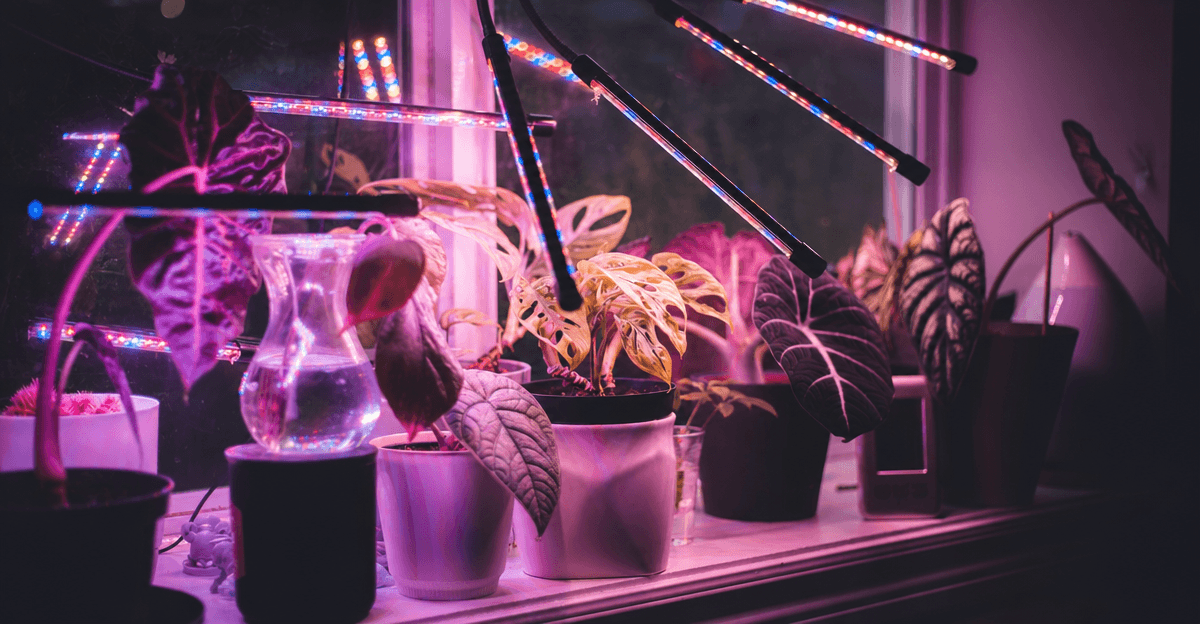
Early LED grow lights used only red and blue diodes -- the two peaks of chlorophyll absorption. These "blurple" lights bathed everything in an eerie purple glow. They worked, but modern research consistently shows that balanced white-spectrum LEDs outperform narrow-band fixtures in most real-world growing conditions.
Why? White LEDs include green wavelengths that penetrate the canopy, provide a more natural growth pattern, and make it easier to visually diagnose plant health problems (try spotting a nutrient deficiency under purple light).
The University of Arizona found that plants grown under purple LED light consumed 40% less energy in some cases, but this advantage disappears with modern high-efficiency white LEDs that achieve similar or better results. The practical advice from BIOS Lighting's research summary: focus on "high-efficiency full-spectrum white fixtures with proper PPFD targeting and strategic far-red/UV application" rather than extreme red/blue ratios.
Efficiency: Why It Saves You Real Money
The number to look for is photosynthetic photon efficacy (PPE), measured in µmol/J. It tells you how much usable light you get per watt of electricity.
| Light Type | PPE (µmol/J) | 5-Year Energy Cost* |
|---|---|---|
| HPS (High Pressure Sodium) | 0.9-1.7 | Highest |
| Fluorescent | 0.8-1.5 | Medium |
| LED (current generation) | 2.0-3.1 | Lowest |
For the same light output. Source: MU Extension
Current LEDs deliver 30-50% energy savings compared to HPS and fluorescent alternatives. Over a five-year span, LEDs have the highest upfront cost but the lowest total cost of ownership thanks to lower electricity bills and longer lifespan (50,000+ hours, or roughly 5-7 years of daily use).
For home growers, this matters. The University of Minnesota estimates that a single 9-watt LED grow light for a small hydroponic bucket system costs about $5.44 per year to run, with bulb replacement needed only every five years.
The LED grow light market reflects this shift: valued at $3.51 billion in 2025, it is projected to reach $27.34 billion by 2035, driven largely by controlled environment agriculture adoption.
What This Means for Your Setup
Here is how to apply this research to your grow:
If you are just starting out:
- Buy a full-spectrum white LED panel rated above 2.0 µmol/J
- Target 250-350 PPFD at canopy height for leafy greens and herbs
- Run lights 14-16 hours per day to hit a DLI of 12-17
- Do not stress about specific red/blue ratios -- a good white LED already has them
If you want to optimize:
- Look for fixtures with a far-red channel (700-750 nm) for 10-25% far-red supplementation
- Consider ending your light cycle with a brief UV-B exposure to boost flavor compounds
- Monitor DLI, not just hours -- a dimmer light running longer is not the same as a brighter light running shorter
- Remember the trade-off: higher red ratios grow bigger plants, higher blue ratios grow more nutrient-dense plants
What to avoid:
- Cheap "blurple" panels with no PPFD or PPE specs listed
- Fixtures claiming "1000W equivalent" without actual µmol output data
- Running lights 24/7 -- most plants need a dark period for healthy growth
The Bottom Line
LED grow light technology has matured. The science is clear: full-spectrum white LEDs with good efficiency ratings (above 2.0 µmol/J) are the best choice for most home hydroponic growers. Target the right PPFD and DLI for your specific crops, and you will get better results than chasing the "perfect" red-to-blue ratio.
The exciting frontier is far-red supplementation, which offers real yield improvements backed by university research. But the basics -- adequate intensity, proper duration, and decent efficiency -- will get you 90% of the way there.