Succession Planting: End the Glut, Harvest Every Week for Up to 9 Months
Plan staggered sowings at 7-30 day intervals so your garden produces continuously across three full seasons — not a single overwhelming glut. Includes a crop-specific interval chart, a four-phase planting framework, and the frost-date formula for calculating your last sowing window.
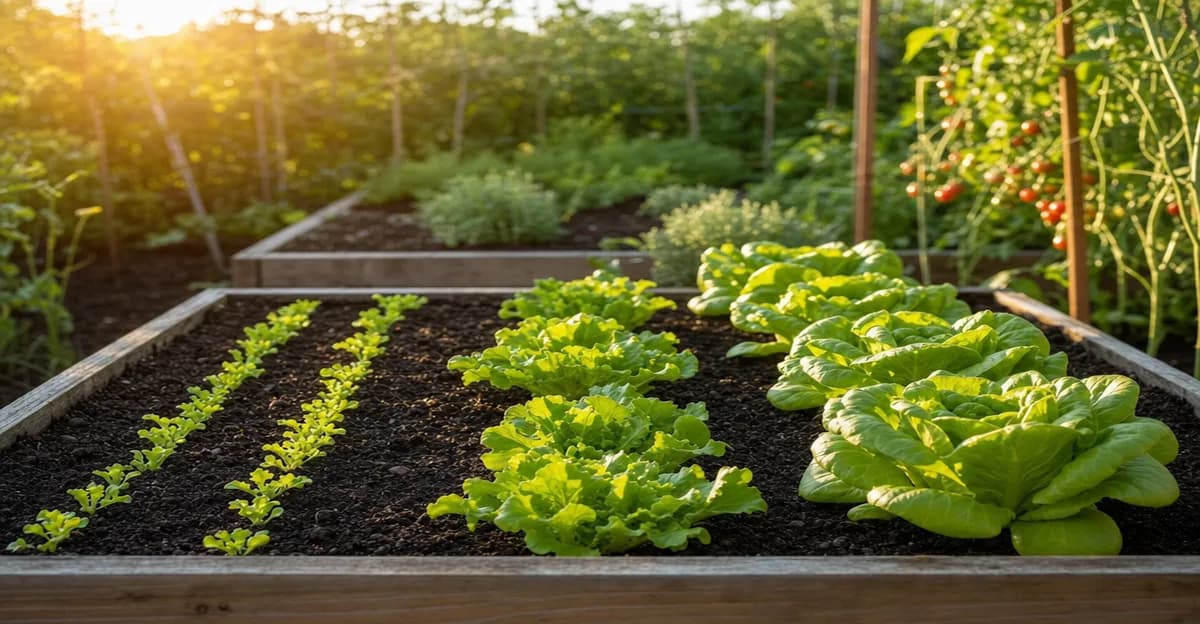
Key takeaway: Succession planting means sowing the same crop at staggered intervals — every 7 to 30 days depending on the vegetable — so that you harvest steadily across the season instead of getting one overwhelming flush. Ten university extension services independently confirm this method. By combining relay planting with crop replacement — rotating cool-season and warm-season species through the same beds — growers in warmer zones can maintain production across spring, summer, and fall.
The Problem: The Feast-or-Famine Garden
Most vegetable gardens operate on a boom-bust cycle. You plant everything in spring, harvest mountains of produce in midsummer, and then watch the beds empty out by autumn. The result is weeks of excess followed by months of nothing.
In the UK and maritime climates, gardeners call the worst stretch the hungry gap — the period from March to early May when winter stores are depleted and spring crops are not yet ready to pick. April tends to be the leanest month. In the continental US (zones 5-7), the equivalent gap runs from roughly November through March, though it goes largely unnamed because most growers have already stopped expecting anything from the garden by then.
Succession planting is how you close that gap — or at least shrink it dramatically.
What Succession Planting Actually Means
The term gets used loosely, so it helps to define three distinct strategies that extension services identify:
-
Relay planting (same-crop continuity): Sowing the same vegetable at regular intervals — for example, planting a new row of lettuce every two weeks — so harvests overlap and you never run out. Penn State Extension lists mesclun, Swiss chard, beets, bush beans, carrots, cucumbers, radishes, and summer squash as ideal relay crops.
-
Succession planting (crop replacement): Planting a different species in a spot as soon as the previous one is harvested. For example, warm-season beans go into the bed where cool-season peas just finished. Texas A&M describes a typical cycle: broccoli, lettuce, and peas in early spring → beans, tomatoes, and peppers in summer → a cover crop or fall brassicas.
-
Interplanting (space sharing): Growing two or more vegetables in the same space simultaneously — like tucking lettuce between young tomato rows while the tomatoes are still small enough to let light through.
All three methods can work together. This guide focuses primarily on relay planting and crop replacement — the two strategies that directly control when you harvest.
The Core Formula: Three Numbers You Need
ATTRA, the USDA-funded sustainable agriculture program, boils continuous-harvest planning down to three factors:
- Appropriate planting dates — based on your frost-free date (spring) and first-freeze date (fall)
- Days to maturity (DTM) — how long from sowing to first harvest
- Length of harvest window — how many days you can pick from a single planting before quality drops
Once you know these three numbers for a given crop, you can calculate exactly when to sow each round and when to stop.
Calculating Your Last Planting Date
Cornell Cooperative Extension provides a practical formula:
Last sowing date = First expected frost date − days to maturity − germination days
For a crop with 60 DTM and 7 days to germinate, with a first frost around October 15, the last sowing would be around August 8. ATTRA offers a simpler rule of thumb: stop sowing roughly 80 days before your average first fall frost.
Crop-Specific Planting Intervals
Not every vegetable needs the same spacing between sowings. Johnny's Selected Seeds, drawing from multi-year trial data, categorizes 21 vegetable crops into interval groups:
| Interval | Crops | Why |
|---|---|---|
| 7 days | Lettuce, salad greens, arugula, spinach | Fast-growing; individual plantings produce for only 1-2 weeks before bolting or quality drops |
| 10-14 days | Radishes, carrots, beets, cilantro | Short DTM but slightly longer harvest windows |
| 21 days | Bush beans, cucumbers, sweet corn | Medium cycle; each planting produces for 2-3 weeks |
| 30 days | Summer squash, zucchini | Longer harvest window per planting; fewer rounds needed |
Iowa State Extension confirms the general principle, documenting succession intervals of 7-14 days for crops like carrots and sweet corn within their planting window. Virginia Tech Extension recommends sowing "every 2-3 weeks during the planting window" as the general guideline for most crops.
Variety Maturity Staggering
Beyond planting the same variety repeatedly, West Virginia University Extension identifies a third approach: planting varieties with different maturity lengths at the same time. ATTRA gives the example of sweet corn, where a 70-day variety and a 100-day variety planted on the same date will produce harvests 30 days apart. This technique works well for crops where you want a longer spread but lack the bed space for multiple sowings.
Master Succession Interval Calendar by Zone
The interval chart above tells you how often to plant each crop. This calendar tells you when to start, when to stop, and how many rounds you get — adjusted to your USDA hardiness zone. Stop dates use the Cornell last-sowing formula (frost date minus days to maturity minus germination buffer), with a floor of 80 days before first frost per ATTRA's general guideline.
| Zone | Frost-Free Window | 7-Day Crops (lettuce, greens) | 14-Day Crops (radish, carrot) | 21-Day Crops (beans, corn) | 30-Day Crops (squash) |
|---|---|---|---|---|---|
| 3-4 | Late May – Mid Sep (~110-130 days) | Jun 1 – Jul 15 (6-7 rounds) | Jun 1 – Jul 1 (3-4 rounds) | Jun 1 – Jul 1 (2-3 rounds) | Jun 1 – Jun 30 (1-2 rounds) |
| 5-6 | Mid Apr – Mid Oct (~150-180 days) | Apr 20 – Aug 15 (16-17 rounds) | Apr 20 – Aug 1 (7-8 rounds) | May 1 – Jul 15 (4-5 rounds) | May 1 – Jul 1 (2-3 rounds) |
| 7-8 | Mid Mar – Mid Nov (~200-240 days) | Mar 15 – Sep 15 (26+ rounds) | Mar 15 – Sep 1 (12-13 rounds) | Apr 1 – Aug 15 (7-8 rounds) | Apr 1 – Aug 1 (4-5 rounds) |
| 9-10 | Year-round (mild winters) | Year-round (52 rounds) | Year-round (26 rounds) | Feb – Oct (12-14 rounds) | Mar – Sep (7 rounds) |
How to read this table: The date ranges show the sowing window — the first reasonable sowing date through the last sowing date that still allows harvest before frost. Round counts are approximate and assume you sow at the interval specified in the chart above (7, 14, 21, or 30 days). Adjust your start date forward if the ground is still waterlogged or frozen at the calendar date.
Zone 3-4 strategy: Your season is short but intense. Prioritize the 7-day crops (lettuce, spinach, arugula) where you can fit 6-7 relay rounds into a compact window. For 21- and 30-day crops, plant two rounds maximum and focus on varieties with the shortest days to maturity.
Zone 5-6 strategy: You have the widest margin for error. Start cool-season crops as soon as the soil reaches 4°C / 40°F and extend into fall using the Cornell last-sowing formula to calculate your cutoff. Sixteen rounds of lettuce is realistic if you start early under row cover.
Zone 7-8 strategy: You can succession plant greens almost continuously from mid-March through mid-September — over 26 weekly sowings. The challenge shifts from "not enough season" to scheduling discipline. Use a recurring calendar reminder every 7 days for fast crops and every 21 days for beans and cucumbers.
Zone 9-10 strategy: With negligible frost risk, the calendar inverts — the limiting factor is summer heat rather than winter cold. Pause lettuce and spinach sowings during peak heat (Jul-Aug) when they bolt within days, and resume in September. Warm-season crops like beans and squash carry production through the gap.
The Four-Phase Framework
The University of Maryland Extension outlines a practical four-phase approach that sequences cool-season and warm-season crops through the year:
Phase 1 — Early spring (as soon as ground can be worked): Direct-sow cold-hardy crops like peas, spinach, and radishes.
Phase 2 — Mid-spring (2-4 weeks before last frost): Set out cold-hardy transplants — brassicas, onions, lettuce starts.
Phase 3 — Late spring (after frost danger passes): Plant warm-season crops — tomatoes, peppers, beans, squash, cucumbers.
Phase 4 — Summer through fall (ongoing): Succession plant fast-cycle crops (beans, cucumbers, squash) into spaces where cool-weather crops have finished. As summer fades, replace spent warm-season crops with fall brassicas and late greens.
This cycle is not a one-time plan; it is a continuous rotation where every empty spot becomes an opportunity for the next planting. UMD's core advice: "plant a little bit of each vegetable every two weeks" for sustained harvest.
Advanced Relay Planting Sequences
The four-phase framework above gives you the seasonal blueprint. These three bed-level sequences show you exactly how to execute it — which crop follows which, when to transition, and how to keep each bed producing from first thaw to final frost.
Sequence A: The Cool-Season Relay Bed
This bed stays productive from early spring to late fall by chaining cool-weather crops through the shoulder seasons and yielding the middle months to one warm-season occupant.
| Timing | Crop | Notes |
|---|---|---|
| Early Mar (under row cover) | Spinach + radishes (direct sow) | Radishes harvest in 25-30 days; spinach produces for 6-8 weeks |
| Mid Apr | Lettuce relay begins (sow every 7 days) | Tuck between maturing spinach; harvest spinach as lettuce fills in |
| Late May | Pull lettuce; transplant bush beans | Beans fix nitrogen for the fall brassicas that follow |
| Mid Aug | Pull spent beans; direct sow fall spinach + kale | Residual nitrogen from bean roots feeds the fall greens |
| Oct – Nov | Harvest fall greens; mulch bed for winter | In zones 7+, overwintered spinach can survive under cover for a March harvest |
Sequence B: The Warm-Season Succession Bed
This bed maximizes summer production by staggering warm-season crops rather than planting them all at once.
| Timing | Crop | Notes |
|---|---|---|
| After last frost | Planting 1: Cucumbers + bush beans | Both produce within 50-60 days |
| 3 weeks later | Planting 2: Summer squash (adjacent row) | Offsets the cucumber harvest by 3 weeks |
| 6 weeks later | Planting 3: Second round of bush beans | Replaces the first bean planting as it declines |
| Mid-summer | Remove spent cucumbers; sow fall beans or carrots | Use the Cornell last-sowing formula to confirm enough days remain |
Sequence C: The Full-Season Intensive Bed (Zones 6-8)
This sequence applies all three strategies — relay planting, crop replacement, and interplanting — to extract five distinct harvests from a single 4 x 8 ft bed across the year.
| Phase | Timing | Crop | Strategy |
|---|---|---|---|
| 1 | Mar | Peas (trellised) + radishes (interplanted at base) | Interplanting: radishes harvest before peas need the space |
| 2 | May | Pull radishes; lettuce fills the base rows | Relay: lettuce succession continues under pea canopy shade |
| 3 | Jun | Pull peas at decline; transplant tomatoes into same trellis | Crop replacement: tomatoes inherit the nitrogen peas fixed |
| 4 | Aug | Pull lettuce; sow fall beets + chard around tomato base | Interplanting: root crops share space with upright tomatoes |
| 5 | Oct | Remove frost-killed tomatoes; harvest beets; overseed with winter rye cover crop | Cover crop holds nutrients until the March restart |
Transition timing rule: Start your replacement crop's transplants or pre-soak seeds 7-10 days before you plan to remove the outgoing crop. A bed that sits empty for even two weeks during peak season represents a lost harvest cycle. Texas A&M emphasizes that the key to crop replacement is planting the next crop immediately after clearing the previous one.
Why It Works Beyond the Plate
Succession planting is not only about spreading your harvest. Peer-reviewed research supports broader benefits:
- Improved soil health: Ehrmann and Ritz (2013) found that multi-cropping systems in temperate climates improve soil community composition, nutrient cycling, and soil structural dynamics compared to monocultures.
- Reduced pest and disease pressure: The same study documented effective pest, disease, and weed control as a consistent benefit of sequential cropping systems.
- Ecosystem services: Gaba et al. (2015) showed that multiple cropping systems provide ecosystem services beyond yield — including reduced environmental impacts and the potential to replace agrochemical inputs through positive plant interactions.
- Disease suppression through rotation: Clemson Extension recommends that the same crop family be grown in the same spot no more than once every three years to disrupt soil-borne pathogens, insects, and nematodes — a rotation that succession planting naturally encourages.
Extending the Calendar With Season Protection
Without any protection, succession planting with crop replacement can keep beds productive across three full seasons — spring, summer, and fall — in warmer zones. In USDA zones 8-10, where frost-free windows stretch from late February through November, that three-season span covers roughly nine months. To push further into the cold months, season-extension tools make a measurable difference.
University of Minnesota Extension provides quantitative data:
- Lightweight row covers: Add approximately 2°F of frost protection
- Heavyweight row covers: Provide 6-10°F of protection, shielding plants down to about 20°F
- Cold frames: Retain heat and extend the growing season by "a couple of weeks" on each end
- Growth effect: Seedlings under row cover fabric grow at roughly twice the rate of unprotected plants
Virginia Tech Extension reports that row covers and cold frames extend planting and harvest windows by 2-4 weeks in both spring and fall. Combined, these tools can add 4-8 weeks to your growing season.
Eliot Coleman demonstrates the upper limit of this approach at his farm in USDA Zone 5 (Maine): year-round vegetable harvest using only unheated cold frames and mobile greenhouses — no supplementary heat. His methodology, proven since 1995, relies on the fact that most of the US receives more winter sunshine than southern France. While Coleman's approach requires purpose-built infrastructure, it proves that the "hungry gap" can be eliminated entirely in zones where most growers assume winter growing is impossible.
Putting It Together: Your First Season
Start simple. Pick 3-4 crops from the 7-14 day interval group (lettuce, radishes, spinach, cilantro) and commit to sowing a short row every two weeks from your frost-free date until midsummer.
Week 1: Sow Row A of lettuce and radishes. Week 3: Sow Row B. Row A radishes may be nearly ready. Week 5: Sow Row C. Harvest Row A radishes; Row A lettuce is at peak. Week 7: Sow Row D. Harvest Row B radishes; start cutting Row B lettuce.
By week 7, you have overlapping harvests with no gap. Scale from there.
For crop replacement, follow the four-phase framework: as each cool-season bed empties, plant the next warm-season crop immediately. Do not leave beds empty — an empty bed is a missed harvest.
Common Mistakes
Planting too much at once. The whole point is to plant less at each sowing so you harvest manageable amounts over time. UConn Extension emphasizes that succession planting "guarantees prolonged harvest instead of a single large harvest" — but only if each individual sowing is proportionally smaller.
Ignoring the last-sowing cutoff. Every succession crop has a final planting date beyond which there is not enough growing season left to reach maturity. Count backwards from your frost date using the Cornell formula.
Neglecting crop rotation within successions. If you relay-plant lettuce in the same spot all season, you risk soil nutrient depletion and disease buildup. Rotate even within the season — move each new sowing to a different section of the bed.
Skipping record-keeping. ATTRA stresses the value of production records and consulting local growers, because microclimates, soil conditions, and variety performance vary enormously between gardens.
Related Reading
If you are working toward a year-round harvest using these techniques, our year-round vegetable garden guide builds on succession planting with a full 12-month plan across two climate tracks.