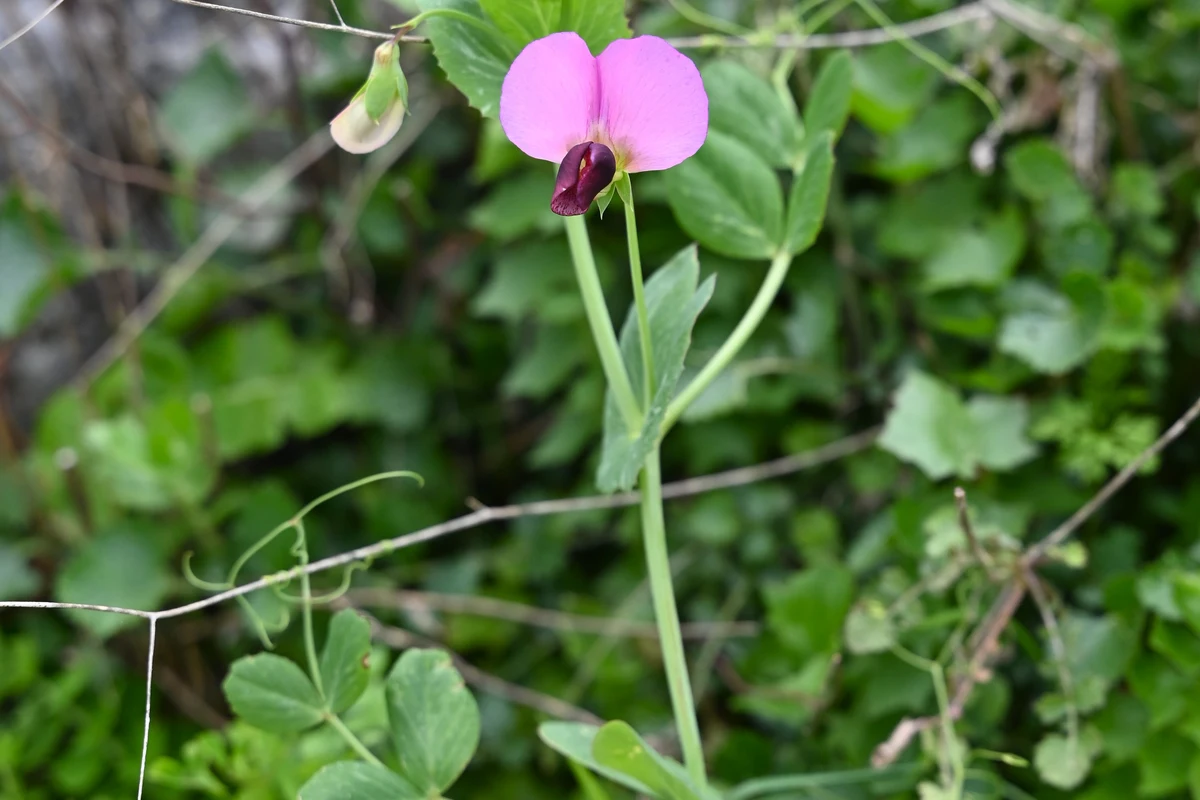
About This Plant
Austrian winter pea is a cool-season field pea grown mainly as an overwintering cover crop, forage, green manure, or dry-seed pea. It germinates in cold soil, fixes nitrogen when inoculated with pea/vetch Rhizobium, and produces weak vining stems that perform best in well-drained soil or mixed with small grains for support.
How to Grow Austrian Winter Pea
Learn how to grow Austrian Winter Pea from seed to harvest in 150 days. Beginner-friendly. Planting, care, feeding and the right growing conditions.
Sources cited: 15.
Nutrient Requirements by Growth Stage
Austrian winter pea nutrition should be interpreted differently for soil and hydroponics. In soil, inoculated field pea obtains much of its nitrogen from Rhizobium; NDSU notes good stands may obtain up to 80% of N through fixation, and routine nitrogen fertilizer is usually unnecessary…
Sign in to view nutrient requirements
A free account unlocks NPK targets for all four growth stages, micronutrient levels, a per-stage nutrient calculator, and the full nutrition guide. Signing up takes one click. Truleaf is a free, non-profit project, and every new account helps it grow. No spam, ever.
Growing Environments
Outdoor soil is the primary verified environment for Austrian winter pea as a cover crop, forage, green manure, or dry pea. Greenhouse and indoor systems are plausible for research, shoots, seedling production, or demonstrations, but they are not the main way to capture soil nitrogen-fixation benefits…
Temperature
Austrian winter pea is a cool-season field pea. Seeds can germinate near 5C, and USDA/NRCS uses about 41F as the practical minimum for winter pea establishment. The best crop growth is cooler than the laboratory germination optimum: field pea production guides consistently favor cool conditions and warn that heat during flowering and seed set reduces performance. Use about 13-24C as the working growth range, with 18C as a practical target for protected culture.
Humidity
No complete field-pea source defines one exact relative-humidity optimum. A 50-70% indoor or greenhouse target remains reasonable, with short tolerance up to about 75% only when leaves dry quickly…
Light
Treat Austrian winter pea as a full-sun cool-season crop for biomass, flowering, and seed production. The previous DLI 12 value was too weakly sourced as an optimum, so the guide uses a moderate protected-culture target near DLI 16 with a 14-hour photoperiod…
Airflow
No peer-reviewed paper found a species-specific airflow value in m/s. The evidence supports moderate canopy ventilation as disease and lodging management: weak vining stems, dense growth, dew, and wet leaf surfaces increase disease risk…
Sign in to view environmental requirements
A free account unlocks exact temperature, humidity, light and airflow targets, including germination and growth ranges, DLI, photoperiod and PPFD, plus the full environment guide. Signing up takes one click. Truleaf is a free, non-profit project, and every new account helps it grow. No spam, ever.
Hydroponic System Compatibility
Soil, raised beds, and drip-irrigated substrate are the strongest fits. Pea roots and nodules need oxygen, and disease guidance repeatedly warns against wet, compacted, poorly drained conditions…
Growing Media
Use fertile, well-drained soil or a loose substrate that behaves like a well-aerated loam. USDA and NDSU guidance support field pea in well-drained soils with near-neutral pH, while fertility sources emphasize soil testing for phosphorus, potassium, sulfur, and pH correction…
Container Specs
No Austrian winter pea-specific container trial gave exact pot dimensions, so this section is lower confidence. Use at least 30 cm depth, 25 cm width, and about 7 L volume for a small container crop, with strong drainage and support if vines are allowed to elongate…
Training & Support
Support is recommended but not mandatory. Austrian winter pea has weak vining stems and tendrils, and field sources commonly recommend mixing with wheat, rye, triticale, barley, or oat for vertical support and better stand structure…
Sign in to view system compatibility
A free account unlocks why each of the six systems fits or fails, plus growing media, container sizes, training methods, companion plants, and the full systems guide. Signing up takes one click. Truleaf is a free, non-profit project, and every new account helps it grow. No spam, ever.
Propagation
Propagation is by direct seed. Plant into firm, moist soil when the top layer is near 5C or warmer; emergence usually takes about 10-14 days under field conditions…
Harvesting
For green manure, termination timing controls the harvest goal. Full bloom maximizes nitrogen contribution, while earlier termination before first bloom can make chemical or mechanical kill easier and reduce excess biomass before the following crop…
Planting Calendar
Calendar windows are regional. Fall cover-crop sowing ranges from mid-August in colder systems to November in warmer southern systems; Arkansas Extension lists Aug…
Common Issues
The current issue list needed several corrections. Powdery mildew on pea is best attributed to Erysiphe pisi rather than Erysiphe polygoni, and Ascochyta should be treated as a disease complex rather than a single organism…
Get the full science-backed guide
By signing up, you help keep Truleaf free and support the growth of our nonprofit project. Your account unlocks full details for every plant issue—including symptoms, causes, step-by-step solutions, and prevention—plus the month-by-month planting calendar, the complete guide, and all research sources. It only takes one click. No spam, ever.