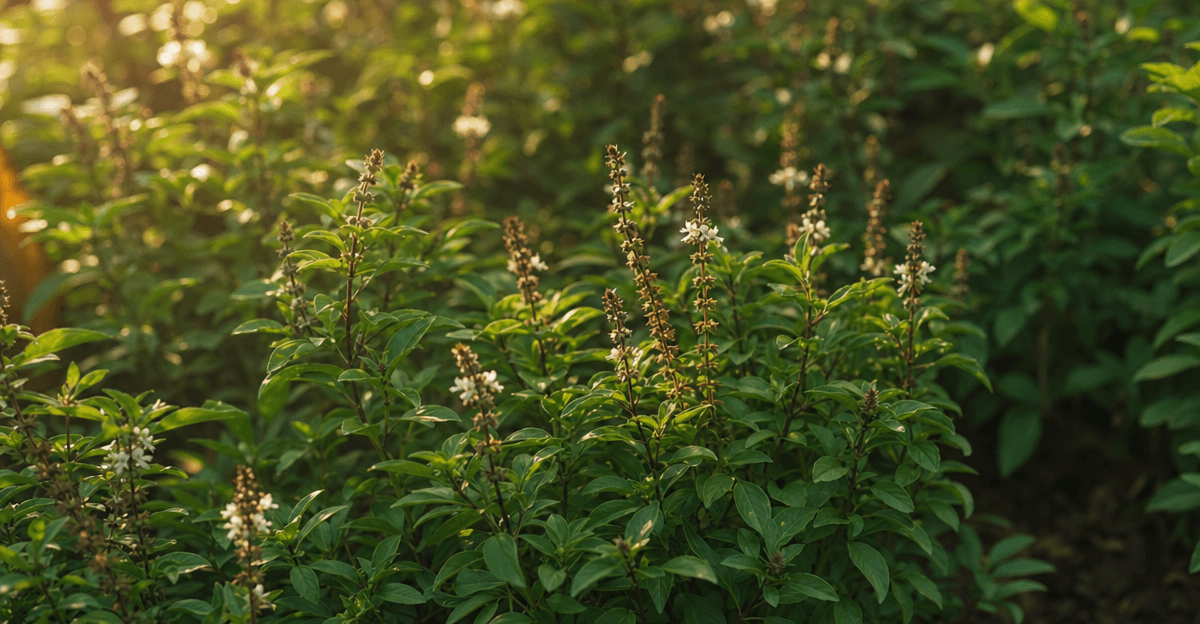
À Propos de cette Plante
Le basilic est une herbe aromatique de saison chaude cultivée pour ses feuilles tendres et ses récoltes répétées, donnant les meilleurs résultats sous une chaleur constante, une fertilité modérée et une taille fréquente des sommités.
Comment cultiver Basilic
Apprenez à cultiver Basilic de la graine à la récolte en 50 jours. Difficulté Beginner. Guide complet des nutriments, exigences pH/EC et conditions de culture pour hydroponie, sol et serre.
Appuyé par 26 citations évaluées par des pairs.
Besoins en Nutriments par Stade de Croissance
Le basilic doux prospère dans les systèmes hydroponiques avec des concentrations nutritives modérées. Durant la phase de semis, une solution à demi-concentration à EC 0,5-1,0 dS/m est recommandée, fournissant environ 100-150 ppm d'azote, 30-45 ppm de phosphore et 120-180 ppm de potassium…
Connectez-vous pour voir besoins en nutriments
Un compte gratuit débloque les objectifs NPK des quatre stades de croissance, les niveaux d'oligo-éléments, un calculateur de nutriments par stade et le guide de nutrition complet. L'inscription ne prend qu'un clic. Truleaf est un projet gratuit et à but non lucratif, et chaque nouveau compte nous aide à grandir. Jamais de spam.
Environnements de Culture
Le basilic grand vert prospère dans les quatre environnements de culture. En extérieur, il donne de meilleurs résultats en plein soleil (minimum 6 à 8 heures par jour) par temps chaud, après que tout risque de gel soit écarté…
Température
Le basilic commun est une herbe de saison chaude avec une température de l'air optimale d'environ 26°C pour la croissance végétative. Walters et al. (2023) ont démontré que la température quotidienne moyenne optimale pour la production de masse fraîche variait de 32.6°C à faible luminosité (DLI 6 mol/m²/d) à 35.5°C à luminosité modérée (DLI 11 mol/m²/d), la masse fraîche augmentant de 3 fois lorsque la MDT passait de 23°C à 35.7°C. La croissance cesse effectivement en dessous de 10°C. Pour la germination des graines, Zhou et Welbaum (2012) ont déterminé la température de base à 11.8°C, avec une vitesse de germination optimale à 35°C et un plafond de 43°C ; cependant, la germination devient peu fiable en dessous de 20°C. Une plage de germination pratique de 20-30°C est recommandée. Les températures de la zone racinaire entre 23-31°C favorisent la croissance hydroponique. Dans les environnements contrôlés, le maintien de 22-28°C offre le meilleur équilibre entre taux de croissance, production d'huiles essentielles et résistance aux maladies.
Humidité
Le basilic commun pousse bien à des niveaux d'humidité modérés de 50-70%, avec 60-65% étant optimal pour une croissance équilibrée et la résistance aux maladies. Le principal problème lié à l'humidité est le mildiou du basilic causé par Peronospora belbahrii…
Lumière
Le basilic commun est une culture à forte luminosité qui répond fortement à l'intégrale lumineuse quotidienne (DLI). Des recherches de Walters et al…
Circulation d'Air
Une circulation d'air adéquate est essentielle pour le basilic commun, tant pour l'efficacité photosynthétique que pour la prévention des maladies. Une vitesse de l'air dans le couvert végétal d'au moins 0.3 m/s est recommandée pour des taux photosynthétiques optimaux, avec un objectif de 0.5-0.6 m/s pour assurer une…
Connectez-vous pour voir besoins environnementaux
Un compte gratuit débloque les valeurs exactes de température, d'humidité, de lumière et de ventilation, y compris les plages de germination et de croissance, DLI, photopériode et PPFD, ainsi que le guide d'environnement complet. L'inscription ne prend qu'un clic. Truleaf est un projet gratuit et à but non lucratif, et chaque nouveau compte nous aide à grandir. Jamais de spam.
Compatibilité des Systèmes Hydroponiques
Le basilic grand vert se comporte bien dans tous les principaux types de systèmes hydroponiques. Khater et al…
Substrats
Le basilic grand vert s'adapte bien à tous les substrats hydroponiques courants. Dans l'étude comparative de Khater et al…
Conteneurs
Le basilic grand vert est une excellente plante en contenant. Utilisez un pot d'au moins 20 cm de profondeur et 20 cm de largeur, avec un volume minimum de 5 litres par plant…
Palissage et Support
Le basilic ne nécessite pas de structures de soutien physiques, mais un pinçage et une taille réguliers sont fortement recommandés pour maximiser le rendement et prévenir la floraison prématurée. Commencez à pincer lorsque les plants atteignent 15-20 cm de hauteur avec au moins 3 séries de vraies feuilles : coupez la…
Connectez-vous pour voir compatibilité du système
Un compte gratuit débloque les raisons pour lesquelles chacun des six systèmes convient ou non, ainsi que les substrats, les tailles de pot, les méthodes de palissage, les plantes compagnes et le guide des systèmes complet. L'inscription ne prend qu'un clic. Truleaf est un projet gratuit et à but non lucratif, et chaque nouveau compte nous aide à grandir. Jamais de spam.
Propagation
Le basilic doux se propage facilement par graines ou par boutures de tiges. Les graines constituent la méthode la plus courante : semer à 3-6 mm de profondeur dans un substrat de démarrage humide à une température de sol optimale de 20-25°C…
Récolte
Le basilic est une véritable plante à couper-et-revenir qui repousse vigoureusement après une récolte correcte. La récolte doit commencer dès que la plante possède au moins trois paires de feuilles (15-20 cm de hauteur), en coupant la tige principale juste au-dessus d'un nœud foliaire ; chaque nœud coupé produit deux…
Calendrier de Plantation
Pour les climats tempérés de l'hémisphère Nord (zones USDA 5-7), commencer les graines de basilic en intérieur 4-8 semaines avant la dernière date de gel, généralement de février à avril selon la zone. Repiquer les plants aguerris en extérieur après tout risque de gel et lorsque les températures nocturnes restent…
Problèmes Courants
Le basilic grand vert est sensible à plusieurs maladies et ravageurs graves qui peuvent entraîner une perte totale de la récolte s'ils ne sont pas maîtrisés. La fusariose, causée par le champignon tellurique Fusarium oxysporum f…
Accédez au guide complet fondé sur la science
En vous inscrivant, vous nous aidez à maintenir Truleaf gratuit et soutenez la croissance de notre projet à but non lucratif. Votre compte débloque tous les détails de chaque problème végétal—symptômes, causes, solutions étape par étape et prévention—ainsi que le calendrier de plantation mois par mois, le guide complet et toutes les sources de recherche. Un seul clic suffit. Jamais de spam.