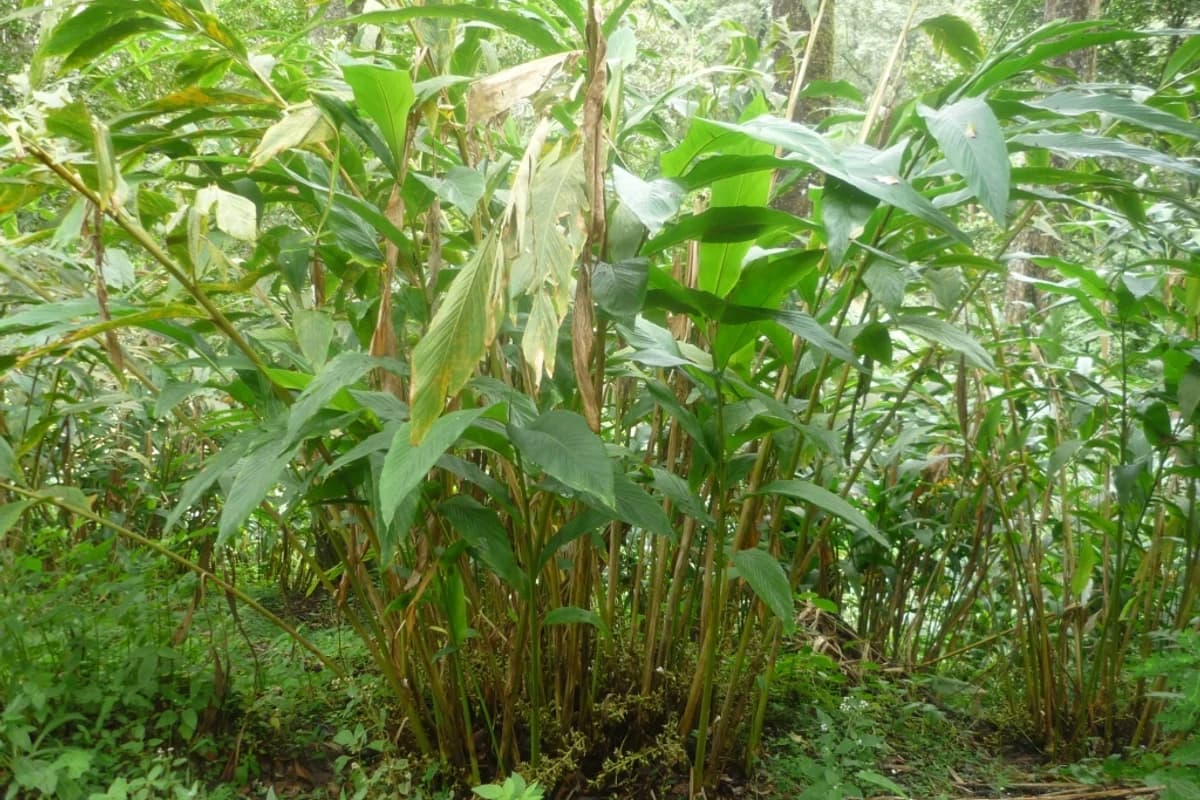
About This Plant
Cardamom is a perennial, rhizomatous herb in the ginger family, native to the humid evergreen forest understory of South India and the Western Ghats. It is grown for aromatic green capsules whose seeds are used as a high-value spice, and productive cultivation depends on filtered shade, high humidity, organic-rich acidic soil, and careful drainage.
How to Grow Cardamom
Learn how to grow Cardamom from seed to harvest in 1095 days. Advanced difficulty. Complete nutrient guide, pH/EC requirements, and growing conditions for soil & container.
Backed by 19 peer-reviewed citations.
Nutrient Requirements by Growth Stage
Cardamom nutrition is verified mainly as soil fertilizer, not hydroponic ppm. KAU recommends 5 kg organic manure per plant and 75:75:150 kg/ha/year N:P2O5:K2O in rainfed Kerala plantations, split before and after the southwest monsoon [ref-1]…
Sign in to view nutrient requirements
A free account unlocks NPK targets for all four growth stages, micronutrient levels, a per-stage nutrient calculator, and the full nutrition guide. Signing up takes one click. Truleaf is a free, non-profit project, and every new account helps it grow. No spam, ever.
Growing Environments
Outdoor shaded tropical production is the primary evidence base: cardamom is grown as an understory crop in humid highland forest systems with deep humus-rich acidic soils [ref-1][ref-2]. Greenhouses and warm indoor spaces can maintain the heat, humidity, and filtered light needed for foliage, and NC State notes it is…
Temperature
Cardamom is a humid tropical understory crop. Seed work should avoid treating 35C as an optimal germination target: controlled incubation research found the best germination near 30C, while 35C produced only weak emergence and colder incubations failed [ref-3]. Established clumps tolerate a broader field range around 15-35C, but production guidance is strongest around warm, shaded, high-humidity sites, with about 22-24C favored for productive growth [ref-1][ref-2][ref-12].
Humidity
The current 70-90 percent humidity target is directionally correct for a crop native to moist evergreen forest systems [ref-1][ref-2]. NC State Extension lists about 75 percent humidity for container or greenhouse care, and the Cardamom Hills paper shows higher shade levels raising canopy humidity near panicles…
Light
Light guidance should emphasize filtered shade, not a strict photoperiod. Cardamom is shade-adapted: a field physiology study found 50-75 percent shade supported shade-acclimation traits, and Frontiers data reported useful PPFD responses around 300-900 umol/m2/s [ref-4][ref-5]…
Airflow
No source gives a numeric airflow rate, but cardamom sources consistently support open, sanitary canopy management. Trashing old shoots and dried panicles at monsoon onset exposes panicles, improves bee access, and reduces disease carryover [ref-1]…
Sign in to view environmental requirements
A free account unlocks exact temperature, humidity, light and airflow targets, including germination and growth ranges, DLI, photoperiod and PPFD, plus the full environment guide. Signing up takes one click. Truleaf is a free, non-profit project, and every new account helps it grow. No spam, ever.
Hydroponic System Compatibility
The previous aeroponics=true value was not supported. Cardamom is a rhizomatous, shallow-rooted clump crop grown in humus-rich forest loam, trenches, pits, nursery beds, or polybags [ref-1][ref-2]…
Growing Media
Use a moisture-retentive but well-drained, organic-rich acidic medium. KAU describes productive sites as deep, well-drained forest loams rich in humus, available phosphorus, and potassium [ref-1]…
Container Specs
Published evidence supports containers most clearly for nursery production. ICAR recommends drained 20 x 20 cm polybags filled with fertile topsoil, cow dung, and sand for secondary nursery seedlings, while Ethiopian nursery work used smaller polybags to test media and watering frequency [ref-2][ref-6]…
Training & Support
Cardamom does not need trellising or vine training. It is a rhizomatous herbaceous clump grown under shade trees, so the relevant management is shade regulation, mulching, drainage maintenance, trashing old shoots, and occasional establishment staking [ref-1][ref-2]…
Sign in to view system compatibility
A free account unlocks why each of the six systems fits or fails, plus growing media, container sizes, training methods, companion plants, and the full systems guide. Signing up takes one click. Truleaf is a free, non-profit project, and every new account helps it grow. No spam, ever.
Propagation
Cardamom can be propagated by seed or rhizome division. Commercial production usually favors disease-free sucker division because a mature tiller with rhizome and a young shoot establishes quickly and stays true to type [ref-1][ref-2]…
Harvesting
Harvest is selective and repeated because cardamom capsules mature unevenly. Plants normally start bearing in the second or third year, supporting the current 1095-day standard harvest time for full production [ref-1][ref-2]…
Planting Calendar
Schedule cardamom around monsoon timing. IISR recommends seed sowing in September in Karnataka and November-January in Kerala and Tamil Nadu, while field planting normally occurs in June-July with the southwest monsoon in Kerala and Tamil Nadu or November-January in Karnataka [ref-2]…
Common Issues
The verified issue list centers on rhizome and clump rots, thrips, viral mosaic, capsule rot, and humidity or heat stress. Rhizome rot involves Pythium, Rhizoctonia, and Fusarium pathogens and is managed with clean planting material, drainage, sanitation, and Trichoderma or Pseudomonas biocontrol where available…
Get the full science-backed guide
By signing up, you help keep Truleaf free and support the growth of our nonprofit project. Your account unlocks full details for every plant issue—including symptoms, causes, step-by-step solutions, and prevention—plus the month-by-month planting calendar, the complete guide, and all research sources. It only takes one click. No spam, ever.