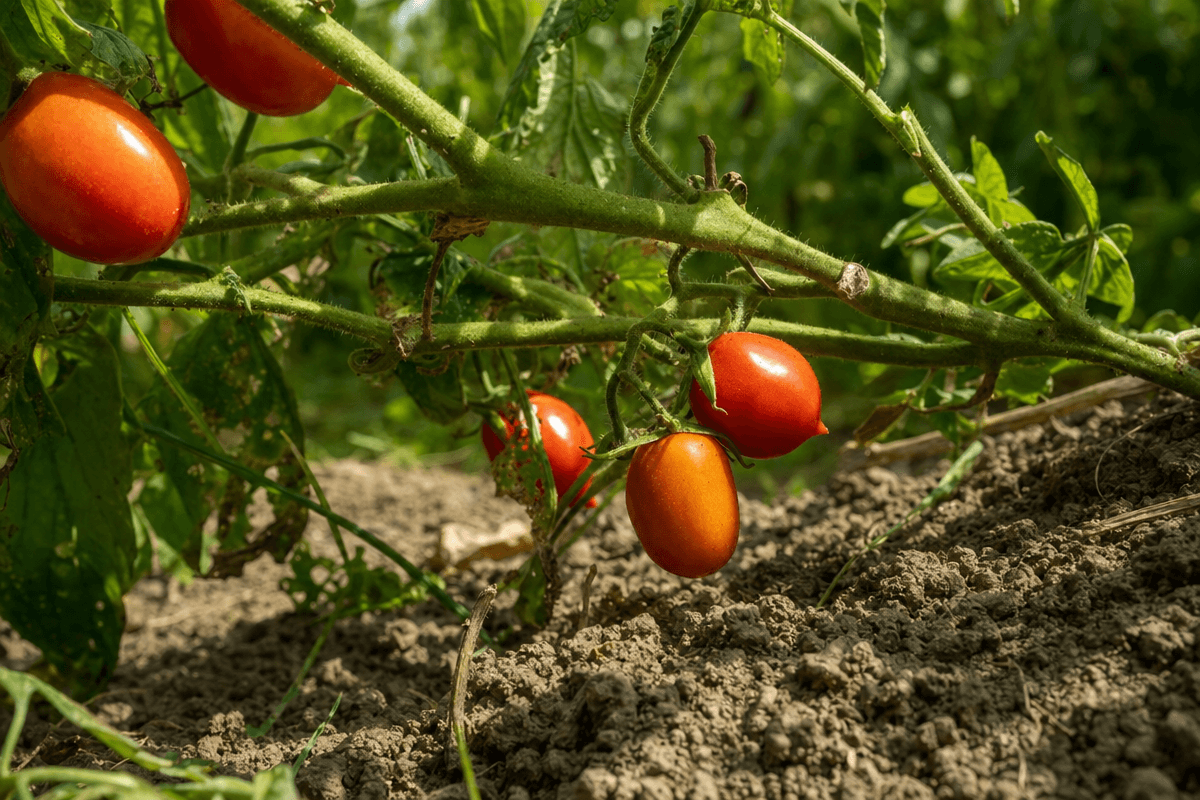
About This Plant
Tomato is a warm-season fruiting crop grown for repeated cluster harvests and needs strong light, staged nutrition, and consistent training support through the production cycle.
How to Grow Tomato
Learn how to grow Tomato from seed to harvest in 130 days. Beginner difficulty. Complete nutrient guide, pH/EC requirements, and growing conditions for hydroponics, soil & greenhouse.
Backed by 27 peer-reviewed citations.
Nutrient Requirements by Growth Stage
Hydroponic tomato nutrition must be stage-managed for optimal production. During seedling phase, nitrogen is kept low at 70-90 ppm with potassium at 120-144 ppm…
Sign in to view nutrient requirements
A free account unlocks NPK targets for all four growth stages, micronutrient levels, a per-stage nutrient calculator, and the full nutrition guide. Signing up takes one click. Truleaf is a free, non-profit project, and every new account helps it grow. No spam, ever.
Growing Environments
Tomatoes are remarkably adaptable across all four primary growing environments. Outdoor field cultivation is traditional, suitable across USDA zones 3-11 during frost-free seasons…
Temperature
Tomato seeds germinate across a wide thermal range, with practical minimum of 15C and maximum of 35C; the optimum for fast, uniform germination is 20-25C (6-8 days to emergence). For vegetative and reproductive growth, daytime temperatures of 21-27C and nighttime temperatures of 16-18C are recommended. The single-value optimum is approximately 24C as a 24-hour mean. Temperatures above 30C impair lycopene synthesis and fruit coloring, while sustained heat above 34C day / 19C night causes up to 71% reduction in fruit set. Below 15C, growth slows markedly and chilling injury may occur. A positive day-night differential (DIF) of 5-8C promotes stem elongation and photosynthesis.
Humidity
Relative humidity for hydroponic tomato production should be maintained between 60-80% during the day and 65-75% at night, with an optimal target around 70% for pollination and general growth. A vapor pressure deficit (VPD) of 0.5-0.8 kPa is recommended for most growth stages, increasing up to 1.2 kPa during late…
Light
Tomatoes are high-light-demanding crops. For mature fruiting plants, the optimal daily light integral (DLI) is 22-30 mol/m2/d, with a recommended target of 25 mol/m2/d for consistent high yields…
Airflow
Air movement is critical for tomato canopy health, CO2 replenishment, and transpiration regulation. Research demonstrates that a minimum canopy-level air velocity of 0.3 m/s is required to reach the plateau of photosynthetic production…
Sign in to view environmental requirements
A free account unlocks exact temperature, humidity, light and airflow targets, including germination and growth ranges, DLI, photoperiod and PPFD, plus the full environment guide. Signing up takes one click. Truleaf is a free, non-profit project, and every new account helps it grow. No spam, ever.
Hydroponic System Compatibility
Tomatoes thrive in most active hydroponic systems. Drip irrigation on inert substrates (rockwool, coco coir) is the global commercial standard, offering precise fertigation control and proven scalability…
Growing Media
Substrate selection significantly impacts tomato yield and nutrient dynamics. In a controlled study comparing rockwool, coconut coir, and peat-vermiculite, coconut coir produced highest fruit yield (84.9 t/hm2) versus rockwool (67.5 t/hm2) and peat-vermiculite (76.9 t/hm2), with significantly greater potassium and…
Container Specs
Container tomato cultivation requires careful sizing to prevent yield loss. The absolute minimum is 30 cm (12 inches) in both depth and width, corresponding to a 5-gallon (19 L) container suitable for compact determinate and cherry varieties…
Training & Support
Training and support are essential for productive tomato cultivation, particularly for indeterminate varieties whose single fruiting clusters can exert 4.5-5.4 kg of downward pull. The stake-and-weave (Florida weave) uses stakes between every other plant with UV-resistant twine at 15-20 cm intervals…
Sign in to view system compatibility
A free account unlocks why each of the six systems fits or fails, plus growing media, container sizes, training methods, companion plants, and the full systems guide. Signing up takes one click. Truleaf is a free, non-profit project, and every new account helps it grow. No spam, ever.
Propagation
Tomatoes are propagated by three primary methods. Seed propagation is the most common: sow seeds 6 mm deep in sterile media at 24-29C; germination occurs in 5-10 days…
Harvesting
Tomatoes are harvested by hand throughout the season as individual fruit reach desired maturity. The USDA color classification defines six stages from Mature Green through fully Red, with Brix increasing from 4.0 to 5.5 across stages…
Planting Calendar
For Northern Hemisphere temperate zones (USDA 5-8), the tomato calendar spans January through October. Seed starting indoors begins 6-8 weeks before last frost: Zone 8 in early January, Zone 6 in early-to-mid February, Zone 5 in late February…
Common Issues
Tomato crops face a wide spectrum of diseases, pests, and physiological disorders. In hydroponic and greenhouse systems, Pythium root rot is the foremost concern; warm recirculating solutions above 25C allow zoospore dispersal, requiring UV sterilization and biocontrol inoculation…
Get the full science-backed guide
By signing up, you help keep Truleaf free and support the growth of our nonprofit project. Your account unlocks full details for every plant issue—including symptoms, causes, step-by-step solutions, and prevention—plus the month-by-month planting calendar, the complete guide, and all research sources. It only takes one click. No spam, ever.
Related Plants
Basil
Herbs · Beginner
Marigold
Flowers · Beginner
Carrot
Vegetables · Intermediate
Garlic
Vegetables · Intermediate
Onion
Vegetables · Intermediate
Chive Blossom
Flowers · Beginner
Parsley
Herbs · Intermediate
Asparagus
Vegetables · Intermediate
Lavender
Herbs · Intermediate
Celery
Vegetables · Advanced
Nasturtium
Flowers · Beginner