Como Cultivar Pimenta-Preta: 9 Passos do Estacamento à Colheita
Siga 9 passos claros para cultivar pimenta-preta (Piper nigrum) em casa — desde a propagação por estacas e escolha do solo até à gestão de pragas e colheita dos seus próprios grãos de pimenta.
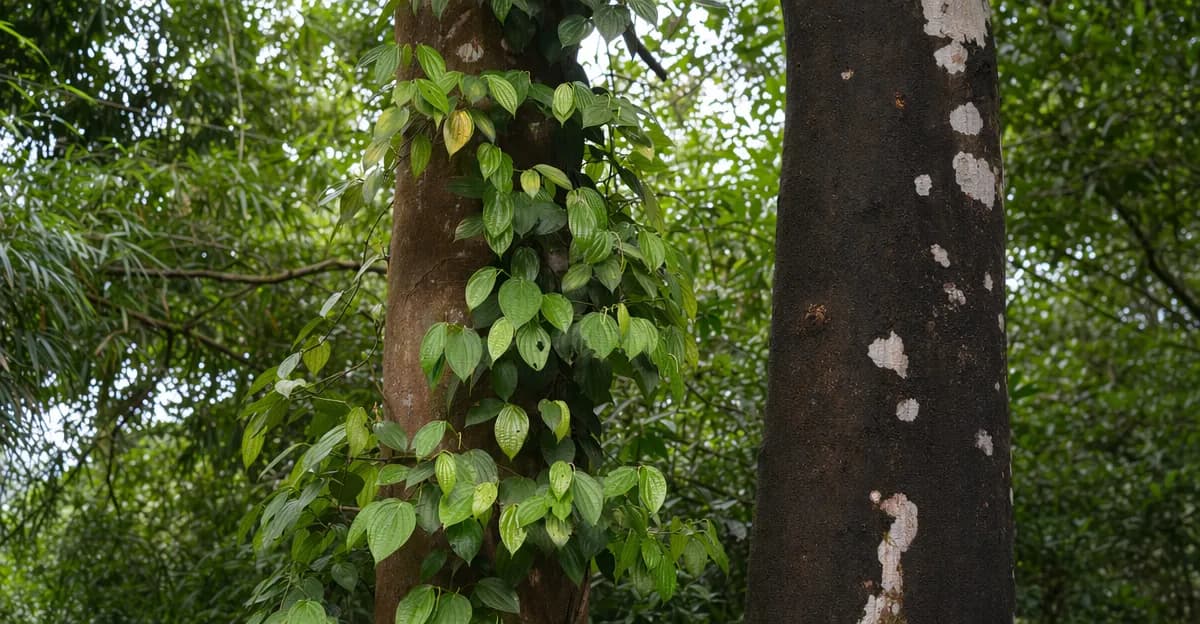
Ponto-chave: A pimenta-preta é uma trepadeira tropical que a maioria dos cultivadores domésticos consegue cultivar com sucesso em vasos — os dois fatores críticos são o calor (nunca abaixo de 10 °C) e a humidade consistente acima de 60%. Acerte estes dois pontos, e a Piper nigrum produzirá cachos de grãos de pimenta em três a cinco anos, proporcionando-lhe a versão mais fresca possível da especiaria mais comercializada do mundo.
Imagem: Varghese K James via Wikimedia Commons (CC BY 4.0). Trepadeira de pimenta-preta a crescer naturalmente numa jaqueira em Kerala, Índia — o seu habitat nativo.
Porquê a pimenta-preta merece um lugar no seu jardim
A pimenta-preta (Piper nigrum) é uma trepadeira lenhosa perene nativa da Costa do Malabar, no sudoeste da Índia. Pertence à família Piperaceae e é, em volume, a especiaria mais comercializada do planeta — um título que mantém há mais de dois mil anos. Na Roma Antiga, os grãos de pimenta eram usados como moeda. Atualmente, a produção global ultrapassa as 460.000 toneladas por ano, liderada pelo Vietname, Índia, Brasil e Indonésia (Guilherme et al., 2019).
O ardor característico provém da piperina, um alcaloide bioativo concentrado na camada exterior do fruto. A pimenta-preta moída contém cerca de 3% de óleo essencial, que proporciona a sua complexidade aromática — notas que desaparecem em poucas semanas após a moagem, e é exatamente por isso que os grãos cultivados em casa, moídos na hora, têm um sabor dramaticamente diferente do pó pré-moído esquecido no fundo do armário.
Para cultivadores domésticos fora dos trópicos, a boa notícia é que a Piper nigrum se adapta bem ao cultivo em vasos. Pode ser mantida compacta numa pequena treliça, tolera ambientes interiores quando a humidade e o calor são controlados, e é uma atraente planta perene de folhagem com as suas folhas brilhantes em forma de coração — mesmo antes de começar a frutificar.
1) Clima e seleção do local
A pimenta-preta é uma planta dos trópicos húmidos, naturalmente distribuída entre as latitudes 20° Norte e 20° Sul. Na natureza, trepa pelos troncos das árvores nos Ghats Ocidentais da Índia — a única fonte conhecida de germoplasma selvagem de P. nigrum (Tirumala Rao et al., 2017).
Temperatura: A gama ideal para crescimento ativo é de 23–32 °C, com melhor desempenho por volta dos 28 °C (Penn State PlantVillage). A trepadeira tolera uma gama mais ampla de 10–40 °C (Guilherme et al., 2019), mas o crescimento abranda abaixo dos 20 °C e a planta sofre danos nos tecidos abaixo dos 10 °C. A geada é fatal.
Rusticidade: Zonas USDA 10–12 para cultivo ao ar livre durante todo o ano. Nas zonas 9 e inferiores, cultive a pimenta-preta em vasos que possa levar para dentro de casa quando as temperaturas noturnas desçam abaixo dos 15 °C. O Missouri Botanical Garden classifica-a como zona 12, observando que é "intolerante a temperaturas de inverno abaixo de 10 °C."
Luz: Sombra parcial a luz indireta intensa. No seu habitat natural, a pimenta-preta cresce sob o copado da floresta, recebendo luz filtrada em vez de exposição direta. Procure oferecer cerca de seis horas de luz intensa e filtrada por dia. O sol direto da tarde, especialmente em climas quentes, pode queimar as folhas.
Precipitação/equivalente de rega: Nas plantações comerciais, a precipitação anual de 1.250–2.000 mm, bem distribuída ao longo da estação de crescimento, é considerada ideal (Karnataka State Spices Development Board). A pimenta-preta também prospera em regiões equatoriais mais húmidas, recebendo até 3.000 mm, desde que a drenagem seja adequada. Para cultivadores em vasos, isto traduz-se em humidade consistente — consulte a secção 4.
2) Solo e substrato
A pimenta-preta exige solo bem drenado, rico em matéria orgânica e com boa arejamento. Raízes encharcadas são a causa mais comum de insucesso.
pH: 5,5–6,5 (ligeiramente ácido). Investigações sobre o estado nutricional em solos de P. nigrum confirmam que trepadeiras vigorosas crescem consistentemente em solos dentro desta gama, com N-total em torno de 0,22% e fósforo e potássio adequados (BIOTROP Journal).
Textura: Franco-arenoso a franco é o ideal. Evite argila pesada, a menos que seja corrigida com matéria orgânica grosseira e perlite para evitar compactação.
Mistura para vasos: Uma mistura de envasamento tropical bem drenada funciona bem. Combine:
- 40% substrato de envasamento de alta qualidade
- 30% perlite ou pedra-pomes (para drenagem e arejamento)
- 20% fibra de coco (para retenção de humidade)
- 10% casca compostada ou húmus de minhoca (para nutrientes de libertação lenta)
Nota: A pimenta-preta é altamente suscetível à podridão radicular. Na dúvida, prefira uma mistura mais arenosa e de drenagem mais rápida em vez de uma que retenha mais humidade.
3) Propagação
A pimenta-preta pode ser iniciada a partir de sementes, estacas de caule ou estolhos (rebentos rasteiros). As estacas são o método-padrão tanto para produtores comerciais como para entusiastas — estabelecem-se mais rapidamente e produzem plantas fiéis ao tipo original.
A partir de estacas:
- Selecione caules semi-lenhosos dos ramos laterais de uma trepadeira saudável e em frutificação. Evite o caule principal de escalada.
- Corte segmentos de 15–20 cm de comprimento, cada um com dois ou três nós e pelo menos uma folha.
- Mergulhe a extremidade cortada em hormona de enraizamento (opcional, mas útil).
- Plante numa mistura húmida de 50/50 perlite e fibra de coco, enterrando um ou dois nós abaixo da superfície.
- Mantenha num local quente (25–30 °C) e húmido, com luz indireta intensa. Uma campânula de humidade ou saco plástico sobre o vaso ajuda.
- As raízes formam-se normalmente em quatro a seis semanas. Transplante quando a estaca tiver produzido de quatro a sete folhas novas.
A partir de sementes: Grãos frescos (não secos e processados da prateleira de especiarias) podem ser semeados a cerca de 5 mm de profundidade numa mistura húmida para germinação. A germinação é lenta — até 30–40 dias — e as plântulas desenvolvem-se muito mais lentamente do que as estacas. As sementes de grãos de pimenta-preta secos geralmente não são viáveis porque a etapa de fervura no processamento mata o embrião.
Dica: Se encomendar estacas ou plantas online, procure cultivares nomeadas quando disponíveis. Panniyur-1 é um híbrido indiano bem estudado, conhecido pela alta produtividade e qualidade. Karimunda e Sreekara são cultivares tradicionais fiáveis com boa tolerância a doenças.
4) Rega e humidade
A pimenta-preta é sensível à seca. Investigações sobre eficiência do uso da água em P. nigrum demonstraram que tanto a altura da planta como a área foliar diminuem acentuadamente sob stress hídrico, com cultivares suscetíveis a apresentar danos significativos na membrana celular em seis dias de seca (MDPI, 2023). Ao mesmo tempo, o excesso de rega causa podridão radicular — o problema que mais mata esta trepadeira.
Frequência de rega: Mantenha o solo consistentemente húmido, mas nunca encharcado. Permita que os 2–3 cm superiores do solo sequem ligeiramente entre as regas. Na prática, isto significa geralmente regar a cada dois ou três dias durante a estação quente de crescimento e reduzir para uma vez por semana no inverno, quando o crescimento abranda.
Humidade: Procure manter 60–80% de humidade relativa do ar. Em ambientes interiores secos, a trepadeira terá dificuldades. Para aumentar a humidade:
- Coloque o vaso sobre um prato de seixos com água (vaso acima do nível da água).
- Agrupe-a com outras plantas tropicais.
- Utilize um humidificador próximo.
- Pulverize a folhagem de manhã (evite pulverizar à noite, o que pode favorecer problemas fúngicos).
Nota divergente: Alguns guias de cultivo recomendam pulverização diária como principal estratégia de humidade. Investigações sobre patógenos fúngicos em P. nigrum sugerem que isto pode aumentar o risco de doenças foliares em espaços mal ventilados. Um humidificador ou prato de seixos é mais fiável e seguro para a planta.
5) Fertilização
A pimenta-preta tem uma exigência nutricional baixa a moderada. O excesso de fertilização, especialmente com azoto, promove crescimento vegetativo exuberante em detrimento da floração e frutificação.
Abordagem equilibrada: Utilize um fertilizante líquido equilibrado (10-10-10 ou proporção NPK semelhante) diluído a metade da concentração, aplicado a cada quatro a seis semanas durante a estação ativa de crescimento (primavera ao outono). Reduza ou suspenda a fertilização no inverno.
Opção orgânica: Aplique uma cobertura de húmus de minhoca ou composto bem curtido duas a três vezes por ano. Uma camada fina de mulch de casca compostada ajuda a manter a biologia do solo e fornece nutrientes de libertação lenta.
Micronutrientes: A pimenta-preta beneficia de magnésio e ferro, particularmente em solos alcalinos ou empobrecidos. Se notar amarelecimento entre as nervuras das folhas (clorose internerval), suplemente com um fertilizante equilibrado de micronutrientes ou uma rega com sal de Epsom (1 colher de chá por litro de água, aplicada uma vez por mês).
Nota: Não siga dosagens fixas de marcas específicas. As necessidades nutricionais variam conforme o tamanho do vaso, substrato e condições de cultivo. Comece de forma conservadora e aumente apenas se a planta apresentar sintomas de carência.
Calendário Detalhado de Nutrientes por Fase de Crescimento
Os conselhos gerais de fertilização acima são suficientes para a maioria dos cultivadores domésticos. Para quem deseja otimizar o crescimento e a frutificação, aqui está um guia nutricional específico por fase, baseado nas exigências fisiológicas da Piper nigrum em cada etapa de desenvolvimento.
Fase 1 — Estabelecimento (meses 1–12): Durante o primeiro ano, a trepadeira concentra-se no desenvolvimento das raízes e no crescimento inicial de escalada. A exigência nutricional é baixa. Aplique um fertilizante líquido equilibrado (NPK 10-10-10) a um quarto da concentração a cada seis a oito semanas. O excesso de azoto nesta fase promove crescimento fraco e espigado com má formação de raízes. O pH do solo deve ser mantido entre 5,5–6,5 para assegurar a disponibilidade de micronutrientes.
Fase 2 — Crescimento vegetativo (ano 1–3): Uma vez que a trepadeira esteja a escalar ativamente e a produzir novos ramos laterais, aumente a fertilização para fertilizante equilibrado a meia concentração a cada quatro a seis semanas. Nesta fase, uma proporção ligeiramente mais rica em azoto (ex.: NPK 3-1-2) favorece o desenvolvimento da copa. Investigações em solos produtivos de P. nigrum mostram que níveis de N-total em torno de 0,22% com fósforo e potássio adequados se correlacionam com crescimento vegetativo vigoroso.
Fase 3 — Pré-floração e floração (ano 3–4): À medida que a trepadeira se aproxima da maturidade reprodutiva, mude para uma formulação rica em potássio (ex.: NPK 2-3-4). O potássio apoia a iniciação floral e a formação dos frutos. Reduza o azoto para evitar crescimento vegetativo excessivo em detrimento das flores. Continue a fertilizar a cada quatro a seis semanas durante a estação de crescimento.
Fase 4 — Frutificação e colheita (ano 4+): Durante a frutificação ativa, a exigência de potássio da trepadeira atinge o pico. Aplique um fertilizante líquido rico em potássio (ex.: NPK 1-2-4) a cada quatro semanas durante a estação de frutificação. Cada espiga desenvolve aproximadamente 50 drupas ao longo de seis a oito meses, e o custo energético do desenvolvimento dos frutos é significativo. Suplemente com uma rega de micronutrientes contendo magnésio e ferro duas vezes durante a estação de frutificação. Após a colheita, regresse a uma formulação equilibrada para apoiar a recuperação e o novo crescimento.
| Fase | Período | Proporção NPK Sugerida | Frequência | Foco Principal |
|---|---|---|---|---|
| Estabelecimento | Meses 1–12 | 10-10-10 (um quarto da concentração) | A cada 6–8 semanas | Desenvolvimento radicular |
| Vegetativo | Ano 1–3 | 3-1-2 (meia concentração) | A cada 4–6 semanas | Crescimento da copa e ramos |
| Pré-floração | Ano 3–4 | 2-3-4 (meia concentração) | A cada 4–6 semanas | Iniciação floral |
| Frutificação | Ano 4+ | 1-2-4 (concentração total) | A cada 4 semanas | Desenvolvimento e qualidade dos frutos |
Nota: Estas proporções são orientações, não prescrições. Ajuste conforme a resposta da sua trepadeira, tipo de substrato e qualidade da água local. Uma análise de solo ou tecido vegetal uma vez por ano fornece dados mais úteis do que qualquer calendário fixo.
6) Condução e suporte
Na natureza, as trepadeiras de pimenta-preta trepam troncos de árvores usando raízes aéreas, alcançando até 10 m de altura. Na cultura, as trepadeiras são tipicamente mantidas a 3–4 m nas plantações comerciais. Em vasos, pode mantê-las bem mais pequenas.
Para vasos: Forneça um suporte resistente — um tutor de musgo, treliça de bambu ou pequena estrutura de madeira — com pelo menos 1–1,5 m de altura. As raízes aéreas da trepadeira agarram-se a superfícies rugosas e húmidas, pelo que um tutor de musgo ou estaca envolvida em fibra de coco é ideal.
Poda: Desponte as extremidades dos ramos laterais no início da primavera para estimular um crescimento mais arbustivo e mais ramos floríferos. Remova caules mortos, danificados ou voltados para dentro para melhorar a circulação de ar. Numa trepadeira em vaso, procure manter de três a cinco caules principais conduzidos no suporte.
Tamanho do vaso: Comece com um vaso de pelo menos 45–60 cm de profundidade com amplos orifícios de drenagem. A pimenta-preta tem um sistema radicular relativamente superficial, concentrado nos 30 cm superiores do solo, mas a profundidade é importante para a drenagem.
7) Pragas e doenças
A doença mais destrutiva da pimenta-preta em todo o mundo é a podridão do pé causada por Phytophthora, provocada principalmente por Phytophthora capsici e, como investigações moleculares recentes demonstraram, pela sua espécie-irmã Phytophthora tropicalis (Bhai et al., 2022). A doença causa emurchecimento súbito, escurecimento do caule e morte rápida da planta. Prospera em solo encharcado durante condições quentes e húmidas — a atividade do patógeno atinge o pico a temperaturas do solo de 22–28 °C com humidade relativa acima de 80% (ScienceDirect, 2022).
A prevenção é muito mais eficaz do que o tratamento:
- Assegure excelente drenagem. Nunca deixe o vaso em água estagnada.
- Evite molhar a base do caule ao regar.
- Mantenha boa circulação de ar ao redor da planta.
- Utilize substrato limpo e pasteurizado.
- Aplique produtos de biocontrolo à base de Trichoderma como drench preventivo no solo — a investigação confirma que Trichoderma harzianum reduz significativamente a incidência de podridão do pé em P. nigrum.
Outras doenças:
- Antracnose (Colletotrichum spp.): lesões escuras e deprimidas em folhas e frutos. Melhore a circulação de ar e remova as partes afetadas.
- Declínio lento: causado por um complexo de nemátodos das galhas e fungos do solo. Cultivadores em vasos que usam substrato pasteurizado raramente encontram este problema.
Pragas comuns:
- Percevejo-rendado da pimenta e cochonilhas: insetos sugadores de seiva encontrados na página inferior das folhas. Trate com sabão inseticida ou óleo de nim.
- Afídeos: comuns nos rebentos tenros. Remova com um jato forte de água ou aplique nim.
- Besouro pollu (Longitarsus nigripennis): uma praga importante no campo na Índia que danifica frutos em desenvolvimento. Raramente encontrada no cultivo em vasos em climas temperados.
Nota: Para cultivadores domésticos fora dos trópicos, a podridão radicular por excesso de rega é, de longe, o problema mais provável. As doenças e pragas exóticas de campo listadas acima são mencionadas para completude, mas são incomuns em vasos com boas práticas de cultivo.
Guia Avançado de Diagnóstico e Resolução de Problemas
Os problemas comuns acima cobrem a maioria das situações que os cultivadores domésticos encontram. Esta secção aborda cenários de diagnóstico menos óbvios e protocolos de recuperação para quando as coisas correm mal apesar de boas práticas culturais.
Árvore de decisão de diagnóstico — trepadeira murcha:
-
Verifique a humidade do solo primeiro. Insira um dedo 5 cm no substrato.
- Solo está seco: Falta de rega. Retome a rega regular. O emurchecimento por stress hídrico normalmente reverte-se em 24–48 horas se detetado cedo. A investigação mostra que os danos na membrana celular começam em seis dias de seca sustentada, pelo que deve agir rapidamente.
- Solo está húmido ou encharcado: Provável podridão radicular. Passe ao passo 2.
-
Inspecione a base do caule e as raízes.
- Base do caule enegrecida e mole com mau cheiro: Podridão do pé por Phytophthora. Retire a planta do vaso, corte todo o tecido enegrecido até encontrar tecido saudável, branco ou verde, polvilhe as superfícies cortadas com fungicida à base de cobre e replante em substrato fresco e estéril. Aplique um drench de Trichoderma harzianum no solo como preventivo. A taxa de recuperação é baixa se mais de 50% do sistema radicular estiver afetado — nesse caso, faça estacas saudáveis da parte acima da infeção para iniciar uma nova planta.
- Raízes acastanhadas e moles, mas caule intacto: Podridão radicular geral por excesso de rega. Corte as raízes mortas, replante numa mistura mais arenosa e reduza a frequência de rega. A recuperação demora quatro a oito semanas.
- Raízes saudáveis e brancas: O emurchecimento não está relacionado com as raízes. Verifique stress por temperatura (abaixo de 10 °C) ou choque recente de transplante.
Árvore de decisão de diagnóstico — folhas amareladas:
| Padrão | Causa Provável | Ação |
|---|---|---|
| Folhas mais velhas amarelecem primeiro, de forma uniforme | Carência de azoto | Aumente N na fertilização; verifique se o pH está entre 5,5–6,5 |
| Amarelo entre nervuras, nervuras permanecem verdes | Carência de magnésio ou ferro | Drench com sal de Epsom ou suplemento de ferro quelado |
| Folhas novas pálidas ou amarelas | Carência de ferro (frequentemente relacionada com o pH) | Reduza o pH para 5,5–6,0; aplique ferro quelado |
| Amarelecimento súbito com queda de folhas | Stress radicular ou exposição ao frio | Verifique as raízes; confirme temperatura acima de 15 °C |
| Manchas amarelas com margens escuras | Infeção fúngica (antracnose) | Remova folhas afetadas; melhore a circulação de ar |
Prazos de recuperação:
- Stress hídrico ligeiro: 1–3 dias para recuperação total da turgescência
- Podridão radicular (deteção precoce, menos de 25% de perda de raízes): 4–8 semanas para novo crescimento radicular
- Podridão radicular (moderada, 25–50% de perda de raízes): 8–16 semanas; pode a copa em um terço para reduzir a exigência de transpiração
- Dano por frio (exposição a 5–10 °C): As folhas danificadas não recuperarão — pode-as quando novos rebentos surgirem (normalmente 3–6 semanas em condições quentes)
- Infeção severa por Phytophthora: Faça estacas e propague novamente em vez de tentar salvar a planta
Quando desistir: Se uma trepadeira perdeu mais de 75% do sistema radicular ou tem infeção por Phytophthora que se estende acima do primeiro nó, é mais eficiente propagar a partir de secções saudáveis do caule do que tentar a recuperação. As estacas da porção superior não infetada enraízam em quatro a seis semanas e ultrapassarão a recuperação da planta original.
8) Colheita e processamento
A paciência é essencial. Trepadeiras de pimenta-preta cultivadas a partir de estacas normalmente começam a florescer no terceiro ou quarto ano, com pico de produção a partir do quinto ano. Uma trepadeira saudável pode produzir durante 20–40 anos (Britannica).
Quando colher: Cada espiga floral desenvolve cerca de 50 pequenas drupas ao longo de seis a oito meses (Britannica). Colha quando os primeiros frutos de cada espiga começarem a mudar de verde para amarelo ou vermelho — isto indica que a espiga está a aproximar-se da maturidade plena.
Tipos de processamento — todos a partir do mesmo fruto:
| Tipo | Método | Sabor |
|---|---|---|
| Preta | Colha quando um ou dois frutos da espiga ficarem vermelhos. Escalde em água a ferver durante 10 minutos, depois seque ao sol (ou desidrate a 50 °C) durante três a cinco dias até ficarem enrugados e escuros. | Completo, complexo, pungente |
| Branca | Colha totalmente maduras (vermelhas). Deixe de molho em água durante 7–15 dias até a casca exterior amolecer, depois remova o pericarpo por fricção. Enxague e seque. | Mais acentuada, menos complexa, terrosa |
| Verde | Colha imaturas (verdes). Liofilize, desidrate imediatamente ou conserve em salmoura para manter a cor verde. | Fresca, vibrante, ligeiramente pungente |
Rendimento: A recuperação seca a partir de frutos frescos varia normalmente de 26–39%, dependendo da cultivar e de se os frutos foram escaldados antes da secagem (o escaldamento melhora a recuperação para cerca de 33–39%). Uma trepadeira madura em vaso em condições ideais pode produzir várias centenas de gramas de pimenta seca por ano — suficiente para abastecer uma família.
9) Roteiro prático para iniciantes
Se esta é a sua primeira trepadeira de pimenta-preta, eis um plano passo a passo:
- Obtenha uma planta saudável ou estaca enraizada. Cultivares nomeadas são preferíveis quando disponíveis, mas qualquer P. nigrum vigorosa de um viveiro de confiança serve. Evite comprar grãos secos como semente — o processamento torna-os inviáveis.
- Escolha um vaso com pelo menos 45 cm de profundidade e múltiplos orifícios de drenagem. Terracota é excelente pela respirabilidade; plástico retém humidade durante mais tempo (uma faca de dois gumes com esta planta).
- Prepare o seu substrato. Siga a receita da secção 2. Preencha o vaso, regue bem e deixe drenar completamente antes de plantar.
- Instale um suporte. Coloque um tutor de musgo ou treliça de bambu no centro do vaso antes de plantar. A trepadeira não se manterá de pé sozinha.
- Plante e regue. Posicione o torrão à mesma profundidade em que estava no vaso do viveiro. Regue até a água escorrer pelos orifícios de drenagem, depois deixe o excesso drenar.
- Encontre o local certo. Luz indireta intensa; longe de correntes de ar frio e saídas de aquecimento; temperatura mínima de 18 °C durante todo o ano. Um parapeito de janela na casa de banho ou cozinha frequentemente oferece calor e humidade naturais.
- Estabeleça um ritmo de rega. Verifique os 2–3 cm superiores do solo a cada dois dias. Regue quando estiver seco ao toque. Registe o seu calendário durante o primeiro mês para calibrar.
- Fertilize com moderação. Comece a fertilizar um mês após o plantio. Fertilizante líquido equilibrado a meia concentração a cada quatro a seis semanas durante a estação de crescimento.
- Tenha paciência. A trepadeira passará os seus primeiros um a dois anos a estabelecer raízes e a trepar o suporte. Não espere frutos antes do terceiro ano. A sua primeira temporada deve ser tratada como um período de observação — acompanhe a resposta da planta ao seu ambiente e ajuste luz, água e humidade conforme necessário.
Guia de Escalonamento Comercial
Para produtores que consideram a pimenta-preta como cultura comercial, a economia e a logística diferem substancialmente do cultivo doméstico em vasos. Esta secção descreve as considerações principais para escalar de uma trepadeira de hobby para uma plantação produtiva ou sistema intensivo.
Expectativas de rendimento:
A produção global média é de aproximadamente 462.000 toneladas por ano numa área estimada de mais de 530.000 hectares, resultando numa média global aproximada de cerca de 870 kg/ha. Contudo, os rendimentos variam enormemente por região, cultivar e gestão:
| Região ou Sistema | Rendimento Típico (seco, kg/ha) | Observações |
|---|---|---|
| Vietname (intensivo) | 2.000–4.000 | Plantio denso em postes de betão, uso intensivo de fatores de produção |
| Índia (tradicional) | 300–500 | Cultivo à sombra em árvores vivas como suporte |
| Índia (cultivares melhoradas) | 800–1.500 | Panniyur-1, Sreekara em suportes de madeira morta |
| Brasil (semi-intensivo) | 1.500–2.500 | Sistemas a pleno sol, potencial de colheita mecanizada |
Densidade de plantio e sistemas de suporte:
As plantações comerciais normalmente espaçam as trepadeiras de 2,5 x 2,5 m a 3 x 3 m, resultando em 1.100–1.600 plantas por hectare. As opções de suporte incluem:
- Suportes vivos (ex.: Erythrina spp., Gliricidia sepium): Tradicionais na Índia e Sri Lanka. A árvore fornece sombra e fixação de azoto. Menor custo de estabelecimento, mas requer poda anual do suporte.
- Suportes de madeira morta: Pilares de granito ou betão, de 3–4 m de altura. Maior investimento inicial, mas maior durabilidade e gestão mais fácil das trepadeiras. Padrão no Vietname.
- Sistemas de treliça: Treliças de arame com postes de betão. Permitem plantio mais denso e colheita mais fácil. Em crescente adoção no Brasil e em plantações mais recentes do Vietname.
Custos de estabelecimento e cronograma:
| Item | Custo Aproximado (USD/ha) |
|---|---|
| Preparação do terreno e instalação de suportes | 2.000–5.000 |
| Material de plantio (1.200 estacas) | 600–1.200 |
| Infraestrutura de rega | 1.000–3.000 |
| Fertilizantes e biocontrolo (primeiros 3 anos) | 500–1.000/ano |
| Mão de obra (plantio, condução, manutenção) | Variável por região |
| Total de estabelecimento (anos 1–3) | 5.000–12.000 |
As trepadeiras começam a produzir no ano 3–4 a partir de estacas e atingem produtividade plena no ano 6–7. O ponto de equilíbrio ocorre normalmente no ano 5–7, dependendo do preço de mercado e do rendimento. Uma plantação bem gerida permanece produtiva durante 20–40 anos, tornando a longa fase de estabelecimento um investimento compensador.
Considerações sobre mão de obra:
- Colheita é a operação mais intensiva em mão de obra. Cada espiga deve ser colhida individualmente quando um ou dois frutos ficam vermelhos. Um apanhador treinado pode colher 15–20 kg de frutos frescos por dia.
- Processamento (escaldamento, secagem ou imersão para pimenta branca) requer instalações dedicadas. A secagem ao sol necessita de 3–5 dias de tempo consistente; secadores mecânicos oferecem fiabilidade com custo adicional de capital.
- Monitorização de pragas e doenças é crítica. A podridão do pé por Phytophthora pode destruir uma secção inteira da plantação numa única estação de chuvas se a drenagem e o biocontrolo forem negligenciados.
Considerações de mercado:
A pimenta-preta seca é comercializada a aproximadamente USD 3.000–7.000 por tonelada, dependendo da origem, grau e condições de mercado. Produtos especiais (origem única, certificação biológica, grau Malabar ou Tellicherry) obtêm prémios de 50–200% acima dos preços de commodity. Para pequenos produtores comerciais, os mercados de especialidades e venda direta ao consumidor oferecem as margens mais atrativas.
Consideração final
Cultivar pimenta-preta em casa é um jogo de longo prazo. A trepadeira recompensa a paciência: três a cinco anos de cuidado atento ao calor, humidade e drenagem antes da primeira colheita, depois décadas de produção a partir de uma única planta. Os dois controlos de maior impacto são a temperatura (nunca abaixo de 10 °C) e a drenagem do solo (a podridão radicular mata mais trepadeiras de pimenta em vasos do que qualquer praga ou doença). Acerte estes pontos, mantenha a humidade acima de 60%, fertilize com moderação, e terá um fornecimento constante dos grãos de pimenta mais frescos e aromáticos que alguma vez provou — colhidos de uma trepadeira a trepar um tutor na sua sala de estar.