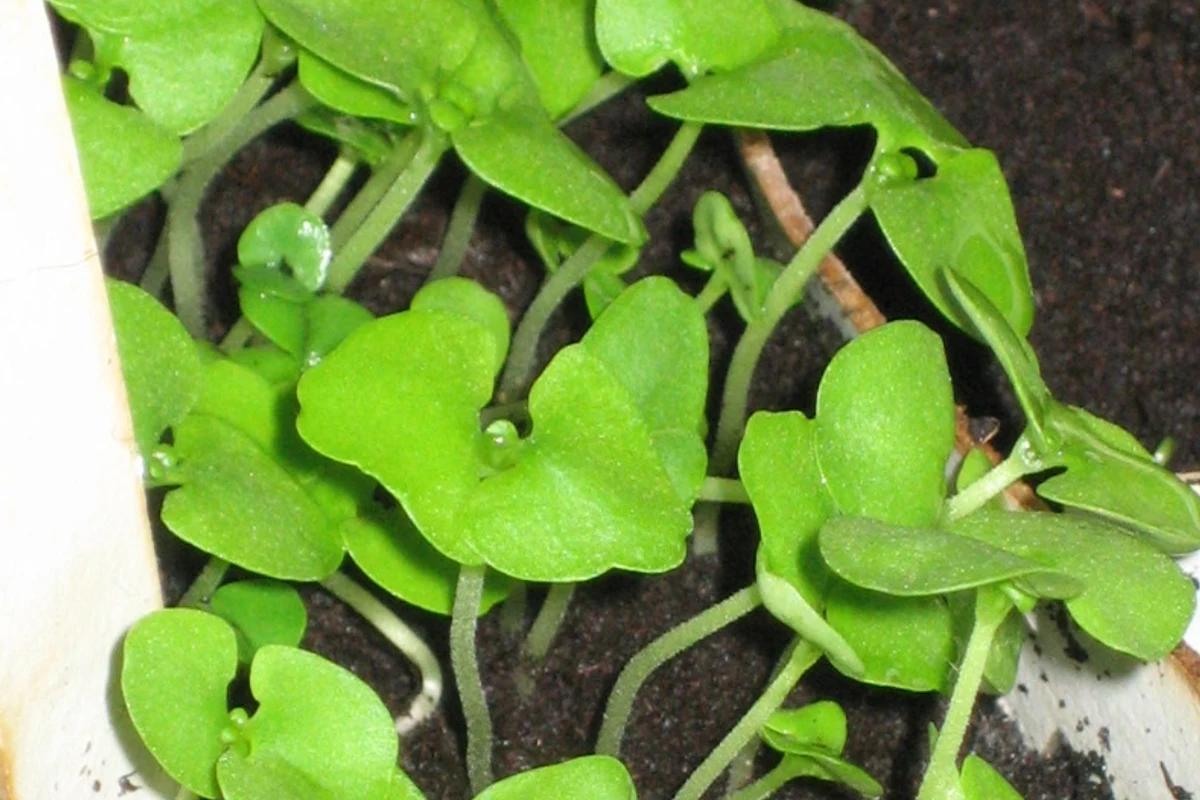
About This Plant
Basil microgreens are aromatic Ocimum basilicum seedlings harvested once at the cotyledon to first-true-leaf stage. They are slower and more moisture-sensitive than brassica microgreens, but reward clean tray culture with intense basil flavor, vivid color, and high-value garnish quality.
How to Grow Basil Microgreens
Learn how to grow Basil Microgreens from seed to harvest in 16 days. Beginner-friendly. Planting, care, feeding and the right growing conditions.
Sources cited: 13.
Nutrient Requirements by Growth Stage
Use water or pre-moistened substrate during blackout, then apply low-to-moderate fertility only after germination if the tray is grown on inert media or held to first true leaf. In a floating basil-microgreen study, 50% Hoagland gave the highest yield, supplying about 105 ppm N, 15.5 ppm P, 117.5 ppm K, 100 ppm Ca, 24…
Sign in to view nutrient requirements
A free account unlocks NPK targets for all four growth stages, micronutrient levels, a per-stage nutrient calculator, and the full nutrition guide. Signing up takes one click. Truleaf is a free, non-profit project, and every new account helps it grow. No spam, ever.
Growing Environments
Basil microgreens fit indoor, greenhouse, and container production. Extension guides emphasize shallow trays, protected structures, windowsills, shelves, or grow lights, and academic studies show controlled floating, ebb-and-flow, and mat-based systems can produce marketable basil microgreens…
Temperature
Basil microgreens are warm, short-cycle seedlings. Controlled floating-system trials germinated seed at 25 C and grew trays at about 24/22 C day/night, while an ebb-and-flow study used 23/18 C day/night. Use 24-25 C for rapid germination and 20-25 C during growth, with 23-24 C as a practical target.
Humidity
Academic basil-microgreen trials commonly used moderate-to-high humidity, including 65-75% RH in floating culture and about 60% RH in ebb-and-flow culture. For production, keep normal crop humidity closer to 55-70% and reserve 70-75% for covered germination only, because dense trays and mucilaginous basil seed hold…
Light
Basil microgreens tolerate and respond strongly to controlled LED lighting. A 300 umol m-2 s-1 PPFD with a 16 h photoperiod gives about 17.3 mol m-2 d-1 DLI and matches multiple basil-microgreen studies using 300 PPFD…
Airflow
Airflow is a disease-control requirement for basil microgreens, not just a comfort setting. Dense seed, humid covers, wet mats, and basil seed mucilage create a moist boundary layer where damping-off and visible mold can spread…
Sign in to view environmental requirements
A free account unlocks exact temperature, humidity, light and airflow targets, including germination and growth ranges, DLI, photoperiod and PPFD, plus the full environment guide. Signing up takes one click. Truleaf is a free, non-profit project, and every new account helps it grow. No spam, ever.
Hydroponic System Compatibility
The strongest system fits are shallow tray culture, ebb-and-flow benches, hydroponic mats, and floating or static raft trays. Ebb-and-flow and bottom watering keep foliage drier than overhead watering, while floating systems are supported by basil-microgreen nutrient trials…
Growing Media
Use a clean shallow soilless medium or hydroponic mat. Basil-microgreen studies used cocopeat/perlite mixes, rockwool, natural fiber mats, and agar or perlite experimental substrates…
Container Specs
A standard 10 x 20 inch shallow plastic microgreen tray with drainage nested in a solid bottom tray is sufficient. Use about 2.5-5 cm of media; University of Maryland recommends 1-1.5 inches for microgreens, while basil microplant research notes that deeper substrates up to 6 cm can improve harvestable fresh weight…
Training & Support
No trellis, pruning, topping, thinning, or support is used for basil microgreens. The crop is intentionally dense, remains in the final tray, and is harvested once at the cotyledon to early true-leaf stage…
Sign in to view system compatibility
A free account unlocks why each of the six systems fits or fails, plus growing media, container sizes, training methods, companion plants, and the full systems guide. Signing up takes one click. Truleaf is a free, non-profit project, and every new account helps it grow. No spam, ever.
Propagation
Basil microgreens are propagated only by seed. Sow dry seed densely on moist media or a clean hydroponic mat, press for seed-to-media contact, and cover or weight during early germination…
Harvesting
Harvest basil microgreens once, not as cut-and-come-again basil. Cut stems just above the media or mat with sanitized scissors when cotyledons are fully expanded and first true leaves are beginning to appear…
Planting Calendar
Treat basil microgreens as a year-round indoor or protected tray crop. Sow a new tray whenever supply is needed, cover for roughly 4-7 days under Utah State guidance, then grow under light until the cotyledon to first-true-leaf harvest window…
Common Issues
The main production failures are damping-off, mold, uneven germination, legginess, seed hull retention, and food-safety contamination. Damping-off is commonly associated with Pythium or Rhizoctonia, and Pythium ultimum has been studied directly on basil microgreens…
Get the full science-backed guide
By signing up, you help keep Truleaf free and support the growth of our nonprofit project. Your account unlocks full details for every plant issue—including symptoms, causes, step-by-step solutions, and prevention—plus the month-by-month planting calendar, the complete guide, and all research sources. It only takes one click. No spam, ever.