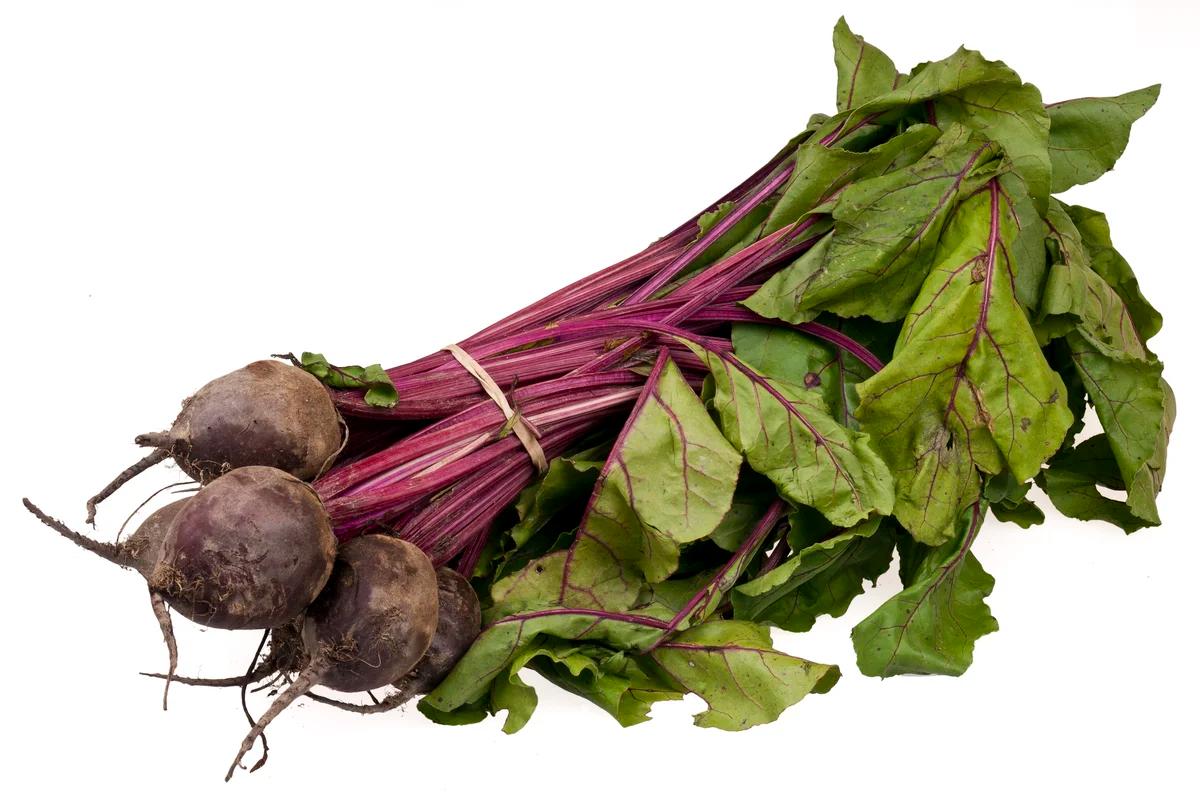
About This Plant
Beet (Beta vulgaris) is a cool-season biennial root crop in the Amaranthaceae family, harvested in year one for its swollen taproot and nutritious greens. A potassium-dominant feeder with the highest boron demand of any common vegetable, beet thrives in all major hydroponic systems with EC 1.4-3.0 mS/cm and a uniquely high pH preference of 6.0-7.0. Each seed cluster contains 2-5 embryos requiring thinning unless monogerm varieties are used. Root bulking occurs over 21 days at 15-18C, producing roots averaging 150g per plant and 4.0 kg/m2. Nitrogen must be reduced during root bulking while potassium increases to promote sugar accumulation and root quality. Beet is biennial and does not flower during cultivation; all flowering-stage values are zero.
How to Grow Beet
Learn how to grow Beet from seed to harvest in 70 days. Beginner-friendly. Planting, care, feeding and the right growing conditions.
Sources cited: 28.
Nutrient Requirements by Growth Stage
Beet follows a distinctive potassium-dominant nutrition pattern with nitrogen that decreases during root bulking. During seedling establishment (EC 0.8-1.4), provide moderate NPK at 100-28-125 ppm to support early growth without salt stress…
Sign in to view nutrient requirements
A free account unlocks NPK targets for all four growth stages, micronutrient levels, a per-stage nutrient calculator, and the full nutrition guide. Signing up takes one click. Truleaf is a free, non-profit project, and every new account helps it grow. No spam, ever.
Growing Environments
Beets are highly adaptable and grow across all common environments. Outdoor: plant as a cool-season crop in spring or fall; full sun preferred; tolerates light frost to approximately -2C; USDA zones 2a-11b…
Temperature
Beet (Beta vulgaris) is a cool-season crop with distinct temperature requirements for germination versus root development. Seeds germinate across a wide range (10-29C), with the optimal window at 13-24C and fastest emergence near 28C. Below 7C germination is very slow; above 30C germination rate drops sharply. During vegetative growth, beets perform best at 10-24C. Leaf growth peaks at 24C while taproot development is optimized at 17C; the ideal balance for whole-plant production is 15-18C. Temperatures above 24C cause zoning -- white concentric rings in the root interior that reduce market quality. Beets tolerate light frost to approximately -2C but prolonged heat above 25C degrades root quality and may trigger premature bolting in stressed plants.
Humidity
Beets tolerate a moderate humidity range but face significant fungal disease pressure under high-humidity conditions. The optimal range is 50-70% RH with 60% as the target in controlled environments…
Light
Beets require full sun -- a minimum of 6 hours direct sunlight outdoors, or equivalent supplemental lighting indoors. Target DLI of 17 mol/m2/d for adequate root bulking; insufficient light (DLI <12) results in excessive top growth with poor taproot development…
Airflow
Air circulation is critically important for beet production, primarily for Cercospora leaf spot prevention. Target 0.3-0.8 m/s at canopy level -- gentle enough to avoid mechanical stress on leaves but sufficient to promote transpiration and rapid leaf drying…
Sign in to view environmental requirements
A free account unlocks exact temperature, humidity, light and airflow targets, including germination and growth ranges, DLI, photoperiod and PPFD, plus the full environment guide. Signing up takes one click. Truleaf is a free, non-profit project, and every new account helps it grow. No spam, ever.
Hydroponic System Compatibility
Beets grow in all six major hydroponic systems, but root crop anatomy creates specific considerations for each. Aeroponics produces the highest yields -- mist-based root zone delivery allows unrestricted taproot growth with maximum oxygen availability…
Growing Media
Substrate selection for beets must prioritize physical space for taproot expansion and consistent moisture delivery. Perlite provides excellent drainage and aeration, is lightweight, and allows root expansion; perlite-vermiculite blends (70:30) work well in ebb-and-flow systems…
Container Specs
Container depth is the most critical specification for beet production. Standard globe varieties (Detroit Dark Red, Chioggia) require minimum 20 cm (8 in) depth; cylindrical varieties (Cylindra) need 25-30 cm…
Training & Support
Beets require absolutely no training, staking, trellising, or structural support. They are low-growing root vegetables with compact foliage reaching 15-35 cm in height…
Sign in to view system compatibility
A free account unlocks why each of the six systems fits or fails, plus growing media, container sizes, training methods, companion plants, and the full systems guide. Signing up takes one click. Truleaf is a free, non-profit project, and every new account helps it grow. No spam, ever.
Propagation
Beets are propagated exclusively by seed. Each beet 'seed' is actually a multi-germ fruit cluster (utricle) containing 2-5 embryos, so multiple seedlings emerge from each cluster and thinning is mandatory…
Harvesting
Beet greens regrow after cutting -- harvest outer leaves at 15-20 cm tall, leaving the growing point intact. Greens can be cut 2-3 times before root harvest…
Planting Calendar
Direct sow March through August (months 3-8); succession sow every 2-3 weeks for continuous harvest. For a fall crop, sow 8-10 weeks before first frost…
Common Issues
Beets face a range of diseases and pests across all growth stages. The most damaging foliar disease is Cercospora leaf spot (C…
Get the full science-backed guide
By signing up, you help keep Truleaf free and support the growth of our nonprofit project. Your account unlocks full details for every plant issue—including symptoms, causes, step-by-step solutions, and prevention—plus the month-by-month planting calendar, the complete guide, and all research sources. It only takes one click. No spam, ever.