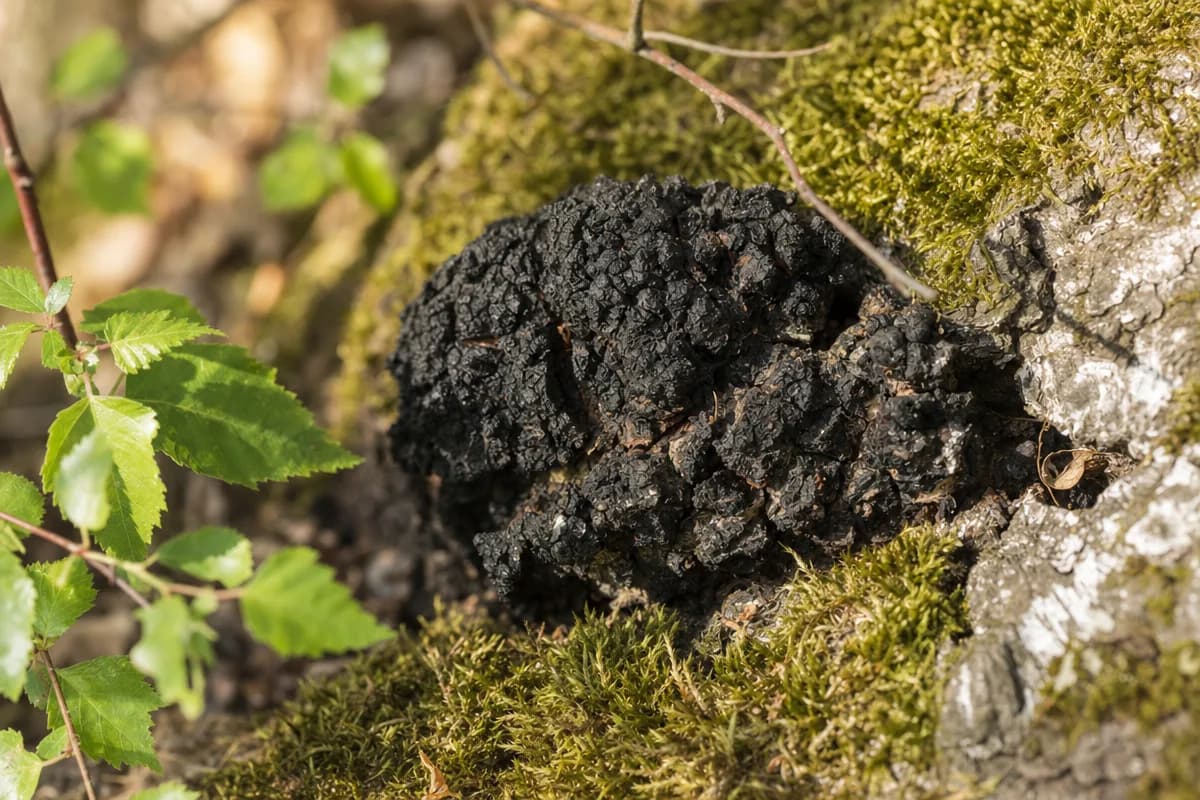
About This Plant
Chaga is a slow-developing canker-rot fungus grown or harvested as a sterile conk on living birch trees. True conk production is a multi-year forest inoculation system, while indoor culture produces mycelium rather than wild-equivalent chaga.
How to Grow Chaga
Learn how to grow Chaga from seed to harvest in 1825 days. Advanced difficulty. Complete nutrient guide, pH/EC requirements, and growing conditions for soil & container.
Sources cited: 12.
Nutrient Requirements by Growth Stage
Stage-based plant NPK ppm values are unsupported for chaga. Primary studies use fungal media and substrates: malt or yeast extract, glucose or mixed sugars, starch, peptone, MgSO4, CaCl2, KH2PO4, birch bark, or food-industry side streams…
Sign in to view nutrient requirements
A free account unlocks NPK targets for all four growth stages, micronutrient levels, a per-stage nutrient calculator, and the full nutrition guide. Signing up takes one click. Truleaf is a free, non-profit project, and every new account helps it grow. No spam, ever.
Growing Environments
Outdoor living-birch stands are the verified system for true chaga conk production. Indoor systems can maintain cultures or produce mycelial biomass in broth, but they should not be represented as producing equivalent wild conks…
Temperature
Laboratory mycelium grows best in the mid-to-high 20s C: controlled work found strong growth around 28 C and no growth at 37 C, while submerged-culture optimization used 24-26 C depending the system. Field conk production is not managed by a single air-temperature setpoint; it depends on living birch hosts in boreal or cool northern forests.
Humidity
No source provides a validated relative-humidity target for chaga conk production. Ecological sources instead place chaga in cool, humid boreal to hemiboreal birch habitats, including peat-bog and higher-elevation sites…
Light
Chaga is not a photosynthetic crop, so DLI and PPFD targets are not biologically meaningful for conk production. Natural development occurs through infection of living host wood and sterile conk emergence from the stem…
Airflow
Field chaga guidance does not define canopy airflow targets. In controlled fermentation, I…
Sign in to view environmental requirements
A free account unlocks exact temperature, humidity, light and airflow targets, including germination and growth ranges, DLI, photoperiod and PPFD, plus the full environment guide. Signing up takes one click. Truleaf is a free, non-profit project, and every new account helps it grow. No spam, ever.
Hydroponic System Compatibility
DWC, NFT, ebb-flow, drip, Kratky, and aeroponics are not suitable for chaga conk production. Chaga is a wood-decay fungus of living host stems, not a plant with roots in nutrient solution…
Growing Media
The real production medium is living birch stem wood. Field methods use colonized dowels placed into drilled host trees, while lab studies use agar, potato dextrose broth, malt or yeast media, defined sugar-nitrogen broths, and birch bark residues…
Container Specs
No complete source validates container-grown birch as a reliable chaga conk system. Containers or flasks are appropriate for sterile culture, inoculum, or mycelial biomass trials, but true conk production is documented on living trees in forest stands…
Training & Support
Plant training is not applicable. Production management means selecting suitable low-value or set-aside birch, using clean inoculation technique, tracking infection over years, and harvesting conservatively…
Sign in to view system compatibility
A free account unlocks why each of the six systems fits or fails, plus growing media, container sizes, training methods, companion plants, and the full systems guide. Signing up takes one click. Truleaf is a free, non-profit project, and every new account helps it grow. No spam, ever.
Propagation
Practical cultivation begins with verified I. obliquus mycelium, then uses colonized wooden dowels or plugs inserted into drilled wounds on living birch…
Harvesting
Harvest only confirmed chaga from living host trees and avoid cutting trees just to reach conks. Forest-product guidance recommends removing attached bark or wood, cutting material into chunks, and drying promptly below 50-60 C to prevent spoilage…
Planting Calendar
For field cultivation, inoculate living birch near the start of the thermal growing season; Finnish trials found early-season timing improved infection and conk outcomes. Expect a long horizon: conks may appear after about five years but can take much longer, and EFI guidance frames first harvest around 5-9 years…
Common Issues
The main problems are slow or absent conk formation, host misidentification, confusion with burls or other decay fungi, tree decline, and post-harvest mold. Maine Forest Service notes that sterile conks form after infection and that symptoms such as swelling and bark cracking can precede visible conks…
Get the full science-backed guide
By signing up, you help keep Truleaf free and support the growth of our nonprofit project. Your account unlocks full details for every plant issue—including symptoms, causes, step-by-step solutions, and prevention—plus the month-by-month planting calendar, the complete guide, and all research sources. It only takes one click. No spam, ever.