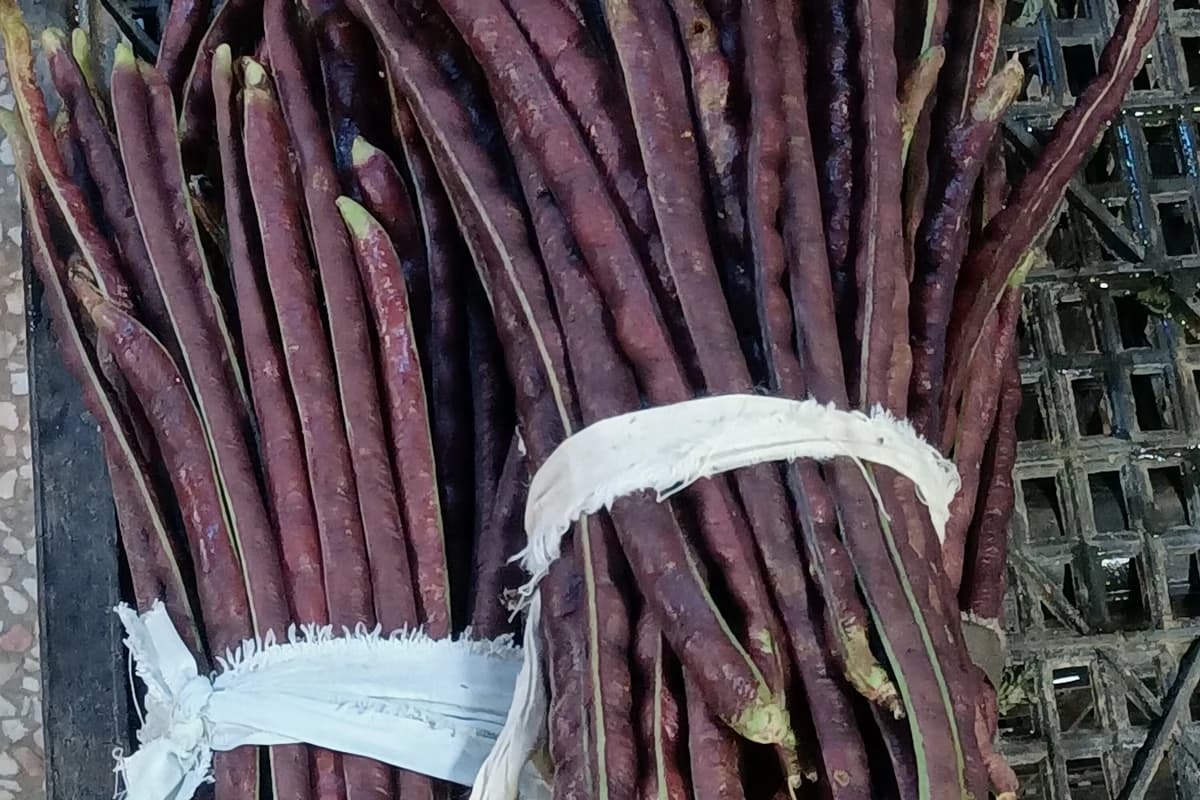
About This Plant
Cowpea (Vigna unguiculata), also known as southern pea or black-eyed pea, is a heat-tolerant annual legume grown for fresh pods, shell peas, dry seed, forage, and nitrogen-fixing cover crop use. It performs best in warm soil, full sun, well-drained media, modest starter fertility, and dry foliage conditions that limit foliar disease.
How to Grow Cowpea
Learn how to grow Cowpea from seed to harvest in 75 days. Intermediate difficulty. Planting, care, feeding and the right growing conditions.
Sources cited: 23.
Nutrient Requirements by Growth Stage
Cowpea nutrition should be managed as a legume, not a heavy-nitrogen fruiting crop. Extension sources recommend soil-test-based P and K, inoculation where cowpea rhizobia may be absent, and little or no nitrogen except modest starter N on low-N soils because excess N suppresses nodulation and delays maturity…
Sign in to view nutrient requirements
A free account unlocks NPK targets for all four growth stages, micronutrient levels, a per-stage nutrient calculator, and the full nutrition guide. Signing up takes one click. Truleaf is a free, non-profit project, and every new account helps it grow. No spam, ever.
Growing Environments
Cowpea is best represented as an outdoor, greenhouse, and container crop rather than a household indoor crop. It is heat tolerant, drought tolerant after establishment, and adapted to full sun, but it dislikes frost, flooding, cold wet soil, and prolonged waterlogging…
Temperature
Cowpea is a warm-season legume. Field guides recommend sowing once soil is at least about 18-21C, while laboratory work found fastest normal germination and seedling development around 30-35C. Vegetative growth is well suited to warm days near 25-35C, with about 29C a practical controlled-environment target; avoid sustained heat above the low-to-mid 30s during flowering and pod set because pod set can suffer.
Humidity
No source gives a cowpea-specific relative-humidity optimum, so humidity is managed mainly for disease risk. Greenhouse cowpea sand-culture work ran near 43-52% RH, and extension disease guidance emphasizes dry foliage, spacing, and air movement to reduce leaf spots, blights, and mildews…
Light
Cowpea should be treated as a full-sun crop. Home and extension guides call for at least 6 hours of sun, preferably 8-10 hours, and many cultivars flower as short-day to day-neutral types depending on genotype…
Airflow
No paper defines a cowpea canopy air-speed optimum, so airflow is an operational disease-control setting. Use gentle continuous movement around 0.3-0.8 m/s and enough ventilation to keep leaves dry after irrigation or rain…
Sign in to view environmental requirements
A free account unlocks exact temperature, humidity, light and airflow targets, including germination and growth ranges, DLI, photoperiod and PPFD, plus the full environment guide. Signing up takes one click. Truleaf is a free, non-profit project, and every new account helps it grow. No spam, ever.
Hydroponic System Compatibility
Drip into well-drained media is the strongest controlled-system fit because it supports root aeration and keeps foliage dry. DWC can be biologically feasible for research if aeration is strong, but production evidence is limited…
Growing Media
Use warm, well-drained media. Extension sources repeatedly prefer sandy loam or sandy soil with pH about 5.5-6.5, and warn against heavy wet soils, flooding, and poor drainage…
Container Specs
Cowpea can grow in containers, but one plant should have at least a 5-7 gallon container with drainage, equivalent to about 19-26 L. A 30 cm depth and width is a practical minimum for bush cultivars; vining types need more root volume, more lateral space, and a support structure…
Training & Support
Training support is variety-dependent. Bush southern peas usually need no support, semi-vining types may benefit from light support for airflow and harvest access, and vining forms should be given sturdy trellis, stakes, or netting…
Sign in to view system compatibility
A free account unlocks why each of the six systems fits or fails, plus growing media, container sizes, training methods, companion plants, and the full systems guide. Signing up takes one click. Truleaf is a free, non-profit project, and every new account helps it grow. No spam, ever.
Propagation
Cowpea is propagated by seed. Direct sow after frost danger once soil is warm; extension guides advise about 0.5-1.5 inches planting depth, warm soil for rapid emergence, and proper cowpea/southern-pea inoculant where the crop has not recently been grown…
Harvesting
Harvest timing depends on the market stage. Snap pods are picked very young, fresh-shell peas when pods change color and seeds are plump, and dry seed after pods brown and seed hardens…
Planting Calendar
Use a warm-season direct-sow calendar. In northern-temperate planning, sow outdoors in May through July after frost and soil warming, then harvest from midsummer into autumn depending on sowing date and cultivar…
Common Issues
The original issue set was useful but incomplete and mixed physiological and disease problems. Keep CABMV and other mosaic viruses separate from aphid feeding, split Fusarium wilt from seedling/root rot, and classify iron chlorosis as a nutrient availability disorder rather than an infectious disease…
Get the full science-backed guide
By signing up, you help keep Truleaf free and support the growth of our nonprofit project. Your account unlocks full details for every plant issue—including symptoms, causes, step-by-step solutions, and prevention—plus the month-by-month planting calendar, the complete guide, and all research sources. It only takes one click. No spam, ever.