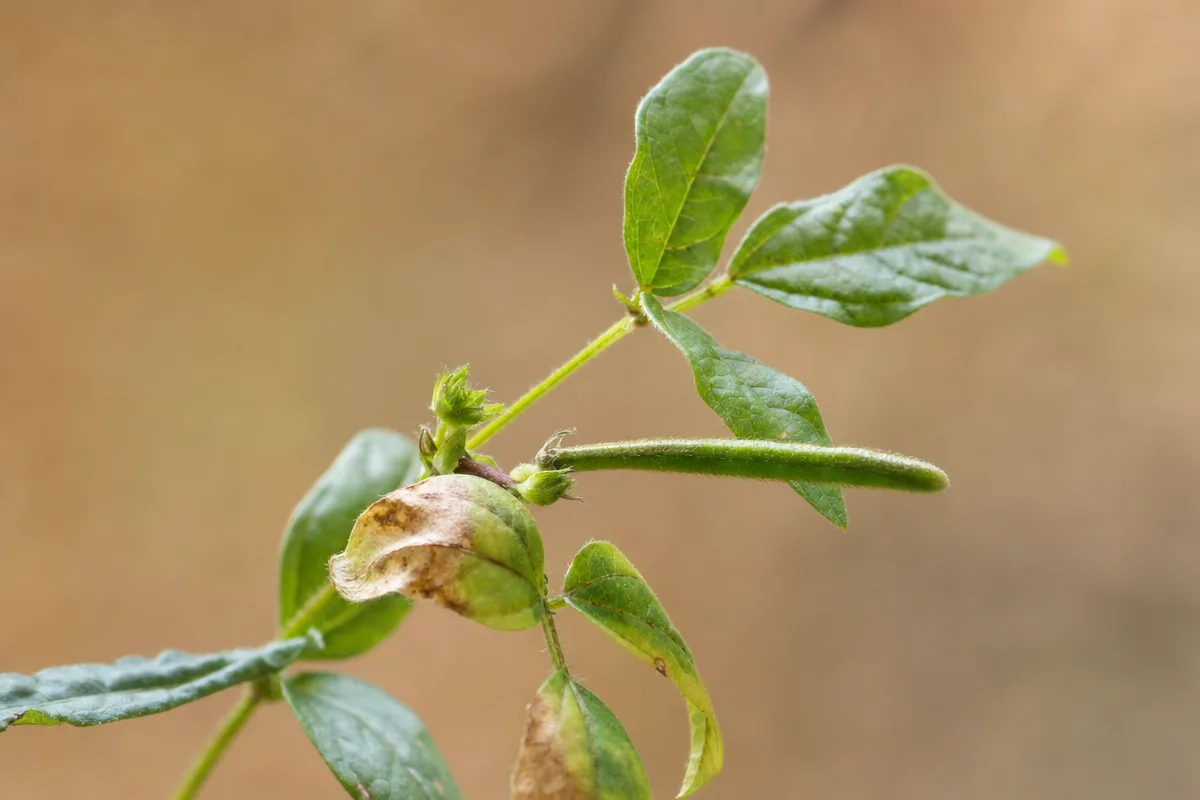
About This Plant
Mung Bean (Vigna radiata), also called green gram or moong, is a fast-growing, warm-season nitrogen-fixing legume grown for its edible dry seeds and, most commonly in soilless culture, for its sprouts and microgreens. Sprouts are produced on clean water alone over 4-7 days from seed reserves, while a full grain crop matures in about 75 days. It germinates in roughly 3 days above 16C, prefers 25-32C and 60-80% humidity, and as a quantitative short-day plant flowers faster under shorter days. It feeds like a legume: low starter nitrogen in inoculated field soil but sustained mineral nitrogen in uninoculated hydroponics, with phosphorus the main yield lever and potassium rising through pod-fill. Mung bean is salt-sensitive, so nutrient-solution EC is kept moderate. Its most serious pest problem is whitefly-vectored yellow mosaic virus (MYMV), managed with resistant varieties and vector control.
How to Grow Mung Bean
Learn how to grow Mung Bean from seed to harvest in 75 days. Beginner difficulty. Complete nutrient guide, pH/EC requirements, and growing conditions for hydroponics, soil & greenhouse.
Sources cited: 51.
Nutrient Requirements by Growth Stage
Mung bean feeds like a nitrogen-fixing legume, and the single most important point is a field-versus-hydroponic split. In inoculated field soil, Bradyrhizobium nodules supply most of the crop's nitrogen, so extension packages apply only a small starter dose of about 12.5-23 kg N/ha and excess nitrogen suppresses…
Sign in to view nutrient requirements
A free account unlocks NPK targets for all four growth stages, micronutrient levels, a per-stage nutrient calculator, and the full nutrition guide. Signing up takes one click. Truleaf is a free, non-profit project, and every new account helps it grow. No spam, ever.
Growing Environments
Mung bean adapts to indoor, greenhouse, outdoor, and container culture. It grows to grain maturity in controlled chambers under warm temperatures and moderate humidity, and its dominant soilless forms, sprouts and microgreens, are ideal indoor crops produced on trays or in jars…
Temperature
Mung bean is a warm-season crop. Germinate at 22-30C, with fastest, most complete germination near the top of that band (highest germination, shoot and root growth recorded at 30C). Grow at 25-32C with an optimum near 29C; controlled full-cycle trials used a non-stress regime of 34/25C day/night, so a 34C day is still non-stress and the 32C ceiling is a conservative optimal-growth limit rather than a stress threshold. Heat stress appears only around 39/30C and above, sharply cutting chlorophyll and seed yield and shortening the cycle to 63-70 days.
Humidity
Hold relative humidity around 70%, within a workable 60-80% band. Complete studies ran across this range: full-cycle grain chambers at about 60% RH, mung-bean cultivation at 70% RH, and sprout and microgreen production at 80% RH…
Light
Target a daily light integral near 18 mol/m2/day delivered over about a 14-hour photoperiod at roughly 350 umol/m2/s; these three values are internally consistent (350 umol/m2/s for 14 h is about DLI 18). Two caveats apply…
Airflow
Provide gentle, steady air movement across the canopy, roughly 0.3-1.0 m/s, as standard controlled-environment practice; no mung-bean-specific airflow figure is published. Active airflow keeps leaf surfaces dry to limit foliar disease and supports transpiration and sturdy stems…
Sign in to view environmental requirements
A free account unlocks exact temperature, humidity, light and airflow targets, including germination and growth ranges, DLI, photoperiod and PPFD, plus the full environment guide. Signing up takes one click. Truleaf is a free, non-profit project, and every new account helps it grow. No spam, ever.
Hydroponic System Compatibility
Mung bean's best-documented soilless use is sprout, microgreen, and fodder production, which has direct peer-reviewed support: sprouts and microgreens on tissue trays, hydroponic microgreens on nutrient solution, and hydroponic sprouted green fodder. For these, passive systems such as DWC and Kratky are excellent…
Growing Media
For the dominant sprout and microgreen forms, mung bean is grown with essentially no medium: tissue or paper trays, jars, or thin inert mats rinsed with clean water, with the crop living on seed reserves. For a full-cycle grain crop in a media system, a free-draining inert mix such as coco coir with perlite, or clay…
Container Specs
Mung bean grows to maturity in containers. Controlled studies raised it in pots about 16 cm wide by 24 cm tall with roughly 5.5 kg of soil and completed the full cycle in pots…
Training & Support
Mung bean needs no trellis, stake, or training. Cultivated types are erect to semi-erect bushes bred for a determinate, uniform-maturing habit and are self-supporting…
Sign in to view system compatibility
A free account unlocks why each of the six systems fits or fails, plus growing media, container sizes, training methods, companion plants, and the full systems guide. Signing up takes one click. Truleaf is a free, non-profit project, and every new account helps it grow. No spam, ever.
Propagation
Grow mung bean from seed only; there is no cutting or vegetative route. Sow about 3 cm deep into warm soil once soil temperature is reliably above 16-17C, because at a constant 14C seeds germinate but the seedlings fail to emerge…
Harvesting
Mung bean is grown for two products with different harvest logic. For dry seed, pods mature asynchronously, so growers hand-pick in 2-3 passes as pods turn brown to black, or cut the whole plant once most pods are mature; seed quality peaks when pods are taken at 70-80 days after sowing and from the basal end of the…
Planting Calendar
Mung bean is a warm-season annual grown in late spring and summer. The key timing anchor is soil temperature: sow after it reaches about 16C…
Common Issues
Mung bean's most serious problem is mungbean yellow mosaic virus (MYMV), transmitted persistently by the whitefly Bemisia tabaci; leaves show yellow specks that coalesce into bright mosaic mottling and early infection causes heavy yield loss. It is not seed- or contact-transmitted, so control centers on host…
Get the full science-backed guide
By signing up, you help keep Truleaf free and support the growth of our nonprofit project. Your account unlocks full details for every plant issue—including symptoms, causes, step-by-step solutions, and prevention—plus the month-by-month planting calendar, the complete guide, and all research sources. It only takes one click. No spam, ever.