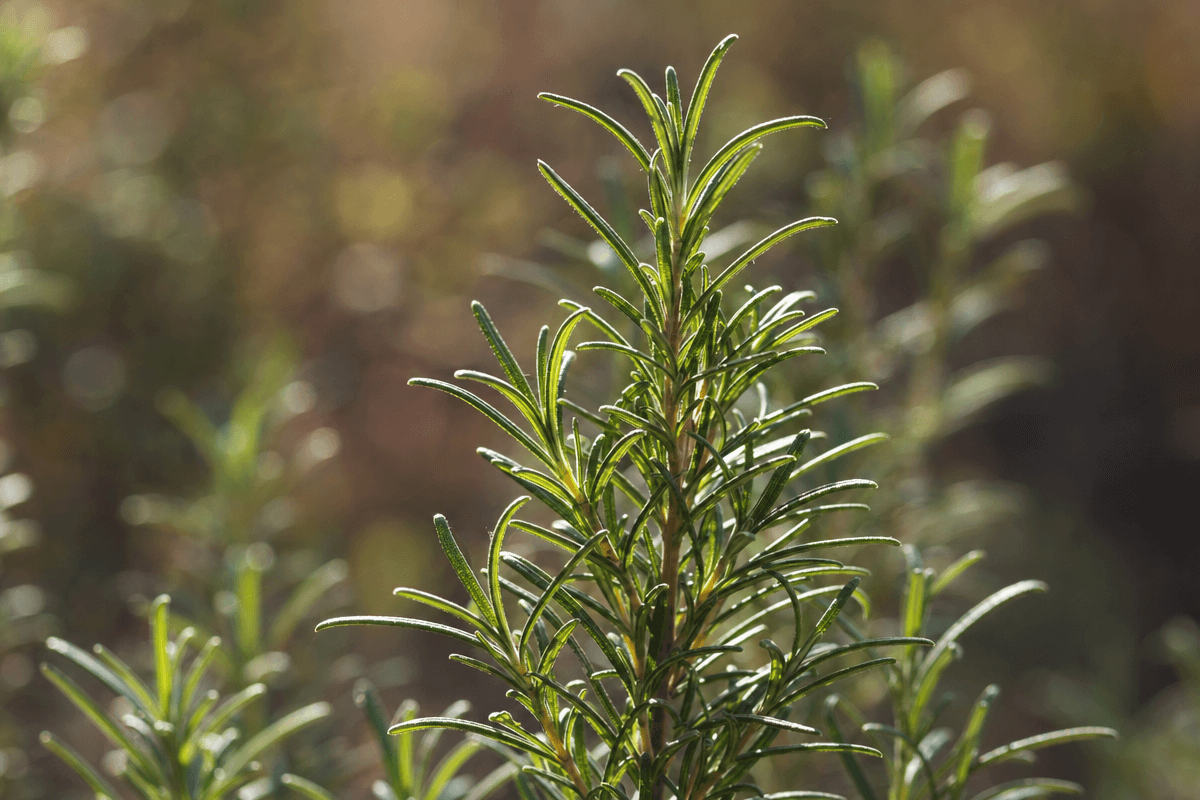
About This Plant
Rosemary is a woody evergreen herb adapted to dry Mediterranean conditions and needs bright light, fast drainage, and restrained irrigation for clean growth.
How to Grow Rosemary
Learn how to grow Rosemary from seed to harvest in 120 days. Intermediate difficulty. Planting, care, feeding and the right growing conditions.
Sources cited: 30.
Nutrient Requirements by Growth Stage
Rosemary in hydroponics requires a potassium-dominant nutrient solution with moderate nitrogen, reflecting its origin on nutrient-poor Mediterranean limestone soils. The optimal vegetative-phase solution is N 175, P 40, K 235, Ca 160, Mg 40, S 40 ppm, derived from the modified Sonneveld herb solution (N 150, P 31, K…
Sign in to view nutrient requirements
A free account unlocks NPK targets for all four growth stages, micronutrient levels, a per-stage nutrient calculator, and the full nutrition guide. Signing up takes one click. Truleaf is a free, non-profit project, and every new account helps it grow. No spam, ever.
Growing Environments
Rosemary grows successfully across all four environments. Outdoor: The primary environment in USDA zones 7-11 (cold-hardy cultivars like 'Arp' survive to zone 6)…
Temperature
Rosemary (Salvia rosmarinus) is a Mediterranean shrub adapted to warm, dry conditions with moderate temperatures. For seed germination, maintain substrate temperatures of 18-27C (65-80F), with 21-24C being the sweet spot for consistent sprouting in 14-21 days. During active vegetative growth, daytime temperatures of 20-25C with nighttime drops to 16-18C are optimal. Lykokanellos et al. (2025) used 25 +/- 2C day and 18 +/- 2C night in their controlled greenhouse rosemary propagation study. Above 27C, growth quality begins to decline; heat stress symptoms (leaf scorch, wilting) appear above 35C, though rosemary is more heat-tolerant than its close relative lavender. In hydroponic environments, target 22C as the overall optimal setpoint, consistent with field-grown Mediterranean herb standards. Rosemary is winter-hardy to USDA zones 8a-10b, tolerating brief exposure to -10 to -15C.
Humidity
Rosemary evolved in the dry Mediterranean climate and strongly prefers low humidity. In hydroponic indoor cultivation, maintain relative humidity between 40-60%, with 45% as the optimal target…
Light
Rosemary is a high-light, full-sun Mediterranean herb requiring abundant illumination for optimal growth and essential oil production. Kohler & Lopez (2021, HortScience) found that rosemary cutting quality peaked at DLI 15.1 mol/m2/d during propagation, with quality declining above 16 mol/m2/d due to necrotic lesions…
Airflow
Rosemary requires consistent air movement to prevent fungal diseases and maintain the dry canopy conditions it evolved with in Mediterranean climates. Maintain airflow velocities of 0.3-1.0 m/s across the canopy…
Sign in to view environmental requirements
A free account unlocks exact temperature, humidity, light and airflow targets, including germination and growth ranges, DLI, photoperiod and PPFD, plus the full environment guide. Signing up takes one click. Truleaf is a free, non-profit project, and every new account helps it grow. No spam, ever.
Hydroponic System Compatibility
For hydroponic rosemary, drip irrigation is the optimal system choice. Abo El-Fadl et al…
Growing Media
The primary recommended medium for hydroponic rosemary is a blend of 70% perlite and 30% coco coir, providing excellent drainage with moderate moisture retention -- critical for this Mediterranean drought-adapted herb. Lykokanellos et al…
Container Specs
For container-grown rosemary, use a pot at least 30 cm (12 inches) in both depth and diameter for a mature plant. Young plants or cuttings can start in 15-20 cm pots and be repotted annually…
Training & Support
Rosemary is a self-supporting woody evergreen shrub requiring no staking, trellising, or structural support. However, regular pruning is essential to maintain compact growth, prevent excessive woodiness, and prolong productive plant life…
Sign in to view system compatibility
A free account unlocks why each of the six systems fits or fails, plus growing media, container sizes, training methods, companion plants, and the full systems guide. Signing up takes one click. Truleaf is a free, non-profit project, and every new account helps it grow. No spam, ever.
Propagation
Rosemary is propagated by four methods: stem cuttings, seed, layering, and division. Stem cuttings are the overwhelmingly preferred technique…
Harvesting
Rosemary is a perennial evergreen subshrub that regrows reliably after harvest, with a productive lifespan of 10-20+ years under proper pruning. Harvest in the morning after dew has dried but before midday heat, as essential oil concentration peaks at this time; El-Sayed & Aly (2022) confirmed oils are richest in the…
Planting Calendar
Sow indoors (Jan-Mar): Start seeds indoors 10-12 weeks before the last frost date. In zones 8-10, begin in January-February; zones 5-7, start late February-March…
Common Issues
Rosemary (Salvia rosmarinus) is generally disease-resistant when given the low-humidity, well-drained conditions it evolved with on Mediterranean sea cliffs. However, hydroponic or greenhouse cultivation introduces specific risks…
Get the full science-backed guide
By signing up, you help keep Truleaf free and support the growth of our nonprofit project. Your account unlocks full details for every plant issue—including symptoms, causes, step-by-step solutions, and prevention—plus the month-by-month planting calendar, the complete guide, and all research sources. It only takes one click. No spam, ever.