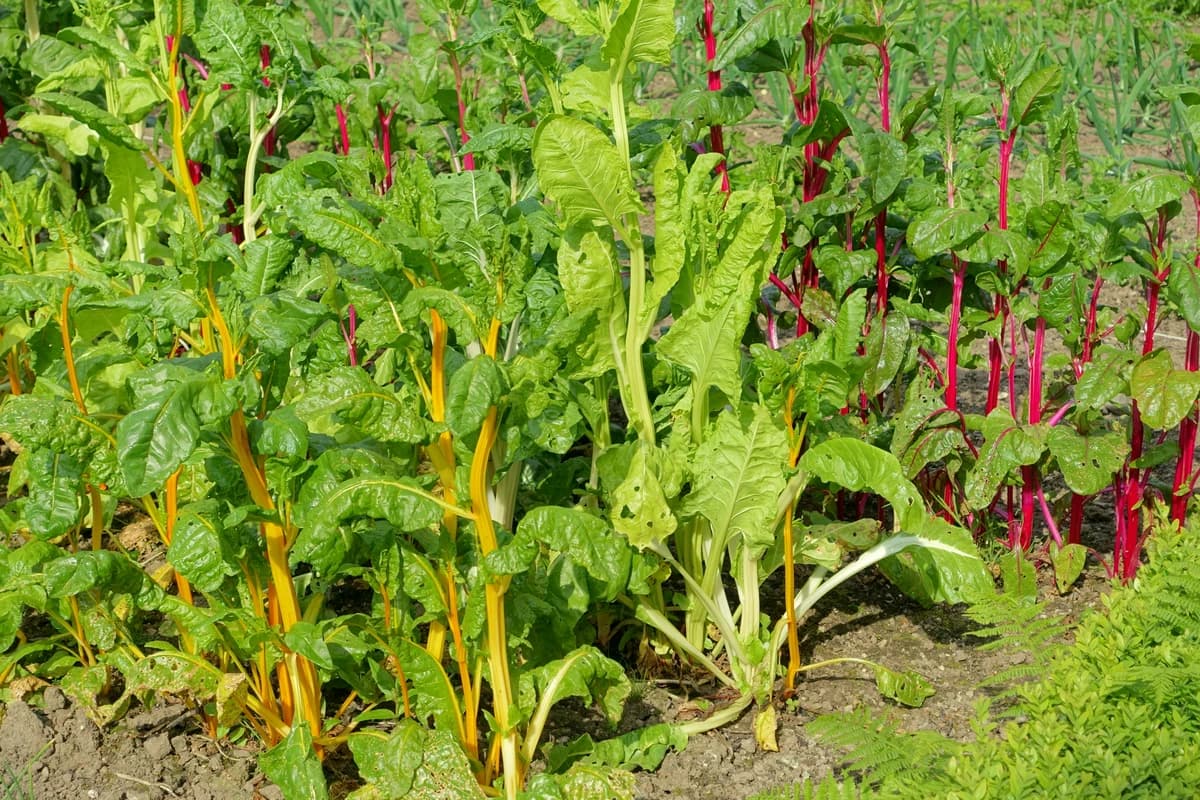
About This Plant
Swiss chard (Beta vulgaris var. cicla) is a cool-season biennial leafy green in the Amaranthaceae family, harvested for its large, colorful leaves and thick petioles via cut-and-come-again throughout the growing season. A potassium-dominant, calcium-hungry feeder closely related to beet, it thrives in all major hydroponic systems at EC 1.6-2.4 mS/cm and pH 5.8-6.8. Seeds are multi-germ clusters producing 2-5 seedlings requiring thinning. First harvest occurs 45-58 days from sowing, with regrowth every 14-21 days. Tolerates both light frost and moderate heat better than spinach, rarely bolting.
How to Grow Swiss Chard
Learn how to grow Swiss Chard from seed to harvest in 58 days. Beginner-friendly. Planting, care, feeding and the right growing conditions.
Sources cited: 25.
Nutrient Requirements by Growth Stage
Swiss chard is a heavy-feeding leafy green requiring elevated N, K, and especially Ca compared to lettuce. During seedling establishment (EC 0.8-1.4), a half-strength Hoagland or Sonneveld solution at N 80-120, K 80-130, Ca 60-110 ppm supports early growth without salt stress…
Sign in to view nutrient requirements
A free account unlocks NPK targets for all four growth stages, micronutrient levels, a per-stage nutrient calculator, and the full nutrition guide. Signing up takes one click. Truleaf is a free, non-profit project, and every new account helps it grow. No spam, ever.
Growing Environments
Swiss chard is highly adaptable and grows across all common environments. Outdoor: plant as a cool-season crop in spring or fall; full sun preferred but tolerates partial shade (4-6 hours); tolerates frost to -4C; USDA zones 2a-11b…
Temperature
Swiss chard (Beta vulgaris var. cicla) is a cool-season crop that tolerates more heat than spinach and rarely bolts. Seeds germinate across a remarkably wide range (5-38C), with the fastest emergence near 30C. During vegetative growth, chard performs best at 10-27C. The optimal temperature for leaf production is 15-24C, with 18C as the ideal midpoint balancing rapid growth with leaf quality. Unlike its beet sibling, Swiss chard continues productive growth above 24C, though leaf size and quality decline above 27C. Swiss chard tolerates light frost to approximately -4C and can be harvested into early winter with frost protection. Prolonged cold exposure below 10C for 2+ weeks can trigger vernalization and eventual bolting, but this is far less common than in spinach. In hydroponic systems, maintain nutrient solution temperature at 18-22C to prevent root rot while optimizing nutrient uptake.
Humidity
Swiss chard tolerates a moderate humidity range of 50-70% RH with 60% as the target in controlled environments. Humidity management is critical because chard's large leaves are prone to tip burn when calcium transport is impaired by high humidity and low transpiration…
Light
Swiss chard is classified as a high to very high light plant, showing linear growth increases from DLI 2 to at least 22 mol/m2/d with no saturation point. Target DLI of 16 mol/m2/d for standard production, balancing maximum leaf growth with manageable tip burn risk…
Airflow
Air circulation is critically important for Swiss chard, more so than most leafy greens due to the large leaf surface area that creates stagnant boundary layers. Target 0.3-1.0 m/s at canopy level…
Sign in to view environmental requirements
A free account unlocks exact temperature, humidity, light and airflow targets, including germination and growth ranges, DLI, photoperiod and PPFD, plus the full environment guide. Signing up takes one click. Truleaf is a free, non-profit project, and every new account helps it grow. No spam, ever.
Hydroponic System Compatibility
Swiss chard grows in all six major hydroponic systems with strong performance across all. Unlike its beet sibling, chard has fibrous roots (no taproot), so standard hydroponic equipment works without modification…
Growing Media
Swiss chard's fibrous root system (not taproot like beet) is compatible with all standard hydroponic media. Perlite provides excellent drainage and aeration; perlite-vermiculite blends (70:30) work well in ebb-and-flow systems…
Container Specs
Container depth of 20 cm minimum is recommended for Swiss chard, accommodating roots that extend to approximately 25 cm. Width of 25+ cm accommodates the plant's 20-35 cm spread; NFT spacing of 25-30 cm between plants confirms this footprint…
Training & Support
Swiss chard requires no training, staking, trellising, or structural support. Plants grow 30-60 cm tall with naturally thick, rigid petioles that provide their own structural support…
Sign in to view system compatibility
A free account unlocks why each of the six systems fits or fails, plus growing media, container sizes, training methods, companion plants, and the full systems guide. Signing up takes one click. Truleaf is a free, non-profit project, and every new account helps it grow. No spam, ever.
Propagation
Swiss chard is propagated exclusively by seed. Each seed is actually a multi-germ fruit cluster (utricle) containing 2-5 embryos, identical to its beet sibling, so multiple seedlings emerge from each cluster and thinning is mandatory…
Harvesting
Swiss chard is a premier cut-and-come-again crop that regrows vigorously after harvest. Harvest outer leaves at 15-25 cm (6-10 inches) by cutting or snapping at the petiole base, leaving the central growing point and at least 3-4 inner leaves intact…
Planting Calendar
Direct sow March through August (months 3-8); succession sow every 2-3 weeks for continuous harvest. Start indoors in February-March (months 2-3) for an early harvest, transplanting 2-3 weeks before last frost…
Common Issues
Swiss chard faces a range of pests and diseases common to the Beta vulgaris family. The most critical physiological disorder is tip burn from calcium deficiency, caused by inadequate transpiration-driven Ca transport to rapidly expanding leaf tips; maintain Ca at 150-200 ppm with good airflow to prevent it…
Get the full science-backed guide
By signing up, you help keep Truleaf free and support the growth of our nonprofit project. Your account unlocks full details for every plant issue—including symptoms, causes, step-by-step solutions, and prevention—plus the month-by-month planting calendar, the complete guide, and all research sources. It only takes one click. No spam, ever.