Can You Grow Black Truffles? 5 Checks for Your Garden
Use five checks to see whether your garden can support black truffle cultivation: soil, space, water, verified planting material, and the long wait.
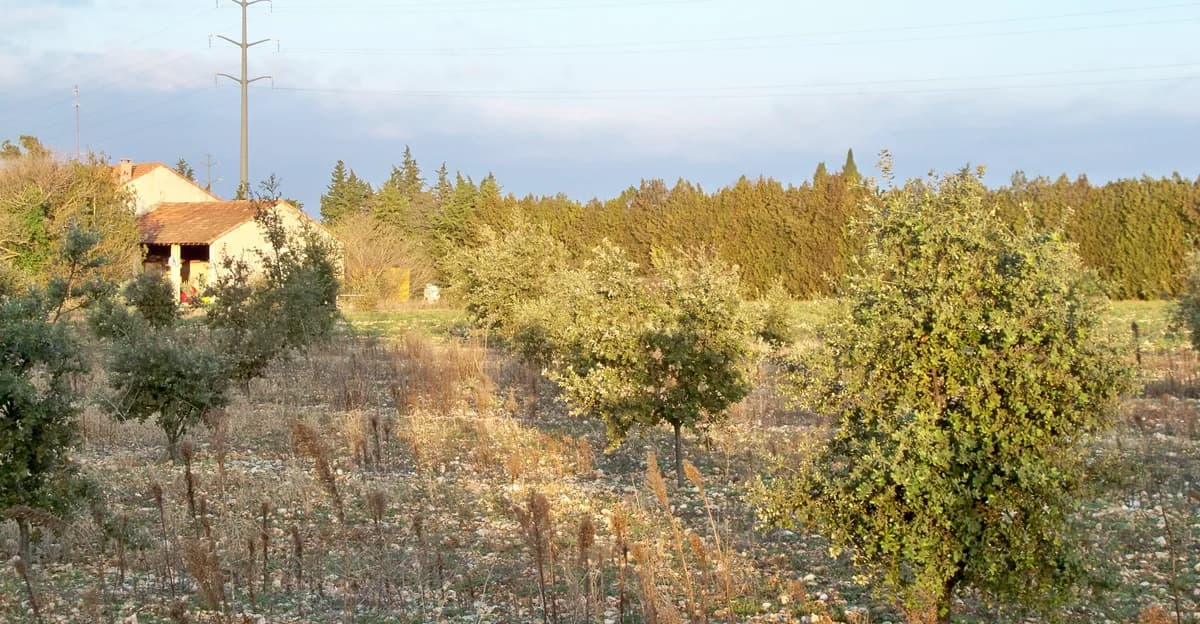
Key point: You can grow black truffles in some gardens, but the project works like a very small orchard. You plant a compatible host tree whose roots carry Tuber melanosporum, then manage the soil, water, canopy, and root zone for years. You do not grow this fungus alone in a pot or sow a truffle into an ordinary garden bed.
Site choice matters more than the purchase of a tree. A plausible site needs calcareous, alkaline, aerated, well-drained soil; enough room for a long-lived host; access to summer water; and a climate that can support both the tree and truffle development. Even a strong site and a well-controlled plant cannot guarantee a crop.
Expect the first harvest, if it comes, to take about 5-10 years. Some orchards produce earlier, some much later, and some never produce. That uncertainty should shape the decision before you spend money or redesign the garden.
For a compact species reference, open the black truffle plant profile.
Start with a go or no-go screen
Use these checks before shopping for an inoculated tree:
| Question | A promising answer | A reason to pause |
|---|---|---|
| Is the soil suitable? | A laboratory analysis shows alkaline, calcareous soil with a porous, well-drained profile | The soil stays waterlogged, is strongly acidic, or has not been tested |
| Is there enough space? | The host can mature with an open canopy and a managed root zone | The only space is a small pot, crowded border, or root zone already occupied by mature trees |
| Can you manage summer water? | Water is available, and irrigation can respond to soil moisture and recent rain | There is no water during dry periods, or the site cannot release excess water |
| Can you buy verified planting material? | An independent body has checked truffle mycorrhization and purity | The seller offers no evidence of which fungus is on the roots or whether contamination was checked |
| Can you accept the wait? | You can manage the site for a decade without depending on a harvest | The project needs a predictable crop date, yield, or financial return |
A garden that fails one of these checks may still be good for fruit, vegetables, or ornamental trees. It is a poor place to begin black truffle cultivation until the limiting condition is understood.
Build a Site Evidence Pack Before You Buy
A useful site assessment gives an adviser evidence to interpret. Create one record for the proposed planting area and keep measured results separate from observations and assumptions. That separation makes it easier to see which uncertainty needs another test and which limitation may rule out the project.
| Record | What to collect | Decision it should support |
|---|---|---|
| Soil | The laboratory report, sampling locations, visible drainage patterns, and notes on compacted or waterlogged areas | Whether the soil's alkalinity, calcareous context, structure, aeration, and drainage are plausible for the host and truffle together |
| Water | The available summer source, rainfall notes, the planned soil-moisture observation method, and where excess water leaves the root zone | Whether the site can respond to dry periods without relying on a copied dose or trapping water around roots |
| Space | A site layout sketch showing the proposed host, mature trees, shade, access routes, irrigation lines, and the area that must remain manageable as the host grows | Whether a long-lived host can keep an open canopy and usable root zone where fungal competition can be monitored |
| Planting material | Host identity, supplier, batch or label number, the body that checked the plant, and what was tested for mycorrhization and purity | Whether independent evidence confirms that the intended fungus is present |
| Time commitment | Who will manage the tree and records, how long the site is likely to remain available, and whether the planting is worthwhile without a crop | Whether the project still makes sense under a roughly 5-10-year planning horizon and the possibility of no production |
Mark each item as documented, needs interpretation, or missing. A laboratory pH result is documented, for example, but the conclusion that the whole profile drains well may still need interpretation. A seller's claim that a plant is inoculated remains missing evidence until the checking method and responsible body are identified.
Send the completed pack to a regional truffle adviser before choosing a host or changing the soil. Ask for a written distinction between a condition that is acceptable, one that can be managed, and one that makes the site unsuitable. If the suggested response includes lime, fertilizer, major drainage work, or a fixed irrigation schedule, ask what site measurement supports it and how the result will be checked. The reviewed evidence does not supply universal doses for those interventions.
Keep the original reports and advice with the supplier documents. If production remains absent years later, this baseline will show what was known before planting and which site or management conditions changed. The baseline cannot explain every outcome. It prevents later observations from being mistaken for the original condition.
Black truffles grow with a living host tree
Black truffle, or Tuber melanosporum Vittad., is a fungus in the family Tuberaceae. French common names include truffe noire and truffe du Périgord.
Its cultivation depends on mycorrhiza, an association between the fungus and living tree roots. In a field pulse-labeling experiment, carbon fixed by a hazel host moved into T. melanosporum mycorrhizas and developing truffle fruitbodies. French research and technical institutions also describe cultivation as a host-tree system built from controlled mycorrhized plants.
That biology changes the whole plan. The tree is the permanent structure of the project, while the truffle fungus lives around and on its roots. The site must support both partners and limit unwanted fungal competition. A packet of spores or a piece of truffle placed in soil is not an evidence-backed substitute for a quality-controlled host plant in this beginner plan.
Test the soil before buying the tree
The reviewed research consistently places T. melanosporum in alkaline, calcareous soils with useful pore space, aeration, and drainage. A pH around 7.5-8.5 is a commonly cited working range, while French field guidance gives pH 7-8. Neither range predicts production by itself.
Order a laboratory soil analysis that can describe pH, carbonate context, texture, and other site conditions relevant to drainage and root growth. Bedrock, pale soil color, or a quick handheld reading cannot establish that a garden is suitable. The Italian soil study linked several physical and chemical properties with production at three nearby plantations, but its authors also limited the conclusion to that study area. Correlations from one area should not become a universal soil recipe.
Avoid correcting the site from pH alone. The evidence does not support a universal lime dose, carbonate target, or fertilizer program for home truffle cultivation. Correct a diagnosed problem only after the soil results have been interpreted for the site and host tree.
Climate ranges are clues, not a pass-fail calculator
Black truffle production is not confined to an exact copy of the climate in Provence or Périgord. A 2014 compilation combined scientific publications with some nursery and news records of producing sites across six continents. The author warned that the recorded boundaries were observations, not optimum values, and that climate variables interact with soil and other non-climatic factors.
This makes local judgment more useful than matching one annual rainfall or temperature number. Summer heat and drought, the timing of rain, soil water storage, host-tree condition, and the biological state of the fungus can pull the site in different directions. INRAE's CulturTruf work uses instrumented sites and soil-water monitoring for that reason.
Ask a regional truffle adviser to interpret the garden's exposure, soil, and water together. A climate chart can show that cultivation is plausible in a region. It cannot show that one corner of your property will fruit.
A small garden is often the limiting factor
No study in the available research directly compares a backyard with a commercial orchard. The space conclusion is an evidence-led inference from how the cultivation system works: it needs a long-lived host, an open managed canopy, root-zone space, irrigation access, and control over competing ectomycorrhizal trees and fungi.
A large garden with open soil may function as a small truffle orchard. A narrow border crowded by mature trees is much harder to manage because the root zones and fungal communities already overlap. A mature container is also outside the cultivation systems supported by the reviewed evidence. Treat “grow black truffles in a pot” as an experiment, not a reliable route to a crop.
Plan for the mature host rather than the size of the plant at purchase. If the site cannot keep the tree for many years, the truffle project does not have a stable foundation.
Buy a plant with independently checked mycorrhization
Plant quality is one part of the risk that you can control. Look for a compatible host plant whose T. melanosporum mycorrhization and purity were checked by an independent body. In France, the CTIFL Référence label is one route: CTIFL technicians assess the mycorrhization level and purity and individually label accepted plants.
The label checks the planting material, not your soil or future harvest. A verified plant can still fail to establish, lose ground to competing fungi, or remain unproductive because the site and seasonal conditions do not support fruiting.
Do not assume that an established garden tree can be inoculated reliably after planting. The available sources do not establish that method as reliable beginner guidance. Start with controlled planting material and ask the regional adviser which host options fit the site.
Manage water without copying a fixed schedule
Summer water matters, but more is not always safer. Short-term summer irrigation can improve production under dry conditions, while high or sustained intensive watering can increase rot or favor competing fungi. The response also changes with soil, weather, tree condition, and stage of orchard development.
Build irrigation around soil-water observation and recent rain. The evidence reviewed for this article does not support a universal number of liters per tree, a weekly calendar, or one irrigation method for every garden. A schedule copied from a different soil can leave the root zone too dry or too wet.
Drainage still matters after irrigation is installed. Water must be available during dry periods without remaining trapped around the roots. If the garden naturally holds water, solve the site question before treating irrigation as the answer.
Skip routine fertilizer and improvised recipes
Published orchard evidence does not support a generic fertilizer program for black truffle. The management review found that responses to fertilization vary and may affect competition among fungi. French field guidance does not recommend routine fertilizer as the starting assumption.
Do not add a mushroom fertilizer, a standard fruit-tree feed, a spore slurry, or a large soil amendment because an online recipe promises faster production. The reviewed sources support none of those recipes. Use soil evidence and specialist interpretation before correcting a measured deficiency or soil constraint.
Expect a long and uncertain pre-productive period
About 5-10 years is a useful planning range for the first crop, with real cases outside it. The review describes pre-productive periods from under five to more than 10 years. French guidance gives five to eight years, sometimes 10. In the academic case studies, some Italian plantations began producing after about four years, while the French orchard used for the carbon experiment first produced after about 14 years.
Those examples are boundaries, not forecasts. Timing changes with the fungus-host combination, plant quality, host growth, site, and management. Production can also remain absent.
Keep the project worthwhile as a tree and landscape planting even if no truffle appears. Do not base a household budget or garden deadline on an expected harvest year.
A brûlé is encouraging, but it is not proof
A brûlé is the patch of sparse vegetation that may form around a colonized host. It can show that the below-ground system is affecting nearby plants, but it does not prove that truffles are forming or that a harvest will follow.
One commercially funded study of five UK sites recorded established T. melanosporum mycorrhiza and visible vegetation effects at sites that did not produce truffle fruitbodies during the study. Fruiting also depends on seasonal triggers, moisture, mating biology, competition, and host condition. Do not use the presence or absence of a brûlé as a stand-alone diagnosis.
If you want to know whether the intended fungus remains on the roots, ask a qualified service about direct mycorrhizal assessment rather than relying on surface appearance.
A practical first-year plan
- Order a full soil analysis. Ask for results that a regional truffle adviser can interpret for calcareous soil, pH, drainage, texture, and root-zone suitability.
- Assess the whole site. Map mature trees, shade, drainage, summer water access, and the space the host will need over many years.
- Get regional advice before choosing the host. Match the host and management plan to the climate, soil, and local cultivation experience.
- Buy independently controlled planting material. Keep the label and supplier record with your garden notes.
- Plan irrigation from measured conditions. Monitor soil moisture and rainfall instead of committing to a universal dose or calendar.
- Record establishment without predicting harvest. Note tree growth, water decisions, soil changes, and any observed
brûlé, while treating each as site history rather than proof of future production.
You can keep the site record in a Truleaf grow log, but the first external step is more important: send the soil analysis to a regional truffle adviser before buying the tree.
Run an Annual Establishment Review
An annual review should answer whether the site is still manageable and whether the host-fungus project needs a qualified assessment. It should not turn early signs into a harvest forecast. Use the same observation points each year so that notes from different seasons remain comparable.
Record what happened before explaining it
Start with dated observations: host growth and decline, canopy changes, exposed or compacted soil, standing water, dry periods, irrigation events, and vegetation changes around the tree. For water decisions, add recent rainfall and the soil-moisture observation that prompted the action. This provides more context than a note saying the tree “needed water” and helps an adviser judge whether irrigation responded to the site or followed habit.
Photograph the same views and mark them on the site sketch. If a sparse patch resembling a brûlé appears, record its extent and timing without labeling it proof of truffle production. Mycorrhiza and vegetation effects can persist where fruitbodies are not recorded, and fruiting depends on other seasonal and biological conditions.
Keep three conclusions separate
At review time, sort conclusions into three groups:
- Host condition: Is the tree establishing and can its canopy and root zone still be managed at this site?
- Site condition: Do drainage, water availability, soil disturbance, shade, or nearby root competition differ from the baseline evidence pack?
- Fungal status: Is there direct evidence that the intended fungus remains on the roots, or only a surface observation?
The third question may require direct mycorrhizal assessment by a qualified service. Neither healthy tree growth nor a brûlé answers it alone.
End with a decision for the next season
Record one of four outcomes: continue the current plan, seek interpretation before changing management, investigate a specific site problem, or stop treating the planting as a production project. List each management change with its reason and the evidence used. If several changes are needed, record them separately so later notes do not attribute an outcome to the wrong action.
Keep harvest timing out of this decision. Published examples range from production in about four years to a first crop after about 14 years, while other sites may never produce. The annual review tests whether continued care is reasonable. It cannot predict when a truffle will appear.
Frequently asked questions
Can I grow black truffles in a pot?
The evidence reviewed here supports cultivation in managed orchard soil around a long-lived host tree. It does not establish a mature pot or grow bag as a reliable production system. A container may hold a young plant temporarily, but this article does not recommend container growing as a route to a truffle crop.
Can I bury a black truffle and grow more?
Black truffle cultivation depends on a living mycorrhizal association with a compatible host tree. The beginner route supported by the reviewed sources is an independently checked, inoculated plant. Burying a truffle or applying an improvised spore mixture does not replace that controlled starting material.
What soil pH do black truffles need?
About pH 7.5-8.5 is a commonly cited working range for T. melanosporum, but pH alone cannot determine suitability. The soil also needs a calcareous setting, aeration, drainage, and suitable physical structure. Use a laboratory analysis and site-specific interpretation.
How long does a black truffle tree take to produce?
Plan around roughly 5-10 years, while accepting that production may begin earlier, later, or never. Published examples fall outside that planning range in both directions.
Does a brûlé mean truffles are growing?
It shows that something in the host-root and fungal system may be affecting nearby vegetation. It does not prove that fruitbodies are present or that a harvest will follow. Mycorrhiza can persist without fruiting.
Do I need to live in southern France?
No single regional climate is mandatory. Producing sites have been documented across a broad climatic range, but those observations are not planting thresholds. Local soil, seasonal water, exposure, host condition, and other biological factors still decide whether a particular garden is plausible.