How to Grow Ashwagandha (Withania somnifera): Seed to Harvest
Learn how to grow ashwagandha (Withania somnifera) from seed to root harvest — germination temperature, soil and pH, watering, organic feeding, pests, and even soilless methods, grounded in peer-reviewed research and horticultural extension guidance.
Key point: Ashwagandha (Withania somnifera) is one of the more forgiving medicinal plants to grow — it wants full sun, light well-drained soil, and warmth, and it tolerates poor, dry ground that would starve fussier crops. The two things that decide your success are germination (seed does best in warm soil near 25 °C) and timing the root harvest before the first hard frost. Get those right and a single season is enough to lift roots for drying.
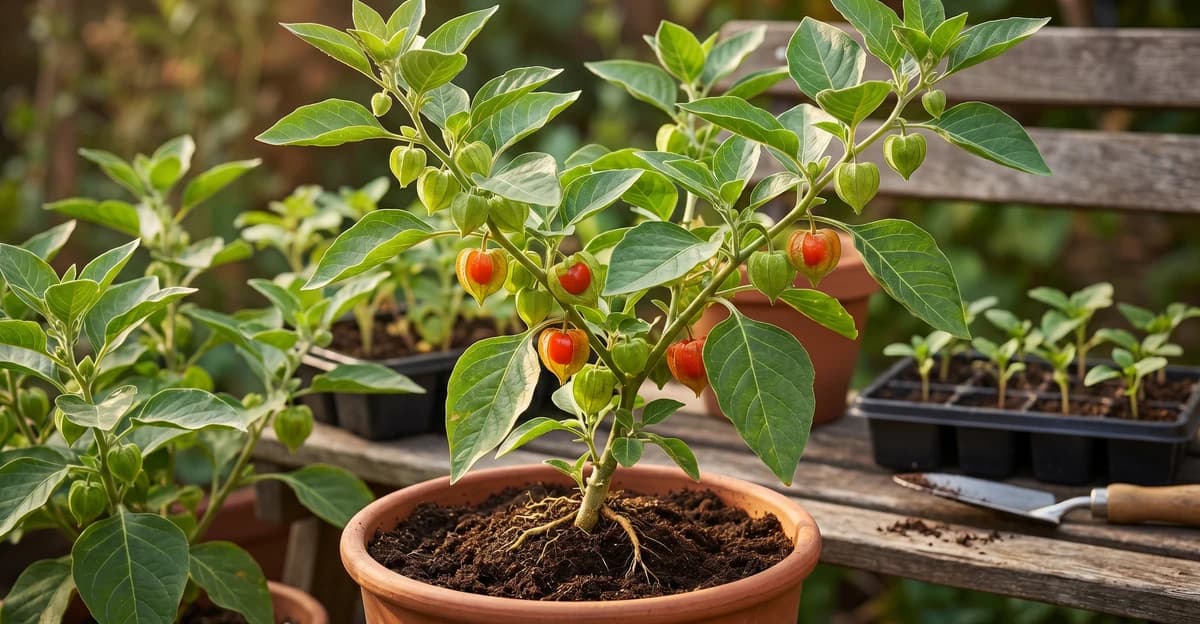
Image: Withania somnifera showing the ripe berries in their papery calyx — the stage at which seed is collected.
Why grow ashwagandha
Ashwagandha is a short, woody perennial shrub in the nightshade family (Solanaceae), native to the dry regions of India, the Middle East, and parts of Africa. It is grown almost entirely for its roots, which are cleaned, dried, and traditionally used as an adaptogenic herb in Ayurveda. We're not making any health claims here — this is a growing guide — but it's worth knowing why the root matters horticulturally: the plant accumulates a family of steroidal compounds called withanolides (the best known are withaferin A and withanolide A), and much of the published cultivation research is aimed at growing roots with more of them. Those same studies are what let us give evidence-based advice on soil, feeding, and growing method below.
For a home or market grower, ashwagandha has three practical virtues: it germinates readily from seed, it thrives on neglect once established, and it fits a single growing season in most climates.
Climate, site, and hardiness
Ashwagandha is a warm-climate plant that wants heat and light.
Sun: Give it full sun — aim for at least six to eight hours of direct light a day. It is not shade-tolerant, and plants grown in shade stay weak and leggy (NC State Extension).
Hardiness — the honest answer. You'll see ashwagandha described both as a perennial and as an annual, and both are right depending on where you garden. It is best understood as a tender perennial: it will live for more than one year only where winters stay essentially frost-free (roughly USDA zone 8–9 and warmer; NC State Extension lists it for USDA 8a–12b), but it is genuinely frost-sensitive — the Plants For A Future database rates its cold tolerance only to about UK hardiness zone 9, and any hard frost kills the top growth. In cool and temperate climates, the practical approach is to grow it as a single-season annual and harvest the roots before the first hard frost, which is also the point at which root compounds are typically at their peak. So if you've wondered whether ashwagandha is a perennial or an annual, the useful answer is: treat it as an annual unless you are frost-free.
Temperature: Warm days and a long, dry finish to the season suit it. It is well adapted to semi-arid conditions and does not need high humidity, which is why it is grown as a rain-fed or lightly irrigated crop across the drier regions of India (TNAU Agritech Portal).
Soil and substrate
This is a plant of poor, dry ground, and trying to grow it in rich, moisture-holding soil is a common mistake.
Texture and drainage: Ashwagandha does best in sandy loam or light red soils with sharp drainage (NMPB agro-technique guide). Heavy, waterlogged soil causes root rot and produces forked, poor-quality roots. If your ground is heavy, grow in raised beds or containers with a gritty mix.
pH: It prefers neutral to mildly alkaline soil, around pH 7.5–8.0 — agreement here is good across the Indian agro-technique guidance and extension sources. It will not thrive in strongly acidic soil.
Container growers: A free-draining mix — for example, good potting soil cut heavily with perlite, coarse sand, or grit — mimics its native ground. A deep pot (at least 25–30 cm) gives the taproot room to develop, since the root is the harvest.
Propagation and germination
Ashwagandha is grown from seed, and germination is where most of the science concentrates.
Temperature is the master switch. Seeds germinate best in warm soil, close to 25 °C — this is the optimum identified by Khanna and colleagues, and temperature is one of the key variables Kambizi and colleagues studied independently, so it rests on more than one source. Sow when the soil has warmed; cold soil gives slow, patchy germination.
Sowing depth and method: Sow shallowly (roughly 0.5–1 cm) into a warm, moist seed bed or tray, then thin or prick out the strongest seedlings. Seedlings are transplanted once they are sturdy enough to handle.
Giving germination a boost. A couple of pre-treatments are supported by research:
- A 12-hour pre-soak in a vermicompost tea (leachate) before sowing improved germination in one controlled study, and has the side benefit of feeding the young seedling.
- One study also found that a plant hormone treatment — gibberellic acid (GA₃) at 150 µg/ml — was the most effective germination enhancer they tested. This is a specific laboratory result from a single study; treat it as a technique worth trying, not a universal requirement. Additional germination work supports the general picture that ashwagandha seed responds well to pre-treatment.
A lab caveat on light. The same germination study found that continuous light favoured germination. That is a controlled-environment optimum — it does not mean you should light a field or seed tray around the clock. In practice, warm soil near 25 °C and shallow sowing do the heavy lifting; the light finding is a lab detail, not a field instruction.
Watering
Ashwagandha is drought-hardy and far more likely to be killed by too much water than too little. Keep the seed bed evenly moist through germination and early establishment, then back off sharply. Established plants want to run on the dry side, and a dry finish to the season concentrates the roots. Consistent overwatering — or heavy, poorly drained soil — invites root rot and wilt diseases (see pests and diseases below).
Feeding and nutrition
Ashwagandha is not a heavy feeder, and the research points clearly toward organic sources.
- Vermicompost and organic amendments raise both biomass and withanolide content compared with chemical fertiliser alone — this is one of the better-supported findings in the crop, shown in a PLOS ONE study on organic cultivation and echoed by work comparing organic versus inorganic nitrogen and phosphorus sources. In other words, feeding the soil biology, not just the plant, tends to give you both a bigger root and a richer one.
- An integrated approach that balances organic and inorganic inputs has also been reported to optimise growth.
We're deliberately not giving a per-plant NPK schedule here — the right rates depend on your soil test, container size, and system, and a general guide is the wrong place for prescriptive dosing. For a stage-by-stage nutrient schedule tailored to ashwagandha, see the dedicated nutrient guide on the ashwagandha plant page. The takeaway for a growing guide is simple: lean organic, especially vermicompost, and don't overfeed.
Spacing, layout, and irrigation
If you are growing a bed or a plot rather than a few pots, layout matters for the size of the roots you lift. A field trial found that planting layout, spacing, and nutrient management under drip irrigation together drove dry-root yield (and the economics of the crop). Drip keeps water off the foliage — helpful against leaf and wilt diseases — and gives you control over that all-important dry finish. Give plants enough room that each can build a solid taproot rather than competing into thin, stringy roots.
Soilless and hydroponic ashwagandha — the research frontier
Most ashwagandha is grown in the ground, but a small and genuinely interesting body of research has tested soilless systems, and this is where growers experimenting with hydroponics should pay attention. Two honest caveats first: all of this work is research-scale — growth chambers and pilot systems, not proven commercial practice — and several of the standout numbers come from single studies. Frame it as emerging, not turnkey.
With that said, the findings are striking:
- Root chemistry can shift in favour of soilless culture. In an aeroponics-versus-hydroponics comparison, aerial (shoot) biomass was statistically similar between the two systems (about 57.6 g dry weight per plant under hydroponics versus 49.8 g under aeroponics), but one study found withaferin A was significantly higher under hydroponics — 7.8 mg·g⁻¹ versus 5.9 mg·g⁻¹ dry weight — leading the authors to conclude hydroponics was the better system for reproducible withaferin A.
- Aquaponics has been used to grow the roots too. In an aquaponics trial, one study found six-month-old roots of the variety Poshita reached about 1.879 mg/g withanolide A (with the variety Jawahar-20 lower, near 1.221 mg/g), while older plants accumulated more compound overall.
- Environmental levers matter under controlled conditions. Elevated CO₂ has been shown to alter the plant's carbon partitioning and raise biomass in a controlled-environment study — the kind of lever a soilless grower can actually pull.
None of this makes hydroponics the standard way to grow ashwagandha. It makes it the interesting edge — and, for a hydroponic-minded grower, a defensible reason to experiment.
Pests and diseases
Ashwagandha is fairly robust, but three problems dominate the literature:
- Leaf spot disease is the most-studied foliar problem, and it matters beyond appearance — infection has been shown to reduce the plant's secondary metabolites, i.e. the very compounds the roots are grown for. Good spacing and airflow, and keeping water off the leaves, are the first line of defence.
- Fusarium wilt is a soil-borne threat, especially in wet or poorly drained ground. A trial found that bio-control agents combined with organics gave effective control — consistent with the organic, well-drained approach recommended throughout this guide.
- Carmine spider mite (Tetranychus urticae) has been recorded infesting ashwagandha in India (the first such record), and, as with most crops, mites flare in hot, dry, dusty conditions. Inspect leaf undersides and treat early.
Because prevention here overlaps so neatly with good culture — sharp drainage, sun, airflow, organic soil life — a well-sited ashwagandha plant rarely needs heavy intervention.
Advanced Troubleshooting: Diagnosis and Recovery
The prevention-first advice above heads off most trouble. This section is for when something has already gone wrong — a decision-tree approach to the handful of issues that actually cost ashwagandha growers a crop, with recovery steps where recovery is still possible.
Decision tree — patchy or failed germination. This is the single most common early failure.
- How warm was the soil? Germination is temperature-gated, with the optimum near 25 °C.
- Below roughly 20 °C: the usual culprit. Cold, slow, uneven emergence is expected. Move trays onto a heat mat or somewhere warmer and re-sow — germination rate and speed both climb sharply as soil approaches 25 °C.
- Warm but still patchy: go to step 2.
- How was the seed sown, and how old is it?
- Sown too deep (below ~1.5 cm): re-sow shallowly at 0.5–1 cm; ashwagandha needs to be near the surface.
- Old or untreated seed: use fresh seed and consider a pre-treatment — a 12-hour vermicompost-tea pre-soak improved germination in a controlled study, and GA₃ at 150 µg/ml was the single most effective enhancer in another.
Decision tree — wilting or collapsing plants. Check the soil before you reach for anything.
- Is the soil wet or soggy?
- Wet soil, plant wilting: this is the classic overwatering-plus-poor-drainage failure, and it opens the door to root rot and Fusarium wilt — a soil-borne disease favoured by wet ground. Stop watering, improve drainage immediately (or lift and repot into a gritty mix), and remove badly affected plants. A trial found bio-control agents combined with organics gave effective control of Fusarium wilt, which fits the organic, sharp-draining approach used throughout this guide.
- Dry soil, plant wilting: simple drought — water and it recovers within a day or two. This is rare, because established ashwagandha prefers to run dry.
- Roots forked, stubby, or stringy at lifting? Not a disease and not treatable mid-season — it traces to heavy or compacted soil, or crowding. Fix soil texture and spacing for the next crop.
Foliage problems at a glance:
| Symptom | Likely cause | Action |
|---|---|---|
| Brown or tan spots spreading on leaves | Leaf spot — matters because it has been shown to reduce the root's secondary metabolites, not just mar appearance | Remove affected leaves, open up spacing and airflow, keep water off the foliage |
| Fine stippling or speckling with faint webbing on leaf undersides, in hot dry spells | Carmine spider mite (Tetranychus urticae), recorded on the crop in India | Inspect undersides early and treat promptly; mites flare in hot, dry, dusty conditions |
| Lower leaves yellowing, soil staying soggy | Overwatering / early root rot | Back off water, check drainage before anything else |
Note: Almost everything on this list traces to two root causes — too much water in soil that drains too slowly, or heat-and-dust stress. A well-sited plant in sharp-draining soil with good airflow rarely reaches the point of needing a rescue protocol.
Harvesting and drying the roots
Roots are typically lifted at the end of a single season, before the first hard frost — which, in cool climates, is also why the plant is grown as an annual (see hardiness above). The plant's own signal for peak root maturity is the leaves beginning to dry and the berries turning red-orange, which in the traditional Indian calendar is reached roughly 150–180 days after sowing; in frost-prone climates the frost date usually forces the harvest at or before that point. Lift the whole plant, separate the roots, and wash them clean.
Drying is what turns a fresh root into a storable one, and it has been formalised: one study developed a dedicated drying protocol for ashwagandha roots, defining moisture and temperature targets to preserve quality. The practical principle is to dry roots down steadily to a stable, storable moisture level without cooking them — gentle, thorough drying rather than high heat.
Root size and quality trace straight back to earlier decisions: sharp-draining soil, restrained watering with a dry finish, organic feeding, and enough spacing. The harvest rewards the whole season's discipline.
A practical starting plan
If this is your first ashwagandha crop, here is a simple sequence:
- Time it to your season. Count back from your first expected hard frost. You want plants sown into warm soil in spring/early summer and harvested before that frost.
- Prepare light, sharp-draining ground — sandy loam or a gritty container mix, target pH around 7.5–8.0. Avoid rich, wet soil.
- Sow into warm soil (near 25 °C), shallowly. For a head start, pre-soak seed for 12 hours in vermicompost tea.
- Pick a full-sun spot — six to eight hours of direct light, minimum.
- Water to establish, then hold back. Keep seedlings moist; run established plants dry-ish. Drip irrigation gives you the most control.
- Feed lightly and organically. Vermicompost is the best-supported amendment; skip the heavy synthetic feeding. For a detailed ashwagandha nutrient schedule, use the plant page.
- Watch for leaf spot, wilt, and mites — good drainage, airflow, and dry foliage prevent most of it.
- Harvest before frost, then dry roots gently and thoroughly for storage.
Grower's Season Calendar
The starting plan gives the sequence; this calendar puts it on a timeline. Ashwagandha is a single-cycle crop of roughly 150–180 days from sowing to root harvest, so the whole thing can be planned backward from your frost date (temperate growers) or run on the traditional monsoon calendar (subtropical growers). The timings below are given as weeks from sowing so they transfer to any climate.
| Phase | Timing | What to do | Watch for |
|---|---|---|---|
| Pre-season | Weeks −2 to 0 | Prepare light, sharp-draining beds or gritty containers; target pH 7.5–8.0. Optionally pre-soak seed 12 h in vermicompost tea. | Don't start until soil will hold near 25 °C |
| Sowing & germination | Weeks 0–3 | Sow shallow (0.5–1 cm) into warm soil; keep the seed bed evenly moist. | Cold soil gives slow, patchy germination |
| Seedling & establishment | Weeks 3–7 | Thin or prick out the strongest seedlings; transplant once sturdy — commercial practice moves 35-day seedlings to the field. Keep moist. | Damping-off in wet, crowded trays |
| Vegetative growth | Weeks 7–16 | Full sun, 6–8 h. Start backing water off — established plants run dry. Light organic feeding only, vermicompost first. | Overwatering; leaf spot in humid spells |
| Maturation & dry finish | Weeks 16–22 | Cut water back hard for a dry finish, which concentrates the roots. Stop feeding. | Spider mite in hot, dry weather |
| Harvest & drying | Weeks 22–26 (≈150–180 days) | Lift whole plants before the first hard frost; wash the roots and dry them gently and thoroughly to a stable storage moisture. | Frost arriving before harvest; drying too hot |
Two reference calendars to map it onto:
- Temperate (frost-limited): count back about 22–26 weeks from your first expected hard frost — sow into warm spring or early-summer soil, harvest in autumn before frost.
- Subtropical / traditional Indian: nurseries are raised in June–July with the monsoon; the crop flowers and sets fruit from about December, and roots are lifted once the foliage dries and the berries ripen — January–March, the later end of the 150–180-day range.
Note: The single most important date is the harvest, not the sowing. A dry finish and lifting before hard frost do more for root quality than hitting any exact sowing week.
Commercial Cultivation and Yield
Everything above scales down to a few pots or up to a field. For growers weighing ashwagandha as a crop rather than a curiosity, here is what field-scale research and extension data show about spacing, yield, and economics. These are per-hectare field figures from Indian trials and extension guidance — a planning reference, not a home-pot prescription (for pot-scale feeding, see the free guidance above and the ashwagandha plant page).
Planting and population:
| Parameter | Extension guidance (TNAU) | Research optimum (Girase, under drip) |
|---|---|---|
| Seed rate | 10–12 kg/ha broadcast; ~5 kg/ha via transplanting | — |
| Spacing | 60 × 30 cm (~55,000 plants/ha) | 30 × 20 cm out-yielded 45 × 20 cm (dry root +19.9%) |
| Crop duration | 150–180 days | — |
| Establishment | Nursery raised June–July; 35-day seedlings transplanted | Broad-bed-furrow layout gave the highest yield |
Dry-root yield — set expectations honestly (yields below are in quintals per hectare, q/ha; a quintal is 100 kg, so 1 q/ha = 100 kg/ha):
- Typical field range: roughly 3–5 q/ha (300–500 kg/ha) of dry root, with well-managed crops reaching a ceiling near 7 q/ha (~700 kg/ha), plus 50–75 kg/ha of seed.
- Optimised drip trial: under drip irrigation with a balanced field feed (75 : 37.5 : 37.5 kg N∶P₂O₅∶K₂O plus 5 t/ha farmyard manure), dry-root yield reached about 8.4 q/ha (837 kg/ha), and a broad-bed-furrow layout on its own gave ~7.9 q/ha (790 kg/ha).
These figures form a hierarchy rather than a contradiction — a typical 3–5 q/ha, a well-managed field ceiling near 7 q/ha, and an optimised drip-irrigation research plot at ~8.4 q/ha, each adding more intensive management than the last. In practice, moving from a typical low-end crop to that research-plot optimum nearly triples the yield (300 → 837 kg/ha).
Economics (from the same drip-irrigation trial):
| Metric | Best layout (broad-bed furrow) | Best spacing × nutrition |
|---|---|---|
| Gross returns | ₹2,20,379/ha | ₹2,56,946/ha |
| Net returns | ₹1,60,796/ha | ₹1,92,496/ha |
| Benefit∶cost ratio | 3.67 | — |
(The rupee figures use the Indian digit grouping, where ₹2,20,379 is 2.2 lakh — that is, ₹220,379.) A benefit∶cost ratio of 3.67 means roughly ₹3.67 came back for every rupee spent in that trial — attractive, but these are optimised research-plot economics in one Indian production context. Real margins depend on local input costs, the price you can sell dried root at, and your own yield, which the field data show swings widely with drainage, spacing, and the dry finish.
Note: The commercial levers are the home ones at scale: sharp drainage, correct spacing so each plant builds a solid taproot, controlled (ideally drip) irrigation for a dry finish, and organic-leaning nutrition. The trials that top the yield tables are the ones that got drainage and spacing right.
Final takeaway
Ashwagandha is a genuinely beginner-friendly medicinal plant: it wants sun, poor sharp-draining soil, and warmth, and it punishes overwatering more than neglect. The precision it asks for is front-loaded — alkaline soil near pH 7.5–8.0, warm-soil germination, and harvest timed before frost — and once those are set, the plant is forgiving and thrives on neglect for the rest of the season. Nail the two pivots — warm-soil germination around 25 °C and a well-timed root harvest before frost — feed it organically, and you can take a crop of dried roots from a single season. For growers who like to push further, the soilless research frontier (hydroponics and aquaponics) is a real, if still experimental, place to raise the roots' prized compounds.