How to Grow Carrots: 65-80 Day Timeline & 2 Mistakes to Avoid
A research-backed carrot growing guide: the 65-80 day germination-to-harvest timeline, the two mistakes beginners make, and an honest look at container and hydroponic viability.
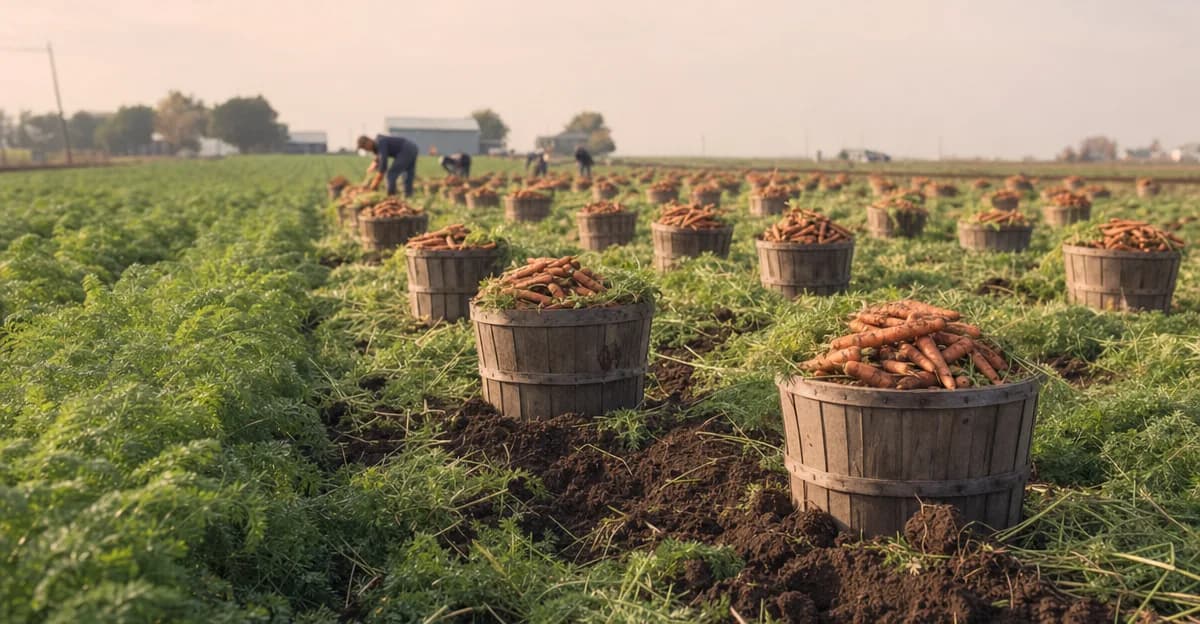
A carrot (Daucus carota subsp. sativus, family Apiaceae) is one crop you cannot rush and cannot transplant. It is grown from seed sown exactly where it will mature, and its entire life is a single, one-way journey: a slow germination, a burst of leafy growth, and then a long stretch where the plant quietly pushes sugar and stored energy down into one taproot. Get the timeline and two key decisions right, and carrots are among the most reliable crops a home grower can raise.
This guide walks through that timeline stage by stage, then covers the two mistakes beginners make most often, and finishes with an honest look at container and soilless growing. Recommendations are grounded in peer-reviewed research and university extension guidance, with explicit notes wherever the evidence disagrees.
The Carrot Growth Timeline at a Glance
Most carrot varieties run from sowing to harvest in about 65 to 80 days, though this stretches in cool weather. The stages are predictable:
- Germination (days 0–21). Carrot seed is slow and often erratic to emerge, typically taking 14 to 21 days. Keep the surface consistently moist through this window.
- Seedling and thinning (weeks 3–5). Once seedlings reach 7–10 cm of foliage, thin them to their final spacing.
- Leaf growth (weeks 4–8). The plant builds its leafy canopy; the root is still thin.
- Root bulking (weeks 6–11). The taproot swells and stores sugars. This is when feeding and watering strategy matter most.
- Harvest (days 65–80). Roots reach eating size and are pulled — once. A carrot produces one root per plant and does not regrow after harvest.
Because a carrot never gets a second chance at its taproot, the early decisions — where you sow, how you thin, and how you feed — determine the shape and quality of everything you eventually pull from the ground.
Stage 1: Germination — Slow, and Temperature-Sensitive
Carrot seed is tiny (roughly 600–800 seeds per gram) and is sown shallow, about 6–13 mm deep. It germinates slowly, so the single most important job in the first three weeks is keeping the seedbed from drying out. A dry crust at the surface is the most common reason a row of carrots never comes up.
Temperature is the other lever. Germination is strongly temperature-dependent: in controlled trials, carrot seed reached about 85% germination at 20 °C but only 27% at 36 °C. The practical target is a soil temperature of roughly 18–24 °C, and reliably below 30 °C. The underlying biology is well described by hydrothermal-time models, in which temperature and moisture jointly govern how fast a seed population emerges — which is why both a moist surface and a moderate temperature matter, not just one or the other.
One research-backed refinement: seed harvested from the primary and secondary umbel orders of the parent plant holds higher vigor at high temperature, so premium seed lots tend to germinate more evenly in warm conditions.
Note on sources. Some popular guides quote a precise "optimal embryo growth temperature" for carrots. We do not, because that specific figure could not be traced to a verifiable source. The temperature and germination numbers above come from controlled germination studies.
Stage 2: Thinning — The Step Beginners Skip
Once seedlings stand about 7–10 cm tall, thin them to 5–7.5 cm apart. This feels wasteful, but crowded carrots compete for space and produce thin, twisted, or stunted roots. Thinning is not optional for a good crop — it is the difference between a row of pencils and a row of proper carrots.
Snip unwanted seedlings at the soil line with scissors rather than pulling them, which avoids disturbing the roots of the keepers next door.
Beginner Mistake #1: Transplanting Carrots
The most common and most damaging beginner error is trying to start carrots in cells or plugs and move them into the garden.
Carrots should be direct-seeded only. This is one of the most unanimous points in the literature — six-plus independent university extension services, seed suppliers, and plant databases agree that carrots are sown where they will grow and are not transplanted. The reason is mechanical: disturbing or bending the delicate taproot during transplanting causes it to fork, twist, or grow multiple legs instead of a single straight root. The same forking happens when the taproot hits a stone, a clod, or compacted soil — which is why carrots want a fine, stone-free, loose growing medium above all else.
If you take one thing from this guide: don't transplant carrots, and give them soft, deep, obstacle-free ground to grow into.
Stage 3: Root Bulking and Feeding
Carrots feed on a schedule that surprises people used to tomatoes or peppers. Fruiting crops are pushed with nitrogen through their productive phase; carrots do the opposite — nitrogen should decrease as the root bulks.
Stage-by-Stage Feeding: NPK, EC, and pH Targets
- Nitrogen (N): provide moderate nitrogen during leafy growth, then reduce it as the root begins to swell — the reduce-nitrogen-through-bulking pattern follows University of Florida IFAS guidance for the crop. As a practical solution-feed target, that translates to roughly 130–180 ppm during leafy growth, easing to 80–120 ppm through bulking — a synthesized working range rather than a figure any single trial publishes at those exact values.
- Potassium (K): carrots are potassium-dominant. Crop nutrient uptake has been reported at roughly N:P:K of 121:27:194 kg/ha — potassium at about 1.6 times nitrogen. That K-forward pattern is corroborated by the perlite hydroponics work of Asaduzzaman et al. (The 121:27:194 figure comes from a fertilizer vendor's crop guide, so treat the exact numbers as guidance; the K-dominant direction is what multiple sources agree on.)
- EC and pH: in soilless systems, run a gentler feed for seedlings (EC around 1.0–1.4, a standard low-strength starting point) and build to the EC 1.6–2.0 at maturity used in the perlite trial, at a pH of 6.0–6.5.
How much total feed? Here the evidence honestly disagrees, and it is worth knowing why. In one perlite hydroponic trial, carrots were optimized at a full-strength nutrient solution (about N 243 / K 313 ppm). In another, using modified rockwool, growers got good yields on a very dilute solution (about N 35 / K 59 ppm) over a 90-day cycle, because nutrients accumulated in the substrate over time. The takeaway is not a single magic ppm number: carrots tolerate a wide feeding range, and the right concentration depends on your system and how long the cycle runs — a short cycle in inert media needs a richer feed than a long cycle in a substrate that stores nutrients.
Beginner Mistake #2: Over-Feeding Nitrogen
The second classic error follows directly from the feeding pattern above: too much nitrogen ruins carrots. Excess nitrogen, especially during root bulking, drives lush leafy tops at the expense of the root and encourages forked, hairy, or split roots. This is why fresh manure and high-nitrogen fertilizers are repeatedly warned against for carrots, and why the feeding curve falls rather than rises as harvest approaches.
Forking has more than one cause — it can be physical (a stone or compacted soil deflecting the taproot) or nutritional (excess nitrogen) — so if your carrots come up split or legged, look at both your soil texture and your feed before blaming either alone.
Growing Conditions: A Cool-Season Root
Carrots are a cool-season crop. They grow best with day temperatures around 16–24 °C and nights around 13–18 °C, and the root itself sizes up best when soil sits around 15–20 °C. Sustained heat above about 24 °C tends to produce paler, more fibrous, poorly flavored roots, which is why many growers time carrots as a spring or fall crop and find that fall-grown carrots taste sweeter after cool nights.
Container and Raised-Bed Carrots
Carrots can be grown in containers, but this is the one area where the practical advice comes with an honest caveat.
The depth of the container has to match the variety. Full-size types such as Nantes and Danvers want at least 30 cm (12 in) of depth, while short, blunt cultivars — Parisian (round), Chantenay, and other stump-rooted types — do well in about 20 cm.
Sources disagree on how enthusiastic to be. Iowa State University Extension bluntly notes that containers are "not a good option" for carrots and steers growers toward short cultivars if they insist. Other extensions and grower experience are more positive about pots, provided the depth and cultivar are matched. Both can be true: a round or stump-rooted variety in a deep-enough container works well, while trying to grow a long Nantes in a shallow pot will disappoint you. Whatever the container, the medium must be loose, fine, and stone-free so the root can drive straight down.
Growing Carrots in a Soilless System
Carrots can be grown hydroponically, but they are picky about the method — and this is where controlled research is especially useful, because a taproot has different needs than a leafy green or a fruiting vine.
Choosing a Soilless System for Carrots
- Substrate-based systems (drip-fed) are the best fit. A taproot needs a physical medium to grow straight into. Fine perlite performs well: in trials, 0.6 mm fine perlite produced the best yields compared with coarser grades, with the solution drip-fed at an EC of about 1.6–2.0 mS/cm. Root-zone aeration also matters — perforated rockwool blocks yielded 2–3 times more than standard rockwool, because better aeration reached the developing root.
- Aeroponics is not recommended. When carrots were grown by misting the roots in air, they produced the smallest, shortest roots with excessive thin secondary branching — the mist gives the taproot no physical support to elongate straight. A side-by-side comparison of substrate, hydroponic, and aeroponic systems found the substrate-based approach best for carrot roots.
- Deep water culture, NFT, and Kratky are poorly suited to carrots for the same reason: a taproot needs a medium to push against and cannot form a proper straight root suspended in water or a thin nutrient film.
In short: if you grow carrots without soil, use a fine, well-aerated substrate with drip feeding — not water-culture or misting systems designed for lettuce.
Stage 4: Harvest, and When to Pull
Carrots are ready roughly 65–80 days after sowing, but the surest signal is the size of the root's shoulder at the soil surface. A common benchmark is a crown diameter of about 1.5–2.5 cm — South Dakota State University Extension suggests pulling when the top of the root reaches about 2 cm across. Under good conditions, a well-grown carrot can reach around 146 g — a figure recorded in an optimized perlite-hydroponic trial, so treat it as an upper benchmark rather than a typical garden yield.
Remember the rule from the timeline: one root per plant, no regrowth. When you pull a carrot, that plant is finished. To harvest continuously, sow in succession every few weeks rather than expecting a single planting to keep producing.
Handling and Storage
Carrots keep remarkably well if handled right immediately after pulling:
- Top them promptly. Cut the leafy tops off to within about 2.5 cm of the crown right away — leaving the greens on pulls moisture out of the root.
- Store cold and humid. Carrots hold best at 0–1 °C and 95–98% relative humidity, where they can keep for four to six months. A perforated bag in the coldest part of a refrigerator approximates this.
Diseases and Pests
Most carrot problems are preventable with spacing, airflow, and clean rotation.
Disease and Pest Prevention Protocol
The threats worth knowing:
- Leaf blights (Alternaria and Cercospora). The most common foliar diseases. They are favored by 8–12 hours of leaf wetness at 20–30 °C, so they thrive on crowded, wet foliage. Prevent them with proper thinning for airflow, watering at the base rather than overhead, and rotation away from previous carrot ground.
- Cavity spot. Sunken lesions on the root, associated with Pythium species in wet, poorly drained soil — another reason drainage and aeration matter.
- Carrot rust fly. A key pest whose larvae tunnel into roots; floating row covers and rotation are standard defenses.
- Aster yellows. A phytoplasma disease spread by leafhoppers, causing distorted, discolored tops and hairy, bitter roots. It is managed mainly by controlling the leafhopper vector and removing infected plants, since there is no cure once a plant is infected.
- Boron deficiency. Can cause root disorders in carrots; commercial crop guides describe the deficiency symptoms, and university extension confirms physiological root problems in this crop, so correct a diagnosed boron shortfall rather than guessing.
Quick Reference: Carrot Growing Cheat Sheet
| Stage | Timing | What matters most |
|---|---|---|
| Germination | Days 0–21 (often 14–21 to emerge) | Constant surface moisture; soil 18–24 °C, below 30 °C |
| Thinning | Seedlings 7–10 cm tall | Thin to 5–7.5 cm apart |
| Leaf growth | Weeks 4–8 | Moderate nitrogen, steady water |
| Root bulking | Weeks 6–11 | Reduce nitrogen; keep potassium high |
| Harvest | Days 65–80, crown ~1.5–2.5 cm | Pull once; one root per plant |
| Storage | Immediately after harvest | Top to 2.5 cm; 0–1 °C, 95–98% RH, 4–6 months |
Two rules above all: direct-seed into loose, stone-free ground (never transplant), and let the feed fall — not rise — as the root swells.
Curious about carrots as a species? See the carrot plant profile for botanical detail and growing data.