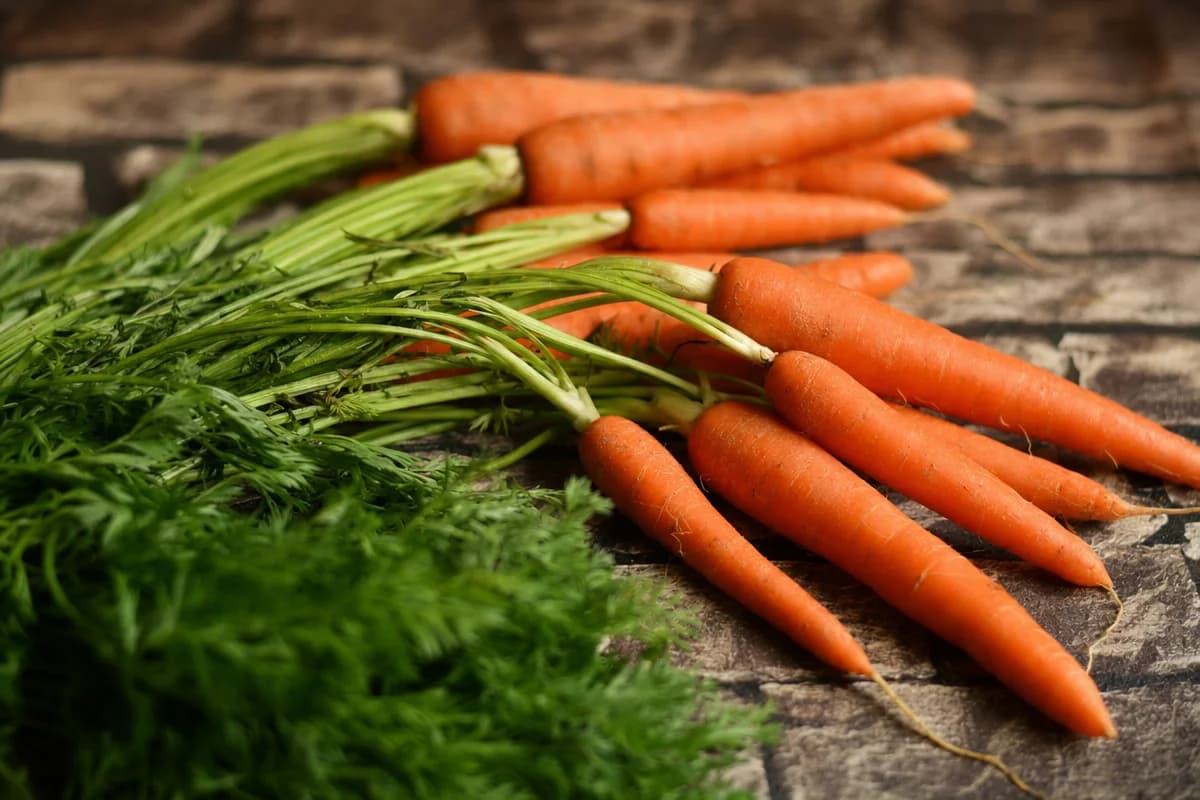
About This Plant
Carrot is a cool-season root crop grown for straight storage roots and requires deep media, moderate nitrogen, and stable moisture to avoid forking and excess foliage.
How to Grow Carrot
Learn how to grow Carrot from seed to harvest in 75 days. Intermediate difficulty. Complete nutrient guide, pH/EC requirements, and growing conditions for soil & container.
Sources cited: 29.
Nutrient Requirements by Growth Stage
Carrot hydroponic nutrition follows a distinctive potassium-dominant pattern with nitrogen that DECREASES during root bulking -- the opposite of fruiting crops. During the seedling phase (EC 1.0-1.4), nitrogen should be moderate at 80-120 ppm with potassium at 120-200 ppm…
Sign in to view nutrient requirements
A free account unlocks NPK targets for all four growth stages, micronutrient levels, a per-stage nutrient calculator, and the full nutrition guide. Signing up takes one click. Truleaf is a free, non-profit project, and every new account helps it grow. No spam, ever.
Growing Environments
Carrots thrive in outdoor, greenhouse, container, and hydroponic indoor environments. Outdoor: The primary and strongly preferred traditional environment, requiring full sun (6-8+ hours daily), deep loose soil, and cool-season temperatures around 18-24C day / 13-16C night…
Temperature
Carrot seeds germinate across a wide temperature range of 10-30C (50-86F), with fastest emergence at 25-27C in as few as 6 days. However, Pereira et al. (2008) demonstrated that germination drops from 85% at 20C to only 27% at 36C, so maintaining substrate below 30C is critical. For practical hydroponic production, target germination temperatures of 18-24C for the best balance of speed and uniformity. During vegetative growth, carrots are a cool-season crop performing best at 16-24C daytime with 13-18C nighttime temperatures. Root development and sugar accumulation are optimal at 15-20C; temperatures above 24C can cause fibrous, poorly colored roots. Rowse & Finch-Savage (2003) confirmed optimal embryo growth at 20-25C. The overall optimal setpoint of 18C reflects the sweet spot for root quality in controlled environments.
Humidity
Carrots tolerate a broad humidity range of 50-80% RH in hydroponic and controlled-environment cultivation, with 65% as the optimal target. Unlike Mediterranean herbs that require low humidity, carrots evolved as a temperate-climate crop and perform well in moderate to moderately high humidity…
Light
Carrots require full sun -- a minimum of 6 hours direct light daily, with 8-10 hours preferred for optimal root development. In hydroponic indoor cultivation, target a DLI of 18 mol/m2/d using full-spectrum LEDs at PPFD 350-420 umol/m2/s…
Airflow
Maintain airflow velocities of 0.3-1.0 m/s across the carrot canopy. The minimum of 0.3 m/s ensures adequate photosynthetic gas exchange and disrupts the boundary layer on foliage, preventing the stagnant humid conditions that favor Alternaria and Cercospora leaf blights…
Sign in to view environmental requirements
A free account unlocks exact temperature, humidity, light and airflow targets, including germination and growth ranges, DLI, photoperiod and PPFD, plus the full environment guide. Signing up takes one click. Truleaf is a free, non-profit project, and every new account helps it grow. No spam, ever.
Hydroponic System Compatibility
For hydroponic carrots, substrate-based drip irrigation is the optimal system choice. Asaduzzaman et al…
Growing Media
The critical property for carrot growing media is fine particle size that supports straight taproot elongation while maintaining adequate drainage. Vermiculite is an excellent primary choice for its fine texture, water-holding capacity, and root-friendly structure…
Container Specs
For hydroponic carrots, container depth is the single most critical specification. Standard Nantes/Danvers varieties require a minimum 30 cm (12 in) depth to allow full taproot elongation without forking…
Training & Support
Carrots require absolutely no training, staking, trellising, or structural support. They are a compact root vegetable whose foliage reaches only 25-45 cm in height…
Sign in to view system compatibility
A free account unlocks why each of the six systems fits or fails, plus growing media, container sizes, training methods, companion plants, and the full systems guide. Signing up takes one click. Truleaf is a free, non-profit project, and every new account helps it grow. No spam, ever.
Propagation
Carrots are propagated exclusively by direct seeding -- transplanting is strongly contraindicated as it causes forked, deformed roots. All major university extension services agree on this point…
Harvesting
Carrots do not regrow after harvest -- the taproot IS the harvest, and each plant produces exactly one root. Harvest when roots reach 1.5-2.5 cm diameter at the crown, typically 65-80 days after sowing for standard varieties…
Planting Calendar
Direct sow (Mar-Jul): Carrots can be planted as soon as substrate temperature reaches 10C, typically 2-3 weeks before last frost. In most temperate zones this means March through July, with successive plantings every 3-4 weeks for continuous harvest…
Common Issues
Carrots face a diverse complex of threats across all growth stages. The most economically significant foliar diseases are Alternaria leaf blight (A…
Get the full science-backed guide
By signing up, you help keep Truleaf free and support the growth of our nonprofit project. Your account unlocks full details for every plant issue—including symptoms, causes, step-by-step solutions, and prevention—plus the month-by-month planting calendar, the complete guide, and all research sources. It only takes one click. No spam, ever.