Planting Asparagus Crowns: Why You Wait 2 Years to Harvest
A year-by-year guide to establishing an asparagus bed from 1-year-old crowns: trench depth, gradual backfill, and why you don't harvest for the first two seasons, grounded in root-growth research and extension guidance.
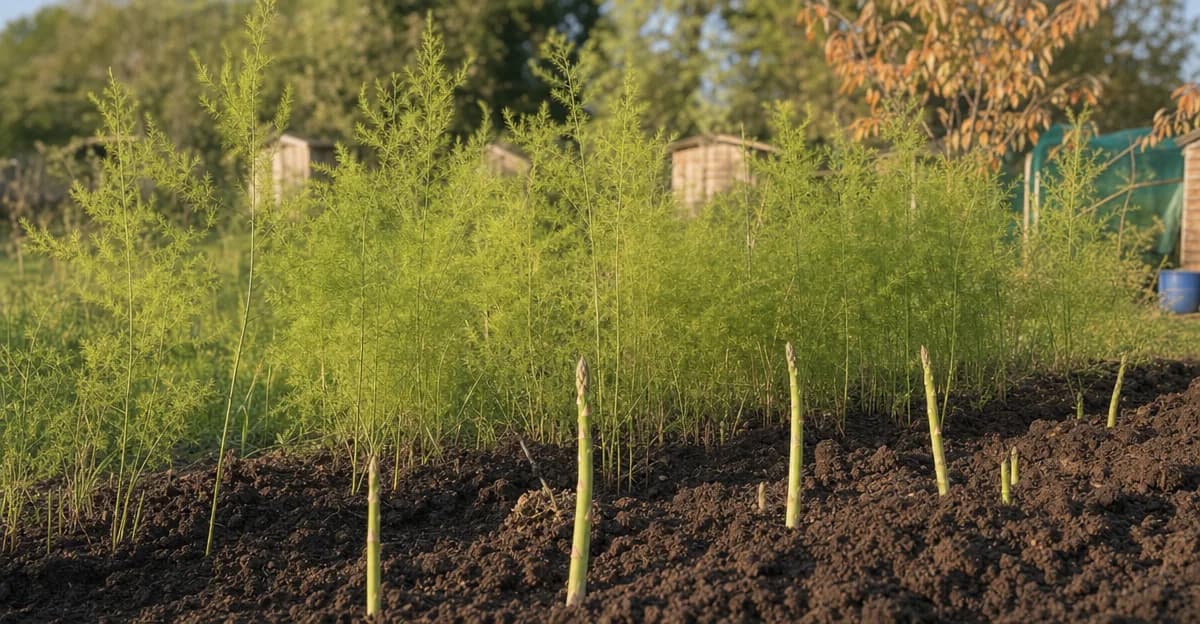
Asparagus (Asparagus officinalis, family Asparagaceae) is a long-lived perennial vegetable, and planting it is one of the few gardening decisions that pays back for 15 to 20 years or more. That payoff comes with a condition almost no other crop imposes: for the first two seasons you plant it, tend it, and harvest almost none of it. The spears you would love to cut are exactly the spears the plant needs to build itself.
This guide walks the establishment years in order: choosing 1-year-old crowns, selecting a site you will not regret, setting the crowns in a trench and backfilling gradually, and then the year-by-year harvest schedule that keeps a young bed building instead of starving. The practical mechanics come from land-grant extension guidance; the reason behind the wait comes from peer-reviewed root-growth research. Where sources disagree, this guide says so.
The Establishment Timeline at a Glance
An asparagus bed is planted once and then measured in years, not weeks. Grown from 1-year-old crowns, a typical establishment arc looks like this:
| Stage | Timing | What you do |
|---|---|---|
| Plant | Early spring, soil workable | Set 1-year crowns in a trench, backfill gradually |
| Year 1 (planting year) | First full season | No harvest. Let every spear fern out |
| Year 2 | Second season | Light harvest at most (about 2 weeks), or wait entirely |
| Year 3 | Third season | Cut for roughly 3 to 4 weeks |
| Year 3–4 onward | Mature bed | Full 6-to-8-week harvest each spring |
The single hardest part of growing asparagus is emotional, not technical: you have to let a food plant grow for two years before it feeds you. Everything below explains how to plant it well and why the wait is not optional.
Why the Wait Works: What the Plant Is Building
Why the Wait Works: Root Architecture Across the Establishment Years
The reason you do not cut spears early is not tradition. It is measurable root biology. In a peer-reviewed study tracking three asparagus cultivars through their early establishment seasons, with soil cores sampled to 0.9 m each spring, the year of sampling significantly affected root development: the plant's fleshy storage roots grew progressively deeper and more extensive with each establishment year. Those fleshy roots are the plant's pantry. They store the carbohydrate reserves that push out next spring's spears, and they are physically laid down over these first seasons.
Every spear is a leaf-bearing shoot in waiting. Left to open into ferny foliage, it photosynthesizes all summer and sends sugars down to build that deepening root system. Cut too early, and you are harvesting the reserves before the plant has finished building the structure that stores them, which weakens the crown and shortens the productive life of the bed. The century of asparagus research reviewed by Drost frames productivity as a long game: a perennial that is set up well in its establishment years rewards that investment across a very long lifespan.
That is the plant-science case for patience. The rest of this guide is about giving those roots the best possible start.
Choosing Your Crowns
Asparagus can be started from seed or from crowns, which are dormant 1-year-old root divisions. Crowns are the standard choice for home growers because they cut roughly a year off the timeline compared with starting from seed; seed is cheaper but adds a full establishment season before you reach the schedule above.
Buy 1-year-old crowns. They are the consensus best value, and they establish more reliably than older 2-to-3-year crowns. Larger, older crowns are sometimes sold as a shortcut to faster yield, but they transplant with more shock and are not reliably faster to full production, so the extra cost rarely buys you time.
For cultivar, prefer an all-male hybrid such as Jersey Giant, Jersey Knight, Guelph Millennium, or Millennium. All-male types put their energy into spears rather than seed, tend to yield more, and do not scatter volunteer seedlings that turn into weeds in the bed. The cultivars studied in the establishment root research (Atlas, Jersey Giant, and Guelph Millennium) are all modern improved types.
Where to Plant: Site Selection and the Replant Problem
Because the bed will stay put for 15 to 20 years, the site decision matters more than any single planting-day step. Get it wrong and you will be living with it for a long time.
Site Selection and the Asparagus Replant Problem
Sun and drainage. Give asparagus full sun and deep, well-drained soil. It does not tolerate waterlogging, which invites crown and root rot, so avoid low spots that stay wet. If your soil is heavy, a raised bed or berm improves drainage and gives the roots room to run.
Soil pH. Target a pH of about 6.5 to 7.0. Asparagus handles near-neutral soil better than most vegetables, so it is worth testing and, if needed, liming an acidic bed before planting.
The one rule beginners break: do not replant on old asparagus ground. This is not superstition. Old asparagus soil accumulates an autotoxic compound, trans-cinnamic acid, which suppresses the growth of new asparagus. Researchers measured it at 174 µM in ten-year-old asparagus soil, with a half-maximal inhibitory concentration of just 24 to 41 µM for asparagus seedling growth, and identified it as a mechanism behind the well-documented "asparagus replant problem." Compounding the chemistry, old asparagus ground also builds up soil-borne Fusarium, the crown and root rot that is a leading cause of decline in young plantings. Put together, the message is simple: plant new crowns on fresh ground, not where asparagus recently grew.
How to Plant: The Trench, Depth, and Gradual Backfill
Asparagus crowns are planted in a trench, and the way you fill that trench in is part of the technique, not an afterthought.
- Dig a trench and set crowns about 15 to 20 cm (6 to 8 inches) deep. Sources give this as a range rather than one number: sandy soils go toward the deeper end, heavy soils toward the shallower. Match the depth to your soil rather than chasing an exact figure.
- Set the crowns buds-up, spreading the octopus-like roots out across the bottom of the trench so they fan away from the central bud cluster.
- Space crowns about 30 to 45 cm (12 to 18 inches) apart in the row, with rows roughly 1.2 to 1.5 m (4 to 5 feet) apart. Asparagus fills in and needs the room.
- Backfill gradually, not all at once. Cover the crowns with only about 5 cm (2 inches) of soil at first, then draw more soil into the trench in stages as the spears grow up through it over the first season, until the trench is level. Burying the whole trench immediately can smother the emerging spears; feeding the soil in over time lets them reach the light while the crown settles at its full depth.
Plant in early spring, as soon as the soil is workable and warming. Timing is driven by soil temperature, not the calendar. Research on asparagus germination and seedling emergence shows that minimum-temperature and heat-sum thresholds, not the date, set how fast the plant moves in spring; the extensions apply that same soil-warmth logic to timing crown planting. That is why "plant when the ground is workable and warming" beats any fixed planting date.
Year 1, the Planting Year: No Harvest
This is the rule the whole guide is built around. In the planting year, harvest nothing. Let every spear grow up and open into ferny foliage, and leave it standing all season.
There is no gray area here. The extensions are unanimous, and the root research explains why: the plant spends its first summer building the deep storage-root system it will draw on for the next two decades. Any spear you cut this year is energy removed from that job. The reward for doing nothing is a stronger bed that produces sooner and longer.
Year 2: The Light-Harvest Debate
Year 2 is the one point where reputable sources genuinely disagree, so this guide gives you the spread rather than pretending there is one answer.
Some extensions and growers permit a light harvest of about two weeks in the second season, cutting only while spears are still coming up thick. Others advise waiting until Year 3 entirely, giving the crown one more full season to build. A third approach ignores the calendar and keys on the plant itself: harvest only when spears are coming up at least pencil-thick, and stop as soon as they thin down.
A practical way to hold all three honestly:
- Safest: wait until Year 3 to take any harvest.
- Widely accepted: if the bed is vigorous, take a light cut of about two weeks in Year 2.
- The stop signal, either way: when spears start emerging thin, stop cutting and let the rest fern out. Thin spears mean the crown's reserves are running low for the season.
There is no wrong choice between "wait" and "light Year-2 cut," as long as you err toward restraint and stop while spears are still thick.
Year 3 and Beyond: Building to a Full Harvest
By the third season the bed can carry a real harvest. Extend cutting to about 3 to 4 weeks in Year 3, then to a full 6-to-8-week season from Year 3 to 4 onward, once the bed is fully established. From there, a well-established asparagus bed produces every spring for 15 to 20 years or more.
The stop signal never changes: harvest until new spears come up consistently thin (thinner than a pencil), then lay down your knife and let the rest fern for the summer to recharge the crown for next year.
Fern Care and Winter Dormancy
The summer ferns are not decoration; they are the engine that refills the crown. Do not cut the ferns down while they are still green. Leave them standing until they have fully browned and died back in fall or winter, so they can move their stored energy down into the crown, then cut the dead foliage back before spring regrowth begins. Removing spent ferns before new spears emerge also clears overwintering pests and disease from the bed.
Establishment-Year Threats to Watch
A young asparagus bed is most vulnerable in its first seasons, before the crown is fully built.
Establishment-Year Threats: Fusarium, Beetles, and Purple Spot
- Fusarium crown and root rot. The classic establishment killer, and the strongest reason to plant on fresh, well-drained ground. It is worse in replant sites and wet soil, and it ties directly back to the site rules above, so drainage and clean ground are your best defense.
- Asparagus beetle. A key pest of both spears and ferns; scout for it through the season and manage it to protect the foliage the crown depends on.
- Purple spot. A foliar disease of spears and ferns that shows up under wet conditions; airflow and clean fern management help keep it down.
The through-line is that most establishment threats are prevented at the site-selection and sanitation stage, not sprayed away later: fresh ground, good drainage, and cutting spent ferns each winter do most of the work.
Quick Reference: Asparagus Establishment Cheat Sheet
| Decision | Guidance |
|---|---|
| Planting stock | 1-year-old, all-male hybrid crowns |
| When to plant | Early spring, soil workable and warming |
| Trench depth | ~15–20 cm (6–8 in), buds up, roots spread |
| Spacing | ~30–45 cm in-row; rows ~1.2–1.5 m apart |
| Backfill | ~5 cm at first, then fill gradually as spears grow |
| Site | Full sun, deep well-drained soil, pH 6.5–7.0 |
| Never | Plant on old asparagus ground (autotoxicity + Fusarium) |
| Year 1 | No harvest; let all spears fern |
| Year 2 | Light 2-week cut at most, or wait; stop when spears thin |
| Year 3+ | 3–4 weeks, building to a full 6–8-week season |
| Ferns | Leave until fully browned; cut back before spring |
| Payoff | A productive bed for 15–20+ years |
The one rule above all: the first two seasons belong to the roots, not to your plate. Plant 1-year crowns on fresh, well-drained ground, hold your harvest, and you buy yourself two decades of spring spears.
Curious about asparagus as a species? See the asparagus plant profile for botanical detail and growing data.