Powdery Mildew Indoors: How to Confirm and Control It
Tell powdery mildew from downy mildew, then control it indoors with humidity and airflow management, potassium bicarbonate, biologicals, and UV, backed by controlled-environment research.
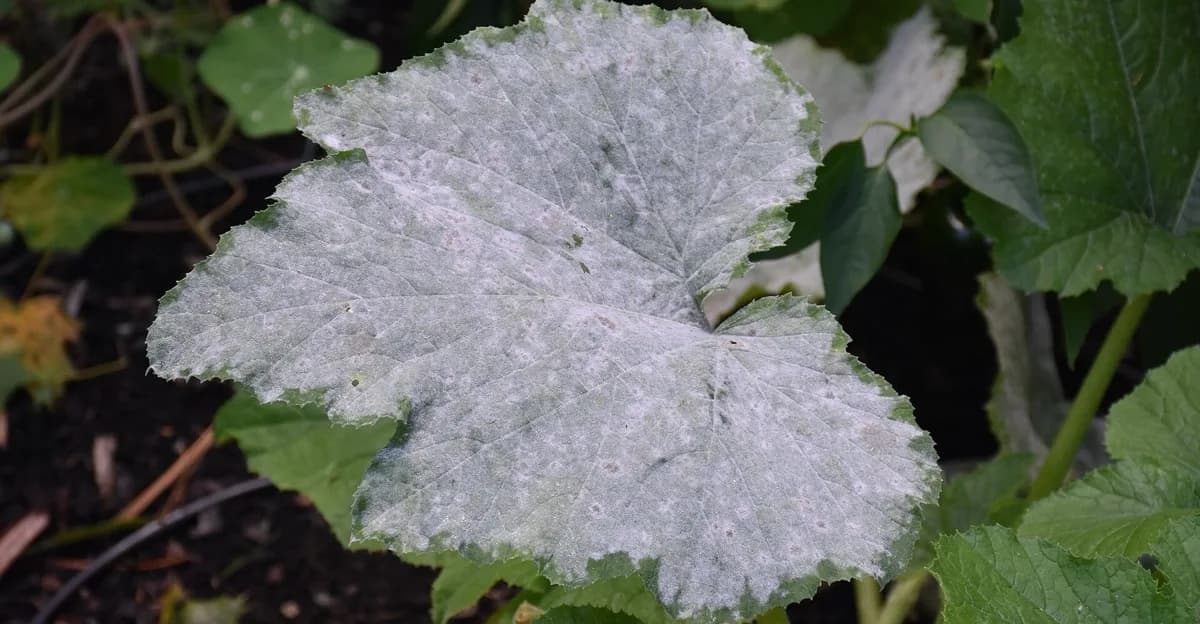
Key point: Powdery mildew is a fungal disease that thrives in high humidity but does not need wet leaves to spread, which is the opposite of most leaf diseases growers expect. Before you treat, confirm you actually have powdery mildew and not downy mildew, because they look different, are caused by different organisms, and respond to different conditions. Once confirmed, the reliable indoor levers are lowering humidity and improving airflow first, then adding a preventive spray or light-based control that fits your crop.
Powdery mildew appears as white to grayish, dusty patches on leaves. On lettuce and other leafy greens it is caused by fungi in the order Erysiphales, most often Golovinomyces cichoracearum, with related species such as Golovinomyces orontii recorded on other leafy greens like corn-salad, and it can show as white powdery growth on both the upper and lower leaf surfaces. The fungi are obligate biotrophs: they can only grow on living plant tissue, sending feeding structures into surface cells while the visible colony sits on top of the leaf, which is why the powder can be rubbed off. Under severe outbreaks, reported yield losses run from 30 to 60 percent, and the disease reduces photosynthesis before the leaf looks badly damaged.
This guide leads with lettuce and leafy greens, where the evidence for powdery mildew is strongest. Basil is a special case, so it gets its own diagnostic step below.
First, confirm it is powdery mildew and not downy mildew
The single most useful thing you can do is separate powdery mildew from downy mildew before spending time or money on a treatment. They are caused by different organisms and are favored by different moisture conditions, so a control aimed at one may do little for the other.
Powdery mildew is a true fungus. The colony grows on the leaf surface as a white to gray powder that rubs off, it can appear on the top of the leaf, and it is favored by high humidity but not by standing water on the leaf. Downy mildew is caused by an oomycete, a water mold, and it behaves differently: on basil especially, it shows as yellowing on the upper leaf with a fuzzy gray-to-purplish growth on the underside, it is favored by leaf wetness and very high humidity, and it does not simply wipe away.
| What you see | Points to powdery mildew | Points to downy mildew |
|---|---|---|
| Color and texture | White to gray dusty patches | Yellow blotches on top, fuzzy gray-purple growth beneath |
| Where it sits | Upper surface, often both surfaces; rubs off | Mostly the leaf underside; does not rub off cleanly |
| Moisture that favors it | High humidity, dry leaf surface | Leaf wetness and saturated air |
| Organism | Fungus (Erysiphales) | Oomycete (water mold) |
For basil growers, this distinction matters most. The dominant "mildew" disease of basil is downy mildew, caused by Peronospora belbahrii, not powdery mildew. If your basil shows yellowing tops and fuzzy discoloration underneath, treat it as downy mildew and manage leaf wetness and humidity, rather than reaching for a powdery-mildew product. If you are unsure which disease you have, match the leaf against both descriptions before acting.
Why powdery mildew thrives in an indoor grow space
Indoor and greenhouse environments can be ideal for powdery mildew because the conditions that favor it are exactly the ones a closed space tends to create: moderate warmth, high humidity, and still air. A review of powdery mildew biology describes epidemics as driven by moderate temperatures around 15 to 27 degrees Celsius, relative humidity above 60 percent, and poor ventilation that lets the disease spread. Conidia, the fungus's airborne spores, travel on air currents and germinate under those moderate, humid conditions.
The counterintuitive part is the role of water. Most leaf diseases need a wet surface, so growers often assume dry-looking leaves are safe. Powdery mildew is different. In a controlled grapevine study at about 25 degrees Celsius, disease rose with humidity toward an optimum near 85 percent relative humidity, and spore germination increased with humidity up to roughly 84 percent, then fell sharply above about 87 percent. In other words, very high humidity and free water actually suppress germination, while the disease peaks in humid but not soaking conditions. A separate review states plainly that the pathogen does not require free water to germinate. This is why powdery mildew can appear on leaves that never look wet.
Microclimate matters as much as the room average. A first-report study of powdery mildew on potato found the disease was worse along sprinkler lines and spread outward from localized spots, showing how pockets of humidity and still air concentrate infection even when the overall space seems fine. Crowded canopies, corners with no air movement, and dense plantings create the same kind of humid, sheltered pockets indoors.
Audit Your Grow-Space Climate
Before adding any spray, measure the conditions that decide whether powdery mildew establishes. The disease is driven by temperature, humidity, and airflow, so those are the first three things to record and correct.
| Condition | Why it matters | Practical target for indoor growers |
|---|---|---|
| Air temperature | Outbreaks are favored in the moderate 15 to 27 degrees Celsius band | You cannot always avoid this range, so lean harder on humidity and airflow |
| Relative humidity | Disease climbs with humidity above 60 percent and peaks near 85 percent | Aim to hold canopy humidity down toward or below 60 percent where the crop allows |
| Air circulation | Poor ventilation lets spores settle and colonies spread | Add gentle, continuous air movement across the canopy, not just an exhaust fan |
| Plant spacing | Dense canopies create humid, still microclimates | Space plants so air reaches every leaf; see our hydroponic lettuce spacing guide |
| Wet or sheltered pockets | Localized humidity concentrates infection | Find corners, low spots, and crowded zones and improve flow there first |
Record these numbers in one place, such as a plant diary, so you can tell whether a change actually moved the conditions. A hygrometer near the canopy is more useful than a room reading, because the leaf-level microclimate is what the fungus responds to. If you can only change one thing, increase steady airflow across the plants; it lowers leaf-level humidity and disrupts the still air spores need.
Manage humidity and airflow before reaching for a spray
Because powdery mildew is driven by humidity and still air, environmental control is the most dependable indoor lever and the one to use first. Lower the humidity around the canopy toward or below the 60 percent range where your crop tolerates it, add continuous air movement so no leaf sits in still air, and open up crowded plantings so the canopy dries between waterings. These steps reduce the conditions the fungus depends on and make any later treatment more likely to hold, because you are no longer fighting the environment at the same time. If you are setting up or rearranging the space, you can map out plant spacing and positions in Garden Architect so the canopy starts open rather than crowded.
This also keeps you clear of a common trap: overwatering or misting the foliage to "wash off" the mildew. Wetting leaves does not reliably remove an established infection and can worsen other diseases, including the downy mildew that basil is prone to. Manage the air, not the leaf surface.
Low-input sprays that work best preventively
Several low-cost sprays have real peer-reviewed support, but almost all of them work far better as preventives applied with thorough coverage than as a rescue for a heavy, established infection. Indoor growing is where they shine, because you control the schedule and can spray on time. Because these are edible crops, apply any named commercial product in this guide at the rate printed on its label and observe any pre-harvest interval it lists; the trials here show what each material can achieve, not a home dose to guess at.
Potassium bicarbonate. In a Tennessee greenhouse trial on a susceptible crop, potassium bicarbonate (as MilStop), applied three times at seven-day intervals, was rated excellent and reduced disease symptoms by 96 to 100 percent. That is strong performance, but it comes from preventive, well-timed, full-coverage sprays in a protected environment. The honest counterpoint: in open-field cantaloupe trials, potassium bicarbonate applied alone reduced severity by only about 31 percent, compared with 98 to 100 percent for conventional fungicides. The lesson for an indoor grower is that potassium bicarbonate is a legitimate contact option that performs well when you start early and cover thoroughly, not a one-shot cure for a canopy already coated in mildew.
Milk sprays. Diluted milk has repeatable peer-reviewed support across several crops. Cow's milk suppressed powdery mildew on greenhouse zucchini in a seminal study, dose-dependent milk sprays controlled strawberry powdery mildew, and later work showed the effect involves resident microorganisms, application timing, and specific milk fractions rather than a simple pH effect. Treat milk as a low-cost preventive rather than a cure, apply it as a dilute spray on a regular schedule, and keep in mind that milk left on leaves indoors can develop an off smell as the organic residue breaks down. Start with a weak dilution and increase only if needed.
Silicon in the nutrient solution (hydroponic systems). For hydroponic growers, adding soluble silicon to the nutrient solution gave modest but real suppression of cucumber powdery mildew in a controlled study, with the effect strongest near 20 degrees Celsius and much weaker at 25 to 30 degrees Celsius. This is a disease-suppression tool, not a fertilizer change, and it is temperature-dependent, so treat it as a supporting measure rather than a primary control. For anything involving your base nutrient mix and its N-P-K balance, follow the plant nutrients guidance for your crop; silicon here is about disease resistance, not feeding the plant.
Biological controls: living antagonists
Biological controls use living organisms to suppress the fungus, and several are backed by peer-reviewed work, with the same preventive caveat as the sprays above.
Bacillus bacteria are the most studied. A University of Guelph study screened 169 seed bacterial endophytes against cucumber powdery mildew and found that 62 of them significantly suppressed the disease, with a preventive effect as high as 89 percent; Bacillus was the most common effective genus, and many strains performed as well as or better than a commercial Bacillus subtilis biofungicide. Earlier work found that Bacillus subtilis applied around the time of inoculation reduced cucumber powdery mildew lesions by 90 to 99 percent, with near-total control from twice-weekly sprays. As with the low-input sprays, field results are more modest: Bacillus subtilis alone reduced cantaloupe powdery mildew severity by only about 29 percent in the field, which is why biologicals belong in a preventive, well-timed program rather than a rescue role. A commercial Bacillus subtilis product (strain QST 713) is the common benchmark these studies compare against.
There is also Ampelomyces quisqualis, a fungus that parasitizes powdery mildew itself and is sold as a biofungicide. It is a useful part of a preventive program, though like the other biologicals it works best before an outbreak gets large.
UV-C and nighttime light: effective but handle with care
One of the more surprising, well-supported controls is ultraviolet light applied at night. In cantaloupe trials, UV-C light applied during darkness reduced spore production and germination without harming the plants, and twice-weekly nighttime UV-C gave control equal to or better than the fungicide standard, with the highest yield. A major review reports that low doses of UV, delivered one to three times per week at night, can be as effective as or better than the best fungicides across many crops, while higher doses damage plants. Nighttime timing is essential because blue light and UV-A during the day strongly reduce UV's effect, so the same treatment applied in daylight does much less. Direct UV-B experiments on cucumber confirm the mechanism, cutting powdery mildew severity sharply by acting on the pathogen directly.
Treat this as informational rather than a step-by-step protocol. UV-C is genuinely effective, but it carries real eye and skin hazards, over-dosing harms the crop, and correct dosing and timing matter. If you pursue it, use equipment designed for the purpose, follow its safety instructions, and never expose yourself to the light. For most home indoor growers, environmental control plus a preventive spray or biological is a simpler and safer starting point.
Track Whether Control Is Working
Powdery mildew management is preventive and gradual, so judge it by trend rather than expecting a coated leaf to clear overnight. Record what you change and what happens, ideally in a plant diary, so you can tell a real improvement from wishful thinking.
| Record | What improvement looks like | What calls for a change |
|---|---|---|
| Canopy humidity and temperature | Leaf-level humidity holds near or below your target, airflow reaches every plant | Humidity stays high or pockets of still air remain near affected plants |
| New leaf growth | Fresh leaves emerge clean while older colonies stop expanding | New leaves keep showing fresh white patches after treatment |
| Spread across the canopy | Affected area stops enlarging and stays localized | The disease jumps to new plants or new zones |
| Spray or biological timing | You applied on schedule with full coverage before heavy infection | Coverage was patchy or started only after the canopy was heavily coated |
Older, already-colonized leaves may not fully recover, since the visible colony sits on damaged tissue; the goal is to protect new growth and stop the spread. If the disease keeps advancing despite good airflow, lower humidity, and preventive sprays, recheck your identification against the downy mildew description before escalating, and confirm your treatment reached the affected leaves.
A prevention-first plan for indoor growers
Use this order for indoor herbs and leafy greens:
- Confirm it is powdery mildew, not downy mildew, using the color, location, and rub-off tests. For basil, treat fuzzy underside growth as downy mildew.
- Measure canopy temperature, humidity, and airflow, and find crowded or still-air pockets.
- Lower humidity toward or below 60 percent where the crop allows, add continuous air movement, and open up dense plantings before spraying.
- Start a preventive spray, such as potassium bicarbonate or dilute milk, early and with thorough coverage rather than waiting for a heavy infection.
- Add a biological control like a Bacillus product on a regular schedule if you want another preventive layer.
- Consider UV or silicon (in hydroponic solution) as supporting measures, understanding their safety and temperature limits.
- Track conditions and new growth over time, and re-confirm the diagnosis if the disease keeps spreading.
The pattern to remember is that powdery mildew is an environmental disease first. It rewards growers who control humidity and airflow and who spray preventively, and it frustrates those who wait for a heavy infection and then look for a single cure.