Hydroponic Lettuce Spacing: Density, Yield, and Tipburn
How plant density changes hydroponic lettuce yield, head size, tipburn, and disease risk, with practical spacing ranges and a thinning plan backed by controlled-environment research.
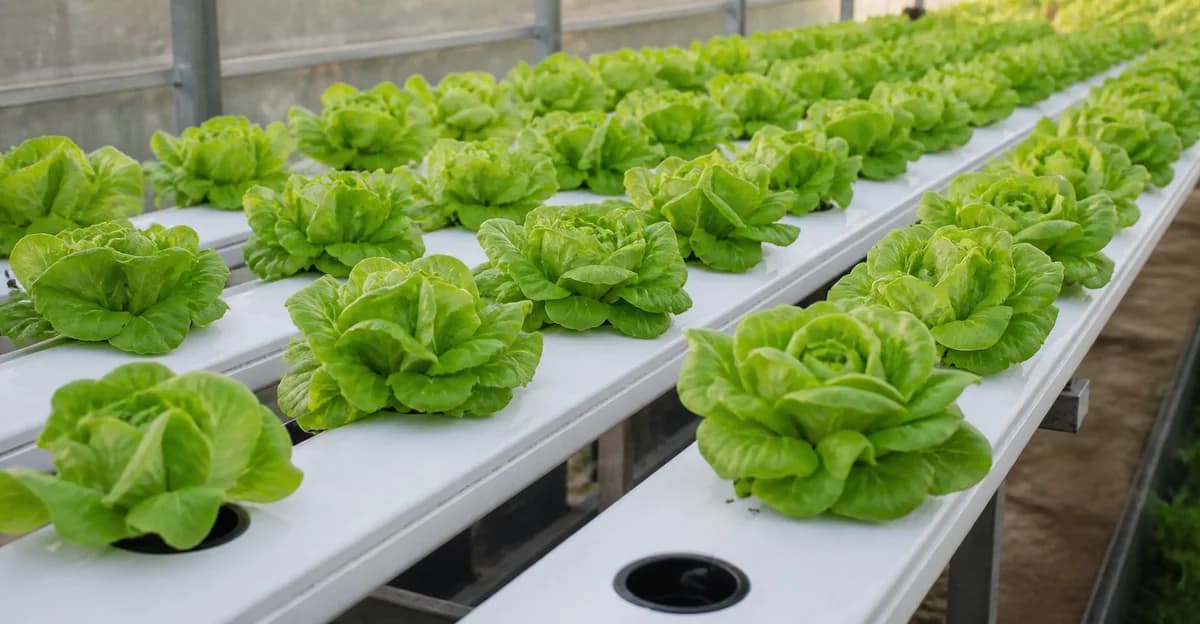
Key point: Planting closer raises the total lettuce you harvest per square meter, but it shrinks each plant and, past a point, degrades quality. In a Wageningen University greenhouse trial, butterhead lettuce started near 92 heads per square meter and was thinned in steps to about 15 heads per square meter to reach a 250 g marketable head; crowding at that scale was linked to tangled roots, outer-leaf tipburn, and malformed heads. The right density depends on what you are growing: baby-leaf and cut-leaf crops can stay dense, while whole heads have to finish at wide spacing.
Spacing is one of the few settings that trades directly between two things you both want. Give each plant more room and it grows larger and cleaner; pack more plants in and you use the growing area harder but push every plant toward light competition and crowded, still air.
The core trade-off: yield per area versus size per plant
Higher planting density increases total yield per unit area while lowering the fresh weight of each individual plant. This is the classic density response, and it shows up consistently across independent hydroponic studies.
A team at the Beijing Academy of Agriculture and Forestry Sciences and the Volcani Institute reviewed this directly, noting that plant spacing "has previously been shown to have a significant effect on plant-scale fresh weight and total yield per unit area," and that the higher densities typical of commercial hydroponics come with a caution: "too high of a plant density will result in light competition due to dense canopy cover." In their own comparison, the more densely planted hydroponic system had a higher canopy cover index but lower leaf area per plant at harvest than a wider-spaced soil crop, which is exactly what you would expect as density rises.
An earlier soilless trial at South Africa's Agricultural Research Council put numbers on the yield side. Across five spacings from 20 to 50 plants per square meter, the closest spacing of 50 plants per square meter gave the highest total yield; raising plant population raised total yield and its components. That result was for leaf and crisphead types on a short cycle, which matters for how you read it.
So density buys you area productivity and costs you plant size. Neither is automatically the goal. Which one you optimize depends on the crop.
Different crops, different final density
The apparent conflict between "densest wins" and "thin heads to 15 per square meter" dissolves once you separate the end products.
If you are growing baby-leaf or cut-leaf lettuce, small plants are the product. You harvest young leaves before plants would have crowded each other badly, so a high, fixed density is efficient. The Agricultural Research Council trial's result, highest total yield at 50 plants per square meter, fits this case.
If you are growing whole butterhead or romaine heads, each plant has to reach a marketable size, and that requires room. The Wageningen greenhouse trial graded heads against a retail standard of 250 g or more for the top class, and reaching that weight meant stepping density down over the crop: from roughly 92 heads per square meter at transplant through 60, 45, 30, 23, 18, and finally about 15 heads per square meter. The researchers estimated each head needed on the order of 11 to 15 mol of photosynthetically active light to hit the target weight, which is simply not available to a plant hemmed in by neighbors. A separate greenhouse study of butterhead 'Rex' on deep-water rafts used a fixed 24 plants per square meter, another point in the low-density range for headed crops.
The practical takeaway is a range, not a single magic number. Headed hydroponic lettuce tends to finish somewhere in the mid-teens to mid-twenties of plants per square meter, and cut-leaf crops can run several times denser. System type, cultivar, and target head size shift the exact figure, so treat these as starting points to calibrate against your own harvests. A grow diary is a straightforward way to log each cycle's final density and harvest weight and refine that target over time. These ranges also assume the rest of the environment suits lettuce: enough light for each head to reach weight and air moving through the canopy. If light or airflow falls short, even correct spacing will not deliver full-size, clean heads.
Where crowding starts to cost quality
Wider spacing does more than grow bigger plants. It protects quality in two ways that are easy to underestimate until you see the damage.
Light: a canopy-cover ceiling
The Wageningen team tracked how much of the growing area the canopy covered and connected it to quality. Once plants shaded each other heavily, quality fell: spacing at covering factors above roughly 98 percent correlated with more severe outer-leaf tipburn and more malformed, elongated heads. They described about 98 percent canopy cover as a spacing threshold, the point at which you should give plants more room rather than let them keep closing the canopy. Densely planted lettuce, in their words, can obstruct head size, leaf expansion, color, and compactness.
The mechanism is straightforward. Wider spacing means higher light availability per head, at the cost of using the growing area less intensively. Let the canopy close completely and the lower and inner leaves lose the light they need to finish, so growth slows and heads deform.
Airflow, calcium, and tipburn
Tipburn, the brown scorching of inner leaf margins, is a calcium problem, not a watering mistake. It appears when a leaf's calcium demand from fast growth outruns supply. Calcium travels with the transpiration stream and barely moves once deposited, so the young, enclosed leaves in the center of a head are hit hardest. A University of Delaware and NC State study of butterhead 'Rex' put it plainly: even with enough calcium in the solution, tipburn still occurs under conditions that limit transpiration, such as high humidity and inadequate air movement.
That study is the clearest evidence on the fix. Enclosed heads trap humid air inside regardless of the room's humidity, so lowering room humidity alone does not reach the problem; you need air moving to the head itself. Vertical airflow fans running at about 1 m/s for 12 hours a day cut tipburn dramatically. In the untreated control, tipburn severity climbed to a 5.0 rating with 39 percent of leaves burnt by 28 days after transplant; under vertical airflow it stayed minimal, at or below a 0.1 rating and 7 percent burnt leaves. The fans worked by driving more calcium into the inner leaves, the tissue where tipburn begins, and plants with more inner-leaf calcium showed less tipburn. Importantly, the airflow did not cost yield.
That trial manipulated airflow with fans, not spacing, so read the spacing link as a sound inference rather than a direct spacing-versus-tipburn result: crowding reduces air movement through the canopy, and air movement to the head is what prevents tipburn. Combined with the Wageningen observation that high density itself tracked with more outer-leaf tipburn, the case for giving heads room to breathe is strong, even though no single trial varied spacing and measured tipburn directly.
Disease risk in dense and stacked layouts
Still air in a crowded canopy is also a disease setup. UF/IFAS Extension warns that in vertical systems, shading of lower plants is a problem and that a lack of consistent airflow "can also decrease productivity and cause fungal and bacterial disease outbreaks" through the production cycle. The Wageningen trial's lowest quality grade included malformed and damaged heads emerging from the densest, most root-tangled plantings. Neither source is a controlled spacing-versus-disease experiment, so treat this as a real but hedged risk: crowding can raise disease pressure, and airflow helps.
Spacing as a management decision
Because spacing pulls area productivity and plant quality in opposite directions, the best choice is the one that matches your product and your constraints, not the tightest layout you can physically fit.
- Wide or stepped spacing favors faster per-plant growth, bigger and better-formed heads, and lower tipburn and disease risk, at the cost of using the growing area less intensively.
- Tight, fixed spacing favors total biomass per square meter and suits small-plant crops, at the cost of light competition once the canopy closes, more crowded air, and more handling if you later need to thin.
Movable gutters or rafts are what let commercial headed-lettuce growers get the best of both: dense at transplant when plants are small, wide at finish when they need light and airflow. If your system has fixed spacing, you are choosing one point on that trade-off for the whole crop, so pick it for the plant size you actually intend to sell or eat.
For a deeper look at the disorder that most often follows crowding, see our guide to hydroponic lettuce tipburn causes and fixes. To choose the plant itself, see the best lettuce varieties for hydroponics.
Build a spacing and thinning plan for your crop
Start from the product, then work backward to a final density and, if your system allows it, a thinning schedule.
1. Define the finished plant. Decide whether you are selling baby-leaf, cut-leaf, or whole heads, and set a target harvest weight or head size. For headed lettuce, a retail-grade target such as roughly 250 g per head is a concrete anchor the Wageningen work used; your market may differ. Everything else follows from this.
2. Set the final density from the target size, not the tray. Headed crops in the reviewed research finished at wide spacing, roughly 15 to 24 plants per square meter, to give each plant the light it needed to reach weight. Cut-leaf and baby-leaf crops can run much denser, into the range where the Agricultural Research Council trial found its highest total yield near 50 plants per square meter. Choose your final density from that band, then confirm it against your own harvest weights over a cycle or two.
3. Watch canopy cover as your live signal. You do not need imaging equipment to use the Wageningen threshold. When the canopy approaches full closure, plants are near the point where quality started to fall in that trial, around 98 percent cover. If a fixed-spacing crop closes canopy well before harvest, your spacing is too tight for that plant size, and next cycle should start wider or finish sooner.
4. Add a thinning schedule only if your hardware supports it. Movable gutters or rafts let you transplant dense and step density down as plants grow, capturing early area efficiency without crowding the finish. A staged sequence, dense at transplant and progressively wider toward harvest, mirrors the commercial approach. If your spacing is fixed, skip this step and instead pick a single density that suits the finished plant.
5. Protect airflow at the final spacing. Whatever density you land on, keep air moving to the heads, especially in stacked or enclosed layouts where humid air pools inside the canopy. Vertical airflow near 1 m/s was enough to hold tipburn near zero in the 'Rex' study without costing yield.
Record final density, harvest weight, tipburn incidence, and any disease for each cycle. Two or three cycles of that log will calibrate the numbers above to your cultivar, system, and room far better than any single published figure.
Read crowding from the symptoms
When a crop underperforms, the pattern of symptoms usually tells you whether spacing is the cause and what to change.
| What you see | Likely spacing-related cause | What to change |
|---|---|---|
| Heads are small or light despite a full growing period | Density too high for the target size; per-plant light limited once canopy closed | Lower final density or finish sooner; for headed crops move toward the mid-teens to mid-twenties per square meter |
| Elongated, malformed, or loosely formed heads | Canopy closed too early, shading inner and lower leaves | Widen final spacing; watch for canopy cover approaching full closure as the trigger to give more room |
| Brown scorched margins on inner leaves (tipburn) | Still, humid air in a crowded or enclosed canopy limiting calcium delivery to the head | Add airflow to the head (vertical fans near 1 m/s helped) and give plants more room so air can move; lowering room humidity alone may not reach enclosed heads |
| Fungal or bacterial outbreaks, worst on lower or inner plants | Poor airflow and shading in dense or stacked layouts | Improve airflow and spacing, prioritize lower tiers in vertical systems |
| Tangled roots and difficulty separating plants at first spacing | Transplant density too high | Reduce starting density, or if using movable gutters, step density down earlier |
| Total harvest per area is low even though individual plants look good | Density too low for a small-plant crop | For baby-leaf or cut-leaf, raise density toward the range that maximized total yield |
Read these as a starting diagnosis, not a verdict. Tipburn in particular has environmental drivers beyond spacing, so confirm airflow and humidity alongside density before you conclude spacing is the whole story.
Frequently asked questions
How many lettuce plants can I grow per square meter hydroponically?
It depends on the crop. Whole-head butterhead and romaine crops in the reviewed research finished at roughly 15 to 24 plants per square meter to reach marketable size, while cut-leaf and baby-leaf crops can run much denser, with one soilless trial finding its highest total yield near 50 plants per square meter. Use those as starting ranges and calibrate to your own harvest weights.
Does closer spacing increase lettuce yield?
Closer spacing increases total yield per square meter but lowers the weight of each individual plant. For small-plant crops that is a good trade; for whole heads it works against the marketable size you are trying to reach, which is why headed crops are thinned to lower final density.
Does crowding cause tipburn in hydroponic lettuce?
Crowding contributes to tipburn indirectly. Tipburn is a localized calcium shortage in fast-growing inner leaves, and it worsens when still, humid air in a dense or enclosed canopy limits the transpiration that carries calcium to the head. A denser planting also tracked with more outer-leaf tipburn in one greenhouse trial. The most direct fix demonstrated was airflow to the head; giving plants more room supports that airflow.
What is the ideal spacing for butterhead lettuce in NFT?
In a Wageningen NFT greenhouse trial, butterhead lettuce was transplanted dense and thinned in steps to about 15 heads per square meter to reach a 250 g head. A deep-water study of butterhead 'Rex' used 24 plants per square meter. Treat the mid-teens to mid-twenties per square meter as a working range for finished heads and confirm against your target head weight.
Can I keep lettuce at one fixed spacing for the whole crop?
Yes, and many home systems do. A fixed spacing means choosing one point on the density trade-off for the entire crop, so set it for the plant size you intend to harvest. Movable gutters or rafts let commercial growers start dense and finish wide, but they are not required if you pick a suitable fixed density and keep airflow adequate.