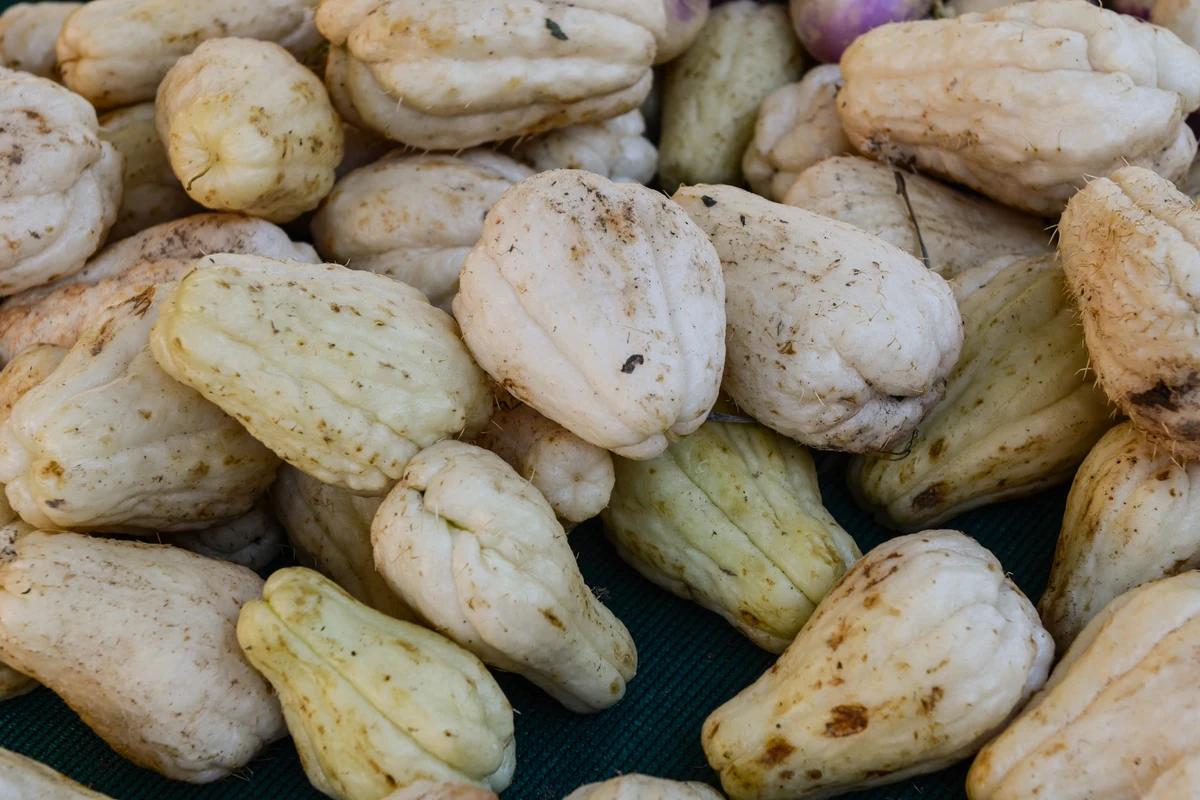
About This Plant
Chayote is a frost-sensitive tropical cucurbit vine grown for crisp edible fruits, shoots, and tuberous roots. It is normally planted as a sprouted whole fruit, trained on a strong trellis, and harvested repeatedly through warm humid production seasons.
How to Grow Chayote
Learn how to grow Chayote from seed to harvest in 120 days. Intermediate difficulty. Planting, care, feeding and the right growing conditions.
Sources cited: 15.
Nutrient Requirements by Growth Stage
Chayote-specific research supports high field nitrogen demand and late potassium demand, but not exact hydroponic NPK ppm by stage. Costa Rica work found yield rising through 300 kg/ha N and estimated maximum yield around 400-500 kg/ha N, while warning that high N increased fungal disease and nonmarketable fruit…
Sign in to view nutrient requirements
A free account unlocks NPK targets for all four growth stages, micronutrient levels, a per-stage nutrient calculator, and the full nutrition guide. Signing up takes one click. Truleaf is a free, non-profit project, and every new account helps it grow. No spam, ever.
Growing Environments
Outdoor trellised soil production is the proven chayote system in frost-free tropical and subtropical climates. Greenhouses are useful for starting plants in cool regions and can support protected production if they provide enough height, pollination access or hand pollination, drainage, and airflow…
Temperature
Chayote is a frost-sensitive tropical and subtropical vine. Use 18-25C for sprouted-fruit establishment, maintain active growth broadly between 15-30C, and manage fruiting near 20-28C with nights above 15C. Sustained heat above about 28C can push vine growth and increase flower or young-fruit drop, while cold and frost damage tender growth.
Humidity
Target high humidity around 80-85% while keeping the canopy open and ventilated. Chayote needs ample moisture, but drought, waterlogging, and stagnant wet foliage are all production risks…
Light
Provide full sun or strong greenhouse light, with mild shade tolerated in hot climates. Flowering is strongly tied to short day length: extension and crop profiles report flowering around a 12-12.5 hour photoperiod…
Airflow
Airflow is a disease-management requirement rather than a high-wind preference. Train vines on a strong trellis and prune dense old growth so leaves dry, pollinators can move through the canopy, and sprays can reach targets when needed…
Sign in to view environmental requirements
A free account unlocks exact temperature, humidity, light and airflow targets, including germination and growth ranges, DLI, photoperiod and PPFD, plus the full environment guide. Signing up takes one click. Truleaf is a free, non-profit project, and every new account helps it grow. No spam, ever.
Hydroponic System Compatibility
Soil culture is the evidence-backed system for chayote: use a deep, organic, well-drained mound or bed with strong trellis support. If soilless production is attempted, a large media-based drip setup is the only defensible option and should be treated as experimental by analogy to greenhouse cucurbits…
Growing Media
Use rich, loose, well-drained sandy loam amended with compost or manure. In high-rainfall areas, grow on raised hills, mounds, or beds so the root zone stays aerated…
Container Specs
Container fruiting is possible but marginal. Use a very large container, about 110 L / 30 gal or larger, with excellent drainage, stable moisture, and a permanent external trellis…
Training & Support
Strong support is required from planting. Chayote is a climbing vine that can reach roughly 10-15 m or more, and extension guides recommend a sturdy trellis, fence, arbor, or overhead support for fruit quality, airflow, and harvest access…
Sign in to view system compatibility
A free account unlocks why each of the six systems fits or fails, plus growing media, container sizes, training methods, companion plants, and the full systems guide. Signing up takes one click. Truleaf is a free, non-profit project, and every new account helps it grow. No spam, ever.
Propagation
Chayote is normally propagated by planting the whole fruit after the single seed has begun to sprout inside it. Treat germination time as establishment of a sprouted fruit rather than emergence of a dry seed; unsprouted fruit can take days to weeks before visible vine growth…
Harvesting
Harvest chayote repeatedly while fruits are slightly immature, firm, shiny, and free of decay, insect injury, bruising, and vivipary. Extension sources commonly place harvest about 28-35 days after pollination, with commercial fields picked two or three times weekly…
Planting Calendar
In tropical and subtropical field systems, plant at the beginning of the rainy season or use irrigation to maintain steady moisture. In frost-prone regions, start sprouted fruits under protection and transplant only after frost risk has passed…
Common Issues
The highest-confidence problems are powdery mildew, fruit-spotting fungi, insect pests, root-knot nematodes/root rots, and stress-related poor fruit set. Podosphaera xanthii is confirmed on Sechium edule in the United States, while IPGRI and UF/IFAS list Ascochyta, Phoma, Mycovellosiella, Colletotrichum, Fusarium,…
Get the full science-backed guide
By signing up, you help keep Truleaf free and support the growth of our nonprofit project. Your account unlocks full details for every plant issue—including symptoms, causes, step-by-step solutions, and prevention—plus the month-by-month planting calendar, the complete guide, and all research sources. It only takes one click. No spam, ever.