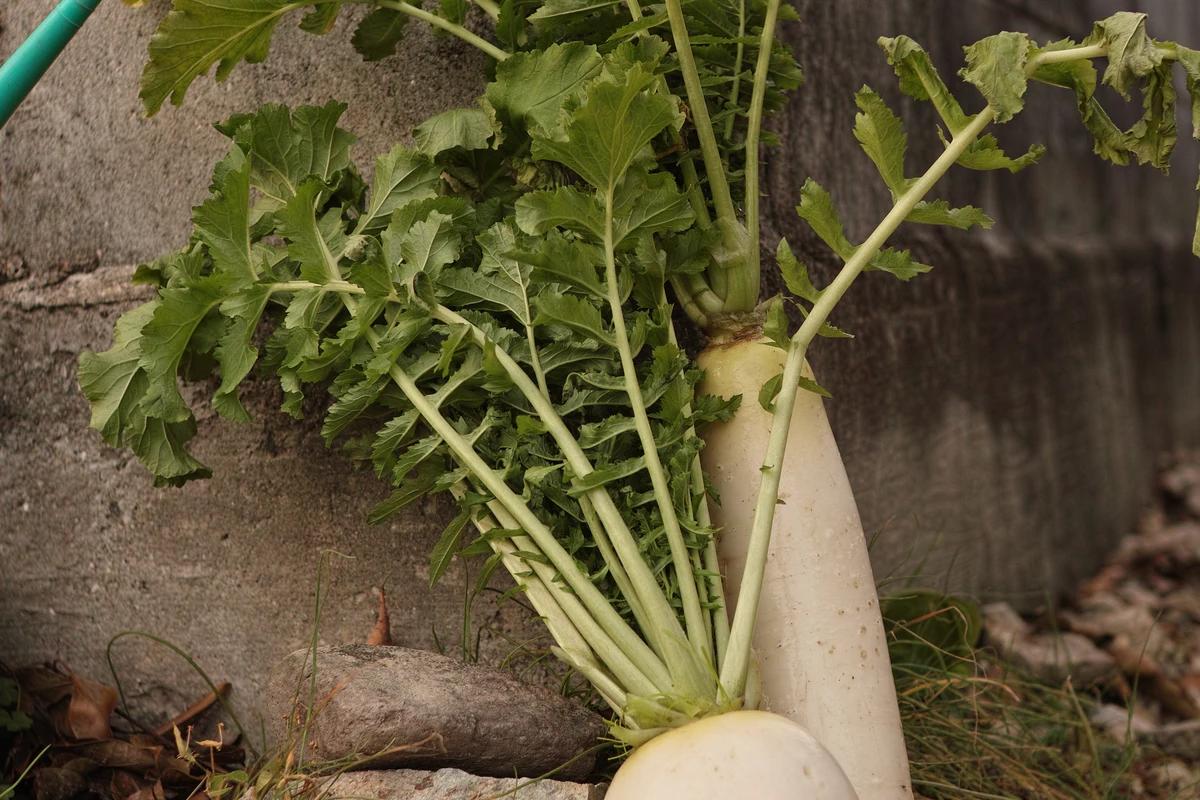
About This Plant
Daikon Radish is a fast-growing, cool-season root vegetable grown for its long white taproot and crisp, mild flavor. It performs best in deep, loose, evenly moist soil or media, and it is also used as a cover crop because its large taproot helps open compacted soil and scavenge residual nitrogen.
How to Grow Daikon Radish
Learn how to grow Daikon Radish from seed to harvest in 60 days. Intermediate difficulty. Planting, care, feeding and the right growing conditions.
Sources cited: 7.
Nutrient Requirements by Growth Stage
Daikon needs moderate nitrogen, adequate phosphorus, and high potassium. Use lower EC for seedlings, full strength during canopy growth, then reduce nitrogen and maintain high potassium during root expansion…
Sign in to view nutrient requirements
A free account unlocks NPK targets for all four growth stages, micronutrient levels, a per-stage nutrient calculator, and the full nutrition guide. Signing up takes one click. Truleaf is a free, non-profit project, and every new account helps it grow. No spam, ever.
Growing Environments
Outdoor beds are the primary evidence-backed environment for full-size daikon, but greenhouse, container, and indoor experiments are feasible when root depth and cool conditions are provided. The crop needs loosened, deep, well-drained media because root crops benefit from soil preparation before planting and long…
Temperature
Daikon is a cool-season root crop. Use 10-24 C for germination and 10-20 C for crop growth, with best root quality near 15 C. Quality disorders such as pithiness, hollowness, and brown heart increase when roots finish warm, especially above about 21-24 C.
Humidity
Use moderate humidity around 55% and keep the upper target near 65%. Higher humidity and leaf wetness increase downy mildew, white rust, and calcium-transport tip burn risk, while very dry air can add moisture stress.
Light
Target DLI 12-15 mol/m2/day for root production and keep photoperiod at 10-12 hours. The structured target uses DLI 12, 12 hours, and about 280 umol/m2/s PPFD…
Airflow
Use gentle continuous airflow and reservoir aeration. Canopy airflow around 0.3-1.0 m/s helps break the leaf boundary layer, supports transpiration-driven calcium movement, and reduces stagnant humid foliage.
Sign in to view environmental requirements
A free account unlocks exact temperature, humidity, light and airflow targets, including germination and growth ranges, DLI, photoperiod and PPFD, plus the full environment guide. Signing up takes one click. Truleaf is a free, non-profit project, and every new account helps it grow. No spam, ever.
Hydroponic System Compatibility
Drip in deep media, deep ebb-and-flow beds, and well-aerated deep water systems are the best hydroponic-style options. Standard NFT channels are too shallow for full-size daikon…
Growing Media
Use loose, stone-free, well-drained media with enough depth for straight taproot growth. Coco coir, perlite, vermiculite, peat-based blends, sandy loam, or deep soil can work when compaction and waterlogging are avoided.
Container Specs
Use containers at least 45 cm deep and 30 cm wide for standard daikon, with excellent drainage and about 10-15 cm plant spacing. Short cultivars can use shallower containers, but long types need 45-60 cm depth.
Training & Support
Daikon needs no support structure. The main care tasks are direct sowing, careful thinning, pest protection, and timely harvest before bolting or overmaturity.
Sign in to view system compatibility
A free account unlocks why each of the six systems fits or fails, plus growing media, container sizes, training methods, companion plants, and the full systems guide. Signing up takes one click. Truleaf is a free, non-profit project, and every new account helps it grow. No spam, ever.
Propagation
Propagate from seed and direct sow. Transplanting is not recommended because daikon taproots are easily forked or deformed by root disturbance…
Harvesting
Harvest whole roots at market size, usually 50-70 days after sowing. Loosen the media before pulling to avoid snapping the taproot…
Planting Calendar
Use direct sowing in early spring or late summer to early fall. Fall production is preferred because root bulking occurs in cooler weather…
Common Issues
High-priority daikon issues are boron-related brown heart, premature bolting from long days or vernalization, pithiness, hollowness, cracking, root rots, calcium transport tip burn, deformed roots, and cool-moist foliar diseases such as white rust and downy mildew.
Get the full science-backed guide
By signing up, you help keep Truleaf free and support the growth of our nonprofit project. Your account unlocks full details for every plant issue—including symptoms, causes, step-by-step solutions, and prevention—plus the month-by-month planting calendar, the complete guide, and all research sources. It only takes one click. No spam, ever.