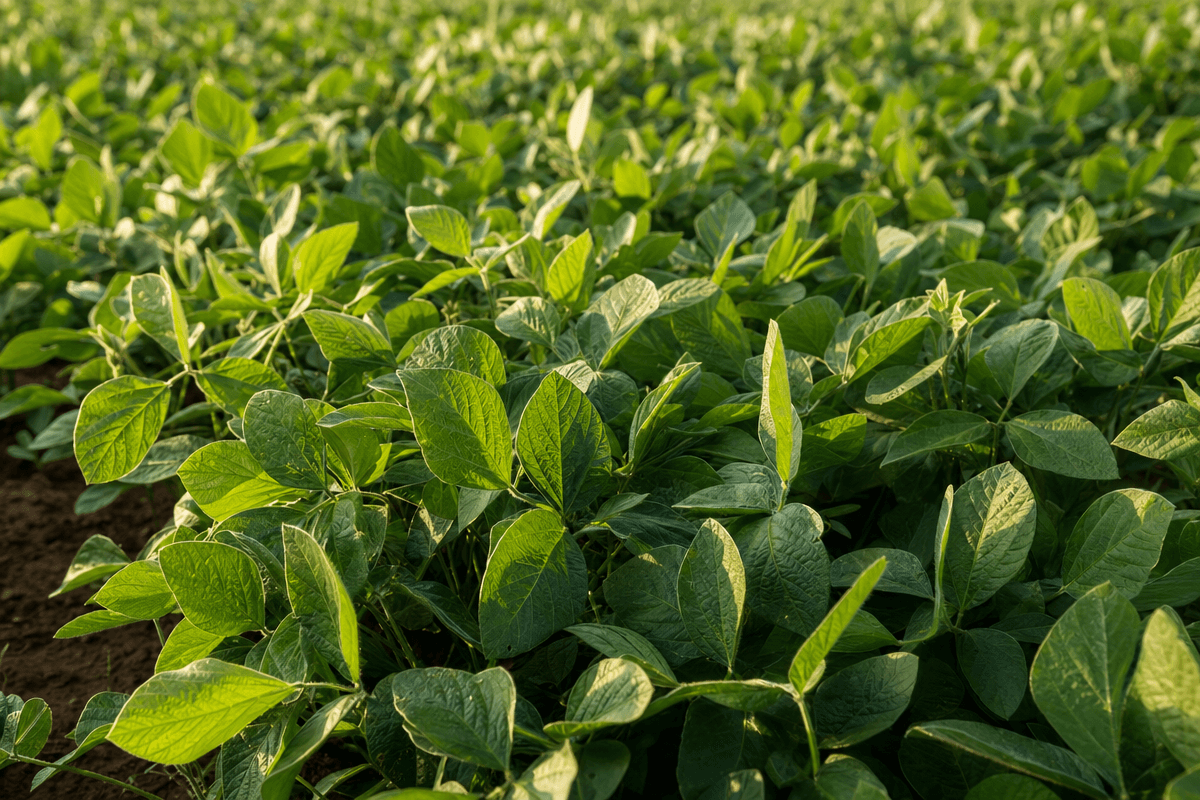
About This Plant
Edamame is a vegetable soybean grown for immature pods and benefits from warm temperatures, balanced nutrition, and harvest timed to the R6 green-seed stage.
How to Grow Edamame
Learn how to grow Edamame from seed to harvest in 80 days. Beginner difficulty. Complete nutrient guide, pH/EC requirements, and growing conditions for hydroponics, soil & greenhouse.
Backed by 30 peer-reviewed citations.
Nutrient Requirements by Growth Stage
Edamame NPK management in hydroponics requires understanding its legume physiology. In hydroponic systems without Bradyrhizobium inoculation, full nitrogen supplementation is required…
Sign in to view nutrient requirements
A free account unlocks NPK targets for all four growth stages, micronutrient levels, a per-stage nutrient calculator, and the full nutrition guide. Signing up takes one click. Truleaf is a free, non-profit project, and every new account helps it grow. No spam, ever.
Growing Environments
Edamame can be grown across multiple environments. Outdoors, it is a warm-season annual suited to USDA zones 5-10, requiring 6-8 hours full sun and frost-free conditions with soil above 15C…
Temperature
Edamame thrives in warm conditions. Germination requires soil or nutrient solution temperatures of at least 15C, with optimal germination at 25-28C -- the practical range for uniform emergence in 5-7 days. Growth below 15C is severely delayed and increases disease risk. Optimal growth occurs between 20-30C, with 26-27C being the ideal air temperature as maintained in the Takano et al. (2025) plant factory study. A day/night differential of 30C day / 25C night also produced excellent results in growth chamber research. Temperatures above 35C cause flower abortion and reduced pod set, while sustained temperatures below 15C slow development significantly.
Humidity
Edamame grows best at 50-70% relative humidity, balancing adequate transpiration with disease prevention. High humidity above 80% significantly increases risk of white mold (Sclerotinia sclerotiorum), downy mildew, and other fungal pathogens…
Light
Edamame is a short-day plant -- daylength critically affects its transition from vegetative growth to flowering and pod formation. Takano et al…
Airflow
Adequate airflow is essential for edamame health in all growing environments. Plants should be spaced at least 15 cm apart to allow air movement through the canopy…
Sign in to view environmental requirements
A free account unlocks exact temperature, humidity, light and airflow targets, including germination and growth ranges, DLI, photoperiod and PPFD, plus the full environment guide. Signing up takes one click. Truleaf is a free, non-profit project, and every new account helps it grow. No spam, ever.
Hydroponic System Compatibility
NFT is the recommended primary system for hydroponic edamame, demonstrated in the world's first artificial-light plant factory study to exceed field yields with superior isoflavone and sucrose content. Drip irrigation into rockwool slabs ranked second -- functional with good results but greater root zone temperature…
Growing Media
For hydroponic production, rockwool cubes (36x36x39 mm) are the validated standard for seedling propagation, transitioning to NFT channels or rockwool slabs for full-cycle production. Rockwool must be pre-soaked and pH-adjusted to 5.5-6.5 before use…
Container Specs
Edamame grows successfully in containers with minimum 30 cm depth and 30 cm width, equivalent to a 5-gallon (19L) pot for 2-3 plants. Drainage is essential: choose pots with multiple drainage holes, or fabric grow bags which provide excellent aeration and prevent root circling…
Training & Support
Standard edamame varieties are compact, self-supporting bush plants reaching 45-90 cm in height -- no staking, trellising, or support structures are required. Unlike pole beans, edamame does not vine or climb…
Sign in to view system compatibility
A free account unlocks why each of the six systems fits or fails, plus growing media, container sizes, training methods, companion plants, and the full systems guide. Signing up takes one click. Truleaf is a free, non-profit project, and every new account helps it grow. No spam, ever.
Propagation
Edamame is best grown from seed by direct sowing -- its sensitive taproot makes transplanting inadvisable. Sow seeds 2.5-4 cm deep, spacing 5-10 cm apart and thinning to 15 cm final spacing…
Harvesting
Edamame is an annual crop harvested once at reproductive stage R6 (full seed), when beans fill 80-90% of each pod. Harvest typically occurs 10-12 weeks after planting…
Planting Calendar
Edamame is a warm-season annual that should be direct-sown after all frost danger has passed and soil has warmed to at least 15C. Planting by USDA zone: Zone 3-4 around May 15; Zone 5-7 around April 15; Zone 8 around March 15; Zone 9 around February 15; Zone 10-11 January 30 or October-December…
Common Issues
Edamame faces diverse pest and disease pressures. Soybean aphid (Aphis glycines) forms dense colonies transmitting Soybean Mosaic Virus, with treatment thresholds of 250 aphids per plant during R1-R5…
Get the full science-backed guide
By signing up, you help keep Truleaf free and support the growth of our nonprofit project. Your account unlocks full details for every plant issue—including symptoms, causes, step-by-step solutions, and prevention—plus the month-by-month planting calendar, the complete guide, and all research sources. It only takes one click. No spam, ever.