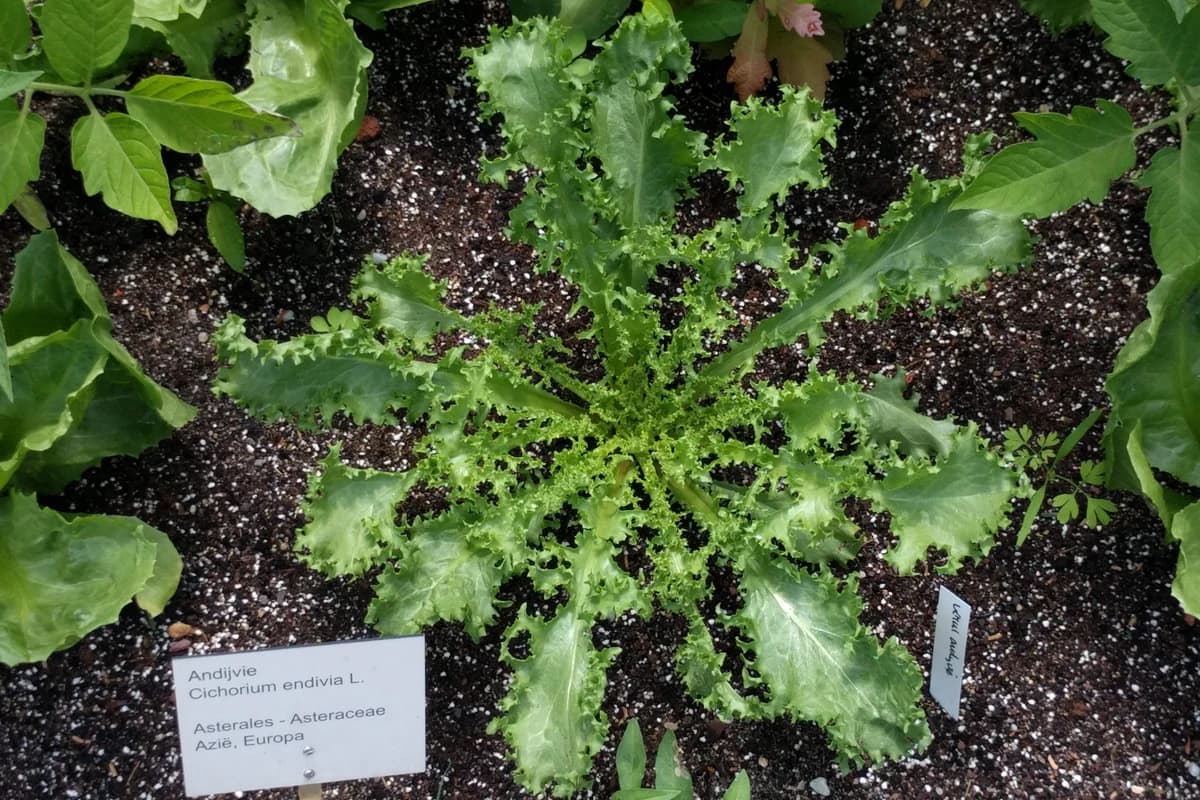
About This Plant
Endive is a cool-season leafy Cichorium crop grown as curly endive or broadleaf escarole, valued for crisp bitter leaves that can be harvested young, cut as full rosettes, or blanched before harvest for a milder pale heart.
How to Grow Endive
Learn how to grow Endive from seed to harvest in 95 days. Intermediate difficulty. Complete nutrient guide, pH/EC requirements, and growing conditions for hydroponics, soil & greenhouse.
Sources cited: 16.
Nutrient Requirements by Growth Stage
Endive is a nitrate-responsive leafy crop. Primary hydroponic research supports about 112 ppm N during establishment, and 139-160 ppm N for rosette harvest; baby-leaf systems used about 140 ppm N, 50 ppm P, and 200 ppm K at pH 5.5-6.5…
Sign in to view nutrient requirements
A free account unlocks NPK targets for all four growth stages, micronutrient levels, a per-stage nutrient calculator, and the full nutrition guide. Signing up takes one click. Truleaf is a free, non-profit project, and every new account helps it grow. No spam, ever.
Growing Environments
Endive fits outdoor, greenhouse, indoor, and container production when the crop stage is matched to the environment. Extension sources support field and garden production in cool spring, fall, or mild winter windows…
Temperature
Endive is a cool-season leafy crop, not a heat crop. Extension sources place good growth around 15.5-21.1C, NC State lists best growth near 15.5-18.3C, and protected plug guidance tolerates short greenhouse ranges up to about 23.9C. Keep production near 18C when possible and avoid heat because hot, dry weather increases bitterness, bolting, and physiological disorders.
Humidity
Mature endive does not have a single well-verified relative-humidity optimum. Baby-leaf research germinated seedlings at 70-80% RH, while greenhouse and tipburn work shows that low humidity and heat can worsen calcium-transport disorders…
Light
Endive grows outdoors in sun, but hot bright conditions increase bitterness and bolting risk. Indoor light should be moderate rather than forced into long-day recipes: a complete baby-leaf study used 12 hours at about 190 micromol m-2 s-1 after emergence, while field guidance favors spring or fall production over…
Airflow
No complete endive source provided a numeric airflow speed in meters per second. Air movement should be managed by outcomes: avoid stagnant wet canopies, prevent condensation during blanching, and support uniform temperature and humidity…
Sign in to view environmental requirements
A free account unlocks exact temperature, humidity, light and airflow targets, including germination and growth ranges, DLI, photoperiod and PPFD, plus the full environment guide. Signing up takes one click. Truleaf is a free, non-profit project, and every new account helps it grow. No spam, ever.
Hydroponic System Compatibility
Endive has direct evidence in recirculating and substrate soilless systems. NFT, floating or DFT-style culture, ebb-and-flow, and semi-hydroponic substrate with drip fertigation are supported by complete crop studies…
Growing Media
Use media that combine fertility, drainage, and steady moisture. Arkansas lists well-drained loam, medium-rich fertility, and pH 5.5-7.0; OSU favors loose fertile loams and muck soils with good water holding and internal drainage…
Container Specs
Container production is suitable for leafy endive when drainage and spacing are preserved. Extension spacing commonly falls around 9-12 inches for home-scale plants, with broader commercial ranges depending on bed layout and cultivar size…
Training & Support
Endive needs no structural training. It grows as a low leafy rosette and does not require trellis, cage, stake, string, netting, topping, or pruning support…
Sign in to view system compatibility
A free account unlocks why each of the six systems fits or fails, plus growing media, container sizes, training methods, companion plants, and the full systems guide. Signing up takes one click. Truleaf is a free, non-profit project, and every new account helps it grow. No spam, ever.
Propagation
Endive is propagated from seed. Start transplants indoors for early crops or direct sow into prepared soil for spring and fall plantings…
Harvesting
Harvest timing depends on product. Baby-leaf systems can finish in about 28-36 days, while full-size endive and escarole commonly mature around 60-100 days depending on cultivar and season…
Planting Calendar
Schedule endive around cool weather. Arkansas recommends late-February indoor starts for early-April transplanting and mid-March to early-April direct seeding, while northern extension guidance also supports late-summer sowing for fall crops…
Common Issues
The issue list now separates physiological and disease problems. Tip burn is a calcium-transport disorder favored by uneven moisture, rapid growth, excess fertility, heat, and low humidity, not simply a lack of soil calcium…
Get the full science-backed guide
By signing up, you help keep Truleaf free and support the growth of our nonprofit project. Your account unlocks full details for every plant issue—including symptoms, causes, step-by-step solutions, and prevention—plus the month-by-month planting calendar, the complete guide, and all research sources. It only takes one click. No spam, ever.