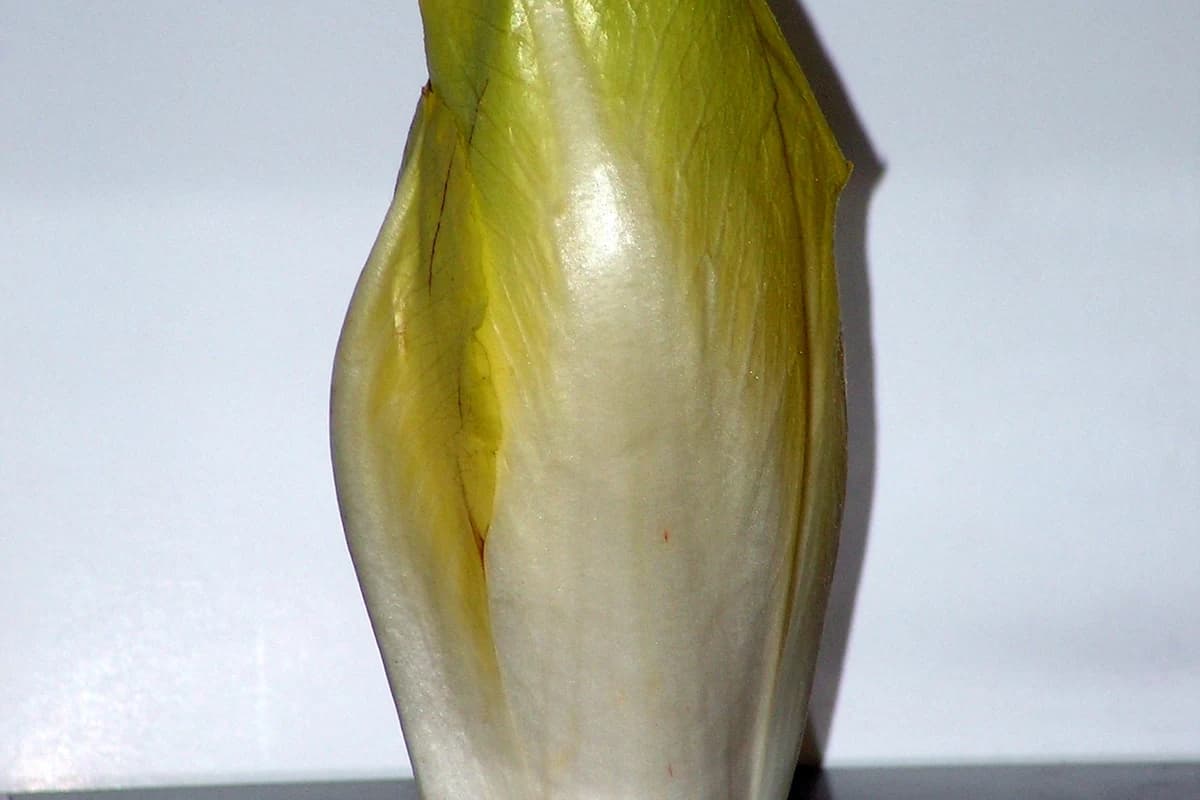
About This Plant
Belgian endive, also called witloof chicory or chicon, is a two-stage chicory crop: growers first raise a deep taproot, then force the stored root in darkness to produce a tight, pale head. It rewards precise moisture, temperature, darkness, and root-quality management more than ordinary leafy-green care.
How to Grow Belgian Endive
Learn how to grow Belgian Endive from seed to harvest in 165 days. Advanced difficulty. Complete nutrient guide, pH/EC requirements, and growing conditions for hydroponics, soil & greenhouse.
Backed by 17 peer-reviewed citations.
Nutrient Requirements by Growth Stage
Nutrition evidence supports caution, not high generic leafy feeding. For field roots, OSU caps nitrogen at 50 lb/acre and WUR says excess nitrogen produces too many leaves, small roots, and loose chicons…
Sign in to view nutrient requirements
A free account unlocks NPK targets for all four growth stages, micronutrient levels, a per-stage nutrient calculator, and the full nutrition guide. Signing up takes one click. Truleaf is a free, non-profit project, and every new account helps it grow. No spam, ever.
Growing Environments
Belgian endive spans outdoor, greenhouse, indoor, and container environments because each stage uses a different setting. Root production is best outdoors or in deep raised beds with friable, well-drained, carrot-suitable soil…
Temperature
Belgian endive needs stage-specific temperature management rather than one leafy-green setpoint. Root production is a cool-season field phase; OSU says roots need about 110-130 frost-free days and OMAFRA lists field production around 7C nights and 21C days. The forcing phase is cooler and dark: OSU recommends 10-16C air with warmer root-zone water, CAES trials used about 16-18C, and OMAFRA lists forcing at 10-15.5C.
Humidity
The old 50-70% humidity value is wrong for the forcing and storage stages that define this crop. OSU recommends forcing rooms at 90% relative humidity or higher, CAES reports stored roots need roughly 95% or higher humidity to avoid withering, and UC Davis recommends harvested chicons be stored at 0C with more than…
Light
Light requirements flip between stages. Root production is a normal photosynthetic field phase, so use full sun or bright greenhouse light to build root carbohydrate reserves; no accepted source verified the previous DLI 12 value as a Belgian-endive optimum…
Airflow
No complete witloof source gave a meters-per-second airflow target. Manage airflow by outcomes: hold the forcing room at 90%+ RH, keep temperature stable, avoid condensation-driven bacterial decay, and cool harvested chicons quickly…
Sign in to view environmental requirements
A free account unlocks exact temperature, humidity, light and airflow targets, including germination and growth ranges, DLI, photoperiod and PPFD, plus the full environment guide. Signing up takes one click. Truleaf is a free, non-profit project, and every new account helps it grow. No spam, ever.
Hydroponic System Compatibility
Hydroponics is validated mainly for forcing harvested taproots, not for growing the roots from seed. OSU describes roots packed upright in soil or hydroponic solution, with circulating and non-circulating systems both used…
Growing Media
For root production, use deep friable soil with good moisture holding, good internal drainage, and pH around 6.5 or higher. WUR emphasizes that roots need at least 60 cm of penetrable depth for reasonable form and closer to 100 cm for well-formed roots…
Container Specs
Containers should be understood as forcing vessels first. Roots are commonly trimmed to 6-9 inches and stood upright in 12-15 inch deep bins, buckets, crates, or similar light-proof containers with sand, sand-peat, or nutrient solution…
Training & Support
Belgian endive needs no trellis, cage, stakes, topping, or pruning in the normal sense. The field crop forms a rosette and taproot, and the marketable head is a forced bud from the crown…
Sign in to view system compatibility
A free account unlocks why each of the six systems fits or fails, plus growing media, container sizes, training methods, companion plants, and the full systems guide. Signing up takes one click. Truleaf is a free, non-profit project, and every new account helps it grow. No spam, ever.
Propagation
Belgian endive is propagated from seed. OSU supports shallow precision sowing and notes that pelletized seed improves uniformity, while USU gives best germination around 18-21C and warns germination is reduced above 27C…
Harvesting
Harvest is two-step. First lift roots after about 130-150 days, when the root is large enough and the white crown patch is about 0.25-0.375 inch thick…
Planting Calendar
In cool temperate systems, OSU plants witloof from April through May and harvests roots from September through November. Connecticut trials used early July sowing to mature roots in late fall and reduce premature bolting risk from cold spring soil…
Common Issues
The issue list should distinguish physiological discolorations from true diseases. De Jaegere et al…
Get the full science-backed guide
By signing up, you help keep Truleaf free and support the growth of our nonprofit project. Your account unlocks full details for every plant issue—including symptoms, causes, step-by-step solutions, and prevention—plus the month-by-month planting calendar, the complete guide, and all research sources. It only takes one click. No spam, ever.