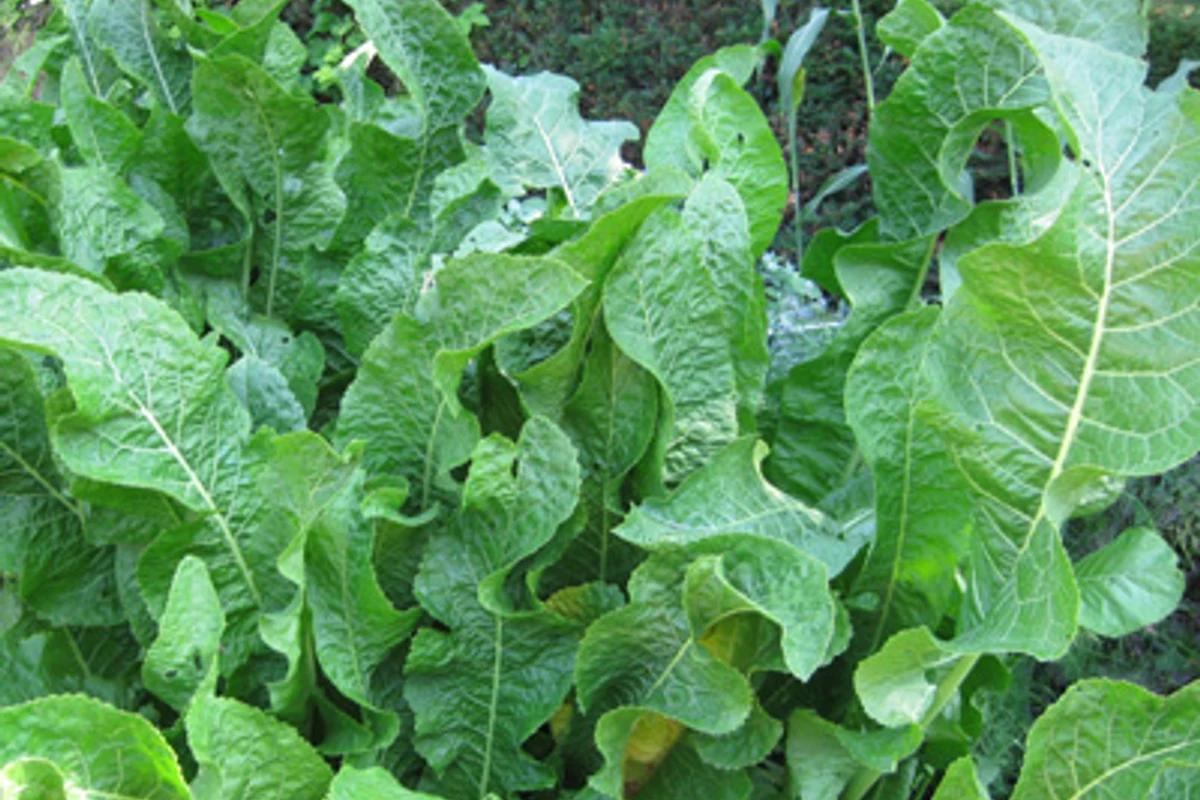
About This Plant
Horseradish is a hardy perennial brassica grown as an annual or managed perennial for pungent white storage roots. It performs best in full sun, cool seasons, and deep friable soil with steady moisture, and commercial-quality roots depend on spring-set root cuttings plus lifting and stripping to reduce branching.
How to Grow Horseradish
Learn how to grow Horseradish from seed to harvest in 180 days. Intermediate difficulty. Planting, care, feeding and the right growing conditions.
Sources cited: 8.
Nutrient Requirements by Growth Stage
Horseradish is not a heavy nitrogen crop. Arkansas calls it a light feeder and recommends spring fertilizer high in potassium and phosphorus but low in nitrogen, such as 5-10-10 at 2-3 lb per 100 sq ft…
Sign in to view nutrient requirements
A free account unlocks NPK targets for all four growth stages, micronutrient levels, a per-stage nutrient calculator, and the full nutrition guide. Signing up takes one click. Truleaf is a free, non-profit project, and every new account helps it grow. No spam, ever.
Growing Environments
Outdoor beds are the primary production environment, especially in temperate climates with cool fall conditions. Greenhouse or container culture is possible only if the root zone is deep, well-drained, and cool enough for storage-root expansion…
Temperature
Horseradish is a cool-season perennial root crop rather than a warm fruiting crop. Utah State gives the best growth temperature as about 60-65F, and multiple extensions describe strongest root enlargement during cool fall weather. Use spring planting, protect from heat stress with moisture and mulch, and delay harvest until after frost for stronger flavor and storage quality.
Humidity
Reviewed sources do not give a precise relative-humidity target for living plants, so humidity should be managed indirectly through disease pressure. Keep foliage dry enough to limit white rust, Cercospora, Ramularia, and bacterial leaf spots, while maintaining evenly moist root-zone conditions for nonwoody roots…
Light
Horseradish is recommended for sunny sites, with NC State specifying full sun in amended, moist, well-drained soil. Because the harvested organ is a storage root, strong canopy growth must be balanced with root quality: fresh manure or late high nitrogen can produce lush tops and branched roots rather than clean…
Airflow
Airflow matters mainly as disease prevention. Virginia Cooperative Extension lists white rust, Cercospora leaf spot, Ramularia leaf spot, bacterial leaf spot, turnip mosaic virus, brittle root, and Verticillium discoloration as production concerns…
Sign in to view environmental requirements
A free account unlocks exact temperature, humidity, light and airflow targets, including germination and growth ranges, DLI, photoperiod and PPFD, plus the full environment guide. Signing up takes one click. Truleaf is a free, non-profit project, and every new account helps it grow. No spam, ever.
Hydroponic System Compatibility
Drip-irrigated beds or deep containers are the most defensible controlled system because they preserve loose media around the storage root. Shallow NFT, DWC, Kratky, and aeroponics are poor matches for market horseradish because the edible organ is a thick root that needs depth, physical support, and clean harvest…
Growing Media
Use deep, rich, moist, well-drained loam with organic matter. Minnesota warns that hard, shallow, stony soils deform roots and reduce yield, while Utah State recommends fertile, well-drained soil with pH 6.0-7.5…
Container Specs
Containers must be treated as root-crop beds, not herb pots. Utah State notes that buried pots or 12-inch-wide by 24-inch-long PVC pipes can be used to keep horseradish from spreading…
Training & Support
Horseradish needs no trellis, but quality roots require cultural training. Minnesota and Nebraska describe lifting and stripping: expose the upper root, leave lower roots intact, remove extra crown shoots and larger side roots, then replace soil…
Sign in to view system compatibility
A free account unlocks why each of the six systems fits or fails, plus growing media, container sizes, training methods, companion plants, and the full systems guide. Signing up takes one click. Truleaf is a free, non-profit project, and every new account helps it grow. No spam, ever.
Propagation
Standard propagation is vegetative. Arkansas, Utah State, and Minnesota all describe crown divisions or root cuttings, planted in early spring as soon as soil can be worked…
Harvesting
Harvest should be delayed until late fall after frost or just before the ground freezes, because root growth is strongest in late summer and fall. Dig deeply beside the plant, lift the crown and root system, trim foliage, and save pencil-sized side roots as next year planting sets…
Planting Calendar
Plant root sets in March or April when soil is workable, then keep early weed pressure low while plants are small. For smoother roots, lift and strip when leaves reach about 8-10 inches and repeat roughly six weeks later…
Common Issues
The most important verified problems are root rot from excess water, flea beetle feeding, white rust, Cercospora and Ramularia leaf spots, bacterial leaf spot, turnip mosaic virus, brittle root, Verticillium discoloration, and root branching from poor fertility timing. Prevention depends on clean planting stock,…
Get the full science-backed guide
By signing up, you help keep Truleaf free and support the growth of our nonprofit project. Your account unlocks full details for every plant issue—including symptoms, causes, step-by-step solutions, and prevention—plus the month-by-month planting calendar, the complete guide, and all research sources. It only takes one click. No spam, ever.