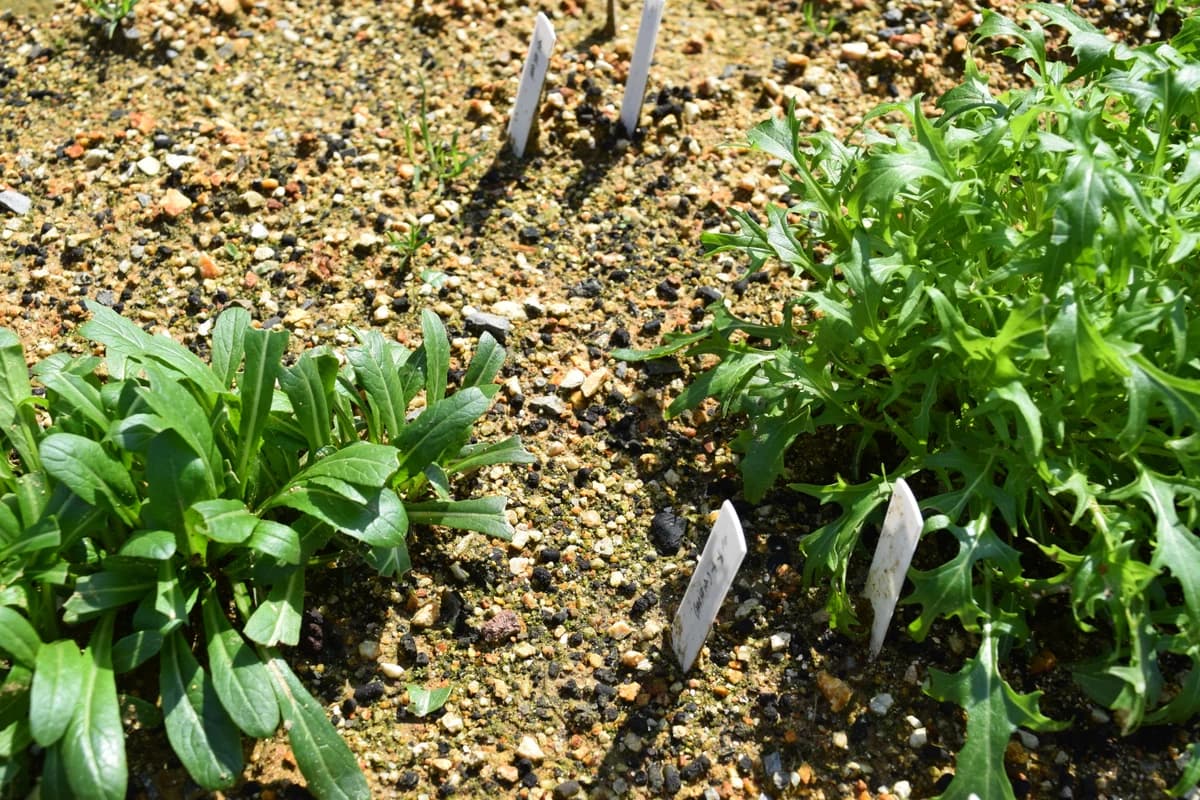
About This Plant
Mibuna is a cool-season Japanese Brassica rapa leafy green grown for long, narrow, mild mustard leaves. It is usually raised from seed, grows quickly in spring or fall conditions, tolerates protected winter production, and is well suited to repeated cut-and-come-again harvests in soil, containers, greenhouse benches, and hydroponic leafy-green systems.
How to Grow Mibuna
Learn how to grow Mibuna from seed to harvest in 42 days. Beginner difficulty. Complete nutrient guide, pH/EC requirements, and growing conditions for hydroponics, soil & greenhouse.
Sources cited: 8.
Nutrient Requirements by Growth Stage
Use moderate, nitrate-dominant leafy-green nutrition. Hydroponic Brassica rapa subsp…
Sign in to view nutrient requirements
A free account unlocks NPK targets for all four growth stages, micronutrient levels, a per-stage nutrient calculator, and the full nutrition guide. Signing up takes one click. Truleaf is a free, non-profit project, and every new account helps it grow. No spam, ever.
Growing Environments
Mibuna is suitable indoors, outdoors, in greenhouses, and in containers. Outdoors it performs best in spring and fall or protected winter beds, especially where cold-tolerant Asian greens are already grown…
Temperature
Mibuna should be managed as a cool-season leafy brassica. Seed work on Brassica rapa subsp. nipposinica found the strongest germination response at 23.5 C, while practical references in that same paper place seed germination across about 7-29 C with emergence in 4-7 days. After emergence, quality is better under cooler active growth. Controlled hydroponic Brassica nipposinica work grew plants at a 15 C greenhouse mean, while space-crop mizuna studies used ISS-like temperatures around 18-25 C or 22.7 C chamber conditions. Keep production near 15-22 C where possible and avoid sustained heat, which accelerates bolting and bitterness.
Humidity
Target moderate relative humidity, roughly 45-70 percent, with 60 percent as the practical indoor set point. The 2025 controlled-environment mizuna study logged 61.6 percent average relative humidity while growing Brassica rapa ssp…
Light
Mibuna can be produced under moderate leafy-green light. The current 300 umol m-2 s-1 value is slightly high for energy-efficient indoor production but still within tested ranges…
Airflow
Use gentle, continuous air movement rather than strong wind. Mibuna forms dense leaf clumps, and the main airflow goal is to prevent humid boundary layers and wet leaf surfaces…
Sign in to view environmental requirements
A free account unlocks exact temperature, humidity, light and airflow targets, including germination and growth ranges, DLI, photoperiod and PPFD, plus the full environment guide. Signing up takes one click. Truleaf is a free, non-profit project, and every new account helps it grow. No spam, ever.
Hydroponic System Compatibility
Hydroponic compatibility is strong for Mibuna and related mizuna. Complete controlled studies grew Brassica rapa var…
Growing Media
Use a fertile, moisture-retentive but well-aerated medium. The seedling-production paper directly tested substrates and found the best emergence and seedling performance with 60 percent earthworm humus, 20 percent coconut fiber, and 20 percent vermiculite…
Container Specs
Mibuna does not need a large container. OSU Extension describes plants as dense leafy clumps up to about 1 foot tall, and seedling trials used plug cells ranging from 11 to 31 cm3 before transplanting…
Training & Support
Mibuna requires no staking, trellising, or structural training. It grows as a compact leafy clump rather than a vine or heavy fruiting plant…
Sign in to view system compatibility
A free account unlocks why each of the six systems fits or fails, plus growing media, container sizes, training methods, companion plants, and the full systems guide. Signing up takes one click. Truleaf is a free, non-profit project, and every new account helps it grow. No spam, ever.
Propagation
Propagate Mibuna from seed. The complete seedling-production study tested six day temperatures with 25 C night temperature, four replications, and 50 seeds per plot; it identified 23.5 C as the best germination temperature…
Harvesting
Harvest Mibuna as a leafy crop before bolting. OSU Extension describes Mibuna as a dense leafy Japanese vegetable up to about 1 foot tall, with mild narrow leaves and cold tolerance…
Planting Calendar
Schedule Mibuna around cool seasons. In cold-winter regions, sow outdoors in early spring as soon as beds can be worked, then sow again in late summer for fall harvest…
Common Issues
The primary issues are bolting, chewing pests, and humidity-related seedling or foliar disease. Heat and long days push Mibuna out of the tender leaf stage, so cool-season scheduling is the first prevention step…
Get the full science-backed guide
By signing up, you help keep Truleaf free and support the growth of our nonprofit project. Your account unlocks full details for every plant issue—including symptoms, causes, step-by-step solutions, and prevention—plus the month-by-month planting calendar, the complete guide, and all research sources. It only takes one click. No spam, ever.