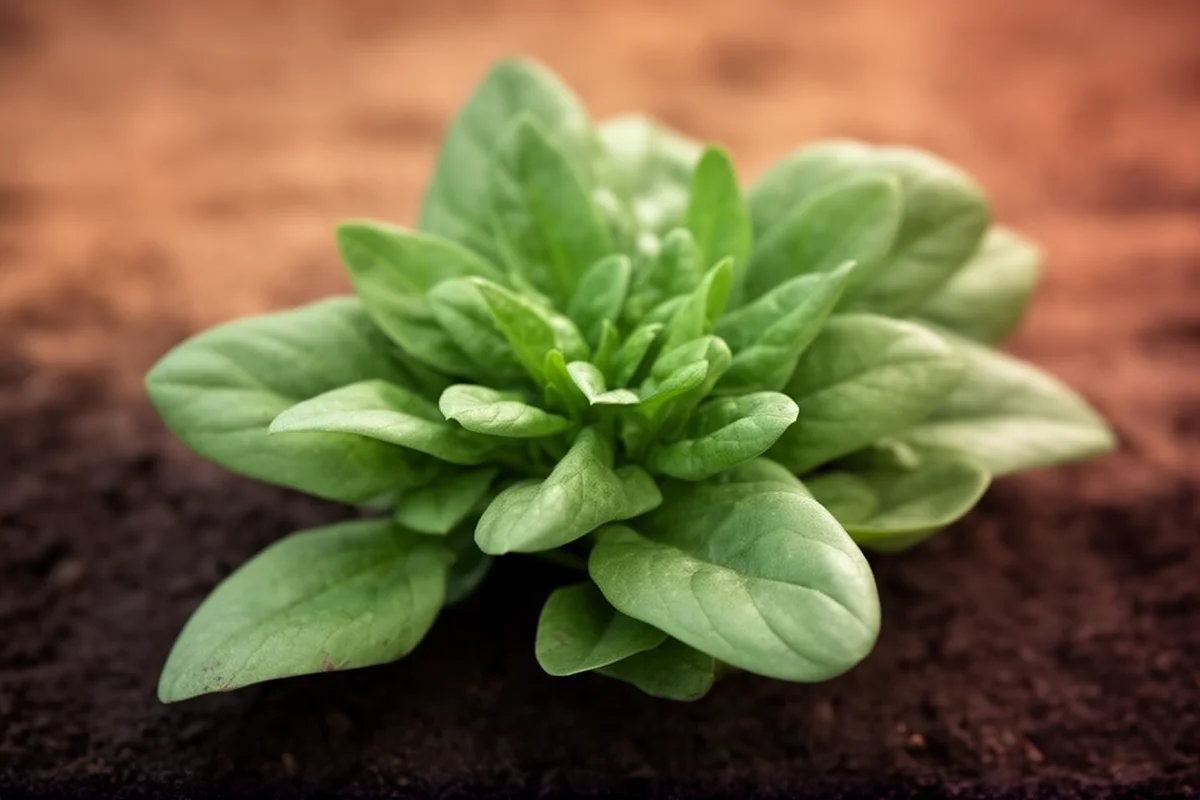
About This Plant
Spinach is a cool-season leafy green grown for rapid high-density harvests and performs best under cool temperatures, moderate light, and careful calcium management.
How to Grow Spinach
Learn how to grow Spinach from seed to harvest in 42 days. Beginner-friendly. Planting, care, feeding and the right growing conditions.
Sources cited: 26.
Nutrient Requirements by Growth Stage
Spinach nutrition follows a potassium-dominant pattern with K demand roughly 1.3-1.4x nitrogen throughout production. During the seedling phase (EC 0.5-1.0 dS/m), nitrogen should start moderate at 75-125 ppm with potassium at 100-200 ppm…
Sign in to view nutrient requirements
A free account unlocks NPK targets for all four growth stages, micronutrient levels, a per-stage nutrient calculator, and the full nutrition guide. Signing up takes one click. Truleaf is a free, non-profit project, and every new account helps it grow. No spam, ever.
Growing Environments
Spinach thrives across indoor, outdoor, greenhouse, and container environments. Indoor/hydroponic: Highly suitable -- complete photoperiod control is critical (12h max to prevent bolting) with temperature at 18-21C…
Temperature
Spinach seeds germinate across a wide temperature range of 7-24C (45-75F), with optimal germination at 15-20C (59-68F). Above 24C, spinach seeds enter thermal dormancy and germination drops sharply. For hydroponic seedling production, Cornell CEA recommends 24C day / 19C night during the transplant phase. During vegetative growth, spinach is a cool-season crop performing best at 18-21C daytime with 16-18C nighttime temperatures. Growth ceases and bolting risk increases sharply above 25C. The optimal setpoint of 18C reflects the sweet spot for leaf quality and bolting avoidance in controlled environments. In outdoor production, spinach tolerates light frost to approximately -7C, making it one of the hardiest leafy greens for early spring and late fall cultivation.
Humidity
Spinach thrives in 50-70% relative humidity with 60% as the optimal target. Cornell CEA explicitly recommends 50-70% RH for hydroponic leafy green production…
Light
CRITICAL: Spinach is a quantitative long-day plant and photoperiod management is essential to prevent bolting. Chun et al…
Airflow
Maintain airflow velocities of 0.3-1.0 m/s across the spinach canopy. The minimum of 0.3 m/s is the critical threshold for optimal photosynthetic gas exchange and ensures adequate CO2 delivery to leaf surfaces…
Sign in to view environmental requirements
A free account unlocks exact temperature, humidity, light and airflow targets, including germination and growth ranges, DLI, photoperiod and PPFD, plus the full environment guide. Signing up takes one click. Truleaf is a free, non-profit project, and every new account helps it grow. No spam, ever.
Hydroponic System Compatibility
Spinach is compatible with all major hydroponic systems, with NFT and DWC being the preferred commercial choices. NFT: One of the most recommended systems -- research shows it produces the highest leaf count (26.5 vs…
Growing Media
For hydroponic spinach, the primary concern is water retention balanced with adequate aeration for the shallow root system. Rockwool is the industry standard for germination and DWC/NFT production -- provides excellent water retention (~80% solution, ~15% air space) and consistent structure for root anchoring…
Container Specs
Spinach is a shallow-rooted crop and container depth requirements are modest compared to root vegetables. For baby leaf production, a minimum depth of 15 cm (6 in) is sufficient…
Training & Support
Spinach requires absolutely no training, staking, trellising, or structural support. It is a low-growing leafy rosette reaching only 15-30 cm in height during vegetative production (up to 45 cm if allowed to bolt)…
Sign in to view system compatibility
A free account unlocks why each of the six systems fits or fails, plus growing media, container sizes, training methods, companion plants, and the full systems guide. Signing up takes one click. Truleaf is a free, non-profit project, and every new account helps it grow. No spam, ever.
Propagation
Spinach is primarily propagated by direct seeding, as the taproot is easily disturbed by transplanting. However, transplanting is possible when seedlings have 4-6 mature leaves and a well-developed root system…
Harvesting
Spinach supports cut-and-come-again harvesting -- leaves regrow from the crown after cutting. Using clean scissors, cut individual outer leaves 2-5 cm above the crown, leaving the central growing point and at least 50% of the plant intact…
Planting Calendar
Direct sow (Mar-May, Aug-Sep): Spinach can be planted 4-8 weeks before the average last frost date in spring, as soon as soil is workable and temperatures reach 2C minimum. For fall crops, sow 6-8 weeks before the first expected frost…
Common Issues
Spinach faces a diverse complex of threats with downy mildew (Peronospora effusa) being the single most economically important disease worldwide. Over 10 races of P…
Get the full science-backed guide
By signing up, you help keep Truleaf free and support the growth of our nonprofit project. Your account unlocks full details for every plant issue—including symptoms, causes, step-by-step solutions, and prevention—plus the month-by-month planting calendar, the complete guide, and all research sources. It only takes one click. No spam, ever.