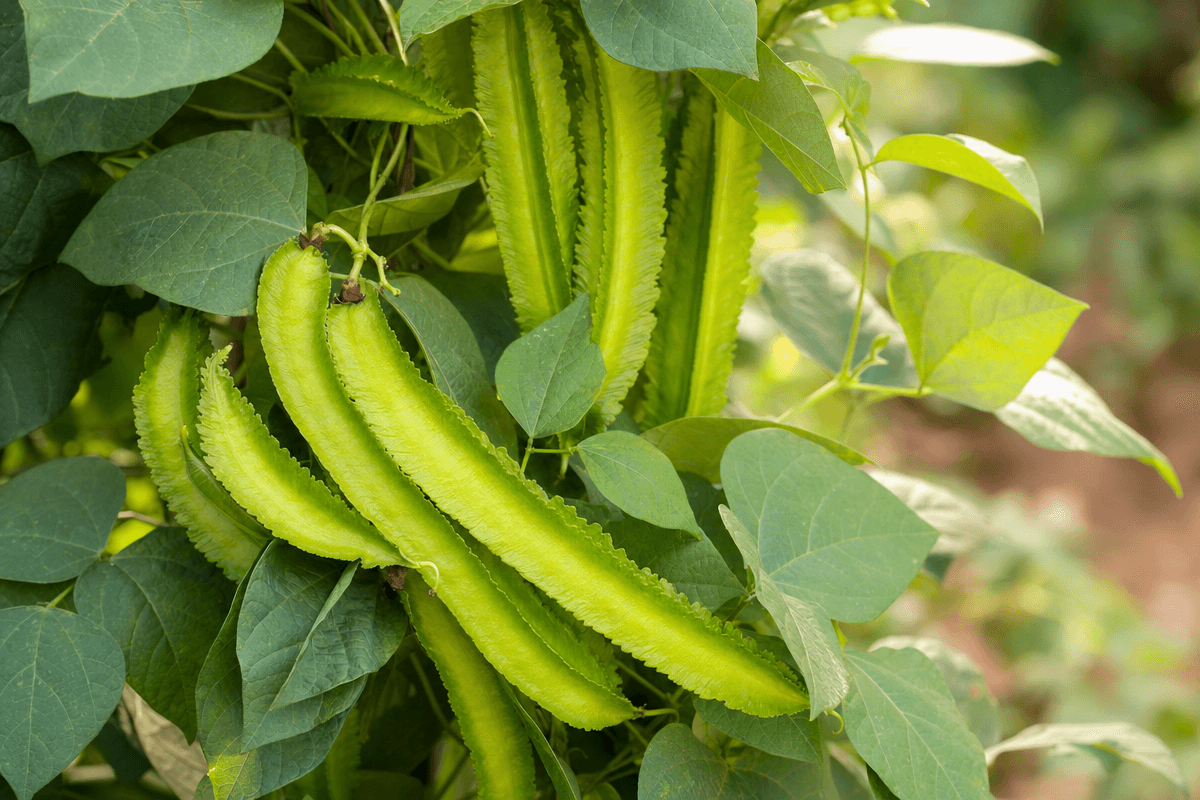
About This Plant
The winged bean is a tropical legume, also known as the Goa bean or four-angled bean, cultivated for its edible pods, leaves, flowers, and tubers. It is a vigorous climbing perennial vine reaching 3-5 metres that thrives in hot, humid conditions. It is one of the most prolific nitrogen-fixing plants in the Fabaceae family, which significantly reduces its need for external nitrogen fertilization.
How to Grow Winged Bean
Learn how to grow Winged Bean from seed to harvest in 75 days. Advanced difficulty. Planting, care, feeding and the right growing conditions.
Sources cited: 30.
Nutrient Requirements by Growth Stage
Winged bean is a nitrogen-fixing legume that produces more nodule biomass per plant than any other member of Fabaceae. This exceptional nitrogen fixation means mineral nitrogen requirements are substantially lower than non-leguminous crops…
Sign in to view nutrient requirements
A free account unlocks NPK targets for all four growth stages, micronutrient levels, a per-stage nutrient calculator, and the full nutrition guide. Signing up takes one click. Truleaf is a free, non-profit project, and every new account helps it grow. No spam, ever.
Growing Environments
Winged bean thrives outdoors in tropical and subtropical climates (USDA zones 10-12), where it is primarily cultivated as a field crop. Greenhouse production extends the growing range to temperate zones by providing warmth, humidity, and photoperiod control…
Temperature
Winged bean is a tropical species with an optimal growth temperature of approximately 27C. The growth range extends from 18-30C, with tolerance down to 14C and up to 40C but with significant growth reduction at extremes. Germination requires warm conditions: 25-30C soil temperature is optimal, with seedlings emerging in 5-7 days under ideal conditions. At temperatures above 30C, some accessions fail to flower even under short days, with the specific risk threshold being a 30/25C day/night regime. Growth effectively ceases below 14C, and the plant is frost-tender with no cold tolerance. For controlled environment production, maintaining 25-30C provides the best balance of vegetative growth and reproductive development.
Humidity
Winged bean is consistently described as requiring hot, humid tropical conditions for optimal growth. The plant originates from humid tropical lowlands of Southeast Asia and Papua New Guinea…
Light
Winged bean is a short-day plant with a critical daylength of approximately 11h15min to 12h15min for flower initiation. Most traditional varieties require short days (<12 hours) to flower, which limits cultivation to tropical/equatorial regions or fall plantings in temperate areas…
Airflow
No peer-reviewed study provides specific airflow velocity recommendations for winged bean. The current values of 0.3-1.0 m/s are general horticultural guidelines rather than species-specific data…
Sign in to view environmental requirements
A free account unlocks exact temperature, humidity, light and airflow targets, including germination and growth ranges, DLI, photoperiod and PPFD, plus the full environment guide. Signing up takes one click. Truleaf is a free, non-profit project, and every new account helps it grow. No spam, ever.
Hydroponic System Compatibility
The only published hydroponic study on winged bean used a nutrient film technique (NFT) system, demonstrating successful growth with exponential biomass increase from 10 days after planting. Ion concentrations in NFT solution declined significantly within 5 days of replenishment, indicating high nutrient uptake rates…
Growing Media
Winged bean prefers well-drained growing media at pH 5.5-7.0 that provides good aeration for Rhizobium nodulation on roots. In field cultivation, rich loamy soil with high organic matter content is ideal…
Container Specs
Winged bean can be grown in containers but requires generous pot size due to its tuberous root system and vigorous vine growth. Use containers of at least 15-20 gallons (45-50 cm deep, 40-50 cm wide) with excellent drainage holes, as waterlogging causes tuber rot…
Training & Support
Winged bean is an obligate climber and sturdy support is essential for healthy growth and pod production. Install support structures before planting, as the weak root system is easily disturbed…
Sign in to view system compatibility
A free account unlocks why each of the six systems fits or fails, plus growing media, container sizes, training methods, companion plants, and the full systems guide. Signing up takes one click. Truleaf is a free, non-profit project, and every new account helps it grow. No spam, ever.
Propagation
Winged bean is primarily propagated by seed, with stem cuttings under mist as a secondary method. Seeds have a hard coat that benefits from scarification or pre-soaking in warm water for 12 hours before planting…
Harvesting
Winged bean is a continuous-harvest crop that regrows and produces pods over an extended season. Pod harvest begins 60-80 days from sowing, typically 2-3 weeks after flowering, when pods reach 15-22 cm in length and remain bright green and tender…
Planting Calendar
In temperate climates, start winged bean seeds indoors 4-5 weeks before the last frost date in a warm greenhouse or on a heat mat at 25-30C. Transplant seedlings outdoors in late spring or early summer after all frost risk has passed, following a one-week hardening-off period…
Common Issues
Winged bean faces several significant biotic threats across tropical growing regions. The most economically important fungal disease is leaf spot caused by Pseudocercospora psophocarpi, documented as the most serious leaf disease in all observed growing areas in Papua New Guinea, significantly reducing pod length and…
Get the full science-backed guide
By signing up, you help keep Truleaf free and support the growth of our nonprofit project. Your account unlocks full details for every plant issue—including symptoms, causes, step-by-step solutions, and prevention—plus the month-by-month planting calendar, the complete guide, and all research sources. It only takes one click. No spam, ever.