Fig Tree Winter Protection: When to Wrap or Move
Fig tree winter protection depends on your winter low: fully dormant, cold-conditioned figs withstand 15°F to 20°F without severe damage. When to wrap or move.
Fig tree winter protection depends on your coldest night. UF/IFAS Extension says fully dormant, cold-conditioned figs withstand 15°F to 20°F without severe damage. Penn State puts the limit at about 20°F, with real damage below 15°F; where nights get that cold, it is reasonable to wrap an in-ground fig or move a pot indoors after a hard frost.

How cold is too cold for a fig tree
| What to check | Value |
|---|---|
| Winter low a fully dormant, cold-conditioned fig withstands without severe damage | 15°F to 20°F |
| When protection goes on | After a hard frost |
A Penn State Extension article by a Master Gardener says even the most cold-resistant edible figs (Ficus carica) only tolerate temperatures down to 20°F and suffer real winter damage below 15°F, 'Chicago Hardy' excepted.
Two reports from outside the United States put the line lower. Earlier publications cited by Khorol Botanical Garden in Ukraine say adult fig plants withstand short winter drops to −15°C (5°F) without cover, while at −18°C (0°F) the crown shoots are badly damaged and at −20°C (−4°F) the whole above-ground part is damaged. A Japanese study cites two 1994 reports that dormant fig buds die at around −10°C (14°F).
The same Japanese study recorded damage inside the UF/IFAS band. Young 'Masui Dauphine' trees planted in an open field in April 2002 were damaged by freezing when the air fell to −6.9°C (19.6°F) in early January 2003. The authors say the trees may have been cooled a further 2 to 3°C by radiative cooling.
Use 15°F to 20°F as your planning benchmark for fully dormant, cold-conditioned trees, knowing that neither UF/IFAS nor Penn State gives a reference for its figures or says how long the cold lasts.
Stage matters as much as the number. UF/IFAS Extension says dormant buds are more susceptible than the wood to subfreezing temperatures, and that soft new growth pushed in late summer by fertilizer or watering is killed by temperatures just below freezing, so it advises against encouraging a late-summer flush. Clemson links winter injury to vigor: in South Carolina's Piedmont, low winter temperatures easily kill vigorous, fast-growing figs, so where figs are often damaged by cold it advises halving the fertilizer, and using none near the mountains.
What your USDA zone tells you about your winter low
USDA ARS bases its Plant Hardiness Zone Map on the average annual extreme minimum winter temperature. Its zones are 10°F bands, each split into a colder 'a' half and a warmer 'b' half 5°F wide, and the current map averages each place's lowest winter temperature over the 30-year span 1991-2020.
USDA ARS describes each zone as a 30-year average of an extreme weather event, the coldest temperature of the year, estimated for map cells about a half mile on a side from nearby weather stations.
USDA ARS calls the zones general guides. A plant grown at the cold edge of the zones where it is adapted can be lost in a rare, extreme cold snap of a day or two, even after thriving for years. Very cold weather early in the fall, or a warm spell in midwinter followed by a sharp change to cold, can injure plants even when the temperature does not reach the zone's average lowest. A sheltered spot in front of a south-facing wall can be warmer than the zone, and a low spot where cold air pools can be cooler.
NC State Extension lists common fig for USDA zones 7a to 10b and advises a south wall or another protected spot, especially in zone 7, which on the USDA map is one 10°F band with 7a its colder and 7b its warmer 5°F half. Neither source says what a zone 7 winter does to fig stems, and the USDA pages read here do not print that band's temperatures.
When to put fig tree winter protection on
The sources tie the start to the plant and the weather rather than to a calendar date, and none gives a lead time in weeks before the first hard freeze. For a fig in the ground, Penn State's sequence starts after a hard frost: strip the remaining leaves and unripe fruit, mulch the base 6 to 12 inches deep with leaves, straw or other organic material, tie the branches together, and wrap them in something breathable such as burlap, canvas or row cover, not plastic, to protect them from wind.
In New York City, Brooklyn Botanic Garden calls figs marginally hardy: they may not survive winter unless protected, although planting against a south-facing wall can help them survive most winters without extra care. Wrapping them in burlap and fallen leaves in late autumn or early winter keeps them from dying back too severely in a cold winter.
Leaf drop can be slow, so it is reasonable to start without waiting for bare branches. At one mild, semi-arid site near Meknes, Morocco, seven fig cultivars kept dropping leaves for more than two months, and complete leaf fall came between late November, after 33 hours of chill, and early December (Northern Hemisphere). In Ukraine's forest-steppe zone, where winter lows fall below −20°C almost every year, Khorol Botanical Garden grows figs only as bushes covered for winter, bending the shoots to the ground in autumn and pinning them with hooks. Field work there since 2014 found it enough to cover them with fallen leaves and then keep the leaves dry with plastic film or other material.
How to wrap a fig in the ground
After the first wrap, encase the tree in cardboard and fill it loosely with straw or other dry, undiseased material so air space remains. Cover it with a tarp to keep moisture out, leaving room at the bottom for air to circulate; an upturned bucket or pot can go on top. The Penn State author prefers straw, not hay, as the fill: it is generally sterile and leaves air pockets, while fallen leaves can carry bacterial or fungal problems onto the branches. The same author reports that bubble wrap and pipe insulation used as wrapping in the past created moist conditions and led to fungal disease such as powdery mildew, and suggests that any wrap that blocks air movement or drying could encourage disease.
Penn State also describes burying the tree: tie the branches, bend the partly rooted tree into a trench, cover it with soil and a barrier against mice and voles, and mulch about a foot deep. It calls this time-consuming but highly effective.
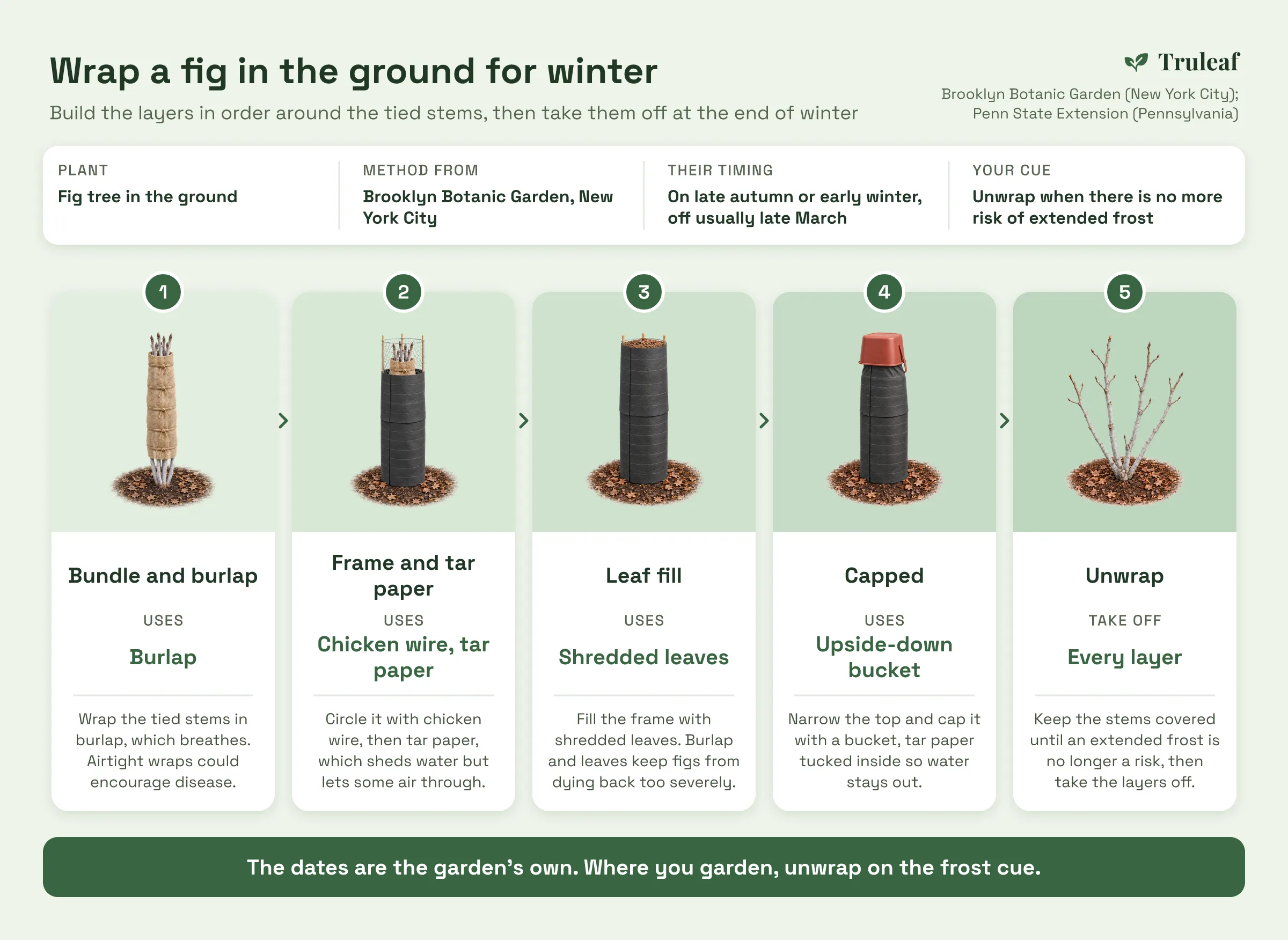
Brooklyn Botanic Garden ties the stems into an upright bundle, wraps the bundle in burlap, builds a chicken-wire cage on stakes around it, and wraps the cage in tar paper or roofing felt, which sheds water but still lets some air through. It then fills the wrapped frame with shredded leaves, narrows the top so an upside-down bucket can cap it, and finishes with a final layer of burlap. Its own fig trees had died back completely to the ground two winters in a row; the garden then began wrapping the fig specimens in its Herb Garden and reported good results for the past few years. Over seven years of field results at Khorol Botanical Garden, figs grown as bushes bent down and covered each winter went through every seasonal stage, including setting fruit. No source read measured the temperature inside a wrap or compared wrapped with unwrapped trees, so the case for wrapping rests on practice and on field accounts like these two. The sources also differ on leaves: Brooklyn Botanic Garden and Khorol use them as fill or cover, while the Penn State author prefers straw.
Mulch over the root zone keeps soil temperature and moisture more even and protects the roots from freeze-thaw damage, Clemson says, and NC State advises mulching the roots especially in the fall to carry the plant through winter. Site matters too: a spot on the south side of a building, out of drying winds, cuts winter injury, and Clemson adds that cold injury is lower where the fig is shaded from direct winter sun early in the morning and late in the evening.
How to overwinter a fig in a pot
NC State Extension says common fig grows well in containers, but a fig in a container must be overwintered indoors. If the pot can be moved, wait for a hard frost, strip the remaining leaves and unripe figs, then move it into an insulated, unheated, preferably dark room, garage or cool basement. Indoors, water the pot about once a month until the soil is just moist, keep it cool rather than warm so it stays dormant until spring, and bring it back outdoors in April, Penn State's timing for Pennsylvania in the Northern Hemisphere. Penn State Extension says figs need at least 100 hours of chilling to fruit, which is why a stored pot should stay cold rather than warm.
No source read gives a storage temperature range for a potted fig. One Penn State Master Gardener kept potted figs in a very cold, uninsulated garage with straw bales around the pots for insulation, and protects a 'Mission' fig in a 3-by-3-foot pot that is not moved in place, as if it were in the ground.
See also how to overwinter rosemary.
When to take the protection off
Brooklyn Botanic Garden takes the wrapping off when the weather warms at the end of winter, once there is no longer a risk of an extended frost; in New York City, in the Northern Hemisphere, it usually unwraps in late March.
Opening buds are the weak point, according to a Japanese study of the variety 'Masui Dauphine'. At 0 to −2°C (32 to 28°F), no buds died at any growth stage. At −3°C (27°F) and below, buds were killed, more of them the further they had developed. At −3°C, ungirdled cuttings lost no buds before bud break, some after bud break and all once the leaves had unfolded. Bud break here was induced, so the result describes buds in a controlled test.
The Khorol Botanical Garden article says spring frosts are very harmful to figs once they start growing: air drops to −5 to −8°C (23 to 18°F) during active growth are critical, and about four hours at that level is enough to damage the above-ground part significantly. In Ukraine's forest-steppe zone, in the Northern Hemisphere, such frosts can come until the end of May or even June. In spring, Khorol takes the winter cover off but leaves the shoots pinned to the ground, which does not hold back growth, so they can be covered again quickly with the same fallen leaves if a frost comes; the shoots are raised once the threat of frost has passed.
Dormancy can be short in a mild climate. At the Moroccan site, cuttings taken every 2 weeks and forced under controlled conditions broke bud poorly in December and January but at 90% to 100% when taken in the last week of February (Northern Hemisphere), and the authors conclude that fig dormancy at that mild, semi-arid site was short and not deep, with a low chill requirement.
If your fig dies back to the ground
No source read gives a temperature that kills fig roots, but Penn State's guidance is that dieback to the base is not the end of the tree. Figs recover by sending up many branches from the roots, and the main crop grows on the current year's new growth and is harvested in late summer to early fall. In the southeastern United States, UF/IFAS Extension says fig trees often freeze back and regrow as multi-stemmed bushes, because periodic cold injury damages the trunk and limbs.
Most figs bear two crops: a light one in early summer on last year's wood and the main one in mid- or late summer on the current season's wood. Many figs suited to cold climates do not usually set the early breba crop, which grows on wood from previous years.
Regrowth is expected, but the next summer's crop can be skipped: in one grower report, the outcome differed between cultivars and with how far they died back. In that 2001 report, reproduced by Clemson, twenty potted figs on the Gulf Coast were exposed to 15 °F in January 1999, and the table shows only the five high-yielding cultivars. Their plant height, assessed in midsummer 1999 after the freeze, was 2.7 to 4.8 feet. 'Violette de Bordeaux' died back to the soil and bore no fruit in 1999 but much fruit in 2000. 'Excel', recorded as 'dieback to 7.5in.', still bore much fruit in 1999 and some in 2000. The table's footnote says its damage dimensions refer to shoot diameter, so what the 7.5 inches measures is unclear.
Variety matters for hardiness as well: Clemson recommends 'Celeste' for colder parts of South Carolina because of its cold hardiness, and Penn State singles out 'Chicago Hardy' as hardier than other figs. UF/IFAS Extension notes that 'Brown Turkey' and 'Celeste' are reported to be more cold hardy than many other figs.
Your next step is the fig plant profile, which covers the rest of the fig's year.
Frequently Asked Questions
What is the coldest temperature a fig tree can handle?
UF/IFAS Extension says fully dormant, cold-conditioned fig trees withstand 15°F to 20°F without severe damage. Penn State says even the most cold-resistant figs only tolerate temperatures down to 20°F and suffer real winter damage below 15°F, 'Chicago Hardy' excepted. Earlier publications cited by a Ukrainian botanic garden say adult plants withstand short drops to −15°C without cover, with crown shoots badly damaged at −18°C and the whole above-ground part damaged at −20°C.
Do I need to cover my fig tree in the winter?
Compare your usual coldest night with 15°F to 20°F, the band UF/IFAS gives for fully dormant, cold-conditioned figs without severe damage. Penn State puts the limit at about 20°F, with real damage below 15°F; where nights get that cold, it is reasonable to cover an in-ground fig. In New York City, Brooklyn Botanic Garden says figs may not survive winter unless protected, although a south-facing wall can help them survive most winters.
How to winterize a fig tree in zone 7?
In zone 7, NC State Extension advises a south wall or another protected spot; it lists common fig for USDA zones 7a to 10b. After a hard frost, Penn State strips the remaining leaves and unripe fruit, mulches the base 6 to 12 inches deep, ties the branches and wraps them in burlap or row cover, not plastic. Mulch over the root zone keeps soil temperature and moisture more even and protects the roots from freeze-thaw damage, Clemson says.
Do I need to bring my fig tree inside for winter?
Only a potted fig comes in: NC State Extension says a fig in a container must be overwintered indoors, though one Penn State Master Gardener protects a 'Mission' fig in a 3-by-3-foot pot in place, as if it were in the ground. If the pot can be moved, wait for a hard frost, strip the remaining leaves and unripe figs, then move it into an insulated, unheated, preferably dark room, garage or cool basement.
Will my fig tree come back if it dies to the ground?
Penn State's guidance is that a fig killed back to its base is not lost: it recovers by sending up many branches from the roots, and the main crop grows on the current year's new growth. UF/IFAS Extension says fig trees in the southeastern United States often freeze back and regrow as multi-stemmed bushes, because periodic cold injury damages the trunk and limbs.
When should I unwrap my fig tree in spring?
Opening buds are the weak point: in a controlled test on 'Masui Dauphine' cuttings forced into bud break, 0 to −2°C killed no buds, while at −3°C ungirdled cuttings lost no buds before bud break, some after it and all after the leaves unfolded. Brooklyn Botanic Garden takes the wrapping off when the weather warms at the end of winter, once there is no longer a risk of an extended frost, usually late March in New York City (Northern Hemisphere).