How to Grow Jaboticaba, the Trunk-Fruiting Brazilian Grape Tree
A science-backed guide to growing jaboticaba (Brazilian grape tree), the fruit that blooms straight from the trunk. Covers acidic soil and pH, light, water, feeding, pruning to protect cauliflory, the honest years-long fruiting timeline, why grafting shortens the wait, container vs. in-ground, and troubleshooting myrtle rust and iron chlorosis.
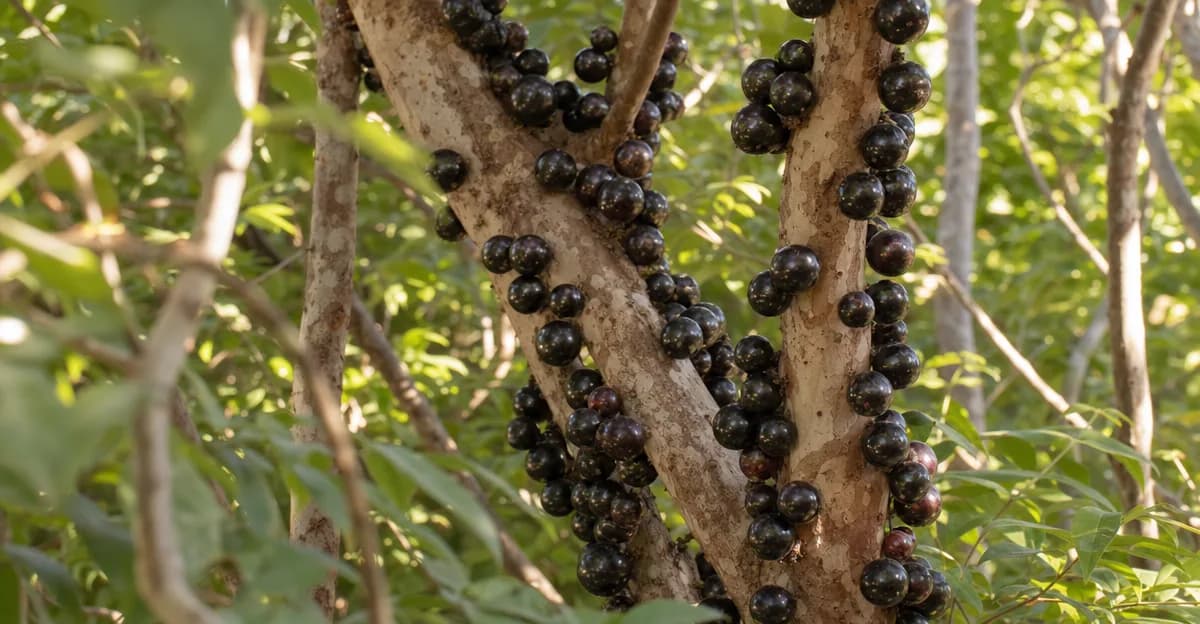
Key point: Jaboticaba (Plinia cauliflora, also spelled jabuticaba) is the Brazilian grape tree — a Myrtaceae relative of guava whose grape-like black fruit grows straight out of the trunk and older branches, a trait called cauliflory. It's rewarding but genuinely advanced: it needs acidic, consistently moist, well-drained soil, protection from frost when young, and — from seed — patience measured in years before the first fruit. The single biggest lever a home grower controls is how they start the tree: a grafted or air-layered plant can begin bearing years sooner than a seedling. See the full jaboticaba growing profile for detailed environment and nutrient data.
What makes jaboticaba unusual
Jaboticaba is a slow-growing evergreen tree in the myrtle family (Myrtaceae), native to Brazil and long grown across South America. Its most striking feature is cauliflory: instead of flowering at the branch tips, it produces flowers — and then fruit — directly on the trunk and old wood. A mature tree in season can look as though someone glued clusters of black grapes onto the bark. The fruit has a thick, grape-like skin over sweet, translucent white pulp.
That growth habit isn't just a curiosity — it shapes how you prune and manage the tree, because the trunk and older branches are the fruiting surface. Remove them and you remove next season's crop. We'll come back to that under pruning.
The other thing to know up front is speed. Jaboticaba earns its "advanced" reputation less through fussiness than through time: a seed-grown tree spends years in a juvenile, non-fruiting phase before it will bloom. Everything below is about giving the tree the acidic, moist, stable conditions it wants — and about choosing a starting plant that shortens the wait.
Choose your tree: seed vs. grafted vs. air-layered
How you acquire your jaboticaba is the most consequential decision you'll make, so it comes first.
From seed. Jaboticaba seed is recalcitrant — it loses viability quickly if it's dried or stored, so it must be sown fresh from ripe fruit. Under warm conditions it germinates over roughly 30–60 days, and research shows larger seeds tend to produce stronger seedlings. Seeds are often polyembryonic (one seed can throw multiple shoots). The catch is the wait: seedlings grow slowly and remain juvenile for years before fruiting — enrichment modelling on this species puts a typical seedling-to-bearing gap on the order of several years or more. Growing from seed is the cheapest and most rewarding path if you're patient; it is not a shortcut.
Grafted or air-layered. For anyone who wants fruit sooner, clonal propagation is the answer. Grafting and air-layering are both used to reproduce named cultivars true-to-type and, importantly, to shorten the juvenile period so the tree bears earlier than a seedling would. Cuttings are possible but unreliable, so grafting and air-layering are the dependable clonal routes. An honest caveat: clonal propagation reduces the multi-year wait — it does not make jaboticaba a fast crop. You are trading years off a long timeline, not turning it into a season-one fruiter.
If your goal is fruit within a reasonable horizon, buy a grafted plant from a reputable nursery. If the journey matters more than the deadline, seed is deeply satisfying — just start with fresh seed and manage your expectations.
Climate: where jaboticaba will actually grow
Jaboticaba is a warm subtropical-to-tropical tree. It grows actively in roughly the 18–30 °C range, with an optimum near 24 °C, and young trees are injured by frost. Mature trees tolerate brief cold better than young ones, but this is not a plant to leave exposed to a hard freeze while it's establishing.
A common myth to retire: you may see a claim that jaboticaba "germinates" down to around −2.8 °C. That figure describes brief cold tolerance in an established tree, not seed germination. Seeds actually need warmth — roughly 15–25 °C — to sprout. Don't try to germinate seed cold.
In practical terms:
- Outdoors year-round: best in USDA zone 9a and warmer, where hard frosts are rare.
- Marginal climates: a greenhouse, or a very large patio container that can be moved or protected, lets growers well outside the tree's comfort zone succeed.
This is a woody, long-lived tree, so full-cycle hydroponic systems (DWC, NFT) aren't the right frame here. When people grow jaboticaba "soilless," it's in containers of a well-drained acidic medium with drip or low-salt fertigation — not a recirculating nutrient-film setup.
Soil and pH: acidic, moist, well-drained
If there's one non-negotiable, it's the root environment. Jaboticaba wants soil that is acidic, consistently moist, and well-drained — the three at once. Target a soil pH around 5.0–6.5; seedling nutrient studies on this species centered near pH 5.5. It does poorly in alkaline or salty soils, which is where the classic iron-chlorosis problem shows up (more on that under troubleshooting).
For containers, build the mix around that profile: an acidic, organic-rich, free-draining medium that holds moisture without staying waterlogged. Peat- or coir-based blends amended for drainage, with acidity maintained by the medium and your feeding choices, suit it well.
Light
Jaboticaba is flexible on light. Young trees appreciate partial shade, and the tree will grow in partial shade through to full sun; under greenhouse production, growers commonly use 30–60% shade cloth. Aim to give an established tree bright light for good growth.
One thing to be clear about: there is no known photoperiod (day-length) trigger that makes jaboticaba bloom on cue. If you grow under lights, treat a healthy daily light integral (in the ballpark of DLI ~22) as a growth target for a vigorous plant — not as a "flowering schedule" you can flip like a switch. Jaboticaba flowers when a mature tree is well-grown and conditions are right, not because you changed the hours of light.
Water and humidity
Consistency is the theme. Jaboticaba likes steady moisture and moderate-to-high humidity — roughly 55–80% relative humidity, with something near 70% ideal — while still getting a chance to dry slightly between wet events rather than sitting soggy. The wet-then-drain rhythm matters: chronically waterlogged roots decline, and a perpetually wet canopy invites disease (see troubleshooting).
In containers, that means watering thoroughly and letting the top of the medium begin to dry before the next deep watering — never letting the rootball dry out completely, and never leaving it standing in water.
Feeding: gentle, acidic, and easy on the nitrogen
The strongest, most consistent fertility message across the extension guidance is don't overdo the nitrogen. Excess N is associated with burn and with making the tree more attractive to pests, and it doesn't buy you fruit. Feed a mature tree with a balanced, slow-release or organic fertilizer formulated for acid-loving plants, keeping the root zone acidic. Where soil or water is alkaline and the leaves yellow between green veins, a chelated iron supplement corrects the resulting chlorosis.
For the more technically minded: a peer-reviewed nutrient-accumulation study grew 'Paulista' and 'Sabará' jabuticaba seedlings and measured how much of each nutrient they took up. Nitrogen was the most-accumulated macronutrient, followed by potassium and calcium, with phosphorus and magnesium lowest — an order of roughly N > K ≈ Ca > S > P > Mg (potassium and calcium swap ranks between the two cultivars). By 450 days, 'Paulista' seedlings had accumulated about N 706, K 541, Ca 488, S 93, P 81, and Mg 66 mg per plant; 'Sabará' about N 611, Ca 424, K 409, S 92, P 62, and Mg 54 — all grown at pH 5.5 and low EC (below 2.4 dS m⁻¹).
Note: This doesn't contradict the "go easy on nitrogen" advice above. A young tree genuinely takes up a lot of nitrogen to build its frame, so it needs an adequate supply. The extension caution is specifically against excess N on an established tree — the surplus that drives soft, pest-prone growth without adding fruit. Supply enough nitrogen for steady growth, pair it with strong potassium and calcium, keep phosphorus modest, and hold total salts (EC) low.
A stage-by-stage feeding and fertigation plan
The free advice above — gentle, acidic, easy on the nitrogen — is all a home grower strictly needs. If you want to fertigate a container tree more precisely, this is how to translate the science into a stage-based plan. Two anchors govern everything: keep the root zone acidic (pH ~5.0–6.5) and keep total salts low. The nutrient-accumulation study grew its seedlings below EC 2.4 dS m⁻¹, and jaboticaba's intolerance of salty soil means you should treat that as a ceiling, not a target.
What the tree actually takes up. The 'Paulista'/'Sabará' accumulation work gives the priority order directly: nitrogen first, then potassium and calcium close behind, with sulfur, phosphorus, and magnesium lowest (N > K ≈ Ca > S > P > Mg). The practical reading is not "pour on nitrogen" — it's supply steady N for framework growth while making sure potassium and calcium keep pace, and don't waste money over-applying phosphorus.
Stage targets for container fertigation (EC as dS m⁻¹, from the Truleaf jaboticaba profile; hold pH 5.0–6.5 throughout):
| Stage | Target EC | Feeding emphasis |
|---|---|---|
| Seedling / establishment | ~1.3–1.4 | Very dilute, balanced acid feed; prioritize root establishment over push growth |
| Vegetative (juvenile frame-building) | ~1.2–1.8 | Steady N to build the frame, matched by K and Ca; keep P modest |
| Flowering (mature tree) | ~1.0–1.6 | Ease total salts; lean K-forward to support fruit set; avoid a nitrogen surge |
| Fruiting | ~1.0–1.6 | Sustain K and Ca; keep EC low to protect the thin-skinned fruit |
How to run it in practice. Feed little and often rather than in heavy doses — a slow-release or organic acid-lovers' feed for the base, topped with dilute liquid fertigation during active growth. Check runoff EC periodically; if it climbs, flush the medium with acidified water and refresh the top-dressing rather than pushing more fertilizer through. If new leaves yellow between green veins at any stage, that's the alkaline-soil iron signal — correct pH and apply chelated iron rather than adding more nitrogen.
Note: These are stage parameters, not a prescription in ppm. Uptake varies with cultivar, container volume, medium, and water chemistry — the accumulation figures come from just two cultivars in one study. A once-a-year check of medium pH and runoff EC will tell you more than any fixed number.
Container vs. in-ground
Both work; the choice is mostly about your climate and space.
In-ground suits zone 9a-and-warmer gardens where the tree can settle in permanently, given acidic, well-drained soil. It's the lowest-maintenance option once established.
Containers are what make jaboticaba possible for cold-climate and greenhouse growers — a very large patio container lets you supply the exact acidic medium the tree wants and move or protect it from frost. The trade-off is diligence: pots dry faster, so the steady-moisture requirement takes more attention, and you'll refresh or top-dress the acidic medium over time to hold pH and keep salts low.
Pruning: work with the cauliflory, not against it
Because jaboticaba fruits on its trunk and old wood, pruning is mostly about shape, airflow, and access — not heavy cutting. The cardinal rule: do not remove large, mature branches, because those are your fruiting wood. Light pruning to open the canopy, improve air circulation (which also helps with disease), and keep a manageable form is fine; hard structural cuts sacrifice future crops.
The fruiting timeline (be honest with yourself)
Here's where expectations need setting.
Getting to first fruit is the long part, and it depends almost entirely on how you started the tree — years of juvenile growth for a seedling, meaningfully sooner for a grafted or air-layered plant.
Once a mature tree flowers, things move quickly: fruit develops from pollination to maturity in about 30–45 days, according to UF/IFAS. (You may see shorter figures like "20–30 days" quoted elsewhere; we're using the sourced 30–45-day range.) A given tree tends to ripen its crop over roughly two weeks, so harvesting is a frequent, hands-on affair during the window.
How often it fruits varies with climate and management. In Florida, peak harvest runs about February–May, with the possibility of off-season fruit; in Hawai'i, trees may produce anywhere from one to six crops a year depending on rainfall, irrigation, cultivar, and elevation. More consistent moisture and warmth generally mean more frequent flushes.
Harvest and the very short shelf life
Harvest jaboticaba when the fruit is fully colored and gives slightly — and harvest often, gathering ripe fruit frequently into shallow trays to avoid crushing the soft, thin-skinned berries.
Then eat them soon. Fresh jaboticaba has a notoriously short shelf life: extension guidance points to roughly 1–2 days at room temperature and about 3–4 days refrigerated before quality falls off. Treat those as practical guidance rather than a hard constant — they come primarily from a single extension source, and separate research on edible coatings and low-temperature storage confirms the general picture (shelf life is short, and coatings/refrigeration extend it) without pinning the exact day counts. The takeaway is the same either way: plan to eat, freeze, or process the fruit into jelly, juice, or wine almost immediately after picking.
Troubleshooting
| Symptom | Likely cause | What to do |
|---|---|---|
| Orange-to-yellow pustules on young leaves and shoots, especially in wet spells | Myrtle rust (Austropuccinia psidii), a Myrtaceae disease favored by warm, wet, humid conditions | Improve airflow, avoid keeping the canopy wet, and remove affected tissue; the disease thrives in a wet canopy during rainy periods. |
| Leaves yellowing between green veins (interveinal chlorosis) | Iron chlorosis from alkaline or salty soil/water locking up iron | Acidify the root zone and apply chelated iron; correct the underlying high pH. |
| Aphids, scale, mealybugs, or whitefly | Usually a symptom of a stressed or over-fertilized (excess-N) tree — uncommon on a healthy one | Relieve the stress, ease off nitrogen, and treat the pests directly; these insects are generally not a problem on an unstressed tree. |
| Declining vigor, root problems | Waterlogged roots from poor drainage or chronic overwatering | Improve drainage; return to a water-then-drain rhythm rather than constant saturation. |
| Fruit spoiling almost immediately | Rapid postharvest decay — normal for this fruit | Harvest frequently, refrigerate promptly, and process quickly; this is inherent, not a growing mistake. |
Myrtle rust deserves a specific note: it's a serious Myrtaceae pathogen, and modelling work indicates its establishment is favored around 15–25 °C and constrained by very high warm-season rainfall (>2000 mm) and sustained heat above ~30 °C. The practical defense for a home grower is cultural — airflow, a canopy that dries out, and prompt removal of infected tissue during rainy periods.
Advanced troubleshooting: decision trees and recovery
The table above covers the common problems. This section is for when something is already going wrong and you need to work out which problem it is and how long recovery takes.
Decision tree — pustules and leaf damage in wet weather:
- Orange-to-yellow powdery pustules on the youngest leaves, shoot tips, and flush growth, appearing during a warm, wet, humid spell (roughly 15–25 °C)? → Treat as myrtle rust (Austropuccinia psidii). Remove and bag infected tissue (don't compost it on-site), open the canopy for airflow, stop overhead watering so the foliage dries, and repeat inspections through the rainy period. Rust pressure eases in sustained heat above ~30 °C and is highest where warm-season rain is heavy.
- Spots or lesions on older leaves, no powdery pustules? → More likely general fungal leaf-spot from a chronically wet canopy — same cultural fix (airflow, dry foliage), lower urgency.
Decision tree — yellowing leaves:
| Pattern | Likely cause | Action |
|---|---|---|
| Yellow between green veins, newest leaves worst | Iron chlorosis from an alkaline or salty root zone | Acidify the medium toward pH 5.0–6.5, apply chelated iron, and fix the water source if it's hard or alkaline |
| Uniform paling with soft, sappy new growth and pests arriving | Over-fertilised, excess-nitrogen stress | Cut nitrogen, flush salts, and let the tree firm up before treating the pests |
| Older leaves yellow, whole tree dull, medium constantly wet | Waterlogged roots | Stop watering, improve drainage, and return to a water-then-drain rhythm |
"My tree just won't fruit." This is the most common jaboticaba complaint, and it's usually not a disease:
- How was it started, and how old is it? A seedling may simply not be old enough — the juvenile phase runs for years, and no amount of feeding shortens it. A grafted or air-layered plant should bear far sooner; if it isn't, keep going down the list.
- Have large, mature branches been cut? Jaboticaba fruits on the trunk and old wood, so hard pruning removes the fruiting surface — the effect shows up as a missing crop a season later. Stop hard-cutting and let the old wood rebuild.
- Is it being pushed with nitrogen? Excess N drives leafy growth at the expense of fruit; ease off and hold EC low.
- Is moisture erratic? Inconsistent water stresses flowering — aim for steady moisture with brief drying between waterings.
Rough recovery timelines:
- Iron chlorosis: new growth greens up over a few weeks once pH is corrected and iron is available; already-yellow leaves may not fully re-green.
- Salt or over-nitrogen stress: flush and hold; expect firmer new growth over several weeks, and treat pests only after the tree stabilises.
- Waterlogging: if caught before root rot sets in, vigour returns once drainage is fixed; badly rotted roots may not recover.
- Myrtle rust: cultural control is ongoing management through each wet season, not a one-time cure — plan on repeated sanitation during rainy periods.
Frequently asked questions
Is jaboticaba easy to grow?
It's best described as advanced. The day-to-day care is not complicated — acidic soil, steady moisture, bright light, gentle feeding — but the tree is slow, needs frost protection when young, and (from seed) makes you wait years for fruit. The techniques are approachable; the patience is the hard part.
How long until a jaboticaba tree fruits?
From seed, expect a long juvenile phase measured in years before the first bloom. A grafted or air-layered tree bears meaningfully sooner because clonal propagation shortens that juvenile period — the single most effective way to get fruit faster. Once a mature tree flowers, individual fruit ripens in about 30–45 days.
Can I grow jaboticaba in a pot?
Yes — and for cold-climate or greenhouse growers it's the recommended approach. Use a very large container with an acidic, well-drained medium, keep it evenly moist, and move or protect it from frost. Container culture takes more watering attention than in-ground, but it lets you control soil acidity precisely.
What soil pH does jaboticaba need?
Acidic — target roughly pH 5.0–6.5 (seedling nutrient work centered near 5.5). Alkaline or salty soil causes iron chlorosis, so keep the root zone acidic and low in salts.
Why is my jaboticaba's fruit going bad so fast?
That's normal. Fresh jaboticaba lasts only about 1–2 days at room temperature and 3–4 days refrigerated — a naturally very short shelf life, not a growing error. Harvest frequently and eat, freeze, or process the fruit right away.
Can I grow jaboticaba hydroponically?
Not as a full-cycle recirculating hydroponic crop — it's a large woody tree. Soilless growers keep it in containers of a well-drained acidic medium watered by drip or low-salt fertigation, which is a very different setup from DWC or NFT lettuce systems.
Scaling up: from patio tree to orchard row
Most readers grow one or two jaboticabas. If you're thinking about a small orchard or a serious container collection, the constraints change — here's what scales and what doesn't.
Spacing and layout. A patio specimen wants a large, deep, well-drained container (roughly 60 cm across and deep, which is about 150–170 L) so you can hold the acidic medium and steady moisture the tree needs. In the ground, jaboticaba becomes a big, long-lived tree: orchard spacing is far wider — commonly about 4.5–6 m between trees — to give each canopy room and airflow. Don't plan an orchard on nursery-pot spacing; you'll crowd the trees and worsen disease pressure.
The timeline is the business risk. From seed, a planting spends years in the non-bearing juvenile phase before any return, which is exactly why commercial and serious growers lean on grafted or air-layered stock to bring bearing forward. Budget for a long establishment period regardless — clonal propagation shortens the wait, it doesn't remove it.
Yield rhythm and climate. How often a mature planting crops is climate- and management-driven: Florida orchards peak around February–May with possible off-season fruit, while in Hawai'i trees may set anywhere from one to six crops a year depending on rainfall, irrigation, cultivar, and elevation. More consistent warmth and moisture generally mean more frequent flushes — but also more myrtle-rust pressure, which modelling places highest in warm, wet regions. Site selection is a disease decision as much as a yield one.
Feeding at scale follows the same rules as a single tree, just budgeted across the block: an acidic, balanced, low-salt program that supplies steady nitrogen with strong potassium and calcium and modest phosphorus, matching the tree's actual uptake order rather than over-applying N.
Plan the postharvest chain before the harvest. Fresh jaboticaba lasts only about 1–2 days at room temperature and 3–4 days refrigerated, so any planting beyond personal use needs a same-day route to market or processing. Refrigeration and edible coatings extend quality somewhat, but the durable value is in juice, jelly, and wine, not fresh long-distance shipping. Size your processing capacity to the roughly two-week ripening window of each tree, not to a single harvest day.
Key takeaways
- Jaboticaba (Plinia cauliflora) is the Brazilian grape tree — a Myrtaceae species whose fruit grows directly on the trunk and old wood (cauliflory), which is exactly why you must not remove large mature branches.
- How you start the tree matters most: seedlings are slow (years to fruit), while grafted or air-layered plants shorten the juvenile period and bear sooner.
- Give it acidic (pH ~5.0–6.5), consistently moist, well-drained soil, moderate-to-high humidity, bright light (partial shade to full sun), and active-growth temperatures of 18–30 °C, with frost protection when young.
- Feed gently: go easy on nitrogen, favor a balanced, low-salt acidic feed with strong potassium and calcium (nitrogen is highest in uptake, so supply enough for the frame but avoid excess), and correct alkaline-soil iron chlorosis with chelated iron.
- Seed is recalcitrant — sow it fresh, never dried or stored — and germinate it warm (15–25 °C), not cold.
- Once a mature tree flowers, fruit ripens in about 30–45 days, a tree ripens its crop over ~2 weeks, and the fresh fruit lasts only days, so process or eat it promptly.
- Watch for myrtle rust in wet weather and iron chlorosis in alkaline soil; most pests appear only on stressed or over-fed trees.
Explore the full plant profile: Jaboticaba on Truleaf.org — environment parameters, nutrient data, propagation notes, and growing calendar.