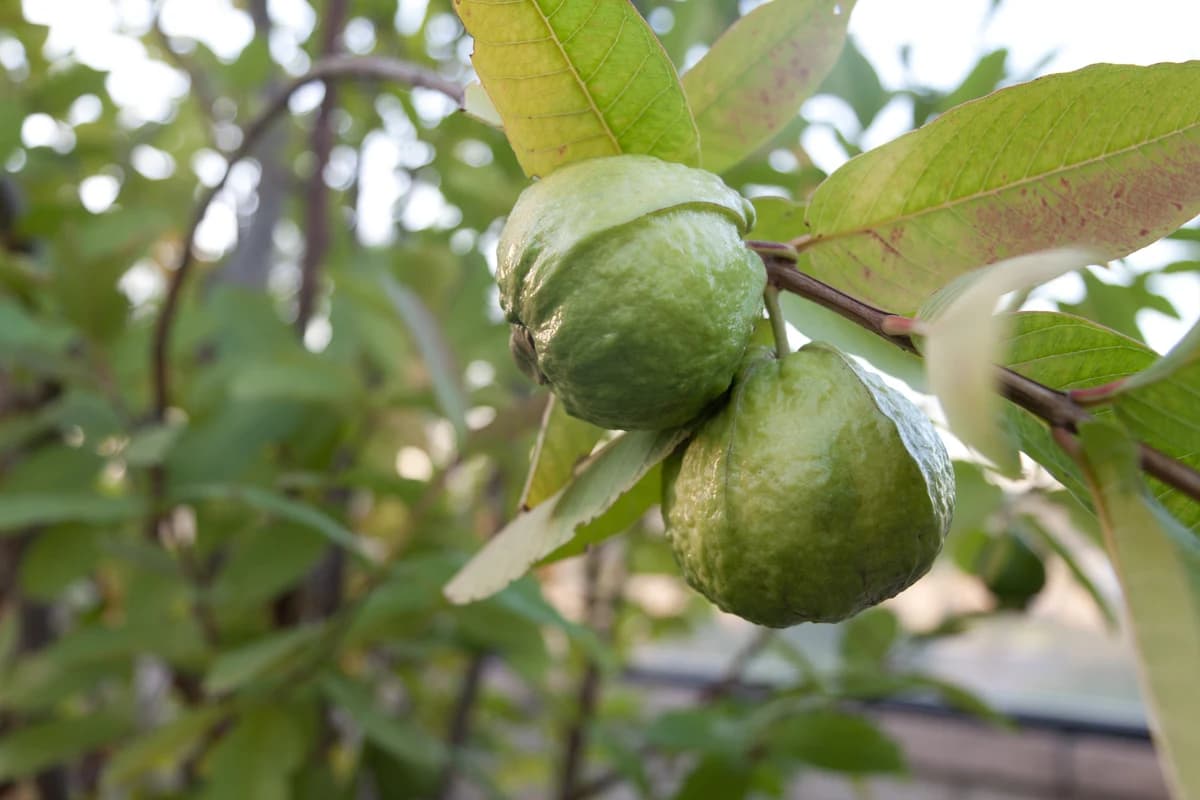
About This Plant
Guava is a tropical to warm-subtropical fruit tree valued for aromatic, vitamin-C-rich fruit eaten fresh, juiced, cooked, or processed into jams and pastes. It performs best in full sun, warm frost-protected sites, and well-drained soil or substrate, with pruning used to manage canopy size, crop timing, airflow, and harvest access.
How to Grow Guava
Learn how to grow Guava from seed to harvest in 365 days. Intermediate difficulty. Complete nutrient guide, pH/EC requirements, and growing conditions for soil & container.
Sources cited: 15.
Nutrient Requirements by Growth Stage
Guava nutrition depends strongly on system. A young-guava nutrient-solution study used total N near 224 mg/L, P 31 mg/L, K 195 mg/L, Ca 120 mg/L, Mg 48 mg/L, sulfate 64 mg/L, and trace B, Cu, Fe, Mn, Zn, and Mo at pH 5.5-6.0…
Sign in to view nutrient requirements
A free account unlocks NPK targets for all four growth stages, micronutrient levels, a per-stage nutrient calculator, and the full nutrition guide. Signing up takes one click. Truleaf is a free, non-profit project, and every new account helps it grow. No spam, ever.
Growing Environments
Outdoor warm-climate production is the best-supported environment for guava. Plant in full sun, choose a warm frost-protected site, and avoid places that remain wet after rain…
Temperature
Guava is a warm subtropical to tropical fruit tree. The best-supported production target is about 23-28C, with broader cultivation ranges reported near 15-30C depending on cultivar, site, and water status. Growth slows below about 16C, young trees can be damaged near -3 to -2C, and mature trees tolerate only short light-freeze exposure. In protected culture, manage for steady warmth rather than cold tolerance, and prevent sharp night drops during flowering and fruit development.
Humidity
No complete guava source verifies a precise relative-humidity setpoint. Use humidity as a disease and fruit-quality control variable: prolonged wetness, high rainfall, and humid fruiting conditions increase anthracnose, fruit scab, stylar-end rot, algal leaf spot, and fruit-quality risk…
Light
Guava should be managed as a full-sun crop for reliable growth and fruiting. UF/IFAS recommends planting in full sun and warns that shading from nearby structures or trees can reduce growth and production…
Airflow
Airflow guidance for guava is best expressed through canopy structure rather than a fan-speed number. UF/IFAS repeatedly recommends pruning to open the canopy to light and air movement, which reduces red alga, leaf spots, anthracnose pressure, and wetness duration…
Sign in to view environmental requirements
A free account unlocks exact temperature, humidity, light and airflow targets, including germination and growth ranges, DLI, photoperiod and PPFD, plus the full environment guide. Signing up takes one click. Truleaf is a free, non-profit project, and every new account helps it grow. No spam, ever.
Hydroponic System Compatibility
The strongest system evidence supports soil, container soil mixes, and drip irrigation or fertigation, not standing-water hydroponics. Guava tolerates several soil textures, and drip/fertigation studies report improved canopy growth, nutrient uptake, fruit retention, and yield under controlled irrigation and…
Growing Media
For production, guava needs a fertile, aerated, well-drained root zone. UF/IFAS reports adaptation to sands, loams, rock-based soils, and muck, with pH 4.5-7 ideal; high-pH soils can work only with active iron management…
Container Specs
Container guava should be treated as a small fruit-tree system. ICAR container work found larger formats, especially 45 x 45 cm and 45 x 60 cm, supported stronger root and shoot biomass and productive fruiting than smaller containers…
Training & Support
Guava needs early structural training and continuing pruning. UF/IFAS recommends heading unbranched young trees at 1-2 ft, selecting 3-4 well-distributed lateral branches, and tipping new shoots after 24-36 inches to encourage branching…
Sign in to view system compatibility
A free account unlocks why each of the six systems fits or fails, plus growing media, container sizes, training methods, companion plants, and the full systems guide. Signing up takes one click. Truleaf is a free, non-profit project, and every new account helps it grow. No spam, ever.
Propagation
Seed is useful for rootstocks or non-clonal propagation, but it should not be presented as true-to-type cultivar production. Guava seed has slow, uneven emergence; a controlled trial found untreated seed averaged about 30 days to germinate, while GA3 at 1000 ppm for 24 hours shortened mean germination to about 16 days…
Harvesting
Harvest guava by maturity stage and intended use. Pink or red dessert guavas are generally picked when the peel turns light green to yellow and then ripened at room temperature; white crisp types are often harvested full-sized while green to light green…
Planting Calendar
Guava calendars are regional and can be manipulated by pruning and water management. PAU recommends transplanting with earthballs in February-March or August-September and sowing rootstock seed in raised beds in August under Punjab conditions…
Common Issues
The highest-confidence guava issues are anthracnose, fruit fly injury, fruit scab or canker, stylar-end rot, root rot or wilt complexes, algal leaf spot, nematodes, and occasional rust or mushroom root rot depending on region. Anthracnose and stylar-end rot often begin in the field but become obvious during ripening,…
Get the full science-backed guide
By signing up, you help keep Truleaf free and support the growth of our nonprofit project. Your account unlocks full details for every plant issue—including symptoms, causes, step-by-step solutions, and prevention—plus the month-by-month planting calendar, the complete guide, and all research sources. It only takes one click. No spam, ever.