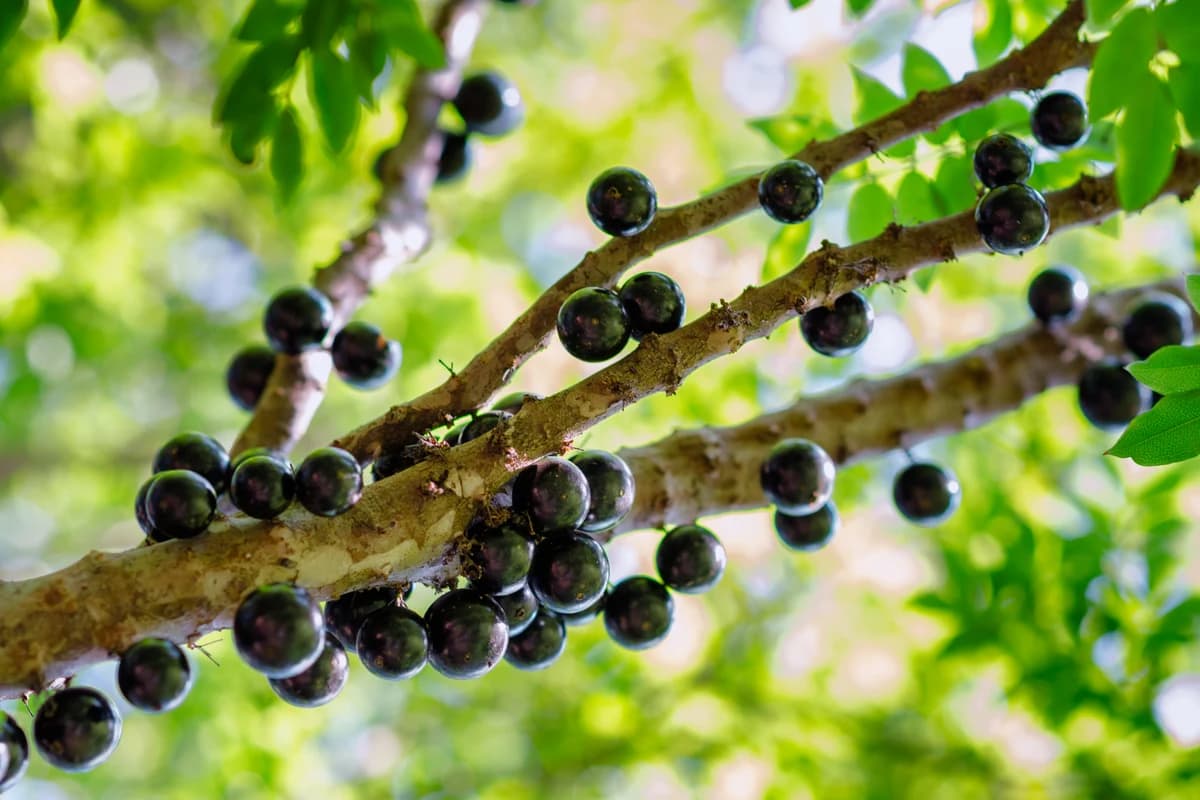
About This Plant
Jaboticaba is a slow-growing Brazilian fruit tree famous for cauliflory: grape-like berries form directly on mature trunks and branches. It suits warm subtropical gardens, greenhouses, and large patio containers when given acidic, consistently moist, well-drained media, frost protection, and patient long-term care.
How to Grow Jaboticaba
Learn how to grow Jaboticaba from seed to harvest in 14 days. Advanced difficulty. Complete nutrient guide, pH/EC requirements, and growing conditions for soil & container.
Sources cited: 8.
Nutrient Requirements by Growth Stage
Seedling nutrient-solution work supports the existing seedling ppm center near N 222, P 62, K 426, Ca 140, Mg 24, and S 32 at pH about 5.5 and low EC. For mature trees, extension guidance is more practical: use acidic media, organic or slow-release balanced fertilizer, avoid salt buildup, and avoid excess nitrogen…
Sign in to view nutrient requirements
A free account unlocks NPK targets for all four growth stages, micronutrient levels, a per-stage nutrient calculator, and the full nutrition guide. Signing up takes one click. Truleaf is a free, non-profit project, and every new account helps it grow. No spam, ever.
Growing Environments
Jaboticaba is best outdoors in USDA zone 9a or warmer, in greenhouses, or in very large patio containers where frost protection and moisture can be controlled. It is slow-growing and can be containerized or trained as an ornamental, but fruiting indoors requires unusually bright light, acidic media, stable moisture,…
Temperature
Treat jaboticaba as a warm subtropical to tropical fruit tree, not a cold-season crop. Seed studies support germination around 15-25C, while extension sources place landscape production in mild warm climates and warn that frost can injure trees, especially young plants. Mature trees may tolerate brief near-freezing events, but active growth and container culture are safest around 18-30C with protection from hard freezes.
Humidity
Jaboticaba performs best with steady moisture and humid subtropical conditions, but disease risk rises when dense canopies stay wet. A practical target is moderate to high humidity with strong drying between rain or irrigation events…
Light
Use bright light with some protection for young or container-grown trees. UF/IFAS reports that jaboticaba prefers partial shade but can tolerate full sun for larger crops, and greenhouse production can use 30-60% shade cloth…
Airflow
Airflow should be managed through spacing and selective pruning rather than high fan speeds. Jaboticaba naturally forms a dense canopy and bears fruit on trunks and older branches, so prune lightly to remove dead, weak, crossing, or light-blocking branches while preserving productive wood…
Sign in to view environmental requirements
A free account unlocks exact temperature, humidity, light and airflow targets, including germination and growth ranges, DLI, photoperiod and PPFD, plus the full environment guide. Signing up takes one click. Truleaf is a free, non-profit project, and every new account helps it grow. No spam, ever.
Hydroponic System Compatibility
Full-cycle DWC and NFT are not supported by the available jaboticaba literature. The species is a long-lived woody tree with shallow fibrous roots, anchorage needs, and multi-year production timing…
Growing Media
Use acidic, moist, well-drained media. UF/IFAS describes jaboticaba as thriving in acidic, consistently moist soils under partial shade, and CTAHR adds that deep, well-drained soil and mulching support shallow roots…
Container Specs
Container culture is realistic because jaboticaba grows slowly, but the container must be large, stable, acidic, and well drained. The tree has shallow roots and can become top-heavy in wind, so large patio containers need generous width, drainage, mulch, and sometimes staking…
Training & Support
Training is mostly light pruning and occasional staking. Immature trees usually need no pruning, though root suckers can be removed if a single trunk is desired…
Sign in to view system compatibility
A free account unlocks why each of the six systems fits or fails, plus growing media, container sizes, training methods, companion plants, and the full systems guide. Signing up takes one click. Truleaf is a free, non-profit project, and every new account helps it grow. No spam, ever.
Propagation
Seed is common, but it must be handled quickly because jaboticaba seed is recalcitrant and loses viability when dried or stored at room temperature. Fresh seed commonly germinates over about 30-60 days, with larger seed producing stronger seedlings in controlled tests…
Harvesting
Harvest fruit directly from trunks and older branches when fully colored and slightly soft. Individual trees can ripen fruit over about two weeks, so harvest frequently and use shallow containers to avoid crushing…
Planting Calendar
In subtropical climates, plant after frost risk and favor the warm rainy establishment season when irrigation is reliable. Florida guidance places peak harvest from February through May with possible off-season crops, while Hawaiʻi observations show one to six crops per year depending on rainfall, irrigation,…
Common Issues
The most defensible issues are myrtle rust during rainy periods, iron chlorosis in alkaline or salt-affected media, stressed-tree insect pests, wet-root decline, and rapid postharvest decay. UF/IFAS notes aphids, scales, mealybugs, and whiteflies are uncommon unless trees are stressed or overfertilized with nitrogen…
Get the full science-backed guide
By signing up, you help keep Truleaf free and support the growth of our nonprofit project. Your account unlocks full details for every plant issue—including symptoms, causes, step-by-step solutions, and prevention—plus the month-by-month planting calendar, the complete guide, and all research sources. It only takes one click. No spam, ever.