How to Harvest Rosemary So It Keeps Growing (Don't Cut the Wood)
Rosemary lives for decades — but one wrong cut kills a branch forever. Learn the green-wood rule, the exact pruning technique that triggers bushier growth, best harvest timing for peak flavor, and how to store rosemary for months.
A single rosemary plant (Salvia rosmarinus) can produce fresh sprigs for 10 to 20 years — but only if you never make one specific mistake: cutting into old, woody stems. Unlike basil or mint, which are soft herbs that bounce back from almost any cut, rosemary is a woody evergreen shrub. Cut into bare wood and that branch dies permanently. Cut in the right place — above green, leafy growth — and the plant branches out, gets bushier, and produces more harvestable stems than before. This guide explains the science behind rosemary's branching response, the exact technique to harvest without damaging the plant, and how to keep it producing decade after decade.
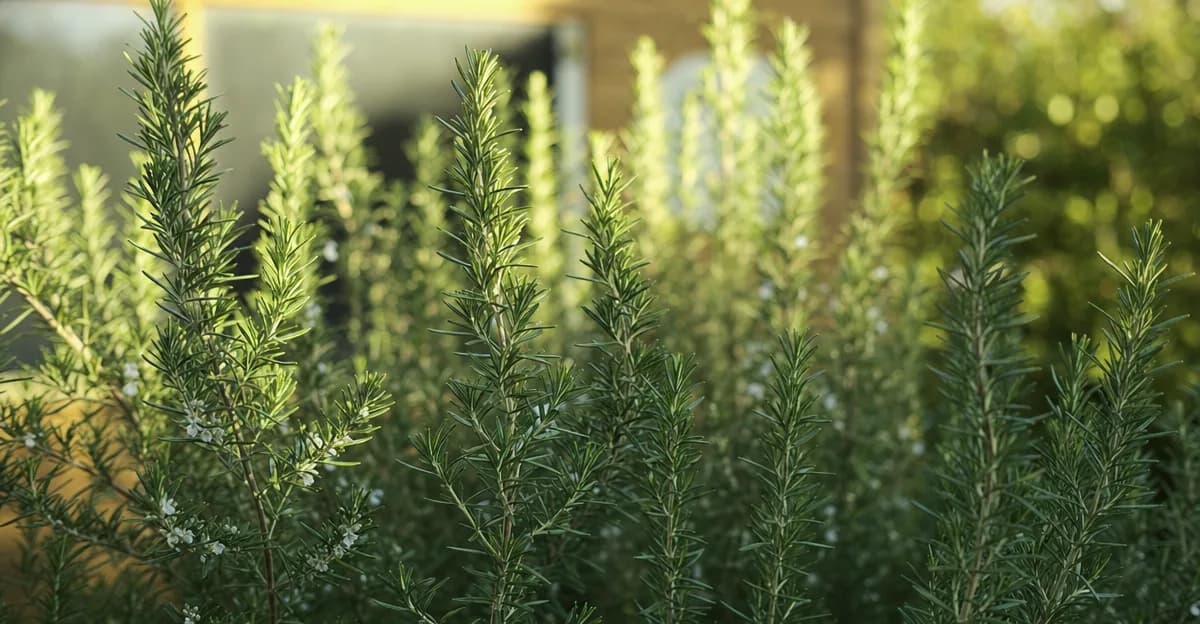
Why rosemary is different from other herbs
If you've harvested basil or mint, you know the pattern: cut above a node, two new stems appear, repeat. Rosemary follows the same hormonal logic, but its woody growth habit adds a critical constraint that soft herbs don't have.
Basil is an annual. Mint is a soft-stemmed perennial. Both regenerate rapidly from virtually any cut because every part of the stem contains viable buds. Rosemary is a woody evergreen subshrub — its stems lignify (turn into wood) over time, and once a stem has gone fully woody, it loses the ability to sprout new growth. Cut below the green zone into bare wood and that branch is dead. There's no coming back.
This is the single most important thing to understand about harvesting rosemary: always cut in the green. As long as you follow that rule, rosemary is one of the most rewarding herbs to harvest — it regrows reliably, produces more branches with every cut, and keeps going for years.
The science: why pruning makes rosemary bushier
When you cut the tip of a rosemary stem, you remove the apical meristem — the growing point that produces the hormone auxin. Auxin flows downward through the stem and suppresses the growth of lateral buds at every node below it, a phenomenon called apical dominance.
Remove the tip and the auxin signal drops. Recent research has revealed that sugar redistribution also plays a key role — sucrose levels in the stem increase rapidly after decapitation, moving far faster than auxin depletion, and this sugar surge helps activate dormant lateral buds. Combined with cytokinins produced in the roots, this triggers the buds at the nodes below the cut to break and produce new lateral shoots.
Rosemary has stronger apical dominance than soft herbs like basil and mint, which means its lateral buds take longer to activate — typically 2-4 weeks rather than days. But the response is reliable, and each cut produces two or more new growing points. Over time, regular harvesting transforms a sparse, upright plant into a dense, bushy shrub loaded with harvestable stems.
When your rosemary is ready to harvest
Rosemary is ready for its first harvest approximately 80-100 days after transplanting, or about 120 days from seed. However, seed germination is slow and unreliable (only about 30% success rate), so most rosemary starts from cuttings or nursery transplants.
Here are the readiness signs:
- Height: The plant stands at least 15-20 cm (6-8 inches) tall
- Stem count: Multiple stems with established leaf growth are visible
- Green growth: At least 8-10 cm of soft, green stem tips on each branch
- Root establishment: The plant is actively growing and producing new tip growth
Once established, rosemary is an evergreen that can be harvested year-round in mild climates (USDA zones 8-10). In colder zones, harvest actively from spring through early autumn and avoid heavy harvesting in late autumn, when the plant needs its foliage to survive winter.
Step-by-step: how to harvest rosemary correctly
What you need
- Clean, sharp pruning snips or scissors (sterilize with rubbing alcohol between plants to prevent spreading disease)
- A bowl or basket for harvested sprigs
The cut
-
Find the green zone. Look at the stem you want to harvest. Follow it from the tip downward until you see where green, flexible growth transitions to brown, woody bark. This boundary is your limit — never cut below it.
-
Cut 8-10 cm (3-4 inches) from the tip. Position your shears on the green portion of the stem and make a clean cut just above a leaf cluster or node. Leave at least 5 cm of green, leafy growth on the remaining stem.
-
Cut at a slight angle. Unlike basil, where a straight cut works fine, rosemary benefits from a slight angle cut that sheds water away from the wound. This reduces the risk of fungal entry in humid conditions.
-
Never remove more than one-third of the plant at once. If you need a large harvest, take sprigs from all around the plant rather than stripping one side.
-
Never cut into old, bare wood. This is the cardinal rule. If a branch has no green leaves remaining, cutting it will not produce regrowth. The only exception is dead or diseased branches, which should be removed entirely to keep the plant healthy.
After the cut
Within 2-4 weeks, you'll see new lateral shoots emerging from the leaf nodes below where you cut. Rosemary's branching response is slower than basil's (which shows new growth in 5-7 days), but the result is the same — each cut point produces two or more new stems, gradually building a denser, bushier plant with more harvestable growth.
When and how often to harvest
Time of day
Harvest in the early morning, after any dew has dried but before the midday heat. Research on rosemary essential oils confirms that oil concentration peaks in morning-harvested samples — the volatile compounds responsible for rosemary's distinctive piney aroma (primarily 1,8-cineole, alpha-pinene, and camphor) dissipate as temperatures rise through the day.
Frequency
Harvest every 2-4 weeks during the active growing season (spring through autumn). Rosemary grows more slowly than basil or mint and doesn't need — or tolerate — the same aggressive cutting frequency. In winter, limit harvesting to occasional light snipping of individual sprigs.
For culinary use, small, frequent harvests work best. Snipping 2-3 sprigs at a time as you cook is perfectly fine and actually encourages denser growth over time.
Seasonal timing
In the Northern Hemisphere, the best harvest window is late spring through summer (May through August). This is when growth is most vigorous and essential oil content is highest. Research on rosemary accessions found that summer harvests consistently produce the greatest essential oil yield — 2.3-3.0% of fresh weight — compared to lower yields in autumn and winter.
For established outdoor plants, the harvest window runs from May through October, with the primary pruning period in March through May and a lighter second round in August through September.
Seasonal Harvest Calendar
This calendar maps the full year for an established rosemary plant in USDA zones 8-10. In colder zones (6-7), shift outdoor activity later in spring and earlier in autumn. Indoor growers can follow the spring-summer pattern year-round with supplemental lighting.
| Period | Stage | Action | Notes |
|---|---|---|---|
| Jan-Feb | Winter dormancy | Minimal harvesting — snip individual sprigs only as needed. Do not prune. | Growth is slowest. Focus on keeping the plant alive, not productive. Indoor plants may need grow lights to maintain 14-16 hours of light. |
| Mar-Apr | Spring flush | Primary pruning window. After the last hard frost, shape the plant by cutting back the top third of each stem to just above healthy leaf growth. Remove any dead, damaged, or crossing branches entirely. | This is the most important pruning of the year. It stimulates a flush of new growth and sets the shape for the season. Never cut into old wood. |
| May-Jun | Active growth | Begin regular harvesting every 2-3 weeks. Take 8-10 cm sprigs from stem tips across the whole plant. | Growth is vigorous. Essential oil content is climbing. This is peak flavor season. |
| Jul-Aug | Peak production | Harvest every 2 weeks. The plant is at maximum growth rate and essential oil peaks. If flowers appear, harvest the flowering stems — the flowers are edible and the stems below will branch. | If the plant is getting too large, this is a good time for a second, lighter shaping prune (never more than one-third). |
| Sep-Oct | Late season | Reduce harvest frequency to every 3-4 weeks. Take only what you need. | The plant needs to harden off before winter. Avoid heavy pruning after mid-September in zones 7-8 — new growth triggered too late won't harden before frost. |
| Nov-Dec | Pre-dormancy | Light snipping only. In cold zones, protect with mulch or move containers indoors. | Rosemary is hardy to approximately -8 to -12C (18-10F) depending on cultivar. Protect roots from hard freezes. |
Cumulative yield: An established rosemary plant produces approximately 0.3 kg of fresh sprigs per year, or about 1.5 kg per square meter in a dense planting. Commercial operations achieve up to 2 kg per square meter annually with optimized spacing and regular harvesting.
Longevity: With annual spring pruning and regular harvesting, rosemary plants maintain productive growth for 10-20+ years. Plants that are never pruned become leggy, woody at the base, and progressively less productive — replacement is easier than rehabilitation for severely neglected specimens.
How to prevent woody, leggy growth
The number one reason rosemary plants become unproductive is neglect — years of growth without pruning. Left unchecked, rosemary naturally grows tall and woody at the base, with green foliage only at the tips of long, bare branches. At this point, there's no way to cut back hard enough to reshape the plant without killing branches, because there's no green growth left to cut above.
What causes woody growth
- No regular harvesting or pruning. This is the primary cause. Stems that are never cut grow longer and lignify from the base upward, steadily losing their ability to sprout.
- Insufficient light. Rosemary needs full sun — at least 6-8 hours of direct light. In low light, the plant stretches and becomes leggy.
- Age. All rosemary eventually becomes woody at the base. The goal is to keep the green zone thick and productive.
How to prevent it
-
Harvest regularly. Every time you cut a stem tip, you reset that stem's growth pattern and force lateral branching. A plant harvested every 2-4 weeks stays dense and bushy.
-
Prune annually in spring. After the last frost, cut back the top one-third of each stem to above healthy leaf growth. This is the single most effective anti-woodiness strategy. It keeps stems short, promotes dense lateral branching, and prevents the plant from outgrowing its green zone.
-
Remove dead wood promptly. Dead or bare branches steal resources and block airflow. Cut them off at the base whenever you spot them.
-
Provide full sun. If growing indoors, rosemary needs at least 14-16 hours under grow lights at 300-400 umol/m2/s to maintain compact, bushy growth.
If your plant is already woody
For mildly woody plants, use a phased approach: cut back one-third of the oldest, woodiest stems each year over three years, always cutting to just above the point where some green growth remains. This gradually forces new growth without shocking the plant.
For severely woody plants where the green zone has retreated to the tips of long bare branches, replacement is more practical than rehabilitation. Take cuttings from the healthy green tips to propagate new plants, then start fresh.
Harvesting different rosemary varieties
All rosemary varieties respond to the same cut-above-the-green-zone technique, but growth habit and hardiness vary significantly:
| Variety | Growth habit | Height | Cold hardiness | Harvest notes |
|---|---|---|---|---|
| Tuscan Blue | Upright, vigorous | 1.5-2 m (5-7 ft) | Zone 8 (-12C/10F) | Chef's favorite. Wide, aromatic leaves with high oil content. Produces abundantly — prune aggressively to keep manageable. |
| Arp | Upright, open | 0.9-1.2 m (3-4 ft) | Zone 6 (-20C/-5F) | The most cold-hardy cultivar. Gray-green leaves with a slightly more camphor-forward flavor. Best choice for zones 6-7. |
| Miss Jessopp's Upright | Columnar, vigorous | Up to 1.5 m (5 ft) | Zone 8 (-12C/10F) | Holds shape naturally with minimal pruning. Light blue flowers. AGM winner. |
| Prostrate (trailing) | Spreading, cascading | 15-30 cm (6-12 in) | Zone 8 (-12C/10F) | Harvesting from trailing varieties requires more care — take fewer, shorter sprigs. More delicate flavor; excellent in dressings and marinades. |
| Blue Boy | Compact, dwarf | 30-60 cm (1-2 ft) | Zone 8 (-12C/10F) | Ideal for containers and windowsills. Smaller leaves but concentrated flavor. Harvest by snipping individual sprigs rather than aggressive pruning. |
| Rosea | Upright | Up to 80 cm (2.5 ft) | Zone 8 (-12C/10F) | Pink flowers. AGM winner. Good all-rounder for both culinary and ornamental use. |
Flavor note: Upright varieties with broader leaves generally contain more aromatic oil than prostrate or dwarf forms. Cold-hardy cultivars like 'Arp' tend to have higher camphor content, producing a sharper, more medicinal note — this is a genetic trade-off for frost tolerance.
Storing your harvest
Rosemary is one of the toughest culinary herbs — its thick, needle-like leaves resist wilting far longer than basil, mint, or cilantro. This makes storage straightforward.
Fresh storage (up to 4 weeks)
- Wrap sprigs in a barely damp paper towel — lightly moist, not wet.
- Place in a resealable bag or airtight container in the refrigerator.
- Store in the warmer part of the fridge (the door shelf, not the back where temperatures fluctuate). Unlike basil, rosemary tolerates refrigeration well.
Alternatively, stand sprigs upright in a glass with 2-3 cm of water, cover loosely with a plastic bag, and refrigerate. This method can keep rosemary fresh for up to four weeks.
Longer preservation
- Freezing (best flavor retention): Strip leaves from stems, spread in a single layer on a baking sheet, freeze until solid, then transfer to a freezer bag. Frozen rosemary retains its flavor for up to six months and can go directly into cooking without thawing.
- Olive oil cubes: Pack stripped leaves into ice cube trays, cover with olive oil, and freeze. Drop cubes directly into roasting pans or skillets.
- Drying: Hang small bundles upside-down in a warm, dark, well-ventilated space for 1-2 weeks. Research confirms that air-drying preserves more volatile aromatic compounds than oven-drying. Store dried rosemary in an airtight container away from light — it keeps for up to one year but is most flavorful within six months.
Common harvesting mistakes
| Mistake | Why it hurts | Fix |
|---|---|---|
| Cutting into woody stems | Rosemary cannot regenerate from bare wood — the branch dies | Always cut above green, leafy growth |
| Removing more than one-third at once | Shocks the plant, stunts regrowth | Harvest in rotation across the whole plant |
| Never pruning the plant | Stems become woody and leggy over time | Prune annually in spring; harvest every 2-4 weeks |
| Harvesting in afternoon heat | Essential oil compounds have partially volatilized | Harvest in early morning |
| Cutting too short on green stems | Leaves too few leaves for photosynthesis | Leave at least 5 cm of green growth on each stem |
| Heavy pruning in late autumn | New growth won't harden before frost | Stop major pruning by mid-September in cold zones |
| Ignoring dead wood | Dead branches waste energy and block airflow | Remove dead or bare branches at the base |
When Regrowth Fails: Diagnostic Guide
If your rosemary isn't responding to harvesting as expected, work through this diagnostic sequence.
No new shoots within 4 weeks of cutting
Check 1: Cut placement. Did you cut above green growth with visible leaves? If you cut into bare woody stem, that branch won't regrow. Solution: focus future cuts on stems that still have green, leafy growth below the cut point.
Check 2: Light levels. Rosemary requires a daily light integral (DLI) of at least 18-20 mol/m2/day for vigorous vegetative growth. Plants in partial shade produce weaker branching responses. If growing indoors, ensure at least 14-16 hours under grow lights at 300-400 umol/m2/s.
Check 3: Root health. Rosemary roots are extremely sensitive to waterlogging. Brown, mushy roots indicate root rot — often Pythium or Phytophthora in overwatered containers or poorly drained soil. Healthy rosemary roots are white and firm. Compromised roots cannot supply the cytokinins needed to activate lateral buds. Ensure soil or growing medium drains rapidly and allow it to dry slightly between waterings.
Check 4: Season. Rosemary's growth slows dramatically in winter. If you cut in November and see no regrowth by January, that's normal dormancy behavior, not a problem. Wait for spring.
Leggy, stretched growth
New shoots growing tall and thin with large gaps between leaf clusters indicates insufficient light. Move to full sun (6+ hours direct) or increase artificial lighting intensity. Rosemary stretches toward light, sacrificing the compact, dense growth that produces the most harvestable material. NC State Extension notes rosemary requires "full sun" and performs poorly in low light.
Brown or black discoloration at cut sites
Darkening at the cut surface within a few days may indicate fungal entry through the wound. This is more common in humid conditions. Prevent by:
- Sterilizing cutting tools with 70% isopropyl alcohol between plants
- Cutting at a slight angle so water drains off the wound
- Ensuring adequate air circulation (0.3-1.0 m/s across the canopy)
- Avoiding harvesting during or immediately after rain
Entire sections of the plant dying back
This may indicate Phytophthora root rot, which causes progressive branch dieback from the base upward. Check the root zone — if soil is consistently wet or drainage is poor, the root system may be compromised. Improve drainage immediately, reduce watering frequency, and remove dead sections. In severe cases, replace the plant in well-drained soil or a container with drainage holes.
Leaves dropping or curling despite adequate water
Check for rosemary beetle (Chrysolina americana), which feeds on foliage and can defoliate stems. Also check for spider mites (tiny webbing on undersides of leaves) and whitefly. In all cases, inspect plants closely — rosemary's dense foliage can hide pests. Remove heavily affected stems by pruning and improve air circulation.
Commercial Harvest Scaling
For growers producing rosemary at commercial volumes, harvesting technique directly impacts both fresh herb yield and essential oil quality.
Yield benchmarks
Under optimal conditions with regular harvesting, rosemary produces approximately 1.5-2 kg of fresh herb per square meter annually. Commercial operations at field scale report average fresh material yields of 10-20 tonnes per hectare (1-2 kg/m2), with dried leaf yields of approximately 2.5 tonnes per hectare.
For essential oil production, yield ranges from 0.5-2% of fresh plant weight depending on cultivar and harvest timing, with the highest concentrations (2.3-3.0%) occurring during summer harvests. Singh and Guleria (2013) reported maximum essential oil yields of up to 129 kg per hectare when harvesting at the full bloom to seed-setting stage.
Harvest scheduling at scale
Commercial rosemary operations typically harvest on a rotation basis: divide the growing area into 3-4 zones and harvest one zone every week. This ensures:
- Continuous supply without gaps
- Each zone gets 3-4 weeks of regrowth between cuts
- Labor is distributed evenly across the month
Rosemary's slower regrowth compared to basil or mint means longer rotation cycles — plan for 3-4 harvests per growing season per zone, rather than the weekly cuts soft herbs require.
Essential oil optimization
For essential oil production, harvest timing is critical:
- Season: Summer harvests yield the most oil (2.3-3.0% of fresh weight). Autumn and winter harvests yield significantly less.
- Growth stage: Full bloom to early seed-setting produces maximum biomass and oil yield.
- Time of day: Morning harvest when oil concentration peaks.
- Drying: Air-dry harvested material in a cool, dark, ventilated space. Air-drying preserves more volatile compounds than oven-drying or freeze-drying.
Post-harvest handling
- Cut in early morning when essential oil content peaks
- Hydrate stems immediately for fresh-market product — place cut stems in clean water within minutes
- Cool rapidly to 2-4C — rosemary tolerates cold storage well
- Target storage at 2-4C with 90-95% relative humidity for maximum shelf life (up to 2-4 weeks)
- Bundle in 25-50 g portions for retail — rosemary's rigid stems hold shape well in packaging
Plantation lifecycle
Rosemary plantations peak in productivity during years 3-8, with well-maintained plants remaining productive for 10-20+ years. Annual spring pruning is essential — without it, the woody zone expands each year and the productive green canopy shrinks. At commercial scale, the cost of annual pruning is significantly lower than the cost of replacing neglected plants.
Putting it all together
Rosemary is the most long-lived herb in the harvest series — where basil lasts one season and mint needs dividing every few years, a well-maintained rosemary plant can produce fresh sprigs for a decade or two. The trade-off for that longevity is one strict rule: never cut into old, bare wood.
The rhythm is simple: harvest every 2-4 weeks during the growing season, always cut in the green zone above leafy growth, never take more than a third, and prune once a year in spring to keep the plant dense and productive. Harvest in the morning for peak essential oil content. Unlike basil, rosemary stores well in the refrigerator — wrapped sprigs keep for up to four weeks.
For detailed growing parameters including temperature, humidity, light, and nutrient requirements, see the full rosemary growing profile. If you're looking for more harvesting guides, see how the technique differs for basil (where pinching above nodes doubles stem count), mint (aggressive cutting that rewards frequent harvest), and cilantro (outer-leaf harvesting to protect the crown).