Hydroponic Setup Cost Breakdown: 6 Systems Compared
Compare dated hydroponic setup costs for six systems, then calculate electricity and nutrient costs for your own Kratky, DWC, NFT, or ebb-and-flow build.
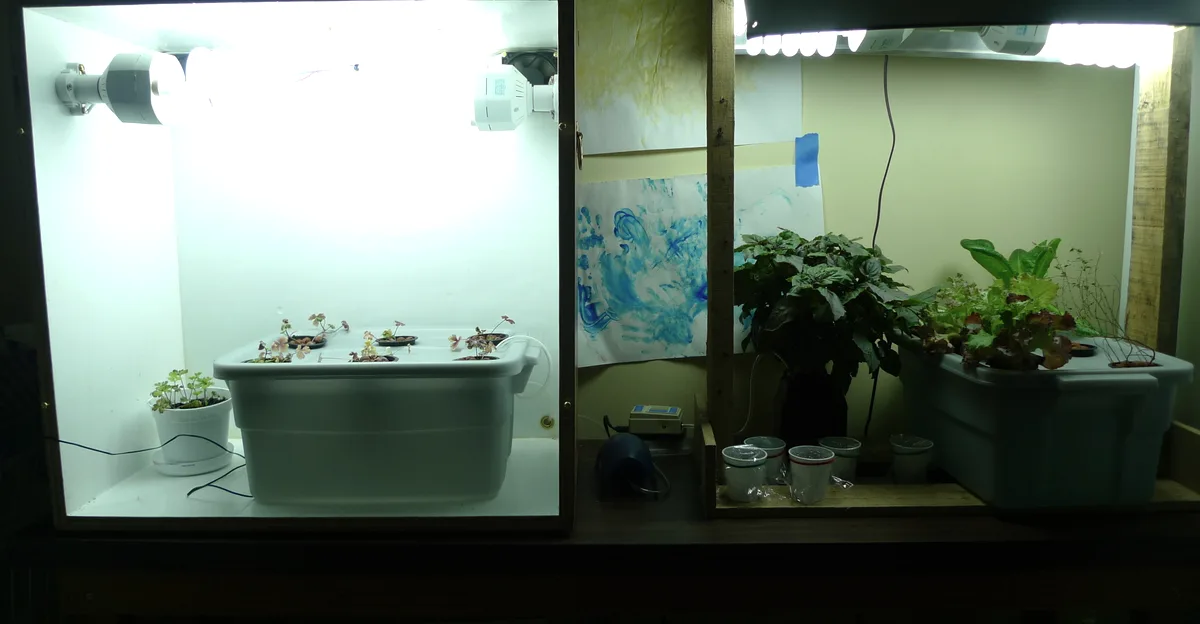
Quick answer: Based on U.S. prices observed on August 2, 2026, starter-basket purchases began at about $20-$66 for a one-bucket Kratky basket and $30-$108 for a one-bucket actively aerated Deep Water Culture basket. Component capacities differ within those ranges: the cited lids support one or four planting sites, and the upper DWC endpoint uses a four-outlet air pump. A 36-site Nutrient Film Technique kit with a basic reservoir was about $61-$81. A 60 cm by 60 cm (2 ft by 2 ft) ebb-and-flow reference basket reached $168-$185 before several required parts were added. Countertop systems with lights ranged from about $43-$200, while one enclosed smart grow box cost about $600.
Those figures are basket or product purchase prices, not capacity-normalized totals. The Kratky and DWC baskets include a purchased pack of growing medium; nutrients, pH supplies, seeds, light, shelving, climate control, taxes, shipping, and ongoing electricity remain outside them and can move the final hydroponic setup cost in either direction. Two products sold under the same system name may also have different capacities and included parts.
Hydroponic setup costs at a glance
| System | Observed price or subtotal | Capacity in this comparison | What is included | What is still outside the price |
|---|---|---|---|---|
| Passive Kratky DIY | About $20-$66 | One bucket; observed lids support one or four sites | Reservoir, plant-support lid or net pot, purchased pack of growing medium | Nutrients, pH supplies, seeds, light |
| Actively aerated DWC DIY | About $30-$108 | One bucket; component capacities differ | Kratky-type vessel, support, purchased medium pack, and air pump | Air stone or tubing where absent, nutrients, pH supplies, seeds, light |
| Small NFT kit plus reservoir | About $61-$81 | 36 sites | Channels, baskets or sponges, water pump, timer, tubing, basic reservoir | Nutrients, pH supplies, seeds, light |
| Ebb and flow reference basket | About $168-$185 subtotal | 60 cm by 60 cm (2 ft by 2 ft) tray | Tray, 95 L (25 gal) reservoir, pump, timer, fill and drain fittings | Tubing, growing medium, pots, stand, reservoir cover if needed, shared supplies, light |
| Countertop system | About $43-$200 | 12-44 sites | Reservoir, pump, integrated LED, timer, varying starter accessories | Replacement consumables and anything omitted by the specific seller |
| Enclosed smart grow box | About $600 | One observed product | Cabinet, light, circulation or ventilation, controller, app features | Ongoing consumables and electricity |
Prices retrieved August 2, 2026, in U.S. dollars. Tax and shipping are excluded. These are observed prices and reference baskets, not market averages. Capacity and inclusions differ, so the rows are not direct value rankings.
The cheapest row is not automatically the cheapest way to grow the same amount of produce. The Kratky and DWC examples each price one bucket, but their lids and pumps are not normalized to one planting site; the NFT kits advertise 36 sites. This evidence also cannot support a universal grocery break-even date or a national average setup price. Crop, harvest, failures, labor, equipment life, local produce prices, and replacement schedules would all have to be defined for that calculation.
Why the system name does not give you the final price
A useful budget has four layers:
- System hardware: the vessel, plant support, channels or tray, pumps, aeration, and method-specific plumbing.
- Shared first-crop supplies: nutrients, pH testing or control, seed-starting supplies, and seeds.
- Site-dependent equipment: lights, shelving, ventilation, heating, cooling, water treatment, and electrical protection.
- Operating costs: electricity, new nutrient solution, water, meter care, cleaning supplies, and worn parts.
This split keeps unlike products from looking comparable. A channel kit may include a pump and timer but omit the reservoir, nutrient solution, and light. A countertop unit may include all three. University of Minnesota and University of Florida guidance also treats system choice, lighting, crop, space, and budget as connected decisions rather than one standard shopping list.
If you are still choosing a method, compare the layouts and trade-offs in our hydroponic systems guide. You can then use the hydroponic equipment list for beginners to check the remaining parts.
Make Quotes Comparable Before Choosing a System
A fair comparison starts with one growing target. Write down the crop, number of plants you expect to grow at the same time, and whether the system will use natural or artificial light. A 36-site kit is not equivalent to 36 usable sites if your crop needs more room than the channel layout allows. Lighting, space, and crop choice also change the equipment you need.
If the crop is not fixed yet, browse the Plant Database before normalizing capacity.
Copy each seller's offer into the same workbook. Keep a blank rather than guessing when a required part has no verified price.
| Comparison field | Option A | Option B | Option C |
|---|---|---|---|
| Usable planting sites for your crop | |||
| Method-specific hardware | |||
| Missing required parts | |||
| Allocated share of nutrients and pH supplies | |||
| Light, shelf, ventilation, or climate equipment | |||
| Tax and shipping | |||
| Comparable startup cost | |||
| Total device watts | |||
| Expected hours of operation per day | |||
| Replacement or care items not included |
Use these calculations only after every option covers the same target:
comparable startup cost = hardware + missing parts + allocated shared supplies + site equipment + tax + shipping
startup cost per usable site = comparable startup cost / usable planting sites
The allocation row prevents a multipack or shared nutrient set from being charged in full to every planting site. Record the purchase price separately from the amount assigned to one build. The Kratky basket in this article shows the difference: one higher-cost medium purchase buys a bulk pack, even though one bucket uses only part of it.
Keep a short confidence note beside each total. Mark direct product pages and complete bills of materials as stronger inputs. Mark category pages, unavailable products, and baskets with unpriced parts as provisional. The dated NFT and ebb-and-flow examples show why a precise subtotal can still be incomplete.
Passive Kratky: about $20-$66 for an observed one-bucket starter basket
The dated Kratky basket had the lowest observed starter-basket purchase in this comparison. A correctly designed non-circulating system does not need a water pump, air pump, or timer. The method uses a falling nutrient-solution level to leave a moist air-root zone above the remaining solution.
The dated one-bucket reference basket contains:
| Component | Lower observation | Higher observation |
|---|---|---|
| Food-contact-appropriate reservoir that can exclude light | $5.98 | $10.57 per bucket in a six-pack |
| Net-pot bucket lid | $4.50 allocated from a six-pack; one 6-inch insert per lid | $6.00 allocated from a five-pack; four 3-inch net pots per lid |
| Purchased growing-medium pack | $9.99 coir brick | $49.47 bulk clay pebbles |
| Observed starter-basket purchase | $20.47 | $66.04 |
The growing-medium row shows how package size can distort a tiny build. The higher total buys a bulk bag, not $49.47 of material consumed by one bucket. The two lid observations also have different capacities, so the range is not a per-site comparison. Reusing a suitable vessel or allocating a multipack across several sites would change the project total. Nutrients, pH supplies, seeds, and light remain outside both totals.
Kratky is passive, but it still needs correct vessel design, plant support, light exclusion, and nutrient-solution management. The peer-reviewed method evidence is lettuce-specific and does not show that one small vessel suits every crop.
Actively aerated DWC: about $30-$108 for an observed one-bucket starter basket
Actively aerated Deep Water Culture (DWC) keeps roots in a deep nutrient solution and deliberately adds aeration. For a one-bucket reference basket, start with the same $20.47-$66.04 vessel, lid, and medium range, then add an observed $9.99-$42.09 air pump. That produces a starter-basket range of $30.46-$108.13. The upper endpoint combines a four-site lid with a four-outlet pump, so it is not the cost of equipment sized for exactly one plant.
Check what the pump box includes. An air stone and tubing may be separate, and pump flow, outlet count, electrical certification, and intended water volume differ. A preassembled one-bucket top-drip DWC variant was listed at $49.90 during research, but it was unavailable and its direct link later failed. Treat that figure as a dated example, not a current recommendation.
Keep passive Kratky and active DWC separate in your budget. Adding an air pump to the Kratky basket changes both the equipment list and the operating-cost calculation.
Small NFT: about $61-$81 for a 36-site kit and reservoir
Nutrient Film Technique (NFT) circulates nutrient solution from a reservoir through growing channels and back again. The core hardware therefore includes a delivery pump, channels, plant holders, tubing, and a return path.
Two observed 36-site kits cost $54.99-$74.99 and listed a pump, timer, tubing, and baskets or sponges. Adding a $5.98 food-safe bucket as a minimum reservoir example produces the $61-$81 anchor. A real layout may need a larger reservoir, different plumbing, or a separately built return path. One kit link also failed its final direct-link check, so verify the chosen product and stock before ordering.
This 36-site basket should not be compared with the one-bucket baskets by total price alone. Divide the price by usable planting sites only after confirming that the crop spacing, reservoir size, channel layout, and included pump suit your plan.
Ebb and flow: $168-$185 before the build is complete
An ebb-and-flow system pumps nutrient solution into a tray and lets it drain back to a reservoir. That requires a flood tray, reservoir, pump, timer, fittings, tubing, and a workable fill-and-return design.
The 60 cm by 60 cm (2 ft by 2 ft) reference basket includes:
| Component | Observed price |
|---|---|
| Purpose-made flood table | $55.99 |
| 95 L (25 gal) reservoir | $65.05-$76.12 |
| 251 GPH pump | $23.51 |
| Grounded programmable timer | $17.99-$23.99 |
| Fill and drain fittings | $5.47 |
| Observed subtotal | $168.01-$185.08 |
This subtotal is intentionally incomplete. It excludes the reservoir cover if required, tubing, growing medium, pots, a support stand, nutrients, pH supplies, light, tax, and shipping. Media volume and tubing length depend on the final layout, so adding invented allowances would make the number look more complete than the evidence allows.
Use the subtotal as the fixed part of a worksheet. Add locally priced rows for the missing parts only after you know the tray height, reservoir position, crop containers, and plumbing route.
Countertop and enclosed systems: about $43-$600 in observed products
Integrated systems bundle more of the indoor setup into one purchase. The observed products included:
| Product class | Observed price | Listed capacity and equipment |
|---|---|---|
| Entry countertop unit | $42.58 | 12 pods, 24 W LED, timer, 4 L (1.1 gal) tank, pump, starter accessories, nutrients |
| Mid countertop unit | $149.91 | 12 pods, LED, display, pump |
| Larger two-tier unit | $199.99 | 44 pods, two 53 W LEDs, timed modes; seller's reservoir-capacity units conflict, so verify capacity |
| Enclosed app-controlled grow box | $599.99 | Enclosure, integrated light, controls, circulation or ventilation features |
The $43-$200 countertop span is not a quality ranking. Plant height, usable capacity, light power, warranty, replacement pods, included nutrients, and marketplace seller support differ. The $600 figure comes from one enclosed product, so it is an example of an automation tier rather than a market range.
An integrated light also moves part of the cost from the site-dependent column into the product price. Compare the full package against a DIY system plus the light, timer, shelving, and other indoor equipment you would otherwise buy.
Add shared first-crop supplies once, not to every line item
The same nutrient product, pH method, seeds, and seed-starting supplies may serve several planting sites. Price them after the method-specific hardware so you do not count one shared bottle set once per bucket.
Current observations offer useful anchors:
| Shared item | Observed price | Budget treatment |
|---|---|---|
| Three-part nutrient set, three 946 mL (1 qt) bottles | $41.19 | Shared consumable, not one-system hardware |
| Nutrients plus pH-control bundle | $59.99 | Alternative to buying the nutrient set and a separate pH-control kit |
| Liquid pH test and adjustment kit | $24.99 | Alternative pH route |
| Budget digital pH pen | $7.99 | Purchase price excludes any required calibration, cleaning, and storage supplies |
| Higher-tier pH pen | $99 plus tax | Includes initial care sachets; ongoing care still costs money |
| pH probe care kit | $25 plus tax | Periodic meter-care example |
Do not add every row. The liquid kit and the two pH pens are alternatives, while the $59.99 nutrient bundle already includes pH-control products. Follow the selected product’s instructions and use Nutrient Manager for product-specific mixing amounts.
Calculate indoor lighting and electricity from your own equipment
Artificial light is site-dependent. A suitable outdoor or naturally lit location may not use it, while indoor growing usually adds a fixture and its electricity use. Peer-reviewed energy studies also show why system labels are poor shortcuts for running cost. In one commercial NFT greenhouse model, heating and cooling used much more energy than circulation pumping. In a separate indoor lettuce experiment, NFT used more mechanical energy than DWC but slightly less total light-plus-mechanical energy because the lighting loads differed.
Two additional peer-reviewed case studies reinforce the need to calculate rather than assume. A commercial closed-environment lettuce model counted lighting, cooling, ventilation, and pumping, and its environmental-footprint results changed substantially with the electricity source. A survey of ten commercial hydroponic farms in one state in southwest Nigeria found different system mixes, power sources, and sensitivity to running-cost changes at its two production scales. Neither study supplies a household cost estimate; together they show why scale, setting, equipment, and local prices must remain explicit.
Calculate each powered device:
monthly electricity cost = watts / 1,000 x hours per day x 30 x price per kWh
For a cycling device, use measured daily runtime instead of 24 hours. Do not estimate watts from pump flow alone. Use the electricity rate on your bill, especially if your tariff changes by time or usage tier.
The U.S. Energy Information Administration reported an average residential price of 18.11 cents per kWh for January through May 2026. At that rate, the examples below work out as follows:
| Example load | Monthly energy | Monthly cost at $0.1811/kWh |
|---|---|---|
| 100 W light, 16 hours/day | 48 kWh | $8.69 |
| 100 W light, 18 hours/day | 54 kWh | $9.78 |
| 24 W countertop light, 16 hours/day | 11.52 kWh | $2.09 |
| 24 W countertop light, 22 hours/day | 15.84 kWh | $2.87 |
| 4 W pump, running continuously | 2.88 kWh | $0.52 |
| 8 W air pump, running continuously | 5.76 kWh | $1.04 |
These wattages are product examples, not sizing recommendations. Add every light, pump, fan, heater, cooler, and controller in your planned indoor setup. Climate-control costs depend on the room and cannot be reduced to one monthly hydroponics estimate.
Estimate nutrient cost from fresh solution mixed
Nutrient cost depends on the product, reservoir volume, crop stage, label dose, and how often you replace the solution. Use this worksheet:
cost per fresh mix = sum of each product dose x its price per mL
Then multiply by the number of complete fresh mixes. Keep top-offs, additives, spills, and discarded solution as separate rows.
As a dated illustration, the researched three-bottle set cost $41.19. Applying two growth-stage rows from its current manufacturer feed chart to a fresh 18.9 L (5 gal) mix produced an estimated $0.80-$1.31 per mix under the dossier’s equal-bottle-price assumption. Four complete fresh mixes would be about $3.19-$5.22 before top-offs, additives, waste, shipping, or later price changes.
This is a price calculation, not a crop prescription. Follow the current label for your selected product and calculate from the volume you mix. A Kratky bucket, DWC reservoir, NFT system, and ebb-and-flow system do not have one shared monthly nutrient cost.
Budget for periodic costs and safe installation
Some purchases do not arrive on a neat monthly schedule. Add blank annual or replacement-cycle rows for meter calibration and storage products, pH controls, air stones, tubing, cleaning supplies, replacement pumps, water treatment, and backup equipment. The observed pH products show why a meter’s shelf price alone does not describe its lifetime cost.
Water, heating, cooling, dehumidification, and ventilation also lack a defensible universal monthly figure. Local utility billing, room conditions, crop load, system size, and equipment choices change the result.
Powered hydroponics places electricity near water. Follow every product’s installation instructions, keep electrical equipment and connections dry, inspect cords, and use ground-fault circuit interrupter protection where required. Local electrical rules still apply.
Model the First 12 Months
Startup price answers what you pay before planting. A first-year model adds the costs that repeat or arrive later. Keep the model tied to your equipment and schedule because energy demand, nutrient use, climate control, and replacement needs change with the system and setting.
Start with two formulas:
monthly recurring cost = electricity + nutrients + water + cleaning supplies
first-year cost = startup purchases + (monthly recurring cost x 12) + periodic costs + replacement reserve
Build three columns instead of trusting one total. The expected column uses the runtime and solution-change schedule you plan to follow. The lower-use and higher-use columns show what happens if lights or climate equipment run for fewer or more hours, nutrient solution is mixed less or more often, or a periodic item is needed sooner than expected. Multiply only the monthly rows by 12; enter meter care and every other periodic purchase once at its expected annual frequency. These are planning cases, not predictions.
| First-year input | Lower-use case | Expected case | Higher-use case |
|---|---|---|---|
| Comparable startup cost | |||
| Monthly lighting electricity | |||
| Monthly pump, aeration, and controller electricity | |||
| Monthly heating, cooling, or ventilation electricity | |||
| Monthly nutrient cost | |||
| Monthly water and cleaning supplies | |||
| Periodic meter calibration, storage, and pH-control products, annual total | |||
| Replacement reserve for pumps, tubing, air stones, or lights | |||
| First-year total |
Change one assumption at a time when comparing the columns. If you change the light schedule, keep the electricity rate and equipment wattage fixed. If you compare nutrient schedules, keep reservoir volume and product price fixed. This makes the source of a cost change visible.
Do not turn the result into a grocery break-even date unless you also track harvest weight, crop failures, equipment life, labor, and the produce price used for comparison. The evidence reviewed for this article does not supply those household inputs.
After the system is running, replace estimates with readings from labels, utility bills, and your own maintenance record. The model then becomes a cost log you can update instead of a one-time shopping estimate.
Build your own hydroponic setup cost worksheet
Use one row per actual product or material. The final column stops a cheap-looking kit from hiding the rest of the build.
| Cost layer | Item | Quantity | Unit price | Startup subtotal | Watts | Hours/day | Monthly cost | Included or still missing? |
|---|---|---|---|---|---|---|---|---|
| System hardware | Reservoir | |||||||
| System hardware | Plant support, tray, or channels | |||||||
| System hardware | Pump, aeration, timer, and plumbing | |||||||
| Shared supplies | Nutrients | |||||||
| Shared supplies | pH test or meter and care products | |||||||
| Shared supplies | Seeds and propagation supplies | |||||||
| Site-dependent | Light and hanging hardware | |||||||
| Site-dependent | Shelf, enclosure, heating, cooling, or ventilation | |||||||
| Periodic | Cleaning, calibration, worn parts, and backup equipment |
Check the capacity, included parts, stock status, warranty, tax, and shipping for every entry on the day you buy. If you need to test whether the equipment fits your room before pricing it, map the reservoir, growing area, lights, and access space in the Truleaf Setup Designer.
Frequently Asked Questions
What is the cheapest way to start hydroponics?
A small passive Kratky one-bucket basket had the lowest observed purchase in this comparison at about $20-$66 before nutrients, pH supplies, seeds, and light. The observed lids support different numbers of planting sites, so this is not a per-site cost range. A correctly designed Kratky system can operate without a pump or timer. Your own total may be lower if you already have a suitable vessel or higher if you need indoor lighting.
How much does a hydroponic system cost per month to run?
There is no supported universal monthly total. Calculate electricity from each device’s watts, runtime, and your tariff. Calculate nutrients from the product label, fresh solution volume, and replacement schedule. Then add local water, climate control, meter care, cleaning, and replacement parts where they apply.
Is hydroponics cheaper than buying groceries?
The retained evidence cannot establish a household break-even date. One small-scale study used 2021 Ugandan prices for a specific outdoor design, while another model studied commercial lettuce production in Arizona. Neither transfers to every crop, household, climate, produce price, or equipment lifetime.
Are countertop hydroponic systems cheaper than DIY systems?
The observed countertop products cost about $43-$200 and included a light, pump, timer, and reservoir in varying configurations. Compare that bundled total with every separate part in your DIY plan. Capacity, plant height, warranty, consumables, and seller support also differ, so purchase price alone does not settle the comparison.