Low Maintenance Hydroponic Plants: Start With Compact Lettuce
Compare low-maintenance hydroponic plants and see why compact lettuce is the best-supported first crop, with Brassica greens and basil as next choices.
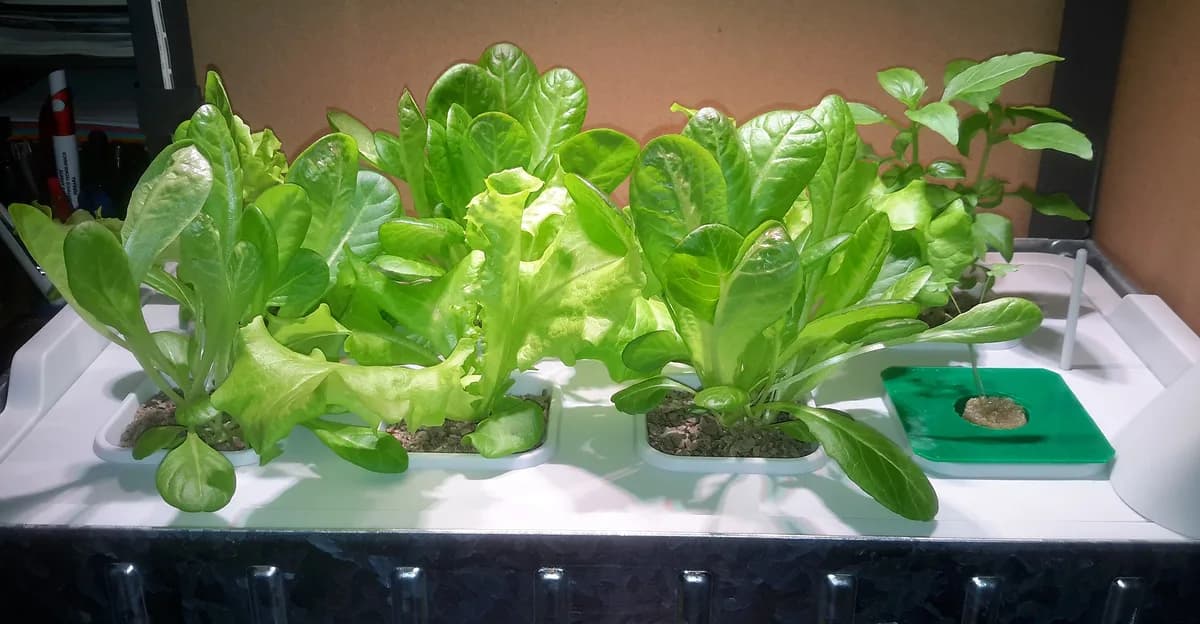
Key point: Compact leaf lettuce has the strongest evidence as a low-maintenance first hydroponic crop. Baby pak choi and other compact Brassica greens are good next choices. Basil works well when your space is warm and bright, but repeated harvests add work.
“Low maintenance” describes a fit between the crop, cultivar, system, and growing space. It does not mean that the plant can be left alone.
The shortlist
| Crop group | Beginner fit | Why it can work | What adds work |
|---|---|---|---|
| Compact butterhead, loose-leaf, and oakleaf lettuce | Best-supported first choice | Compact form, short crop cycle, and a one-time harvest suit small active or passive systems | Cultivar, temperature, light, reservoir size, and system design still affect the result |
| Baby pak choi, mustard greens, mizuna, and compact kale | Good second choice | University sources and a full-text hydroponic methods paper support compact Brassica greens as suitable short crops | Mature size varies, and the evidence does not support one universal ranking within the group |
| Basil | Good in a warm, bright space | A peer-reviewed greenhouse trial and two university guides support hydroponic basil production | Higher warmth and light needs, repeated cutting, and a longer stay in the system can add work |
This is a recommendation by evidence strength, not an easiest-to-hardest biological score. No reviewed study compared every crop under the same conditions or measured “maintenance” as one universal outcome.
Crop-System Fit Matrix
Use the system you already have, or can reliably maintain, as the first filter. This matrix turns the evidence into a crop-selection decision without treating any crop as universally easy.
| Your practical constraint | Strongest starting direction | What must still be checked |
|---|---|---|
| You want a passive setup with no pump | Compact lettuce in a reservoir designed for the full crop | The container must preserve a moist root air space as the solution falls. A smaller or denser setup may still need replenishment and adjustment. |
| You already have a small active channel or raft | Compact lettuce first; trial one compact Brassica cultivar next | Confirm mature size, spacing, flow or aeration, and whether the crops can share one solution. |
| Your growing area stays warm and bright | Basil can follow a successful lettuce crop | Plan for repeat cutting, longer occupancy, and continued solution care. The peer-reviewed basil evidence used active aeration and circulation. |
| You mainly want tomatoes, peppers, or cucumbers | Choose the system around that fruiting crop | Expect more canopy and root space, support work, a longer production period, and closer solution management. |
Apply the matrix in order:
- Eliminate crops that do not fit the available temperature, light, mature size, or system.
- Among the remaining crops, prefer the shortest harvest pattern with the fewest repeated tasks.
- Trial one cultivar before sharing a reservoir or filling every planting site.
This method keeps “low maintenance” tied to observable work. It also leaves room for a crop you value enough to maintain, even when it is not the lowest-work option.
Why lettuce ranks first
Lettuce has the broadest direct support in the reviewed evidence. Independent research teams grew it in passive Kratky systems, a roofed outdoor non-greenhouse system, and small active systems. The outdoor method paper also reported inconsistent or slow growth and called for more work on nutrient, disease, and environmental causes, so it supports feasibility rather than guaranteed performance. University extension guides describe lettuce as a short-term crop for small hydroponic setups.
Start with a compact butterhead, loose-leaf, or oakleaf cultivar. A University of Tennessee Extension guide coauthored with a University of Florida Extension specialist favors bibb or butterhead lettuce for small systems and notes that oakleaf and leaf types can give timely, consistent crops. It also warns that cultivars bred for soil may grow too large for a small hydroponic setup.
That makes cultivar labels useful. Look for seed sold for hydroponics, containers, baby leaf, or compact growth. The label narrows your search, but it cannot guarantee success because your temperature, light, spacing, and system still matter.
Passive does not mean untouched. Bernard Kratky’s lettuce papers describe properly sized, non-circulating systems that can finish a crop without pumps or added solution. A separate Brazilian lettuce trial used a denser channel design and needed solution additions, pH and electrical conductivity (EC) adjustments, daily monitoring, and pest control. Reservoir size and crop conditions decide how much attention a passive system needs.
Note: These findings are compatible rather than contradictory. Kratky’s fill-once result applies to a reservoir sized for the crop, while the Brazilian study began with substantially less solution per plant in a denser channel and replenished it during production.
For a closer look at that trade-off, read our Kratky method guide.
Compact Brassica greens come next
Baby pak choi, mustard greens, mizuna, and compact kale fit the same broad pattern as lettuce: you harvest vegetative growth, compact cultivars fit small spaces, and younger harvests can avoid the demands of a long fruiting cycle.
Treat them as a group of trial candidates. The reviewed sources support their hydroponic fit, but they do not support a precise ranking that says pak choi always needs less work than mustard, mizuna, or kale. Mature size and harvest stage can change the answer.
Choose one compact cultivar and give it the space its mature leaves need. If you share a reservoir with lettuce, check that both crops suit the same conditions and nutrient solution rather than assuming all leafy greens are interchangeable.
Basil is productive, with a different routine
Basil is a credible hydroponic crop, but it is not a direct substitute for one-and-done lettuce. A peer-reviewed greenhouse study grew basil successfully in active Deep Water Culture (DWC) and other soilless systems. In that experiment, the DWC system used an air blower and circulation pump, while the shared nutrient solution was prepared every ten days and adjusted for pH and EC. Those conditions establish feasibility under active management, not that every small basil container is low maintenance.
University guides add the practical difference. Basil prefers warmer conditions and higher light than lettuce, and growers often cut it repeatedly. Herbs kept through several harvests also stay in the system long enough to need continued solution care.
Choose basil when your growing space is warm and bright and you want repeat harvests. Choose compact lettuce when your priority is the shortest path to a first completed crop.
Our hydroponic basil guide covers the crop in more detail.
Why spinach is not on the shortlist
Spinach appears in hydroponic guidance, and Virginia Cooperative Extension grew it in Nutrient Film Technique (NFT) and floating DWC. The same trials used crop-specific germination steps and reported cool-season preferences and Pythium problems. Minnesota Extension independently lists spinach as suitable for NFT, but the reviewed evidence does not establish it as a broadly low-maintenance crop. That evidence gap is why spinach is not ranked here.
Why fruiting crops add work
Tomatoes, peppers, cucumbers, and strawberries can grow hydroponically. Compared with compact lettuce, fruiting crops usually occupy the system longer and can add canopy or root-space demands, support work, and fruiting-stage management. Those trade-offs keep them off the lowest-maintenance shortlist.
The difference becomes clear in passive systems. Kratky’s full-text methods paper found that simple tomato and cucumber production needed much larger reservoirs or extra intervention compared with short leafy crops. Those study-specific containers are not universal sizing rules, but they show why a long fruiting crop can erase the practical advantage of a fill-once setup.
Grow a fruiting crop when you want that crop enough to accept trellising, pruning or clipping, a longer production period, and closer solution management. Match it to a media-based or other suitable system instead of forcing it into a setup chosen for lettuce.
Use five questions to choose your crop
Before buying seed, run each candidate through this check:
- How long will it occupy the system? Short leafy crops preserve the low-work advantage better than long fruiting crops.
- How large will the cultivar become? A crop name is not enough. Compact cultivars are easier to fit into small channels, rafts, and containers.
- Will it need support or repeated cutting? Trellising, pruning, clipping, and repeated harvests add tasks that a one-time lettuce harvest avoids.
- Does your space suit its temperature and light needs? Lettuce favors cooler production conditions than basil, so one global crop calendar would be misleading.
- Can it share the system? Crops in one reservoir need compatible conditions and nutrient management.
If the answer is unclear, trial the crop in a small pilot setup before filling the system. Virginia Cooperative Extension recommends pilot-scale growing because crop and system performance depend on the setup and conditions.
First-Crop Maintenance Baseline
Your first completed crop can become a maintenance benchmark for the next one. Keep a short record during inspections instead of relying on memory. The categories below come from the factors monitored in the lettuce trial and the routine checks described by the university guides.
| Record | What to note | How it guides the next crop |
|---|---|---|
| Solution and water level | Direction of change, unexpected loss, and any refill or correction | Shows whether the reservoir and inspection rhythm were adequate for this crop and site |
| Roots and plant appearance | Root color and odor, wilting, discoloration, uneven growth, or stalled plants | Helps separate a crop-wide system problem from one weak plant |
| Environment | Unusually hot, cold, dim, or bright periods and the crop response | Tests whether the site suits another lettuce cycle, a compact Brassica, or warmer-growing basil |
| Equipment and flow | Pump, aeration, tubing, channel, or emitter problems and the action taken | Reveals the tasks added by the system rather than by the crop |
| Pests and sanitation | What appeared, where it appeared, and cleaning completed between crops | Makes recurring problems visible before they are mistaken for cultivar failure |
| Harvest pattern | One-time harvest or repeated cutting, plus every extra support or training task | Converts the vague idea of “easy” into the work you performed |
At harvest, review the record before changing crops. If the system itself caused most interventions, stabilize it before testing a more demanding crop. If lettuce completed cleanly and the site is warm and bright, basil may be a reasonable next trial. If space was already tight, choose a smaller cultivar rather than adding a larger crop to the same layout.
Change one major choice at a time where practical: cultivar, crop group, system, or location. That makes the next record easier to interpret. Keep manufacturer instructions and crop-specific guidance as the authority for nutrient products and equipment settings; this baseline is an observation tool, not a universal recipe.
Low maintenance still includes routine checks
Even a well-matched lettuce crop needs you to watch the nutrient solution, water level, roots, pests, light, and sanitation. Active systems also depend on equipment such as pumps or aeration, while passive systems depend more heavily on correct reservoir design and the moist air space around developing roots.
Keep the routine proportionate to the system. Inspect often enough to catch falling water, root discoloration, pests, blocked flow, or equipment failure before the crop is damaged. Clean between crops, and use the instructions for your system and nutrient product rather than copying one universal setting from a crop list.
If you are still choosing a setup, compare DWC, NFT, and Kratky systems. Once the system is chosen, start with compact lettuce and learn its normal water use, root growth, and harvest pattern before adding a more demanding crop.
Frequently asked questions
What is the lowest-maintenance hydroponic plant?
Compact leaf lettuce is the best-supported first choice in the reviewed research. It has direct evidence across passive and active small systems, and it avoids the long flowering and fruiting phase of crops such as tomato or cucumber.
Is basil easier than lettuce in hydroponics?
Basil is a proven hydroponic crop, but it usually asks for warmer, brighter conditions and repeated harvests. Lettuce is the stronger first choice when your goal is to complete a short crop with fewer ongoing tasks.
Are passive hydroponic plants maintenance-free?
No. A properly sized Kratky system can remove pumps and reduce solution additions for a short lettuce crop, but reservoir design, environment, roots, pests, and plant health still need attention. Some successful passive trials included active solution adjustment and pest management.
Which popular hydroponic plants were left off the shortlist?
Mint, cilantro, chives, and green onions were not ranked because this research pass did not find enough independent complete sources tied to beginner maintenance. Arugula, Swiss chard, collards, and amaranth are credible later experiments in university guidance, but the available evidence was not strong enough to rank them above lettuce, compact Brassica greens, or conditional basil.