Harvesting and Curing Turmeric and Ginger: Why They Differ
When to dig turmeric and ginger rhizomes, how to cure and dry them, and how to store them, with the crop-specific trade-offs that decide whether you keep curcumin or gingerol.
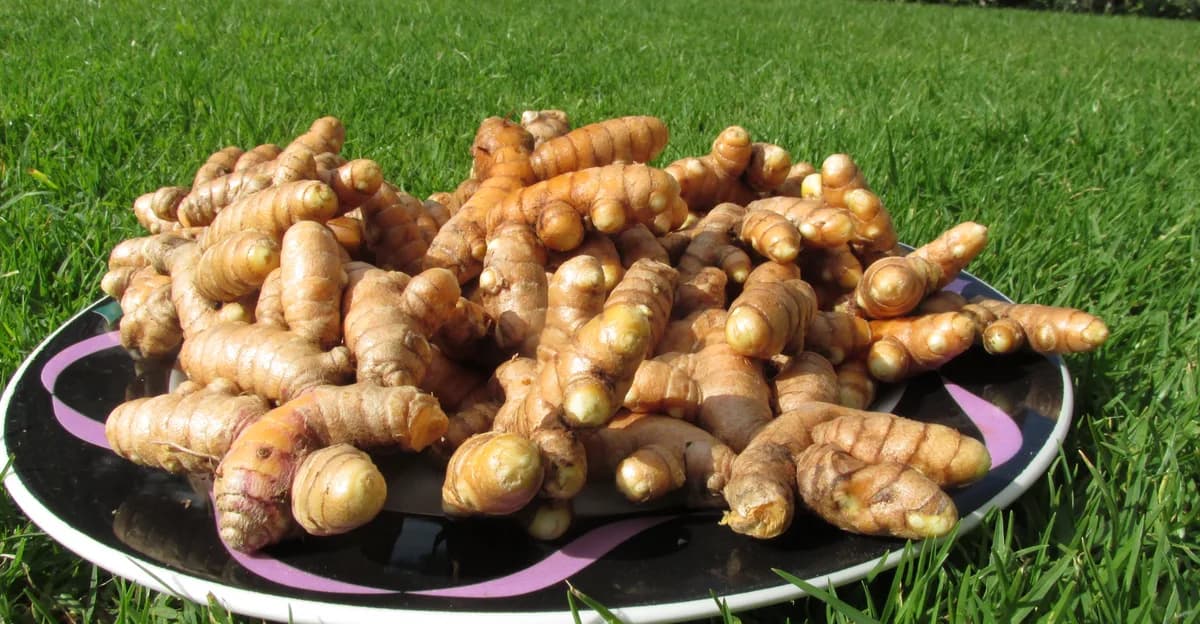
Key point: Turmeric and ginger are close relatives, but they do not behave the same way once you dig them up. When you dry them, blanching for about 15 minutes tends to raise turmeric's curcumin, while the same treatment can cost ginger roughly half its 6-gingerol after just 5 minutes. That single fact should shape how you harvest, cure, and store each crop, because the step that protects one compound can degrade the other. This guide walks through maturity signals, digging technique, curing and drying, and storage for home growers in the US, where both crops are grown as a single-season rhizome crop and lifted in fall before frost. If you have not planted these crops yet, our plant database carries full growing profiles for both turmeric and ginger, from planting through in-season care.
Both plants store their value underground, in a swollen rhizome that is mostly water when fresh, roughly 83 to 94 percent for ginger and a little lower, about 83 to 87 percent, for turmeric. Everything after harvest is about removing that water carefully enough to make the rhizome storable without cooking off the aroma and pigment you grew it for.
When to harvest: maturity is a trade-off, not a deadline
There is no single "ripe" moment for either crop. The right harvest time depends on whether you want tender fresh rhizomes or dense, pungent, storable ones, and the research on both sides is clear that these are different products, not better and worse versions of the same thing.
For ginger, earlier harvest gives you more phytochemical concentration per gram. A Virginia State University study sampled ginger every two weeks across a 16-week window and found total phenolic content highest in week-one "baby" ginger, at about 16.9 mg per gram of dry powder, falling to 10.9 mg by week four and roughly halving by the time the rhizome reached full maturity. Antioxidant capacity fell by a similar 41 to 50 percent over the same period, and 6-gingerol, the dominant pungent compound, declined about 50 percent from baby to mature. A separate Sri Lankan study reached a compatible conclusion for the aroma fraction: essential-oil weight yield was highest at five months and dropped as the rhizome aged, by as much as about 79 percent by eight months.
Read carefully, those numbers describe quality per gram, not total harvest. Baby ginger is milder, juicier, thin-skinned, and richer in phenolics per gram, and it is the better pick for fresh eating. Mature ginger has more dry matter, more fiber, a tougher protective skin, and the pungency and storability that dried product needs. Extension guidance for US home growers reflects that split: dig baby ginger a few months after growth begins if you want tender fresh rhizomes, or wait until the plant has run its full season and the foliage yellows and dies back if you want mature rhizomes to store or dry.
Turmeric follows the same logic. It is typically lifted at full maturity, commonly around 8 to 10 months after planting, when the leaves yellow and the stems fall over, which for most US growers lands in fall as the plant senesces ahead of frost. Younger "baby" turmeric can be dug earlier for fresh use, but the crop grown for dried powder is left to mature so the rhizome accumulates dry matter and curcumin, the orange pigment that makes up roughly 2.5 to 6 percent of the rhizome.
So decide the objective first. If the answer is fresh and tender, harvest younger; if it is dried, pungent, and shelf-stable, wait for the foliage to die back and harvest mature. Because exact timing shifts with cultivar and climate, treat month figures as starting points and let foliage senescence be your on-the-ground signal.
How to lift the rhizomes
The digging itself is simple, but it sets up everything that follows, because damaged rhizomes are the ones that rot in storage.
Time the dig by frost, but know which frost matters. A light fall frost that blackens the foliage is the die-back signal to harvest, not a death sentence for the crop: the rhizome sits below the surface, insulated from the first light frosts that kill the tops. What you have to beat is a hard, ground-penetrating freeze, which does reach and kill the rhizome. So lift after the tops die back but before the ground freezes, and treat the first light frost as your cue rather than your deadline.
Stop watering as the foliage begins to yellow, which firms the skin and eases lifting. Loosen the soil well outside the plant's base with a fork rather than driving a blade straight down through the clump, then lift the whole rhizome mass and shake or brush off loose soil by hand. Snap or cut the tops off, and separate the rhizome into manageable pieces, keeping any you intend to replant as clean seed pieces. Because neither crop survives a hard freeze, store those seed pieces somewhere frost-free over winter and replant them after the last spring frost.
Handle the rhizomes gently. Cuts, bruises, and broken necks are entry points for the rot organisms covered below, so cull anything soft, damaged, or discolored before it goes near your sound rhizomes. Rinse off remaining soil if you are heading straight to curing or fresh use. For rhizomes destined for cool storage rather than drying, many growers brush rather than wash, because surface moisture invites rot; wash those just before use instead.
Curing and drying: where the two crops diverge
This is the step that most changes the final product, and it is where turmeric and ginger part ways. "Curing" here means a brief cook, usually boiling or blanching the rhizomes until they soften, before drying. It gelatinizes the starch, evens out the interior color, drives off the raw earthy odor, and shortens the subsequent drying time. The catch is that the same cook affects each crop's signature compound in opposite directions.
For turmeric, a moderate blanch tends to help. In a University of New South Wales study that dried and blanched both crops in one experiment, blanching turmeric slices for about 15 minutes gave the highest curcumin yield, while 5-minute and 30-minute blanches had little effect. Other turmeric work agrees that curing improves the product: an Indian study found microwave curing raised curcumin and cut drying time from roughly 29 hours down to about 21. So for turmeric grown for color and curcumin, a curing step is worth doing, and a mid-length blanch is a reasonable target.
For ginger, the same study found the opposite. Blanching had a significant negative effect on 6-gingerol: after just 5 minutes of blanching, almost half the 6-gingerol was lost compared with unblanched rhizomes, and it fell further at 15 and 30 minutes. If you are drying ginger to keep its pungency, a long blanch works against you.
Honesty about the evidence matters here, because the literature is not unanimous. The same UNSW paper notes another study where blanching lowered ginger phenolics, while a Polish review of thermal processing concluded that blanching and sun-drying generally retain or increase ginger's antioxidant activity, and that freeze-drying preserved it best while ordinary cooking and microwaving tended to reduce it. The reasonable reading is that blanching effects are crop- and compound-specific and not fully settled, so treat curing as clearly beneficial for turmeric curcumin and as a step to keep short or skip for ginger you want pungent.
Drying temperature is the second lever, and it points the same way. For ginger, 6-gingerol falls as drying temperature and humidity rise; the UNSW work found about 60 °C (roughly 140 °F) to be the practical upper limit for good retention, and that stepping the temperature down during drying, for example from 60 °C at low humidity to 50 °C (about 120 °F), retained slightly more gingerol than holding either condition constant. The Sri Lankan group dried ginger at about 50 °C specifically to protect its volatile compounds from heat loss. The safe reading for ginger is to dry warm but not hot, roughly in the 50 to 60 °C range (about 120 to 140 °F), and to avoid overheating.
Those temperatures are the reason drying here means active, controlled heat, not passive air-drying. A food dehydrator, an oven on its lowest setting, or a warm, dry indoor spot can hold 50 to 60 °C; open fall air in most of the US cannot. Fall air at harvest is cool and damp, well below the drying band, so rhizomes left on a rack in it will not reach a storable moisture and tend to rot before they finish. This is not the passive field curing that onions and garlic get.
Turmeric curcumin is more heat-tolerant. The UNSW study found that higher drying temperature at low humidity tended to raise curcumin retention, and named treatments in the roughly 50 to 60 °C range (about 120 to 140 °F) at low humidity as best. Here too the evidence is mixed: an Indian study that varied drying temperature from 30 to 70 °C found temperature was not statistically significant for curcumin, with blanching time and slice thickness mattering more. The honest conclusion is a working range, not a magic number. Dry turmeric warm and dry, somewhere around 50 to 60 °C at low humidity, and do not chase a single "optimal" temperature that the literature does not agree on.
One more piece of chemistry explains why dried ginger tastes different from fresh. Heat and long storage dehydrate 6-gingerol into 6-shogaol, a sharper, more pungent compound. A Korean study made the shift concrete: across repeated steam-and-dry cycles, 6-gingerol fell from about 3.26 to 0.57 mg per gram while 6-shogaol rose from about 1.30 to roughly 3.0 mg per gram. This is not spoilage; it is the flavor transformation that gives dried ginger its bite. It is also the reason gentle, moderate-temperature drying preserves more of the fresh-ginger character.
Whatever you dry, the goal is low residual moisture. Fresh rhizomes are mostly water, and drying them down to roughly 10 to 12 percent moisture is what lowers water activity enough to stop microbial spoilage and make the rhizome shelf-stable. Expect a large weight loss: since fresh turmeric is about 83 to 87 percent water, drying it to that low moisture leaves only roughly 15 to 20 percent of the fresh weight, so a kilogram of fresh rhizome yields around 150 to 200 grams of dried product.
Storage: the enemy is rot, and it starts before harvest
The main risk in storing rhizomes, especially fresh ones, is soft rot, also called rhizome rot. A comprehensive review identifies Pythium and Fusarium species as the main culprits in ginger, with bacterial Ralstonia also involved, and these pathogens are damaging: they can cut ginger production by 50 to 90 percent in the field, and post-harvest and storage losses commonly run 24 to 50 percent and occasionally exceed 90 percent. Crucially, the disease can develop in storage from an infection the rhizome was already carrying at harvest, which is why the first line of defense is cultural, not chemical: start with healthy, disease-free rhizomes. Turmeric is vulnerable to the same kind of trouble, with Pythium causing rhizome rot on that crop too.
That gives a clear storage strategy. Select only sound, firm rhizomes; cull anything with brown, water-soaked lesions at the collar where the stem meets the rhizome, soft spots, or yellow-tinged decay. For fresh storage, keep rhizomes cool and dry with good ventilation, and check them periodically so a single rotting piece does not spread. For long-term keeping, drying to low moisture is the most reliable route, because it removes the water the rot organisms need. Dried rhizome or powder, kept in an airtight container away from heat, light, and humidity, holds for many months; store whole dried pieces and grind as needed, since ground spice loses aroma faster once its oils are exposed.
A curing and drying plan for each crop
Because the two crops respond to heat oppositely, the practical plan differs. Use these as calibrated starting points and adjust to your own results.
1. Clean and slice for even drying. Wash the rhizomes, then slice them to a consistent thickness so they dry uniformly; the UNSW study used about 4 mm slices. Thinner, even slices dry faster and more evenly than whole rhizomes, and slice thickness measurably affects curcumin retention, so keep it consistent.
2. Cure turmeric, go easy on ginger. For turmeric grown for color and curcumin, boil or blanch the slices until soft; a blanch of around 15 minutes was the best-performing time for curcumin in the reviewed study. For ginger you want pungent, keep any blanch short or skip it, because blanching cost roughly half the 6-gingerol after just 5 minutes. Note that some reviews find blanching retains ginger activity, so if you are curing ginger for a milder, evenly colored dried product rather than maximum pungency, a brief blanch is defensible.
3. Dry warm, not hot. Dry both crops in the roughly 50 to 60 °C range (about 120 to 140 °F) at low humidity, using a food dehydrator, an oven on its lowest setting, or a warm, dry indoor spot rather than open air. Ginger loses gingerol as temperature and humidity climb, so treat about 60 °C (140 °F) as an upper limit and consider stepping down toward 50 °C (120 °F) as drying proceeds. Turmeric curcumin tolerates the warmer end of that band at low humidity, though the evidence on exactly how much temperature helps is mixed, so do not push past this range chasing a number.
4. Dry to the finish, not the clock. Target roughly 10 to 12 percent moisture; the rhizome should be hard and snap rather than bend. Fresh rhizomes are mostly water — ginger 83 to 94 percent, turmeric 83 to 87 percent — so expect dried turmeric to weigh only about 15 to 20 percent of what you started with.
5. Expect dried ginger to taste sharper. Drying converts some 6-gingerol to the more pungent 6-shogaol, so dried ginger is hotter and less fresh-tasting than the raw rhizome. Gentler, lower-temperature drying keeps more of the fresh character.
Log your slice thickness, blanch time, drying temperature, and finished weight each season; a plant diary is a handy place to keep those batch notes alongside your grow. Two or three batches of that record will calibrate these ranges to your cultivar and dryer far better than any single published figure.
Diagnose storage losses before they spread
When stored rhizomes start to fail, the pattern usually tells you the cause and what to change. Because rot can travel from one piece to the next, act on the first signs.
| What you see | Likely cause | What to do |
|---|---|---|
| Brown, water-soaked lesions at the collar; soft, decaying rhizome | Soft rot (Pythium/Fusarium), often from infection present at harvest | Remove and discard affected pieces immediately; improve ventilation; next season start from clean, disease-free seed rhizomes |
| Rot spreading piece to piece in a bin of fresh rhizomes | Moisture and poor airflow letting rot organisms move through the store | Keep rhizomes cool, dry, and ventilated; check regularly and cull early; consider drying the batch for long-term keeping |
| Fresh rhizomes shriveling and going soft without clear rot | Excess moisture loss or overripe/overhandled tissue in warm storage | Store cool with modest humidity and good air movement; use damaged or bruised pieces first |
| Dried pieces going moldy or clumping | Not dried to low enough moisture, or humidity in storage | Re-dry to hard, snappable pieces near 10-12 percent moisture; store airtight away from humidity |
| Dried ginger tasting sharper and less fresh over months | Normal 6-gingerol to 6-shogaol conversion during long storage | Expected, not spoilage; store whole and grind as needed to slow aroma loss |
Treat this as a starting diagnosis. Rot risk is driven by rhizome health at harvest and by storage conditions together, so confirm both before concluding one is the whole cause.
Frequently asked questions
When should I harvest ginger and turmeric?
It depends on what you want. For tender fresh "baby" ginger, harvest a few months into the season; for mature, pungent, storable rhizomes, wait until the foliage yellows and dies back, which for turmeric is commonly around 8 to 10 months after planting. Ginger's phenolics and 6-gingerol are highest young and roughly halve by full maturity, so earlier harvest maximizes concentration per gram while later harvest maximizes dry matter, pungency, and storability. For US home growers, foliage die-back in fall, before frost, is the practical signal for a mature harvest.
Should I cure ginger and turmeric the same way?
No. Blanching or boiling before drying helps turmeric but hurts ginger's pungency. In a study that treated both crops together, a roughly 15-minute blanch gave the highest curcumin for turmeric, while blanching cost ginger about half its 6-gingerol after just 5 minutes. Cure turmeric for better curcumin and color; keep any blanch short, or skip it, for ginger you want pungent.
What temperature should I dry ginger and turmeric at?
Aim for roughly 50 to 60 °C (about 120 to 140 °F) at low humidity for both, and avoid overheating. Those temperatures call for a food dehydrator, an oven on its lowest setting, or a warm, dry indoor space; open fall air in most of the US is too cool and damp to dry rhizomes to a storable state. Ginger loses 6-gingerol as temperature and humidity rise, so about 60 °C (140 °F) is a practical ceiling and stepping down toward 50 °C (120 °F) helps. Turmeric curcumin tolerates the warmer end of that range, though studies disagree on how much temperature actually matters, so treat it as a working band rather than a precise target.
Why does my dried ginger taste sharper than fresh?
Drying and long storage convert 6-gingerol into 6-shogaol, a more pungent compound. In one study, repeated steam-and-dry cycles dropped 6-gingerol from about 3.26 to 0.57 mg per gram while 6-shogaol rose from about 1.30 to roughly 3.0 mg per gram. That is a normal flavor change, not spoilage, and gentler drying preserves more of the fresh character.
How do I keep stored rhizomes from rotting?
Start with sound, disease-free rhizomes, because soft rot often develops in storage from infection already present at harvest. Cull anything with soft spots or brown collar lesions, keep fresh rhizomes cool, dry, and ventilated, and check them regularly. For long-term keeping, dry them down to about 10 to 12 percent moisture, which removes the water rot organisms need, and store the dried product airtight away from heat, light, and humidity.
How much dried product will I get from fresh rhizomes?
Not much by weight, because rhizomes are mostly water. Fresh ginger is about 83 to 94 percent water and turmeric about 83 to 87 percent, and dried turmeric typically finishes at roughly 15 to 20 percent of its fresh weight, so a kilogram of fresh rhizome yields around 150 to 200 grams dried.