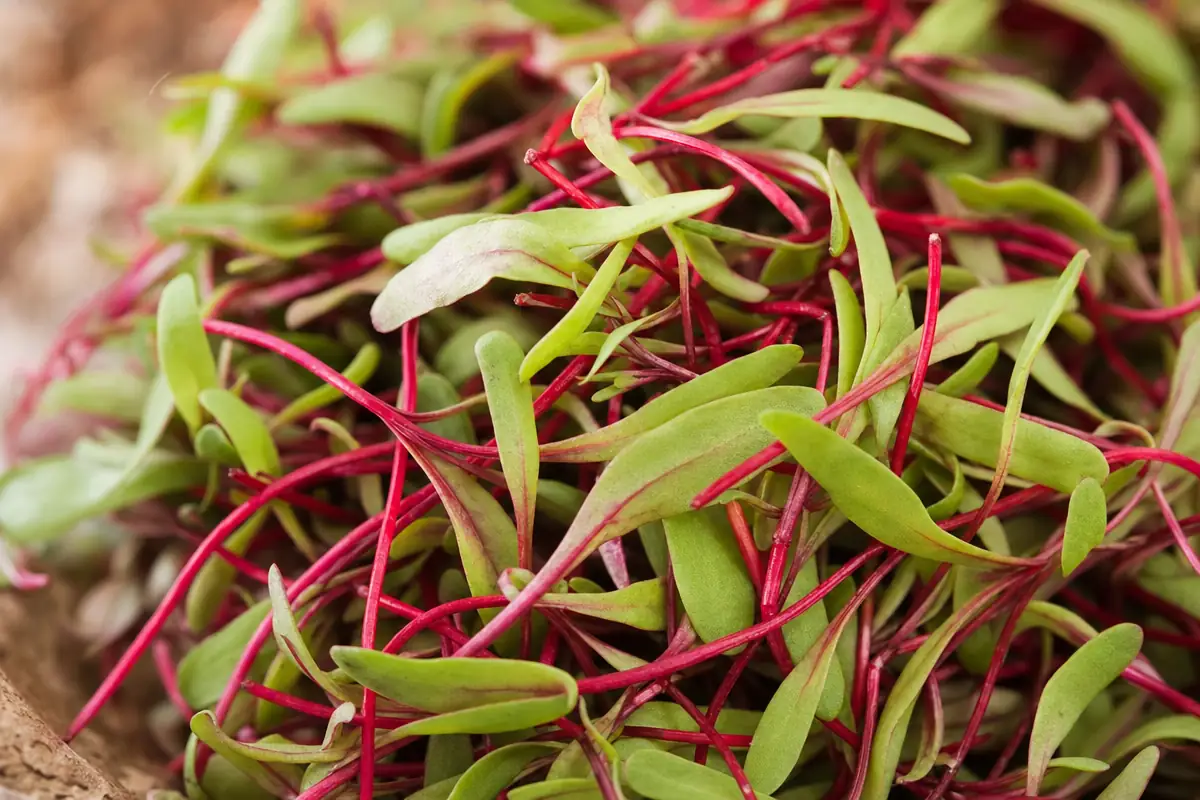
About This Plant
Beet microgreens are young Beta vulgaris seedlings harvested for vivid red stems, green cotyledons, earthy flavor, and betalain-rich color. They are slower and more moisture-sensitive than many brassica microgreens, so they perform best as a short indoor tray crop with clean media, modest LED intensity, and careful airflow.
How to Grow Beet Microgreens
Learn how to grow Beet Microgreens from seed to harvest in 18 days. Intermediate difficulty. Complete nutrient guide, pH/EC requirements, and growing conditions for soil & container.
Sources cited: 11.
Nutrient Requirements by Growth Stage
Beet microgreens need only a seedling-stage nutrient profile. Published microgreen nutrient solutions cluster around half-strength Hoagland programs: about 105-150 ppm N, 15.5-43.7 ppm P, 117-251 ppm K, EC 0.8-1.4 mS/cm, and pH near 5.8-6.5…
Sign in to view nutrient requirements
A free account unlocks NPK targets for all four growth stages, micronutrient levels, a per-stage nutrient calculator, and the full nutrition guide. Signing up takes one click. Truleaf is a free, non-profit project, and every new account helps it grow. No spam, ever.
Growing Environments
Use indoor shelves, controlled rooms, or greenhouse benches where light, humidity, water quality, and sanitation are manageable. Outdoor production is a poor fit for raw microgreens because soil splash, pests, and variable humidity make contamination control harder…
Temperature
Keep beet microgreens near 21 C after sowing. The beet light trial held the crop at 21 +/- 2 C, while extension microgreen guidance gives a practical germination and grow range around 70-75 F. Cooler, wet trays slow germination and increase rot risk, while hotter rooms shorten quality windows and make moisture management harder.
Humidity
Use moderate-high humidity only during covered germination, then vent the tray and rely on moist media rather than stagnant air. The beet microgreen trial ran at 70-80% RH without treatment variation, but extension guidance warns that excess moisture under covers encourages mold and seedling disease…
Light
For yield, target 120-160 umol m-2 s-1 PPFD for about 12 hours, roughly 5-7 mol m-2 d-1 DLI. In a controlled beet microgreen trial, 120 and 160 PPFD outperformed 220 PPFD for yield and water-use efficiency, while 16 hours improved betalain and phenolic concentration but reduced fresh yield…
Airflow
Provide continuous gentle air movement after germination rather than strong wind. Extension guides recommend airflow around dense microgreen clusters to discourage disease and vent humid covers so mold is not favored…
Sign in to view environmental requirements
A free account unlocks exact temperature, humidity, light and airflow targets, including germination and growth ranges, DLI, photoperiod and PPFD, plus the full environment guide. Signing up takes one click. Truleaf is a free, non-profit project, and every new account helps it grow. No spam, ever.
Hydroponic System Compatibility
Shallow trays, fiber mats, ebb-and-flow benches, drip-fed channels, and NFT are the best supported systems. Table-beet research found NFT increased shoot fresh weight compared with peat-lite trays, especially after pregermination…
Growing Media
Choose clean, shallow soilless media or mats. Beet microgreen experiments used peat-perlite substrate, peat-lite, vermiculite pregermination, and fiber mats…
Container Specs
A shallow food-safe plastic tray is enough: 2.5-6 cm media depth or a fitted mat supports a short beet microgreen cycle. Use drainage holes over a solid bottom tray for bottom watering, or a sloped channel for NFT-style fertigation…
Training & Support
No training support is required. Beet microgreens are not thinned, pruned, staked, trellised, or transplanted; they are harvested as a dense seedling canopy…
Sign in to view system compatibility
A free account unlocks why each of the six systems fits or fails, plus growing media, container sizes, training methods, companion plants, and the full systems guide. Signing up takes one click. Truleaf is a free, non-profit project, and every new account helps it grow. No spam, ever.
Propagation
Propagate only from seed balls. Beet seed balls are slower than brassica microgreen seed, and table-beet work found that pregerminating seed balls in moist fine vermiculite for 5 days at 20 C improved shoot fresh weight by 15 days after planting…
Harvesting
Harvest beet microgreens as a one-cut crop when cotyledons are open and true leaves are just beginning. Multi-species and extension sources place microgreen harvest at 7-21 days after sowing; beet-specific datasets used 18 days or 15 days depending on system and treatment…
Planting Calendar
Calendar timing is continuous rather than seasonal. Grow beet microgreens indoors or in protected greenhouse trays any month, and sow repeat trays every 1-2 weeks for steady harvests…
Common Issues
The main risks are damping-off, mold, uneven emergence, leggy stems, and food-safety contamination. Damping-off is caused by seedling pathogens such as Pythium, Fusarium, Phytophthora, and Rhizoctonia, and is favored by reused dirty trays and saturated media…
Get the full science-backed guide
By signing up, you help keep Truleaf free and support the growth of our nonprofit project. Your account unlocks full details for every plant issue—including symptoms, causes, step-by-step solutions, and prevention—plus the month-by-month planting calendar, the complete guide, and all research sources. It only takes one click. No spam, ever.