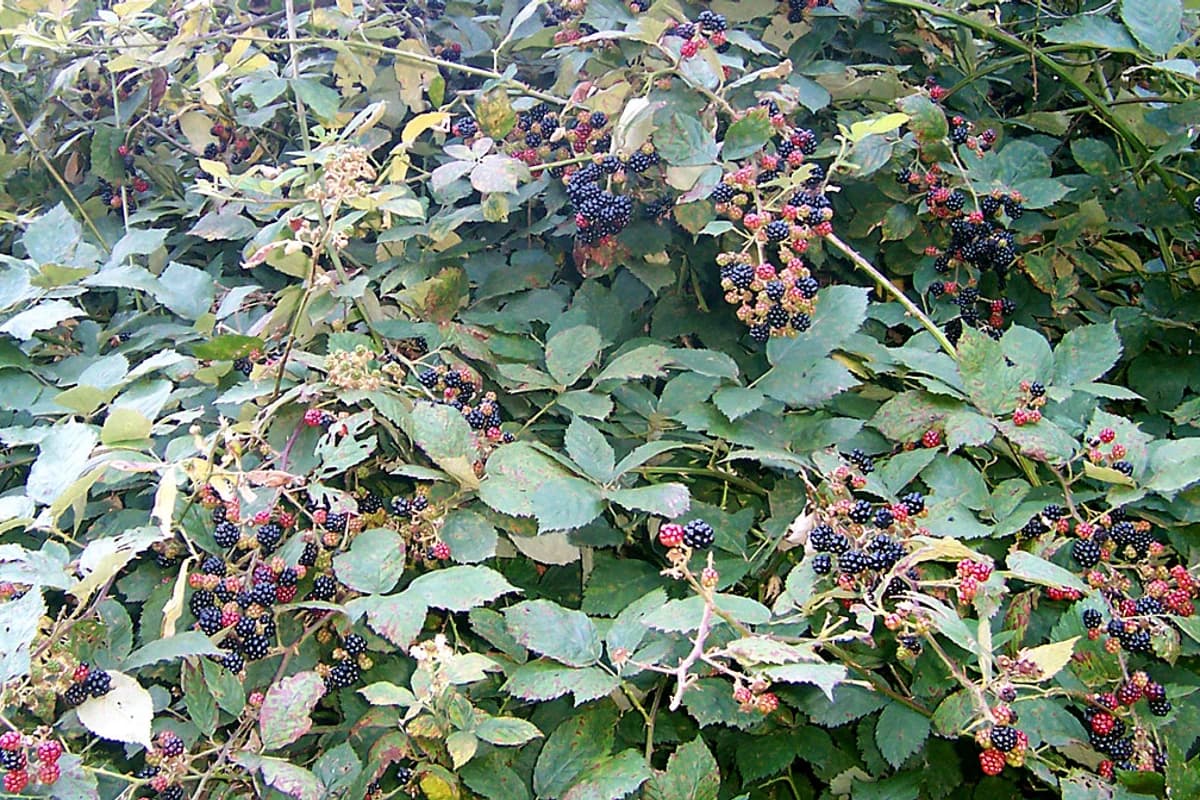
About This Plant
Blackberry is a perennial caneberry grown for dark aggregate fruit on biennial floricanes or first-year primocanes. It performs best in full sun, well-drained slightly acidic soil or drip-irrigated substrate, large containers where used, and a trellis system that keeps canes open for light, air movement, pollination, and harvest.
How to Grow Blackberry
Learn how to grow Blackberry from seed to harvest in 220 days. Intermediate difficulty. Complete nutrient guide, pH/EC requirements, and growing conditions for soil & container.
Sources cited: 18.
Nutrient Requirements by Growth Stage
Blackberry nutrition is best verified from soil tests, drip fertigation guidance, and primocane leaf tissue analysis rather than fixed hydroponic ppm recipes. Academic and extension NPK reviews found no blackberry-specific peer-reviewed hydroponic nutrient solution by stage…
Sign in to view nutrient requirements
A free account unlocks NPK targets for all four growth stages, micronutrient levels, a per-stage nutrient calculator, and the full nutrition guide. Signing up takes one click. Truleaf is a free, non-profit project, and every new account helps it grow. No spam, ever.
Growing Environments
Outdoor field production is the primary evidence base for blackberry, but greenhouse, high-tunnel, long-cane, tabletop, and large-container systems are defensible when light, chilling or cultivar choice, drainage, pollination, and trellis support are handled [ref-3][ref-11][ref-16]. Ordinary indoor home production…
Temperature
Blackberry grows best as a warm-temperate caneberry, not a tropical indoor fruit. Controlled-environment berry guidance supports daytime temperatures near 20-24C with cooler nights near 10-12C, and Phase 2 verification narrowed the active growth range to about 15-27C. Heat stress begins around 30C, with primocane fruit set impaired under hotter bloom conditions. Most floricane cultivars also need chilling, commonly 300-900 hours below about 7C, while primocane-fruiting cultivars can bypass the chill-force cycle for a first-year crop [ref-2][ref-4][ref-11].
Humidity
Keep protected blackberry canopies dry enough for disease control. Daytime RH of 40-60 percent is a practical target, with fruiting generally kept below about 65 percent and strong ventilation used to avoid prolonged leaf or fruit wetness [ref-11][ref-14]…
Light
Blackberry is a full-sun, high-light fruit crop. Field and extension sources require at least 6-8 hours of direct sun, and controlled-environment evidence shows yield increasing with supplemental intercanopy LED light [ref-11][ref-12][ref-13]…
Airflow
Airflow is managed through trellis design, pruning, ventilation, and canopy density. A protected-culture target of about 0.3-0.7 m/s at canopy level is appropriate where fans are used, but the biological goal is faster drying of fruit, flowers, and canes [ref-11][ref-14][ref-15]…
Sign in to view environmental requirements
A free account unlocks exact temperature, humidity, light and airflow targets, including germination and growth ranges, DLI, photoperiod and PPFD, plus the full environment guide. Signing up takes one click. Truleaf is a free, non-profit project, and every new account helps it grow. No spam, ever.
Hydroponic System Compatibility
Drip-irrigated soil, raised beds, containers, and deep substrate are the supported systems. Drip keeps fruit and foliage dry, supports fertigation, and fits the woody perennial root system [ref-2][ref-11]…
Growing Media
Use well-drained sandy loam or loam with more than 3 percent organic matter and pH around 5.5-6.5 for soil production [ref-1][ref-3]. Containers can use a drained mix with soil or potting soil, perlite or pumice, and fine bark…
Container Specs
Standard blackberry containers should be large and deep: OSU home-garden guidance supports 20-30 gallon containers, about 75-114 L, with at least 60 cm depth [ref-18]. The earlier 40 L/45 cm lower bound was undersized for ordinary vigorous cultivars…
Training & Support
Training is required for productive blackberry. Use I, T, V, or rotating cross-arm systems depending on growth habit, budget, and harvest goals [ref-3][ref-11][ref-18]…
Sign in to view system compatibility
A free account unlocks why each of the six systems fits or fails, plus growing media, container sizes, training methods, companion plants, and the full systems guide. Signing up takes one click. Truleaf is a free, non-profit project, and every new account helps it grow. No spam, ever.
Propagation
Cultivated blackberries should be propagated vegetatively. Tip layering is reliable for trailing and semi-erect cultivars, root cuttings and sucker division are common for erect types, and tissue-culture plugs are the clean-stock commercial standard [ref-3][ref-18]…
Harvesting
Harvest blackberries frequently because ripe fruit are highly perishable and non-climacteric. Pick two to three times per week, preferably in the cool morning after dew dries…
Planting Calendar
Plant dormant bare-root blackberry stock from late February through April once soil can be worked. In mild-winter regions, October-November fall planting is also suitable [ref-3][ref-18]…
Common Issues
The common-issue list should prioritize caneberry-specific disease, pest, nutrient, and physiological disorders. Phytophthora language was corrected from P…
Get the full science-backed guide
By signing up, you help keep Truleaf free and support the growth of our nonprofit project. Your account unlocks full details for every plant issue—including symptoms, causes, step-by-step solutions, and prevention—plus the month-by-month planting calendar, the complete guide, and all research sources. It only takes one click. No spam, ever.